This site is supported by our readers. We may earn a commission, at no cost to you, if you purchase through links.

A boa constrictor can look perfectly healthy right up until it isn’t. Humidity is one of those invisible variables that quietly causes kidney stress, stuck sheds, and respiratory infections before you notice anything wrong—and by then, you’re already playing catch‑up. The difference between 50% and 65% relative humidity isn’t something you can eyeball through the glass. You need a gauge you can actually trust.
Not all reptile humidity gauges for boa constrictor keepers are built to the same standard, though, and a cheap, uncalibrated hygrometer can give you false confidence while your boa’s enclosure drifts into dangerous territory.
The right gauge, placed correctly and checked regularly, takes the guesswork out of one of the most critical aspects of husbandry.
Table Of Contents
- Key Takeaways
- Why Accurate Humidity Matters for Boas
- Key Features in Reptile Humidity Gauges
- Top 6 Humidity Gauges for Boa Keepers
- Choosing The Best Gauge for Your Setup
- Maintaining and Troubleshooting Humidity Gauges
- Frequently Asked Questions (FAQs)
- What should the humidity be for a boa constrictor?
- Where to place a hygrometer in a snake tank?
- How often should I replace my hygrometer?
- Can I use multiple gauges in one enclosure?
- Do wireless hygrometers work well for reptile tanks?
- What humidity levels are safe during brumation?
- How does enclosure size affect humidity consistency?
- Conclusion
Key Takeaways
- Keeping humidity between 55–75% isn’t just a comfort setting—it directly protects your boa’s kidneys, skin, and immune system, so a reliable gauge isn’t optional.
- Cheap or uncalibrated hygrometers give you false confidence, meaning you should run a salt test every six months and cross-check with a second gauge to catch sensor drift before it becomes a health problem.
- Where you place your hygrometer matters as much as which one you buy—mount it at mid-body height, away from misting paths, to get readings that actually reflect where your boa lives.
- Digital gauges win on speed and accuracy for most setups, but pairing them with a humidity control system and app alerts is what turns passive monitoring into genuinely hands-free reptile care.
Why Accurate Humidity Matters for Boas
Getting humidity right is a big deal for boa constrictors—too much or too little can cause all sorts of trouble.
Dialing it in gets a lot easier once you understand the humidity requirements for boa constrictors—especially when choosing a substrate that actually holds moisture well.
You’ll need a reliable gauge to keep your snake’s environment in that sweet spot.
Let’s look at the best options for making sure your boa stays healthy and comfortable.
Effects of Humidity on Boa Health
direct lever isn’t just a comfort setting — it’s a direct lever on your boa constrictor health. Keep it in the 55–75% sweet spot, and you’re supporting skin elasticity, mucous membrane health, and immune function simultaneously.
Boa humidity isn’t comfort — it’s the 55–75% sweet spot where skin, immunity, and health converge
Let it slip chronically low, and you’re inviting kidney stress and metabolic rate disruption.
A reliable humidity gauge isn’t optional; it’s the foundation of serious reptile humidity management.
Boa constrictors thrive when the enclosure maintains the optimal humidity range for healthy shedding.
Shedding, Hydration, and Respiratory Concerns
If your humidity gauge isn’t up to snuff, you’ll spot problems fast—patchy sheds, stuck eye caps, or that telltale breathing noise.
Shed timing, skin elasticity, and fluid balance all tie back to reptile humidity management. Boa constrictor health benefits from steady readings, which mean fewer respiratory issues and smoother shedding. Miss the mark, and you’ll see the warning signs firsthand.
Maintaining the optimal humidity range of 55‑75% helps healthy shedding.
Preventing Mold, Bacteria, and Scale Rot
Just as poor humidity can wreck a shed, it also invites mold, bacteria, and scale rot.
Smart Humidity Gradient Design, paired with solid Ventilation Strategies and Substrate Management, keeps surfaces from staying damp.
Cleaning Protocols and Early Scale Monitoring are your insurance—use a reliable Humidity Gauge to track trends and protect reptile health before small problems turn big.
Key Features in Reptile Humidity Gauges
Picking the right humidity gauge makes all the difference for your boa’s health and comfort.
There are a few features you’ll want to look for before settling on one. Let’s walk through what matters most so you can choose with confidence.
Digital Vs. Analog Gauges
Ever wonder if your hygrometer is telling the truth or just guessing?
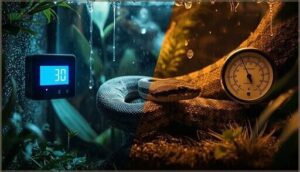
Digital hygrometers—like a reptile terrarium thermometer hygrometer—outshine analog gauges in Accuracy Comparison, fast Response Time, and clear displays.
But analogs win on Power Requirements and Cost Differences. For boa keepers, durability matters most:
- Quick digital readings prevent mistakes
- Analog survives power outages
- Digital tracks spikes
- Analog fades slowly
Importance of Calibration and Data Logging

Even a quality digital hygrometer drifts over time — that’s sensor drift, and it’s sneakier than you’d think.
Run a salt test every few months (Calibration Frequency) to catch it early.
Log Trend Analysis through data logging reveals overnight humidity crashes that your spot checks miss entirely.
Pair that with Automated Alerts in Humidity Control Systems, and you’re making real Data‑Driven Adjustments instead of guesswork.
Placement and Readability Considerations
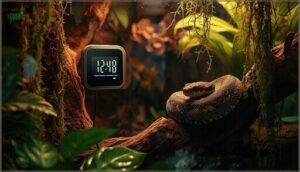
Where you place your hygrometer matters as much as which one you buy. For solid gauge positioning, mount it at mid-body height — that’s where your boa constrictor actually lives.
Eye-level mounting keeps screen visibility easy during daily checks.
Avoid mist ing paths for condensation prevention, and use adhesive strips for mounting stability.
Good terrarium design and setup turns enclosure monitoring from a chore into a quick glance.
Measurement Range and Precision
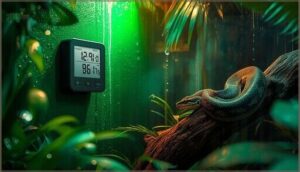
While you’re dialing in humidity control, don’t overlook the nuts and bolts—Range Coverage and Resolution Accuracy can make or break your setup. For reliable environmental monitoring systems, pay attention to:
- Range Coverage (aim for 20–90%)
- Resolution Accuracy (1% steps work well)
- Sensor Drift (expect recalibration)
- Temperature Compensation and Data Logging Precision
A quality digital hygrometer smooths out humidity management headaches.
Top 6 Humidity Gauges for Boa Keepers
Choosing the right humidity gauge makes all the difference for your boa’s health and comfort.
There are a handful of standout options that keepers trust for accuracy and ease of use.
Here’s a closer look at six top picks to help you get it right.
1. REPTI ZOO Terrarium Dual Thermometer Hygrometer
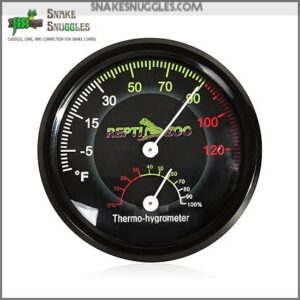
Looking for a humidity gauge that won’t leave you guessing? The REPTI ZOO Dual Thermometer Hygrometer shows temperature and humidity side by side—no button pressing, no squinting.
You get real-time readings every five seconds, covering the full range you need (20–99% humidity, 14–122°F).
The strong suction cup keeps it secure, even with a curious snake.
Battery life stretches over a year, and the compact design fits almost anywhere.
It’s practical, reliable, and built for the everyday demands of boa keeping.
| Best For | Reptile owners who want a simple, battery-free way to monitor temperature and humidity in their terrariums. |
|---|---|
| Product Type | Disinfectant Solution |
| Enclosure Use | Yes |
| Easy Install | No mounting needed |
| Weight | 2.64 oz |
| Eco Friendly | Biodegradable |
| Quality Assurance | EPA Registered |
| Additional Features |
|
- No batteries needed, so it’s energy-saving and hassle-free.
- Easy to read with color-coded segments.
- Compact and lightweight, fits anywhere in the tank.
- Not as accurate as digital meters for humidity-sensitive reptiles.
- Doesn’t include double-sided sticky velcro for easy removal during cleaning.
- May not hold up well in very high humidity environments.
2. JEDEW Digital Hygrometer Thermometer Indoor Outdoor
Want a no-nonsense tool that nails the basics?
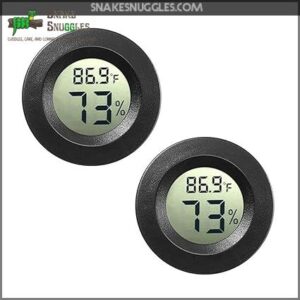
The JEDEW Digital Hygrometer Thermometer delivers accurate humidity and temperature readings every ten seconds—fast enough to catch changes after misting or airing out your boa’s enclosure.
Its compact, round design tucks neatly anywhere, and the clear LCD shows both numbers without fuss.
Humidity accuracy sits at ±5% RH, which is plenty for maintaining that 60–70% sweet spot.
Swap out the LR44 batteries in seconds and you’re back in business—no stress, just reliable data.
| Best For | Anyone who needs a simple, reliable way to monitor temperature and humidity in small spaces like reptile tanks, home offices, greenhouses, or instrument cases. |
|---|---|
| Product Type | Disinfectant Solution |
| Enclosure Use | Yes |
| Easy Install | No mounting needed |
| Weight | 2.09 lbs |
| Eco Friendly | Biodegradable |
| Quality Assurance | EPA Registered |
| Additional Features |
|
- Updates every 10 seconds so you catch changes fast
- Compact round design fits just about anywhere without getting in the way
- Easy battery swap with a standard LR44 cell
- Button placement is awkward and can accidentally switch units or power off the device
- Adhesive backing doesn’t always stick reliably to every surface
- Some users have reported accuracy drift and short battery life out of the box
3. PAIZOO LED Reptile Thermometer Hygrometer
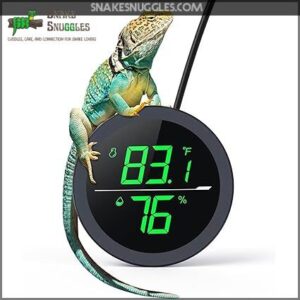
LED Reptile Thermometer Hygrometer is built for keepers who want precision without fuss. Its wired probe — 31.5 inches long — lets you mount the display outside the enclosure while placing the sensor exactly where your boa actually sits.
humidity accuracy is ±5%, temperature ±1°F, and it logs min/max values so you can see overnight dips at a glance. The rechargeable battery lasts one to three months, and the bright LED display wakes with a single tap.
| Best For | Reptile owners who want a simple, real-time way to keep tabs on temperature and humidity inside their terrarium. |
|---|---|
| Product Type | Analog Hygrometer |
| Enclosure Use | Yes |
| Easy Install | Sticky pad included |
| Weight | 1.44 oz |
| Eco Friendly | Energy saving |
| Quality Assurance | 12-month warranty |
| Additional Features |
|
- HD LED display makes it easy to read conditions at a glance, even from across the room.
- Slim, compact design with double-sided tape means setup takes about two minutes.
- Monitors both temperature and humidity in one device, no need for separate gadgets.
- Needs a USB power source to run, so you’ll need an outlet nearby at all times.
- Humidity readings can be hit or miss — some users have flagged accuracy issues.
- A few buyers report the unit stops working after a short time, which is worth keeping in mind.
4. Serundo Digital Reptile Thermometer and Humidity Gauge
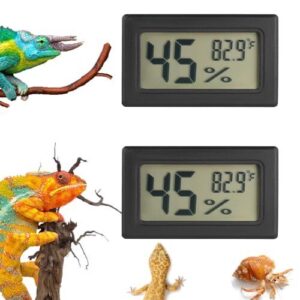
Not every keeper needs a probe running across the enclosure. Sometimes you just want something small, reliable, and out of the way — and that’s exactly what the Serundo HT01 delivers.
This compact unit mounts flush against the glass with double-sided tape, reads both temperature (±1°F) and humidity (±5%), and runs on a button cell battery for months. At roughly 1.4 ounces, it won’t disrupt your setup.
Grab two and compare readings across different zones.
| Best For | Reptile keepers who want a simple, no-fuss way to monitor temperature and humidity in smaller enclosures like leopard gecko or bearded dragon setups. |
|---|---|
| Product Type | Digital Hygrometer |
| Enclosure Use | Yes |
| Easy Install | Adhesive included |
| Weight | 1.06 oz |
| Eco Friendly | No stated claim |
| Quality Assurance | Manufacturer backed |
| Additional Features |
|
- Comes as a two-pack, so you can track conditions in different spots at once
- Mounts easily with double-sided tape — no drilling or fiddling around
- Accurate enough for everyday reptile care with ±1°F and ±5% humidity readings
- The display can be tricky to read depending on where you place it
- Not ideal if you’re managing a large or complex enclosure with multiple zones
- Battery life isn’t guaranteed, though spare batteries are included in the box
5. F10 All Purpose Veterinary Disinfectant
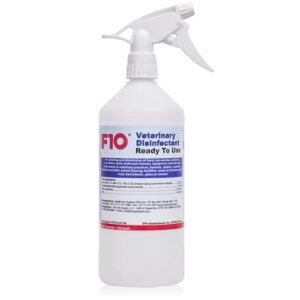
Accurate readings only get you so far — what you do between cleanings matters just as much.
F10 SC is a veterinary-grade disinfectant that kills bacteria (including Salmonella and E. coli), fungi, and viruses without requiring a rinse. That’s a big deal for reptile enclosures.
Mix it at 1:500 for routine cleaning, let it air dry, and your boa’s habitat stays protected.
It’s EPA-registered, biodegradable, and safe around exotics — genuinely hard to argue with that combination.
| Best For | Pet owners, veterinarians, and exotic animal keepers who need a reliable, no-fuss disinfectant for enclosures, kennels, and habitats. |
|---|---|
| Product Type | Digital Hygrometer |
| Enclosure Use | Yes |
| Easy Install | 3M tape included |
| Weight | 2.36 oz |
| Eco Friendly | No stated claim |
| Quality Assurance | Manufacturer backed |
| Additional Features |
|
- Ready to use straight out of the bottle — no mixing, no rinsing, no guesswork
- Kills bacteria, viruses, and fungi, and it’s EPA-registered and biodegradable
- Safe for use around reptiles, birds, and other exotic animals
- Tends to cost more than standard disinfectants you’d find at a pet store
- May not be available for shipping in all areas due to regional regulations
- Probably more than you need for routine, light-duty cleaning tasks
6. Rescue Veterinary Disinfectant Cleaner
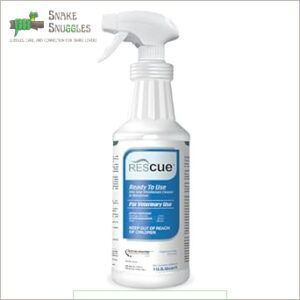
Rescue takes a different angle — instead of a mixing ratio, you get a ready-to-use liquid that disinfects hard surfaces in about one minute. No math, no measuring. The active ingredient is Accelerated Hydrogen Peroxide, which breaks down into water and oxygen after use, leaving no harsh residue behind. That matters in a reptile enclosure.
Just spray, let it sit, and make sure everything’s fully dry before your boa goes back in. Clean setup, zero chemical stress.
| Best For | Reptile keepers, vet clinics, and shelters who want a fast, no-fuss disinfectant that’s safe around animals and doesn’t require any mixing. |
|---|---|
| Product Type | Digital Hygrometer |
| Enclosure Use | Yes |
| Easy Install | Double-sided tape |
| Weight | 1.44 oz |
| Eco Friendly | No stated claim |
| Quality Assurance | Spare batteries included |
| Additional Features |
|
- Ready to use straight out of the bottle — no diluting, no guesswork
- Disinfects in 1 minute and breaks down into water and oxygen, so no harsh residue lingers
- Gentle enough for use around animals and staff, with no strong chemical smell
- Spray nozzle isn’t included, so you’ll need to source one separately
- Pricier per use compared to something like a bleach-water solution
- You have to wait for surfaces to dry completely before letting animals back in, which takes extra time
Choosing The Best Gauge for Your Setup
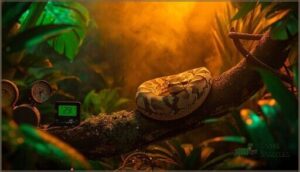
Not every gauge works the same way in every setup — and that’s okay.
Your enclosure size, your boa’s age, and whether you’re running an automated misting system all change what you actually need.
Here’s what I think about before making your pick.
Matching Gauge Features to Enclosure Types
Your enclosure type shapes everything. Glass setups lose moisture fast, so you need a digital hygrometer with strong glass response — under 10 seconds.
PVC offers natural PVC stability, so a basic wall-mounted gauge manages it fine.
For rack portability, rotate compact battery-powered units between tubs.
Wood demands corrosion resistance and sealed probes.
Wireless integration ties it all together for serious boa constrictor care and environmental control systems.
Considerations for Juvenile Vs. Adult Boas
Juveniles and adults aren’t the same animal regarding humidity management.
Your juvenile boa‘s growth humidity needs sit at 65–75% daily, spiking to 85% in humid hides during shedding frequency peaks every 4–6 weeks.
Adults tolerate 55–70% with less monitoring needed.
Matching your digital hygrometer placement to enclosure size impact keeps boa constrictor care accurate and health risk tolerances in check.
Integrating Gauges With Humidity Control Systems
Once digital hygrometer is placed correctly in the snake enclosure, connecting it to a humidity control system is where things get genuinely powerful. Hygrostat calibration ensures your misting system fires only when needed — not randomly.
Check power supply compatibility first (most run 100–240V). Wireless sync protocols let you set alert threshold settings straight from your phone.
Sensor relay wiring ties everything together for hands‑free reptile care.
Maintaining and Troubleshooting Humidity Gauges
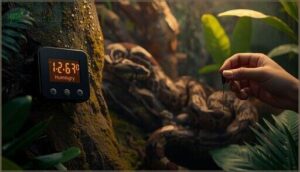
Even the best humidity gauge becomes useless if you’re not keeping it honest.
A little routine care goes a long way toward making sure your readings actually reflect what’s happening inside your boa’s enclosure.
Here’s what you need to know to keep your gauge accurate, clean, and working the way it should.
Regular Accuracy Checks and Calibration
Your humidity gauge is only as good as its last calibration.
Run a Salt Test Procedure every six months — mix table salt with water, seal it with your Digital Hygrometer in a zip-lock bag, and wait up to 24 hours.
It should read 75%. Off by more than 5%? Use Digital Offset Adjustment for digital units or Analog Screw Tuning for dial gauges.
Drift Detection Methods, like cross‑checking with a second gauge monthly, keep your Reptile Enclosure Management airtight.
Cleaning and Maintenance Tips
A dirty hygrometer lies to you.
For solid Reptile Terrarium Maintenance, do Sensor Dust Removal monthly — short bursts of compressed air, device off, battery out. Follow with Surface Wipe Cleaning using isopropyl alcohol on a soft cloth. Apply Disinfectant Application with diluted chlorhexidine weekly in your Snake Enclosure Setup. Use the Sensor Rinse Method with distilled water occasionally, and don’t skip Battery Compartment Care every six to twelve months.
Interpreting and Correcting Readings
Numbers don’t lie — but your gauge might. Salt Test Calibration is your reality check: seal wet salt in a bag with your Digital Hygrometer, and it should read 75%. If it shows 69%, add 6% to every future reading. That’s Offset Correction Methods in practice.
Factor in Temperature‑Humidity Correlation too — warmer air reads wetter. Consistent Sensor Drift Compensation keeps your Snake Enclosure Setup honest.
Frequently Asked Questions (FAQs)
What should the humidity be for a boa constrictor?
Aim for 60–70% as your daily baseline. Juveniles need 70–75%, adults settle around 55–70%, and during sheds, bump it to 75–85% briefly.
Where to place a hygrometer in a snake tank?
Place your hygrometer’s ambient center probe 3 inches above the substrate, mid-enclosure. Add a humid hide spot probe and use side gradient checks to catch the 5–15% variation across your terrarium.
How often should I replace my hygrometer?
Think of your hygrometer like a smoke detector — reliable until it isn’t.
Replace digital units annually; sensor corrosion and calibration drift make year‑old readings untrustworthy.
Analog gauges last longer but still need biannual accuracy checks.
Can I use multiple gauges in one enclosure?
Absolutely — using multiple gauges in one enclosure is smart gradient mapping. Space probes 12–18 inches apart, place one mid-enclosure and one inside the humid hide for accurate, interference-free humidity control.
Do wireless hygrometers work well for reptile tanks?
Yes — wireless hygrometers work great. Models like Govee and Inkbird hit ±3% accuracy, last months on a single charge, and send app alerts straight to your phone.
What humidity levels are safe during brumation?
During brumation, keep humidity between 50 and 60 percent. Too dry causes dehydration; too damp invites respiratory infections. Watch for wrinkled skin or mold — both signal it’s time to adjust.
How does enclosure size affect humidity consistency?
Larger enclosures stabilize humidity better — higher volume ratio means slower moisture loss.
But they need multiple gauges to catch gradient variance.
Tiny tubs swing wildly; big setups reward smart substrate and ventilation choices.
Conclusion
Think of humidity like the foundation beneath your boa’s enclosure—invisible, but everything rests on it. The right reptile humidity gauges for boa constrictor keepers don’t just display numbers; they give you the confidence to catch problems before your snake ever feels them.
Calibrate regularly, position thoughtfully, and trust your data over guesswork. Your boa can’t tell you something’s wrong until it already is.
A reliable gauge speaks first.
- https://www.thebiodude.com/blogs/snake-caresheets/boa-constrictor-care-guide-and-bioactive-terrarium-maintenance
- https://docs.google.com/document/d/1ETuvgkvixUFOeow1j3C8mJtOF9XYcObxvB5qnYdblvo/mobilebasic
- https://reptilesmagazine.com/colombian-boa-constrictor-care-sheet/
- https://youtu.be/GRfJu_FPYW4?si=8eyEpkWsYmOGdg7q
- https://www.reptifiles.com/red-tailed-boa-care/boa-species-subspecies/