This site is supported by our readers. We may earn a commission, at no cost to you, if you purchase through links.
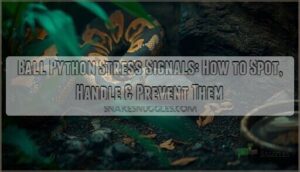
A ball python that’s pacing its enclosure at noon isn’t hunting—it’s sending you a distress signal.
These snakes thrive on routine and quiet, so when their behavior shifts, it’s rarely random.
Stress can sneak up fast, showing itself in subtle ways: a missed meal, a hiss, or even a dull patch of skin.
If you’ve ever watched your python coil tightly after a noisy visitor or refuse food for days, you’ve seen how sensitive to handling and environment.
Understanding ball python stress signals and learning safe handling techniques can make the difference between a nervous pet and a thriving one.
Table Of Contents
Key Takeaways
- Ball pythons show stress through changes like daytime pacing, refusal to eat, defensive balling, and dull skin, so spotting these early helps you act quickly.
- Well-supported handling and limiting sessions to 15–30 minutes once or twice a week are essential for building trust and reducing anxiety.
- A stable environment with correct temperature and humidity, multiple snug hiding spots, and minimal noise is key to keeping your snake calm and healthy.
- Consistent routines, careful socialization, and regular enclosure cleaning prevent stress from building up and make your ball python more resilient over time.
Common Stress Signals in Ball Pythons
Ball pythons are generally calm, but they do have ways of telling you something’s off — you just need to know what to look for.
Their feeding habits are often the first clue — a picky or refusing snake is practically waving a red flag, so brushing up on what ball pythons naturally prey on can help you spot the difference between a mood and a problem.
Stress signals can show up in their behavior, appearance, and daily routines, often starting small before becoming harder to ignore.
Here are the most common signs your ball python may be stressed.
Increased Daytime Activity
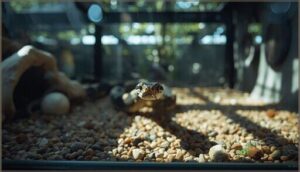
Watching your ball python pace the enclosure all day is a red flag worth taking seriously. These are nocturnal animals — daytime movement should be minimal.
When stress triggers like poor enclosure temperatures, inadequate hides, or bright overhead lighting disrupt their natural activity patterns, restless daytime behavior follows.
Consistent glass surfing or roaming signals that something in their environment needs your attention.
Providing adequate hiding spots helps reduce stress and encourages natural behavior.
Defensive Balling and Hissing

Unlike the restless pacing you just read about, defensive balling and hissing are harder, more immediate stress thresholds your ball python hits when it feels cornered or threatened.
Watch for these body language cues:
- Tight curling into a ball
- Sustained hissing patterns during or after handling
- Head tucked firmly beneath coils
- Flinching at touch
These balling triggers and defensive behaviors demand you back off — immediately.
Refusal to Eat or Reduced Appetite
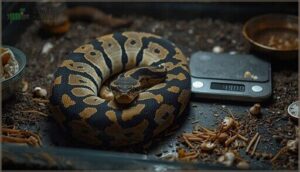
When stress builds, appetite is often the first casualty. A ball python may skip meals after frequent handling or sudden changes.
If your snake refuses food, check your feeding schedule, prey temperature, and prey size.
Weight monitoring helps spot early trouble—loss over 10% in two weeks signals concern.
Stress management and a proper acclimation period restore reptile health.
incorrect husbandry conditions can also cause a ball python to stop eating.
Erratic or Unusual Movements

Beyond appetite changes, movement tells the story clearly. A ball python showing rapid jerking, restless pacing, or defensive squirming is signaling genuine distress.
Tense startle responses and recoil retreat — where your snake pulls sharply backward — are classic behavioral signs tied to environmental causes like loud noises or abrupt handling. Trust what you’re seeing; reptile behavior rarely lies.
Color Changes and Shedding Issues
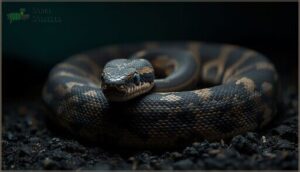
When your ball python’s scales take on a dull, muted look outside the pre‑shed color shift, you’re likely seeing stress‑induced dullness—especially if appetite drops or hiding increases. Abnormal discoloration, like patchy spots or persistent gray blotches, often flags health issues.
If your snake’s breathing sounds raspy or labored alongside those scale changes, it’s worth reading up on recognizing early signs of pneumonia in ball pythons before things escalate.
Handling shedding effects poorly can lead to incomplete shed signs, making these physical indicators essential behavioral signals to monitor.
Causes of Stress During Handling
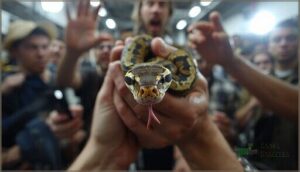
Handling your ball python might seem straightforward, but a few common mistakes can quietly trigger stress before you even realize it.
Most of the time, it’s not one big thing — it’s small, overlooked habits that add up.
Here are the main causes to watch out for.
Excessive or Rough Handling
Rough touch does more damage than most owners realize.
Gripping too tightly restricts breathing, and without proper snake support, the dangling rear third strains muscles.
Forceful grip handling techniques can trigger immediate body stiffening — a clear behavioral sign of distress.
For better ball python care and reptile stress management, gentle handling isn’t optional. It’s the foundation of trust.
Sudden Environmental Changes
Think of your ball python’s environment as its entire world — even small shifts hit hard.
Rapid Temp Fluctuations, Humidity Collapse, or Light Cycle Disruption can immediately derail normal thermoregulation.
Enclosure Transfer Stress from moving to a new habitat, or a sudden Substrate Change, leaves snakes disoriented and defensive.
Keeping temperature, humidity, and enclosure conditions stable isn’t just comfort — it’s survival language.
For a ball python, a stable environment is not a luxury — it is survival
Loud Noises and Vibrations
Your ball python feels sound differently than you do — vibration sensitivity means it picks up low-frequency noise through its jaw and body, not ears.
Bass-heavy speakers, slamming doors, and vacuum cleaners all register as threats.
Without acoustic isolation or substrate dampening, repeated exposure causes noise-induced appetite loss and chronic stress. Keep the enclosure away from high-vibration areas to protect reptile health and behavior.
Inadequate Support of Body
Ever notice your snake wriggle or coil tightly when you pick it up? That’s a clear physical indicator of stress from undersupported midsection, tail‑only lifting, or a head guidance lapse.
If you allow an overreaching extension or sagging spine, your ball python’s body language shifts—rapid tongue flicks, tense muscles, and sudden defensive movements signal it’s time to improve your handling technique.
Safe Handling Techniques to Reduce Stress
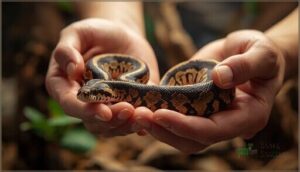
Handling your ball python with care makes a world of difference in their stress levels.
There are a few simple techniques you can use to keep them comfortable and safe.
Let’s walk through the best ways to handle your snake without causing unnecessary anxiety.
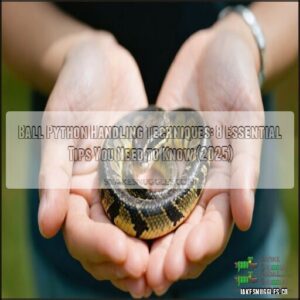
Supporting The Snake’s Full Body
Supporting your python’s full body is as essential as a sturdy bridge under a traveler’s feet. Use these steps:
- Mid-body Grip: Secure gently around the middle.
- Two-hand Pickup: Support behind the head and under the midsection.
- Continuous Contact: Maintain hand contact along the snake’s length.
- Tail Support: Prevent tail-only lifts to avoid injury.
Proper husbandry starts here.
Moving Slowly and Calmly
Once your python’s body is well supported, focus on your hand approach speed. Moving slowly, with a steady rhythm and predictable hand path, signals safety.
Sudden gestures or wide sweeps can trigger defensive behavior.
Calm body language and gradual motion reduce visual stimulus, letting your snake track you, tongue-flick, and relax. You’ll see stress melt into curiosity.
Limiting Handling Sessions
Slow movements build trust — but how long you handle matters just as much.
Session Duration Limits and Weekly Frequency Guidelines are the backbone of responsible ball python care:
- Keep sessions to 15–30 minutes maximum
- Handle 1–2 times weekly for stress‑free behavioral modification techniques
- Follow post‑feeding restrictions: wait 48–72 hours after meals
- Skip shed cycle handling entirely — zero sessions
Watch stress monitoring cues closely throughout every interaction.
Allowing Acclimation Time
Time limits alone won’t help if your ball python hasn’t settled into its new home yet. That’s where the initial no-off period comes in — give a newly arrived snake at least 7 full days without handling.
Pair that with a gradual feeding schedule, a quiet enclosure setup with proper hiding spot introduction, and temperature stabilization. Behavioral indicators will tell you when it’s ready.
Environmental Adjustments for Stress Relief

Your ball python’s environment does more for its stress levels than almost anything else you can do.
Getting a few key things right in the enclosure can make a dramatic difference in how calm and comfortable your snake feels day to day.
Here’s what to focus on.
Optimizing Temperature and Humidity
Think of your enclosure’s thermal gradient setup as a comfort map your ball python navigates all day. Keep the cool side between 24–26 °C and the warm side at 31–33 °C.
For humidity calibration techniques, target a 50–60 % baseline, rising to 75 % during shedding. Strategic heat source placement, paired with data logging strategies and a consistent misting schedule optimization, eliminates the guesswork that quietly drives stress.
Providing Multiple Hiding Spots
Having at least two hiding spots — one on the warm side for digestion, one on the cool side for retreat — is non‑negotiable in ball python care. Hide placement aligned with temperature zoning gives your snake real choice.
Size matters too: snug, body‑hugging hides reduce stress far better than open cavities. Cork bark and PVC are solid material choices that support both environmental enrichment and animal welfare.
Minimizing Loud Noises and Disruptions
Reducing stress starts with weaving acoustic foam panels and door sweep installation into your ball python care routine.
Placing the enclosure on a carpeted base and choosing a quiet room placement shields your snake from disruptive noise.
Gentle background white noise offers environmental enrichment, masking household activity.
These practical steps help prevent animal stress, supporting calm behavior and healthy environmental adjustments for your ball python.
Ensuring Proper Enclosure Size
Getting enclosure size right is one of the most overlooked aspects of ball python care. For adult reptile husbandry, a 4×2-foot footprint provides proper temperature gradient length and natural movement.
Poor floor space ratio forces constant wall contact — a clear stress trigger.
Follow size scaling guidelines as your snake grows, weave in strategic hide placement, enhance vertical utilization with branches, and prioritize habitat maintenance for a calmer environment.
Monitoring and Responding to Stress Signals

Knowing what to look for is half the battle in dealing with keeping your ball python healthy and calm.
Stress signals don’t always show up dramatically — sometimes they’re quiet, easy-to-miss shifts in behavior that can snowball if ignored.
Here’s what you should be tracking and when it’s time to call in a professional.
Tracking Behavioral Changes
Keeping a simple activity log transforms guesswork into clarity. Note your ball python’s hide preference, feeding diary entries, and shedding schedule weekly — then look for patterns.
A sudden shift in behavior often correlates with temperature correlation data you’ve already recorded. These behavioral signs don’t lie.
Consistent tracking is genuinely one of the most underrated tools in ball python care and reptile health and wellness.
Recognizing Subtle Early Stress Signs
Before stress becomes obvious, your ball python is already whispering. Watch for head tucking against the body, subtle body rippling along the spine, and a rising tongue flick rate — all early behavioral signs that something feels off.
Cool spot preference over warm zones and rapid breathing during handling are quiet red flags. Recognizing stress in your snake this early makes all the difference.
Consulting a Veterinarian When Needed
Some stress signs go beyond what you can fix at home. Wheezing, open‑mouth breathing, jaw swelling, blood from the vent, or severe skin wrinkling — these are emergency signs demanding immediate veterinary attention.
Exotic vet selection matters here; not every clinic treats reptiles. A certified specialist runs diagnostic tests, builds targeted treatment plans, and guides follow‑up care to fully restore your ball python’s animal health.
Preventing Future Stress in Ball Pythons

Preventing stress isn’t just about fixing problems as they come up — it’s about building habits that make stress less likely in the first place.
Your ball python thrives on predictability, cleanliness, and space that feels like its own.
Here are the key practices that make the biggest difference long-term.
Establishing a Consistent Routine
Building a reliable routine acts like a safety net for your ball python’s well-being. When you stick to predictable habits—such as 1. Feeding Schedule Timing, 2. Handling Frequency, 3. Light Cycle Consistency, and 4. Enclosure Cleaning Schedule—you create stability.
Paired with steady Temperature/Humidity Stability, these patterns encourage calm behavior, making environmental enrichment and gentle handling much more effective.
Gradual Socialization and Desensitization
Just as a consistent routine lays the groundwork, gradual socialization is your next tool for pet stress management. Using a Stepwise Exposure Plan, you pair Positive Association Techniques with careful Reading Early Stress signals. Track your Handling Frequency Schedule and Desensitization Progress Log for steady improvement. Here’s how it looks in practice:
| Stepwise Exposure | Positive Association |
|---|---|
| Short sessions | Calm cloth scent |
| Increase duration | Food after handling |
| Log behavior | Return to hide |
| Watch stress | End on calm note |
| Adjust frequency | No loud noises |
Regular Enclosure Maintenance
A clean enclosure does just as much for your snake’s calm as any handling routine. Spot clean feces and shed skin several times a week, and follow a Substrate Rotation Schedule — full replacement every one to three months keeps bacteria low without constantly disrupting scent cues.
Use Humidity Monitoring Tools daily, scrub Water Bowl Cleaning Frequency at least weekly, and follow a safe Disinfection Safety Protocol with reptile‑approved products.
Avoiding Overcrowding and Co-housing
After you’ve nailed regular enclosure maintenance, remember that ball pythons thrive in solitary housing. Overcrowding ramps up disease transmission risk and disrupts natural snake behavior.
Stick to Enclosure Size Standards, offer Separate Heat Zones, and use Individual Feeding Stations. You’ll see clear Solitary Housing Benefits—less stress, better husbandry, and more opportunity for environmental enrichment.
- Enclosure Size Standards
- Separate Heat Zones
- Individual Feeding Stations
Frequently Asked Questions (FAQs)
Can ball pythons recognize their owners over time?
Not quite like a dog greeting you at the door — but through scent familiarity and the habituation process, your ball python does learn unique chemical signature, building durable handler consistency over time.
Do ball pythons experience stress during shedding season?
Yes — shedding brings real stress.
Pre‑shed lethargy, vision impairment stress from milky blue eyes, appetite drops, and hormonal fluctuations all peak during this cycle, making your ball python more defensive and sensitive than usual.
How does diet affect a ball pythons temperament?
Diet shapes temperament more than most owners realize.
Poor calcium-phosphorus balance, wrong prey size, or inconsistent meal frequency can trigger lethargy, irritability, and defensive strikes — signs easily mistaken for handling stress rather than nutritional gaps.
What role does age play in stress tolerance?
Age shapes everything.
Juvenile handling limits are tight — under 10 minutes — while adults acclimate faster.
Senior support needs increase as muscle tone fades.
Developmental stress sensitivity and age‑based feeding stress vary widely across a ball python’s lifespan.
Can illness mimic stress signals in ball pythons?
Absolutely — illness can look just like stress.
Respiratory infection signs, inclusion body disease, and scale rot confusion are real risks.
Persistent appetite loss, vomiting, or weight loss indicators all warrant veterinary diagnostic cues over routine stress assumptions.
Conclusion
Funny how a creature without a voice can say so much—if you’re paying attention.
Your ball python’s pacing, balling up, or skipped meals aren’t drama; they’re data.
Once you learn to read ball python stress signals, handling becomes less guesswork and more conversation.
A calm enclosure, steady routine, and patient hands don’t just reduce stress—they build trust.
And a python that trusts you? That’s a genuinely thriving animal.