This site is supported by our readers. We may earn a commission, at no cost to you, if you purchase through links.
A reptile kept under the wrong UV lamp isn’t just comfortable—it’s quietly losing bone density. Metabolic bone disease develops without visible symptoms until fractures appear, and the culprit is almost always inadequate UVB, not poor diet. Most keepers focus on temperature gradients and forget that wavelengths between 280–320 nm drive the entire vitamin D3 synthesis chain your animal depends on.
Small enclosures introduce an extra level of complexity—mesh lids cut UVB transmission by 30–35%, and compact spaces leave little room for error in lamp placement. The right fixture at the wrong distance renders even a quality bulb useless.
These ten reptile UV lamps for small enclosures are ranked by output consistency, species compatibility, and practical fit for nano and mid-size setups.
Table Of Contents
- Key Takeaways
- Top 10 Reptile UV Lamps for Small Enclosures
- 1. Exo Terra Daylight LED Bulb
- 2. Zoo Med Reptisun LED Terrarium Hood
- 3. Exo Terra Dome Light Fixture
- 4. Reptisun Compact UVB Fluorescent Light
- 5. REPTIDLDB Linear UVB Reptile Light
- 6. Hygger Zoo T5 UVB Reptile Light
- 7. T5 UVB Reptile Light Fixture
- 8. Arcadia T5 UVB Reptile Light Kit
- 9. REPTI ZOO T5 HO UVB Terrarium Light
- 10. Mega Ray UV Vapor Reptile Bulb
- Why UVB Lighting Matters in Small Enclosures
- Choosing The Right UVB Lamp Type
- What Size UV Light for a 3ft Vivarium?
- UVB Lamp Maintenance and Safety Tips
- Frequently Asked Questions (FAQs)
- Conclusion
Key Takeaways
- Mesh lids silently steal 30–50% of UVB before it ever reaches your reptile, so always verify intensity with a meter at basking height — not at the bulb.
- UVB output fades long before a bulb stops glowing, so replace compact fluorescents every 6–8 months and T5 HO tubes every 10–12 months regardless of appearance.
- Matching your lamp to your reptile’s Ferguson Zone is non‑negotiable — a 10.0 bulb in a leopard gecko setup causes overexposure the same way a 5.0 bulb fails a bearded dragon.
- Mercury vapor bulbs like the Mega Ray 160W eliminate fixture clutter by combining basking heat and 14% UVB in one socket, but demand precise distance calibration to avoid intensity spikes.
Top 10 Reptile UV Lamps for Small Enclosures
Not all UV lamps are built the same, and in a small enclosure, the wrong pick can mean too little coverage or too much intensity in too tight a space.
A quick look at reptile UVB lights for beginners breaks down exactly which bulb types work best depending on your enclosure size and setup.
These ten options cover the range — from compact CFLs to mercury vapor — so there’s something here whether you’re housing a leopard gecko or a juvenile bearded dragon.
Here’s what made the cut.
1. Exo Terra Daylight LED Bulb
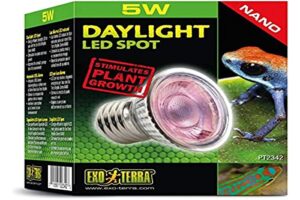
The Exo Terra Daylight LED Bulb (PT2342) isn’t a UVB source — and that’s the point.
Running at just 5 watts, it delivers bright 6500–6700 K daylight that drives plant and moss growth without adding UV stress to species that don’t need it.
Think hatchlings, amphibians, or invertebrates in nano and mini terrariums.
It fits standard Exo Terra dome fixtures and genuinely enhances coloration.
Just note the mixed durability reports — keep your receipt.
| Best For | Owners of nano or mini terrariums housing hatchlings, amphibians, or invertebrates who want strong daylight lighting to support live plants and moss without UV exposure. |
|---|---|
| Wattage | 5W |
| UVB Output | None |
| Bulb Type | LED |
| Enclosure Suitability | Nano/Mini terrarium |
| Heat Output | Minimal |
| Bulb Lifespan | Inconsistent (reported <1.5yr) |
| Additional Features |
|
- Bright 5W daylight output that actually drives plant and moss growth
- Enhances the natural coloration of both animals and plants
- Fits standard Exo Terra dome fixtures — no adapter needed
- Some users report bulbs failing within weeks or after about 1.5 years
- Inconsistent quality, with a few buyers receiving defective units out of the box
- No UVB output, so it can’t serve as a sole light source for species that need UV
2. Zoo Med Reptisun LED Terrarium Hood
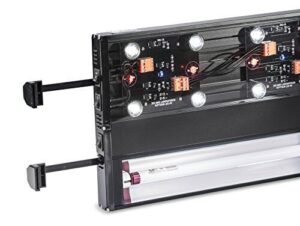
If you need UVB in the same hood as your daylight spectrum, the Zoo Med Reptisun LED Terrarium Hood (LF-87) covers both. It combines a 5.0 HO T5 UVB bulb with daylight LEDs, red plant-growth LEDs, and blue lunar LEDs — three switches, three separate functions.
Adjustable rails fit enclosures from roughly 15 to 31 inches wide. The reflector pushes UVB downward efficiently.
One real drawback: no built-in timers. You’ll want an external controller to automate your day-night cycles properly.
| Best For | Reptile and amphibian keepers who want UVB and full-spectrum lighting in a single hood for medium to large terrariums. |
|---|---|
| Wattage | 39W (T5 HO) |
| UVB Output | 5.0 HO |
| Bulb Type | T5 HO fluorescent |
| Enclosure Suitability | Medium-large vivarium |
| Heat Output | Minimal |
| Bulb Lifespan | 20,000 hours |
| Additional Features |
|
- Combines UVB, daylight, plant-growth, and lunar LEDs all in one unit — no need for multiple fixtures
- Three separate switches give you real control over your lighting modes
- Long 20,000-hour lifespan means you won’t be replacing it anytime soon
- No built-in timer, so you’ll need an external controller to automate day-night cycles
- Bulky design can feel oversized on smaller enclosures
- Some users have had issues with the UVB bulb and may need to upgrade to a 10.0 separately
3. Exo Terra Dome Light Fixture
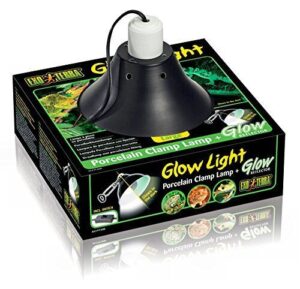
Where the Zoo Med hood locks you into one integrated unit, the Exo Terra Dome Light Fixture (PT2056) gives you flexibility.
It’s a standalone aluminum dome rated to 100 watts, with a heat-resistant porcelain socket that supports incandescent, compact fluorescent, and halogen bulbs. The built-in reflector directs light and heat downward — no wasted output bouncing sideways.
An adjustable clamp makes repositioning straightforward. Pair it with a thermostat, though; the dome itself doesn’t regulate temperature.
| Best For | Reptile owners who want a flexible, no-frills heat and light setup they can customize with their own bulbs and thermostat. |
|---|---|
| Wattage | 100W max |
| UVB Output | None (fixture only) |
| Bulb Type | Fixture only |
| Enclosure Suitability | Universal terrarium |
| Heat Output | High (up to 100W) |
| Bulb Lifespan | Varies by bulb |
| Additional Features |
|
- Aluminum build with a porcelain socket handles heat well and works with incandescent, CFL, and halogen bulbs
- Built-in reflector pushes light and heat straight down, so you’re not wasting output
- Adjustable clamp makes it easy to reposition without much hassle
- No temperature regulation built in — you’ll need a separate thermostat to keep things safe
- Capped at 100 watts, so it won’t work for setups that need higher wattage
- Some users have flagged durability concerns and run into trouble with warranty claims
4. Reptisun Compact UVB Fluorescent Light
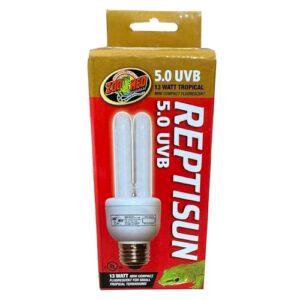
If you want a bulb that pulls double duty in a compact space, the Zoo Med ReptiSun Compact UVB Fluorescent is worth a look. At 13 watts, it delivers 5% UVB and 30% UVA through quartz glass — not standard glass — which makes a measurable difference in actual UVB reaching your reptile.
It mounts vertically or horizontally, fits most dome fixtures, and runs cool enough for small terrariums.
Just mark your calendar: replace it every 6–8 months, not when it stops glowing.
| Best For | Tropical reptile and amphibian owners who need reliable UVB in a small terrarium without a lot of heat buildup. |
|---|---|
| Wattage | 13W |
| UVB Output | 5% |
| Bulb Type | Compact fluorescent |
| Enclosure Suitability | Small terrarium |
| Heat Output | Low |
| Bulb Lifespan | 6-8 months |
| Additional Features |
|
- Quartz glass lets more UVB through than standard bulbs — your reptile actually gets what the label says
- Mounts vertically or horizontally, so it fits most dome fixtures you already own
- Runs cool, making it a safe pick for compact enclosures
- Needs replacing every 6–8 months even if it still looks like it’s working
- Not the best fit for larger setups or species with higher UVB demands
- Some users have had bulbs burn out earlier than expected
5. REPTIDLDB Linear UVB Reptile Light
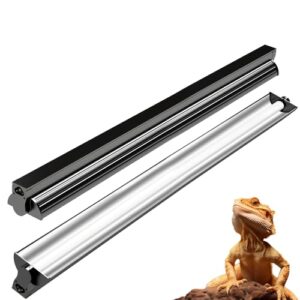
The REPTIDLDB 39W T5 HO fixture runs 34 inches long — that’s real coverage for a medium-to-large desert enclosure. It delivers 10% UVB and 30% UVA through a replaceable T5 HO tube, with a reflective alloy interior pushing output downward where it counts.
If you’re running this fixture over a bioactive or misted setup, brushing up on heat lamp safety for humid enclosures is a smart move before mounting.
Mount it at 18–24 inches above the basking zone.
One catch: the reflective coating can peel after a few months, so inspect it regularly. And don’t skip the separate heat lamp — this fixture doesn’t replace one.
| Best For | Desert reptile owners — especially those keeping bearded dragons or tortoises — who need reliable UVB coverage for a medium-to-large enclosure. |
|---|---|
| Wattage | 39W |
| UVB Output | 10.0 (10%) |
| Bulb Type | T5 HO tube |
| Enclosure Suitability | Medium-large tank |
| Heat Output | Low |
| Bulb Lifespan | 6-12 months |
| Additional Features |
|
- Delivers solid 10% UVB and 30% UVA output with a reflective interior that actually directs light where your reptile needs it
- Flicker-free operation keeps stress low, and the slim profile doesn’t eat up precious enclosure space
- Only the bulb needs replacing every 6–12 months — the fixture itself should last you a good while
- The reflective coating has a habit of peeling after a few months, which can tank UV output if you’re not keeping an eye on it
- Puts out almost no heat, so you’ll need a separate basking lamp — this one can’t pull double duty
- Only comes with a 10.0 UVB bulb, so it’s a no-go if you’re keeping tropical species that need lower UVB levels
6. Hygger Zoo T5 UVB Reptile Light
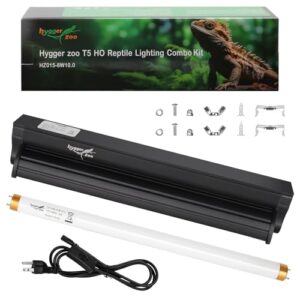
The Hygger Zoo T5 UVB Reptile Light packs a surprising amount of performance into an 8W T5 bulb — 10.0 UVB and 30% UVA output, channeled downward through a polished curved reflector. That reflector isn’t decorative; it actively concentrates rays toward your basking zone.
The aluminum hood dissipates heat well, which helps bulb stability over time. Mount it above a mesh lid or recess it inside the tank to cut transmission loss.
Best suited for bearded dragons and similar desert species in compact setups.
| Best For | Desert reptile owners — especially those keeping bearded dragons, tortoises, or chameleons — who need reliable UVB output in a compact, easy-to-mount fixture. |
|---|---|
| Wattage | 8W |
| UVB Output | 10.0 |
| Bulb Type | T5 fluorescent |
| Enclosure Suitability | Small-medium tank |
| Heat Output | Low |
| Bulb Lifespan | 3-6 months reported |
| Additional Features |
|
- Strong 10.0 UVB output with a polished reflector that focuses rays right where your reptile basks
- Aluminum hood handles heat well, which keeps the bulb running stable and may help it last longer
- Flexible mounting — sit it on a mesh lid or screw it inside the tank to reduce UVB loss
- Some users report bulbs burning out in as little as 3–6 months, so durability can be hit or miss
- Coverage may fall short in larger enclosures — works best in more compact setups
- Build quality feels a bit cheap up close, despite looking decent in photos
7. T5 UVB Reptile Light Fixture
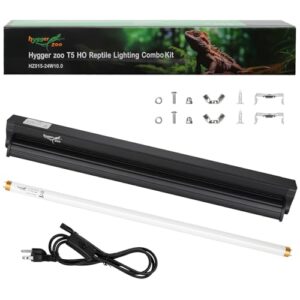
Step up from the 8W model, and this 24W T5 delivers a noticeably wider UVB footprint — enough to cover a 22‑inch stretch of enclosure at 10.0 UVB intensity.
The polished curved reflector pushes output downward efficiently, while aluminum fins keep bulb temperature stable over time.
Mount it on a mesh lid, recess it inside, or fix it to a wooden vivarium — it adapts.
Solid‑mercury luminescence keeps output consistent between replacements.
At $39.88, it’s a practical step up for larger desert species.
| Best For | Reptile owners with larger enclosures who need serious UVB coverage for desert species like bearded dragons, tortoises, or chameleons. |
|---|---|
| Wattage | 24W |
| UVB Output | 10.0 |
| Bulb Type | T5 fluorescent |
| Enclosure Suitability | Medium tank |
| Heat Output | Low |
| Bulb Lifespan | Periodic replacement needed |
| Additional Features |
|
- Strong 10.0 µW/cm² UVB output covers a solid 22-inch stretch — great for bigger tanks
- Polished reflector and aluminum fins work together to keep light focused and the bulb running cool
- Flexible mounting options mean you can dial in the exact distance your animal needs
- Contains mercury, so a broken bulb needs careful cleanup and proper disposal
- UVB fades over time, so you’ll need to swap it out regularly even if it still looks bright
- You’ll need a compatible T5 fixture — it won’t just drop into any setup
8. Arcadia T5 UVB Reptile Light Kit
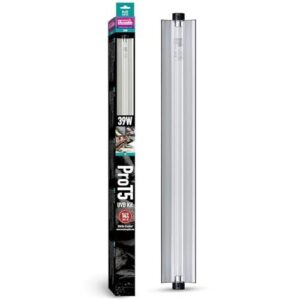
Arcadia builds the T5 UVB Reptile Light Kit around serious photobiology — 14% UVB and 30% UVA output through a 34‑inch, 39‑W tube engineered to German manufacturing standards.
The removable curved reflector focuses output directly into the basking zone, not scattered sideways where it’s wasted.
Mount it inside a wooden vivarium, above mesh, or hung — flexibility is built in.
Link up to 10 units from one power source for multi‑enclosure setups.
At $125.99, it’s a premium commitment, but the UV consistency justifies it.
| Best For | Reptile owners keeping desert species like bearded dragons, Uromastyx, or tortoises who want reliable, consistent UVB without cutting corners. |
|---|---|
| Wattage | 39W |
| UVB Output | 14% |
| Bulb Type | T5 fluorescent |
| Enclosure Suitability | Large vivarium |
| Heat Output | Low |
| Bulb Lifespan | ~12 months |
| Additional Features |
|
- High 14% UVB and 30% UVA output genuinely supports calcium metabolism and keeps desert reptiles healthy and active
- Curved reflector directs light where it matters — right into the basking zone — so none of that UV goes to waste
- Link up to 10 units from one power source, which is a real win for anyone running a multi-enclosure setup
- The power cable feels fragile in practice, and a few users have had to replace it sooner than expected
- At $125.99 upfront plus a bulb swap every 12 months, the ongoing cost adds up compared to budget alternatives
- The fixture runs 34 inches long, so it can feel oversized and awkward in smaller enclosures
9. REPTI ZOO T5 HO UVB Terrarium Light
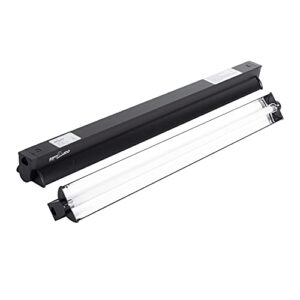
The UVB Terrarium Light punches well above its price point for desert species setups. The 24W model covers 24‑inch enclosures cleanly, with a polished curved reflector that pushes 10.0 UVB directly into the basking zone — not sideways into the walls.
ETL‑certified, rapid‑start ballast, removable power cable. It’s practical hardware.
One real caveat: voltage specs conflict across listings, so verify your region’s compatibility before buying.
Replacement bulbs run steeply, and early failure reports exist — keep your receipt.
| Best For | Desert reptile owners — especially bearded dragon keepers — who want solid UVB coverage without overcomplicating their setup. |
|---|---|
| Wattage | 24W |
| UVB Output | 10.0 |
| Bulb Type | T5 HO |
| Enclosure Suitability | 24-inch enclosure |
| Heat Output | Low |
| Bulb Lifespan | Short (reported <1 month) |
| Additional Features |
|
- Curved polished reflector pushes UVB right into the basking zone, not wasted on the walls
- Rapid-start electronic ballast is energy-efficient and the removable cord makes placement flexible
- Low heat output keeps temperature-sensitive enclosures easy to manage
- Replacement bulbs are pricey (around $118), so the long-term cost adds up fast
- Voltage specs conflict across listings — not ideal if you’re outside a 100–120V region
- Some units fail within a month, and the short return window doesn’t leave much room for error
10. Mega Ray UV Vapor Reptile Bulb
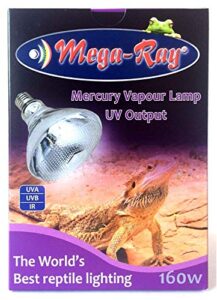
The Mega Ray 160W mercury vapor bulb is a two-for-one — heat and 14% UVB in a single self-ballasted unit. No separate basking lamp needed. That matters in tighter setups where fixture clutter is already a problem.
Position it at the right distance using a meter; too close, and UVB intensity spikes fast. Cool-down takes 15 minutes after shutdown — plan around that. Budget for annual replacement, and watch for early failure signs like audible humming.
| Best For | Reptile keepers who want to simplify their setup by combining UVB and basking heat into one bulb — great for tortoises, bearded dragons, and iguanas. |
|---|---|
| Wattage | 160W |
| UVB Output | Natural sunlight approx. |
| Bulb Type | Mercury vapor |
| Enclosure Suitability | Large basking enclosure |
| Heat Output | High (infrared) |
| Bulb Lifespan | ~12 months |
| Additional Features |
|
- Replaces two bulbs at once, cutting down on fixture clutter and wiring hassle
- Delivers real UVB output that supports Vitamin D₃ synthesis and helps prevent metabolic bone disease
- Boosts activity, appetite, and natural color in your reptile
- Needs a 15-minute cool-down before it’ll restart after shutdown or bumping
- UV output fades over time — expect to replace it around the one-year mark
- Some users report early failures and humming, and customer service experiences seem hit or miss
Why UVB Lighting Matters in Small Enclosures
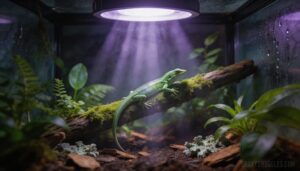
UVB isn’t optional for most reptiles — it drives vitamin D3 synthesis, keeps bones strong, and regulates behavior in ways no supplement can fully replace. In small enclosures, getting the intensity and placement right matters even more, since there’s less room for error.
In small enclosures, UVB placement isn’t optional — it’s the difference between thriving and deficient
Here’s what you need to know before picking the right lamp.
UVB and Vitamin D3 Synthesis in Reptiles
When Previtamin D3 Pathway — specifically wavelengths between 280 and 320 nm — hits your reptile’s skin, it triggers the Previtamin D3 Pathway: 7-dehydrocholesterol converts to previtamin D3, and basking heat drives that temperature-dependent conversion into active vitamin D3.
The Calcium Absorption Mechanism depends entirely on this chain.
In small enclosures, Skin UVB Penetration and Ferguson Zone Correlation determine your species-specific UVB requirements — so UVB intensity monitoring isn’t optional.
Desert species need high UVB are essential for preventing metabolic bone disease.
How UVB Prevents Metabolic Bone Disease
Without sufficient UVB Dosage reaching the basking zone, Vitamin D Activation stalls — and Bone Mineralization collapses shortly after.
Metabolic bone disease follows a predictable path:
- UVB intensity monitoring lapses
- Calcium Absorption drops as vitamin D3 synthesis fails
- Bones soften, deform, and fracture under normal movement
Species-specific UVB requirements and Photoproducts Influence on calcium metabolism make consistent exposure non‑negotiable.
Consider the role of calcium absorption inhibitors in worsening MBD.
UVA Vs UVB: Roles in Reptile Behavior and Health
Both wavelengths matter — but they’re doing completely different jobs.
UVB drives calcium metabolism through vitamin D3 synthesis, directly protecting bone health and immune function.
UVA covers the behavioral side: vision support, activity stimulation, feeding responses, and behavioral enrichment that keeps captive reptiles psychologically engaged.
| Feature | UVA | UVB |
|---|---|---|
| Primary Role | Vision and behavior | Bone health |
| Key Benefit | Activity stimulation | Vitamin D3 synthesis |
| Deficiency Risk | Lethargy, poor feeding | Metabolic bone disease |
| Affects Calcium? | Indirectly | Directly |
| Health Outcome | Behavioral enrichment | Calcium metabolism |
Circadian Rhythm Regulation Through Proper Lighting
Light doesn’t just fuel D3 synthesis — it sets your reptile’s internal clock. Photoperiod consistency is everything. Irregular schedules break circadian entrainment fast.
- Ramp Morning Light Intensity gradually to signal day-start reliably
- Apply Evening Light Dimming in the final 60–90 minutes before lights-out
- Use Spectrum Shifts — cooler daytime, warmer evening — to reinforce timing
- Commit to Darkness Hygiene: zero stray light during the dark phase
Choosing The Right UVB Lamp Type
Not every UVB lamp works the same way — and in a small enclosure, that difference really matters. The lamp type you choose affects coverage, heat output, energy use, and how well it matches your reptile’s actual needs.
Here’s a breakdown of the main options worth knowing before you buy.
Compact Fluorescent UVB Bulbs for Nano Tanks
Compact fluorescents punch above their weight in nano tanks. A 5-watt Zoo Med ReptiSun Compact UVB Fluorescent Light covers most species’ baseline needs — delivering a solid nano UVB spectrum across 260–280 nm.
Bulb lifespan variability means some brands fade at 6 months, others hold to 12. Add a curved reflector for 15–25% reflector efficiency gains, mount 6–12 inches above the basking spot, and verify with a UVB meter calibration check monthly.
LED UVB Fixtures: Energy Efficiency and Dimming Features
LED UVB technology has quietly changed the math on small enclosure lighting. Power Consumption Metrics tell the story: modern fixtures convert 15–25% of draw into usable UVB output — nearly double what older fluorescents manage.
Thermal Management Design keeps diodes cool, supporting Spectral Output Stability across a rated 20,000–50,000 hours. Adjustable Dimming Controls let you dial intensity without swapping bulbs, and Smart Home Integration means your compact tank’s UVB output follows a programmable daylight curve automatically.
Mercury Vapor Bulbs for Combined Heat and UVB
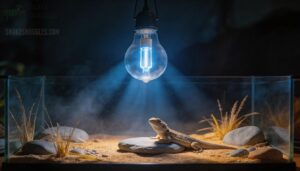
Mercury vapor bulbs run on a different principle entirely — a ceramic arc tube pressurizes mercury vapor to drive UVB emission, while a self‑ballasted design manages startup without external hardware.
Models like the MegaRay Mercury Vapor 160W and DXOPHIEX 100W Mercury Vapor deliver genuine heat‑UV balance from one socket.
Install safety guards, mount vertically, and keep distance at 12–18 inches.
Matching UVB Intensity to Species Ferguson Zone
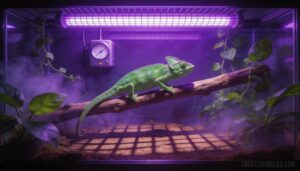
Ferguson Zones aren’t just categories — they’re UVI targets your setup must actually hit. Zone 1 species need a basking UVI of 0.6–1.4; Zone 3–4 animals need considerably higher peaks.
Nail distance calibration first, then account for mesh transmission effects, which can cut output by 50%.
Always verify with a UVB meter at basking height — species-specific UVI targets mean nothing if you’re guessing.
What Size UV Light for a 3ft Vivarium?
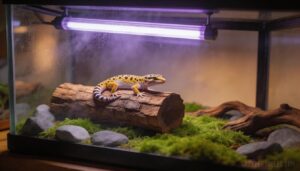
Sizing UV lighting for a 3ft vivarium isn’t guesswork — it comes down to coverage math, wattage, and where your basking zone sits. A few variables like mesh lids and mounting distance can quietly tank your UVB levels before your reptile ever feels the benefit.
Here’s what you need to know before picking a fixture.
Calculating UVB Coverage for Small Enclosure Dimensions
UVB isn’t uniform — it drops off fast with distance. A 10.0 bulb at 24 inches delivers a fraction of what it puts out at 12. That’s distance intensity working against you, and mesh transmission cuts it another 30–50%. Map your animal’s Ferguson Zone first, then verify with a Solarmeter 6.5R at basking height.
- Measure UVB at the exact basking surface, not the enclosure floor
- Account for lamp geometry — coverage narrows toward the edges
- Re-check UV meter placement after any décor rearrangement
- Mesh lids require you to compensate with closer lamp positioning
Fixture Length and Wattage Recommendations by Tank Size
Tank size scaling isn’t guesswork — it’s math.
For compact tanks under 12 gallons, aim for 2.0–3.5 watts per gallon with a 6–8 inch fixture.
Step up to a 24-inch T5 UVB bulb for 24-inch enclosures, mounted 12–18 inches up.
Reflector efficiency gains add 20–40% more UVB output.
Match fixture length ratios to your tank, and UVB coverage stays consistent.
Accounting for Mesh Lids and UVB Transmission Loss
Screen lids are silent UVB thieves — mesh material impact alone can cut transmission by 30–35%. That’s not a rounding error; it’s the difference between healthy bone density and MBD risk.
Reflector compensation strategies help redirect lost photons downward, but UVB meter calibration at the basking surface is the only reliable confirmation. Don’t assume — measure.
Mesh transmission measurement tells you what your reptile actually receives.
Optimal Basking Zone Placement and Lamp Distance
Once you’ve measured what’s actually reaching your basking zone, distance becomes your main dial. Lamp height calibration starts at 12–18 inches for most T5 HO setups, then a temperature gun confirms basking surface thermometry hits your species target — 85–105°F for bearded dragons, 30–33°C for ball pythons.
Adjust the reptile access path so your animal sits directly under the lamp, not beside it.
UVB Lamp Maintenance and Safety Tips
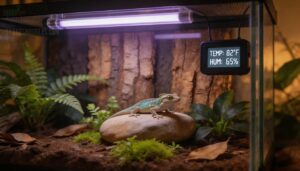
Getting your UVB lamp right is only half the job — keeping it working safely is the other half. A few consistent habits protect your reptile from both UV deficiency and overexposure.
Here’s what you need to know to stay on top of it.
When and How Often to Replace UVB Bulbs
Even when a bulb looks perfectly fine, UVB decay has likely already set in. Follow these Bulb Lifespan Guidelines by type for your UVB bulb replacement schedule:
- Compact and linear fluorescents — replace every 6–8 months
- T5 HO tubes — replace every 10–12 months
- Mercury vapor bulbs — replace every 8–10 months
Replacement Calendar Planning matters — mark install dates immediately. For UVB metering frequency, verify output monthly; when readings drop below your species’ Ferguson Zone target, that’s your Early Replacement Indicator, regardless of schedule.
Cleaning Fixtures and Reflectors in Compact Setups
Replacing bulbs on schedule is only half the equation — a grimy reflector can cut UVB output almost as badly as an expired tube.
For compact tanks, your nano reflector needs a monthly wipe using a lint-free microfiber cloth, compressed air blowing out dust first. Apply distilled water lightly to the cloth — never directly to the surface — wear gloves, and let it fully air dry before reinstalling.
Separating Heat Sources From UVB Lamps Safely
Running heat and UVB off the same overhead cluster is a common mistake in small terrariums — poor ventilation clearance around the UVB fixture shortens its lifespan quickly.
Keep your heat lamp positioned slightly offset, route cables away from the basking zone, and treat electrical isolation between circuits as non‑negotiable.
Separate fixtures, separate controls — that’s the foundation of smart UVB safety guidelines for compact setups.
Providing Shade Zones to Prevent UVB Overexposure
Too much UVB is just as problematic as too little — especially in compact setups where your reptile can’t escape peak exposure zones easily.
Build solid Shade Placement Strategies using these essentials:
- Use UV Blocking Materials with documented filtering ratings
- Create Partial Basking Gradients, not binary on/off zones
- Size Shade Coverage beyond the basking perch edges
- Practice UV Risk Monitoring weekly with a calibrated meter
Frequently Asked Questions (FAQs)
What size UV light for 3ft vivarium?
For a 3ft vivarium, a 24-inch T5 HO fixture hits the sweet spot — covering roughly two-thirds of the tank while leaving room for a cool end.
Is UV light good for a terrarium?
Yes — UV light is essential for any terrarium housing diurnal reptiles. UVB drives vitamin D3 synthesis and calcium metabolism, preventing metabolic bone disease.
Without it, even a well-fed reptile can deteriorate fast.
Are snakes attracted to UV light?
Snakes do show a UV behavioral response, though it varies by species. Diurnal and crepuscular species are more likely to seek UV-enriched basking zones, while nocturnal snakes largely ignore it.
Can reptiles get enough UVB through glass?
No — glass UVB blockage is nearly total. Standard glass filters out almost all UVB wavelengths, so a sunny windowsill delivers heat and UVA, not the UVB your reptile actually needs.
Do nocturnal reptiles need any UVB exposure?
Not always — but don’t dismiss it entirely.
Nocturnal reptiles still catch UV Exposure Frequency in the wild through partial shade.
Without Natural Sunlight Access, Dietary Vitamin D3 supplementation becomes your primary defense against Metabolic Bone Risk.
How does humidity affect UVB lamp performance?
Humidity quietly chips away at UVB output — water vapor causes UVB absorption, scatters photons, and drives lamp temperature rise.
Reflector condensation cuts distribution further, accelerating material aging and shrinking effective bulb lifespan faster than most keepers expect.
Should UVB lamps run on a timer?
Yes — run your UVB lamp on a timer.
A consistent 10–12 hour photoperiod helps maintain circadian rhythm regulation, prevents overexposure, and coordinates heat cycles without guesswork.
Timers also help track bulb aging for replacement.
Conclusion
The right light isn’t just a bulb—it’s a lifeline. Our curated selections eliminate guesswork, delivering the precise UVB spectrum and intensity small enclosures demand.
Here, reptile uv lamps for small enclosures become more than fixtures; they’re essential health safeguards. With science-backed options designed for nano habitats, you gain precise control over metabolic wellness and circadian rhythms.
Choose wisely: your reptile’s skeletal strength, activity, and behavioral vitality hinge on this invisible foundation. Brighten their world correctly—their thriving is non-negotiable.
- https://www.evolutionreptiles.co.uk/blog/why-reptiles-require-uvb-light-and-how-their-bodies-use-it/
- https://tropicaledu.com/vitamin-d3-deficiency-in-reptiles/
- https://www.reptileacademy.co.uk/post/the-science-of-reptile-husbandry-uvb-an-essential-environmental-parameter
- https://www.cttlight.com/post/uvb-and-vitamin-d3-the-science-behind-healthy-reptile-lighting
- https://exo-terra.com/explore/academy/lighting/vitamin-d3-and-reptiles-a-vital-connection/