This site is supported by our readers. We may earn a commission, at no cost to you, if you purchase through links.

A boa constrictor without a hide isn’t just comfortable—it’s running on cortisol. Studies on captive colubrids consistently show that snakes denied visual shielding maintain a perpetual vigilance posture, suppressing appetite and compromising immune function over time. Your boa reads an exposed enclosure the same way you’d read a glass-walled office with no door: nowhere to decompress, nowhere to think.
The fix isn’t complicated, but the details matter more than most keepers expect. Hide placement, interior dimensions, material choice, and humidity all interact in ways that determine whether your snake thrives or merely survives. Done right, learning how to create hides in a boa constrictor tank transforms the enclosure from a display case into a functioning habitat.
Table Of Contents
- Key Takeaways
- Why Boa Constrictors Need Hides in Their Tank
- How to Create Hides for a Boa Constrictor Tank Step by Step
- Choosing The Right Hide Size for Juveniles Vs. Adults
- Selecting Safe Materials (cork Bark, Sealed Plastic, PVC Pipe, Hardwood)
- Building a DIY Storage-tub Hide With a Cut Entrance and Aquarium-safe Sealant
- Constructing a Moss-lined Humid Hide for Shedding Support
- Placing Hides Correctly on The Warm and Cool Sides of The Enclosure
- Elevating Hides to Encourage Climbing and Varied Positioning
- Ensuring Proper Entrance Size, Rounded Edges, and Dark Interiors
- Top 5 Products for Boa Constrictor Hides and Tank Setup
- Cleaning and Maintaining Hides in a Boa Constrictor Tank
- Frequently Asked Questions (FAQs)
- Do boa constrictors need hides?
- How many hides should a boa have?
- How do you keep a boa constrictor?
- Do boa constrictors need a tank?
- Do boas need hides?
- How to make a humid hide for your snake?
- Is it cheaper to build or buy a reptile enclosure?
- How many hides for a snake?
- Can boas share hides in a communal setup?
- How many hides should a large adult have?
- Conclusion
Key Takeaways
- A boa without a hide stays locked in chronic stress mode—cortisol stays elevated, appetite drops, and immune function quietly deteriorates over time.
- Hide placement on both the warm side (88–90°F) and cool side (75–80°F) lets your boa self-regulate temperature without ever crossing exposed ground.
- Material choice matters more than most keepers realize—cork retains humidity and heat, food-grade plastic resists mold, and PVC offers a durable, chemically inert tunnel option.
- A moss-lined humid hide holding 70–90% interior humidity is your single best tool for clean, complete sheds and avoiding the frustration of dysecdysis.
Why Boa Constrictors Need Hides in Their Tank
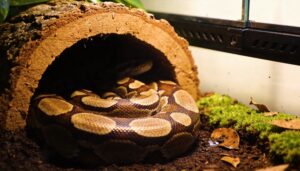
Hides aren’t optional for a boa constrictor — they’re as essential as food and clean water. Without them, your snake stays exposed, stressed, and unable to regulate its own body the way nature intended.
A proper setup makes all the difference, so browsing boa constrictor hides and enclosure essentials can help you find options that actually meet your snake’s needs.
Here’s why getting hides right matters before you build a single one.
How Hides Reduce Chronic Stress in Captive Boas
Without a reliable retreat, your boa stays in a constant watchful posture — and that sustained vigilance drives chronic stress hormone elevation. Visual shielding from properly fitted hides restores behavioral choice, letting your snake decide when to emerge rather than staying exposed.
Without a secure retreat, a boa stays perpetually watchful — hides restore the choice to hide or emerge
That simple control shift reduces defensive postures, rebuilds feeding confidence, and transforms hides into the enclosure’s most powerful environmental enrichment tool.
Research shows that mental stimulation encourages exploration can improve overall health in captive reptiles.
The Role of Hides in Thermoregulation and Temperature Gradient Use
Hides don’t just offer shelter — they anchor your thermal microclimate strategy. Place a warm hide at 88–90 °F and a cool zone refuge at 75–80 °F, and your boa self‑regulates without crossing open ground.
Thermoregulation through hide placement matters because:
- Heat retention varies by material — cork holds warmth longer than PVC
- Cool zone stability depends on keeping that refuge away from all heat sources
- Gradient monitoring requires probes inside both hides, not just ambient air
- Heat transfer variance between wood, ceramic, and plastic creates genuinely different thermal experiences
How Proper Hides Support Successful Shedding Cycles
Temperature gradient management and humidity control work together during shedding cycles.
moss-lined hide holding 70–90% humidity creates the microclimate stability your boa needs for skin shedding efficiency — think of it as loosening a label under warm water.
Bioactive hides with proper hide ventilation prevent moisture buildup while supporting molting comfort, reducing dysecdysis risk and delivering clean, complete peels every time.
How to Create Hides for a Boa Constrictor Tank Step by Step
Building the right hides for your boa doesn’t have to be complicated—it just takes knowing what actually works. From sizing and materials to placement and construction, each decision shapes how safe and settled your snake feels.
Here’s exactly what to do, step by step.
Choosing The Right Hide Size for Juveniles Vs. Adults
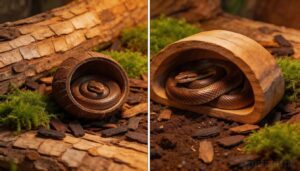
Size is everything regarding coiling comfort. Juveniles need a snug fit with roughly 2–3 inches of interior diameter — tight enough for wall contact on multiple sides. Adults do best around 4–6 inches.
Follow these enclosure size guidelines:
- Juvenile diameter: 2–3 inches interior width
- Adult diameter: 4–6 inches, never oversized
- Growth phase: upsize when the snake can’t fully coil
- Two hides per adult minimum, one per thermal zone
Selecting Safe Materials (cork Bark, Sealed Plastic, PVC Pipe, Hardwood)
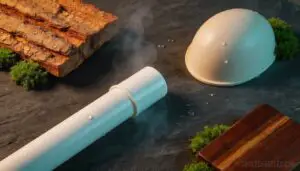
Material choice can make or break your boa’s health long-term. Each option carries trade-offs worth knowing before you build.
For example, the material of your hides matters just as much as placement—explore snake hide options for small and medium boas to find breathable, easy-to-clean choices that hold up on both ends of the temperature gradient.
| Material | Why It Works |
|---|---|
| VOC-free cork bark | Retains humidity, resists warping, sustainable sourcing |
| Food-grade sealed plastic | Non-porous, mold-resistant, easy to sanitize |
| Non-toxic PVC pipes | Durable tunnel style, smooth edges, chemically inert |
Hardwood sealing with reptile-safe coatings prevents moisture absorption; always confirm material safety and durability in reptile hides before committing.
Building a DIY Storage-tub Hide With a Cut Entrance and Aquarium-safe Sealant
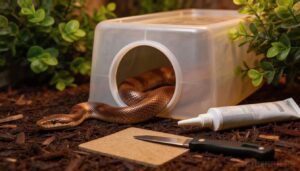
A storage tub costs two dollars and builds one of the safest snug-fitting entrances your boa will ever use. Sand the edges lightly with the Edge Sanding Technique. Apply Sealant Application along all seams, then angle the Entrance Lip Angle slightly inward.
- Cut entrance 2–3 inches wide
- Complete Tub Reinforcement at corners
- Run the Leak Testing Procedure for 24 hours
- Keep interior dark for stress reduction
Constructing a Moss-lined Humid Hide for Shedding Support
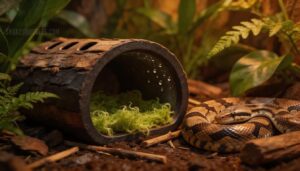
Sphagnum moss is your best ally for shedding cycles — pack it loosely inside a sealed plastic or cork bark container, targeting 75–90% interior humidity.
Moss Selection matters: choose material with strong Moisture Retention that springs back when pressed; never drips.
Add Ventilation Design slots on top, confirm Seal Integrity around edges, and run Safety Checks for sharp surfaces before placing your moss-lined hide.
Placing Hides Correctly on The Warm and Cool Sides of The Enclosure
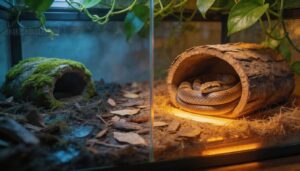
Think of hide placement as drawing a map your boa actually uses.
Anchor the warm-side hide directly over your heat source, where floor temps hold between 88–90°F — this is your Gradient Alignment foundation.
Your cool-side hide belongs at the opposite end, confirmed at 75–80°F.
Maintain a Central Access Path between them, prioritize Hide Stability, and orient entrances away from light for full thermoregulation control.
Elevating Hides to Encourage Climbing and Varied Positioning
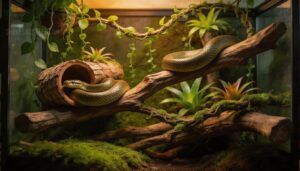
Elevating hides off the floor transforms a flat enclosure into genuine climbing enrichment for semiarboreal snakes.
Install branch hides at mid-height using Ramp Angle Optimization — two ramps at different angles, textured cork for Texture Grip Enhancement.
Apply Vertical Hide Stability with reinforced brackets, dim Lighting Corridor Design between levels, and track Climbing Usage Tracking over two weeks to adjust branch and vine installation placement.
Ensuring Proper Entrance Size, Rounded Edges, and Dark Interiors
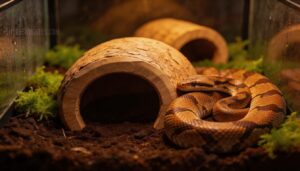
Every millimeter of your hide entrance matters. Size it at least 1.5 times your boa’s widest girth, following Entrance Dimension Guidelines, so snug-fitting entrances create security without trapping.
Sand all edges to Edge Radius Standards — minimum ¼‑inch radius — and line interiors dark for Interior Light Blocking.
Good Airflow Through Entrances also helps Mold Prevention inside cork bark hides and moss-lined retreats.
Top 5 Products for Boa Constrictor Hides and Tank Setup
Getting the right products makes everything else easier. These five picks cover the essentials — substrate, hides, lighting, and water — without overcomplicating your setup. Here’s what’s worth your money.
1. Zoo Med Rock Corner Water Dish
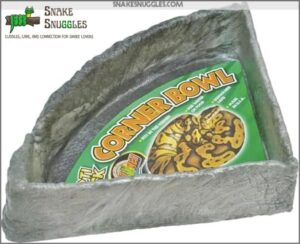
The Zoo Med Rock Corner Water Dish (model ZM92520) earns its place in large boa enclosures for one straightforward reason: capacity. At over one gallon, it allows full-body soaking, which directly aids hydration and shedding.
Its triangular footprint tucks into corners, preserving floor space you’d otherwise lose to a round bowl.
The non-porous, BPA-free plastic resists bacterial buildup between weekly cleans, and it’s dishwasher safe.
Note that its 3.2-inch depth and 3.8-pound weight make repositioning a minor chore—plan placement before filling.
| Best For | Reptile keepers with large enclosures (65+ gallons) who need a roomy soaking dish for snakes, turtles, or bearded dragons. |
|---|---|
| Material | Plastic |
| Brand | Zoo Med |
| Color | Assorted |
| Weight | 3.8 lb |
| Easy to Clean | Dishwasher safe |
| Reptile Compatible | Yes |
| Additional Features |
|
- Holds over a gallon of water, giving big reptiles plenty of room to fully soak
- Corner design saves floor space in the enclosure
- Easy to clean — just toss it in the dishwasher
- High sides can be tough for smaller or younger reptiles to climb in and out of
- You don’t get to pick the color — it’s random, so it might not match your setup
- At 3.8 lbs, it’s a bit of a hassle to move around once it’s in place
2. ReptiChip Organic Coconut Substrate
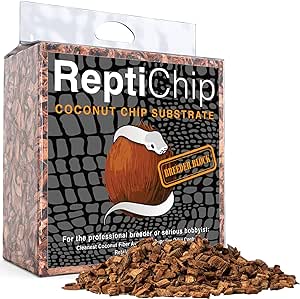
Substrate matters as much as the hide sitting on top of it. 72-quart compressed coconut husk brick expands three to four times its dry volume once hydrated, giving you a loose, diggable medium that holds humidity right in the 60–80% range you need.
It absorbs waste odors reliably, so your spot-cleaning schedule stays manageable—once or twice weekly rather than daily.
At $34.95, the per-use cost stays low.
Just don’t over-soak it; surface mold moves in fast when moisture has nowhere to go.
| Best For | Tropical reptile and exotic pet owners—ball pythons, boas, geckos, turtles, hermit crabs—who want a natural, humidity-holding substrate that cuts down on cleaning time. |
|---|---|
| Material | Coconut Husk |
| Brand | Reptichip |
| Color | Natural Brown |
| Weight | 9.92 lb |
| Easy to Clean | Spot-clean weekly |
| Reptile Compatible | Yes |
| Additional Features |
|
- Expands massively from one compact brick, so you get a huge amount of usable substrate for $34.95
- Holds humidity well and absorbs odors, which means less frequent spot-cleaning and a fresher enclosure
- Soft and diggable with low splinter risk—comfortable for burrowing species
- Breaking the dry brick kicks up dust, which can irritate sensitive animals before it’s fully hydrated
- Too much moisture invites mold, so you have to watch the humidity balance carefully
- Higher upfront cost than basic non-organic options, plus you’ll need your own container for soaking
3. Pangea X Large Reptile Hide Box
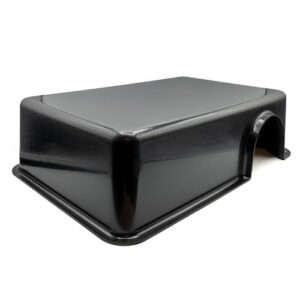
Once your substrate is layered and ready, the hide sitting on top of it needs to hold its own. The Pangea X-Large Reptile Hide Box earns its place here.
At 16.25" × 11" × 4.5", it fits adult ball pythons and medium boas without crowding them. The offset entrance reduces stress noticeably—snakes settle faster.
Heavy 1/8-inch plastic withstands repeated bleach cycles without warping. At $24.99, it won’t strain your budget either.
| Best For | Adult ball pythons, boas, and other medium-to-large terrestrial reptiles in enclosures 2′ × 4′ or bigger. |
|---|---|
| Material | Rigid Plastic |
| Brand | Pangea |
| Color | Black |
| Weight | 1.04 lb |
| Easy to Clean | Non-porous surface |
| Reptile Compatible | Yes |
| Additional Features |
|
- The offset entrance genuinely helps snakes feel secure and settle in faster
- Heavy-duty plastic holds up to repeated bleach cleanings without warping or cracking
- At $24.99, it’s solid value for a hide that can take the weight of a large snake
- Too roomy for juveniles or smaller snakes under ~500g — they won’t feel secure in it
- The plain black look is purely functional, so you may need extra décor to make it blend in
- Large footprint can eat up a lot of floor space in smaller enclosures
4. Zoo Med Reptile Rock Food Dish Medium
A solid hide setup also means your boa needs accessible food and water stations nearby. The Zoo Med Reptile Rock Food Dish Medium manages both duties cleanly.
At 7.25" × 6" with a low 0.75-inch profile, it fits snugly against substrate without tipping.
The molded polystyrene surface resists bacterial growth and wipes down in seconds with reptile-safe disinfectant. That rock texture blends into naturalistic setups without looking out of place—functional, unobtrusive, and durable enough to handle daily use without warping under enclosure heat.
| Best For | Reptile owners who want a low-maintenance, natural-looking dish that works for food, water, or soaking across all life stages. |
|---|---|
| Material | Polystyrene Plastic |
| Brand | Zoo Med |
| Color | Black/Dark Olive |
| Weight | ~0.01 oz |
| Easy to Clean | Smooth low-profile |
| Reptile Compatible | Yes |
| Additional Features |
|
- Smooth, non-porous surface makes cleaning quick and easy — just wipe it down and you’re done.
- The rock design blends right into naturalistic setups without looking like a piece of plastic.
- Tough enough to take a tumble without cracking, so no worries if your boa shoves it around.
- The rough interior bottom can be tricky to scrub thoroughly, especially in the corners.
- At only 0.75 inches deep, it doesn’t hold much water — not ideal for larger species that need a real soak.
- The actual color may not match what you see online, so expect some variation from the catalog photo.
5. Fluker Repta Clamp Lamp
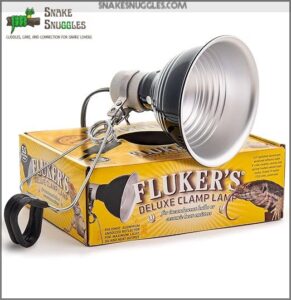
Dialing in your boa’s basking zone starts with reliable heat delivery. The Fluker Repta Clamp Lamp‘s 5.5-inch aluminum dome, ceramic socket, and UL/CUL-approved clamp handle bulbs up to 75 W—enough to hold that warm-side target of 88–90 °F without pushing into dangerous territory.
Clamp it to the rim, angle the swivel head directly over the basking site, and you’re done.
wattage at or below 75 W; the shallow dome overheats fast with anything heavier.
| Best For | Reptile owners who need a simple, repositionable heat lamp for snakes, turtles, or tortoises and want something that clamps right onto the tank rim without any fuss. |
|---|---|
| Material | Aluminum/Ceramic |
| Brand | Zoo Med |
| Color | Black |
| Weight | ~1 lb |
| Easy to Clean | Wipe-down exterior |
| Reptile Compatible | Yes |
| Additional Features |
|
- Works with incandescent, halogen, CFL, and ceramic heat emitters — so you’re not locked into one bulb type
- The ceramic socket handles heat well, and the UL/CUL-approved clamp gives you a secure hold on most tank rims
- Lightweight and easy to reposition whenever you need to adjust the basking angle
- The shallow dome overheats quickly if you go over 75 W, so headroom is limited
- The dome surface gets hot to the touch during use, which can be a problem if you’re reaching around the enclosure
- A few buyers have run into confusing clamp assembly and occasional unit defects out of the box
Cleaning and Maintaining Hides in a Boa Constrictor Tank
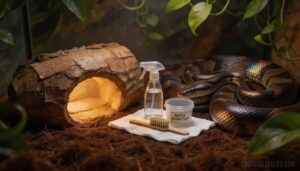
Setting up great hides is only half the job — keeping them clean is what actually protects your boa’s health long-term. Bacteria, mold, and humidity buildup can turn a perfect hide into a hazard faster than you’d expect.
Here’s exactly what you need to know to stay on top of it.
Weekly Cleaning Routine Using Reptile-safe Disinfectants
Every week, move your boa to a safe holding area before applying any disinfectant — fumes build fast in enclosed spaces, so ventilation safety isn’t optional.
Use a reptile-safe option like F10SC or diluted bleach, measuring exact disinfectant dilution ratios per the label.
Respect the full contact time, then let surfaces air dry completely before reassembly.
Consistency here is your regular maintenance schedule in action.
How to Sanitize Plastic and Cork Bark Hides Properly
Plastic hides and cork bark hides each need a different approach.
For plastic, wash with warm water and dish soap, then soak in a 10% bleach concentration for five minutes — rinse until no odor remains.
Cork bark gets a 200°F bake for 45 minutes. Use the airflow drying method with a fan, and apply sealant only after complete drying.
When to Rotate, Repair, or Replace Damaged Hides
Don’t wait for a collapse — your hides age whether you’re watching or not. Follow this Inspection Checklist weekly:
- Check Rotation Frequency — swap places to prevent mold hotspots
- Scan for cracks or softened edges indicating Lifecycle Timing issues
- entrances remain properly sized
- Apply aquarium-safe sealant as Repair Materials for minor gaps
- persistent odor — that’s irreversible; replace immediately
Recommended Hide Replacement Schedule for High-humidity Setups
High humidity doesn’t forgive slow decisions. For moss-lined hides, the Moss Replacement Interval sits at four to six weeks — mold colonies don’t wait.
Cork Degradation Timeline runs about eight weeks before moisture compromises structure. Watch for PVC Cracking Signs around week six.
Log Tracking your cleaning and replacement schedule for snake hides makes humidity timing, material safety, and durability in reptile hides predictable, not reactive.
Monitoring Humidity and Temperature Logs for Enclosure Health
Think of your enclosure logs as a health chart — silent, continuous, never lying. Place your humidity gauge near the bioactive hides and your temperature gauge at mid-height on both sides.
- Set Data Sampling Frequency to every five minutes
- Configure Alert Threshold Settings for 60–80% humidity
- Review Historical Trend Analysis weekly via your digital thermostat controller
Sensor Placement Strategy and Sensor Calibration keep your readings honest.
Frequently Asked Questions (FAQs)
Do boa constrictors need hides?
Yes — and here’s the paradox: a snake that looks completely still is often working hard.
psychological comfort, predator avoidance, and thermoregulation support that keep your boa genuinely healthy, not just calm.
How many hides should a boa have?
Two hides per adult boa are the minimum—one on the warm side, one on the cool side.
As your boa grows from hatchling to juvenile, revisiting boa enclosure setup and enrichment tips can help you arrange hides and upgrade space before stress sets in.
This basic hide placement strategy covers thermoregulation and rest without overcomplicating your enclosure design.
How do you keep a boa constrictor?
Keeping a boa constrictor means nailing thermoregulation, humidity regulation, substrate selection, and a consistent handling routine.
Factor in feeding frequency, water dish design, health checks, and environmental enrichment — and your boa thrives.
Do boa constrictors need a tank?
Absolutely — dedicated boa constrictor enclosure isn’t optional. It controls the temperature gradient, meets space requirements, manages ventilation needs, and keeps escape proofing intact.
Without it, your boa’s health and safety simply can’t be guaranteed.
Do boas need hides?
Boas absolutely need hides. Without them, stress hormone levels climb, feeding responses drop, and thermoregulation suffers. A hidden retreat isn’t optional — it’s the foundation of a healthy, behaviorally enriched enclosure.
How to make a humid hide for your snake?
damp sphagnum moss loosely inside a sealed plastic container with a ventilation slot, place it on the warm side, and monitor humidity monitoring tools to keep moss moisture level damp, never dripping.
Is it cheaper to build or buy a reptile enclosure?
DIY generally runs $150–$250 for a mid-size build versus $340–$420 prebuilt. You’ll save upfront, but prebuilt units include warranties and integrated seals you’d otherwise add separately.
How many hides for a snake?
At minimum, keep two hides — one on each end. Juveniles benefit from three, including a humid option. Adults need at least two secure retreats to support thermoregulation and reduce stress.
Can boas share hides in a communal setup?
Shared hides are a recipe for a dominance hierarchy problem.
Each boa needs its own retreat — hide competition drives stress signals, injury risk, and resource partitioning failure that no enclosure design can fully offset.
How many hides should a large adult have?
For a large adult boa, two to three hides hit the sweet spot. Place one on the warm side, one on the cool side, and optionally a third mid-enclosure.
Conclusion
Did you know that up to 75% of captive snakes exhibit stress-related behaviors? By learning how to create hides in a boa constrictor tank, you can greatly reduce this risk.
A well-designed hide setup promotes thermoregulation, reduces chronic stress, and facilitates successful shedding cycles.
With these step-by-step guidelines, you’re now equipped to transform your boa’s enclosure into a thriving habitat, ensuring a healthier, happier pet for years to come, with a calm and stress-free environment.