This site is supported by our readers. We may earn a commission, at no cost to you, if you purchase through links.
Most reptile keepers obsess over temperature and forget that humidity does half the work. Get it wrong and your boa pays the price: retained eye caps, audible wheezing, an immune system grinding against chronic respiratory infection.
A solid boa constrictor care sheet humidity protocol isn’t complicated, but it demands precision. The difference between 45% and 75% relative humidity determines whether your animal sheds cleanly in one piece or arrives at the vet with necrotic skin folds and a lung infection.
This guide gives you specific numbers, practical tools, and fixes that actually work.
Table Of Contents
- Key Takeaways
- Boa Constrictor Humidity Range: What Level is Best?
- How to Measure Boa Enclosure Humidity Accurately
- How Enclosure Setup Stabilizes Boa Constrictor Humidity
- How to Raise or Lower Humidity Safely
- How Humidity Affects Shedding and Respiratory Health
- Frequently Asked Questions (FAQs)
- What is the ideal humidity level for a boa constrictor?
- What is the best bedding for a boa constrictor?
- How hot is too hot for a boa constrictor?
- What is too hot for a red tail boa?
- How much humidity does a boa constrictor need?
- What temperature should a boa heat mat be?
- What is low humidity for Boas?
- How humid is too humid for a snake?
- How to travel with a boa constrictor safely?
- Can boas adapt to seasonal climate changes indoors?
- Conclusion
Key Takeaways
- Maintain 40–60% humidity for daily care and raise it to 60–70% only during shedding cycles—sustained levels above 70% invite respiratory infections, not just comfort issues.
- Your enclosure’s physical design—moisture-retentive substrate, a humid hide, and controlled ventilation—does more to stabilize humidity than any misting schedule can on its own.
- A digital hygrometer only gives you accurate data if it’s placed correctly, calibrated, and replaced when it drifts more than 5% in a week—bad readings are as dangerous as bad conditions.
- Retained eye caps, multi-piece sheds, and audible wheezing aren’t minor inconveniences—they’re clinical signs that humidity has already failed your animal.
Boa Constrictor Humidity Range: What Level is Best?
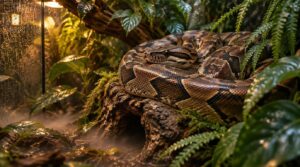
Humidity isn’t a single number—it depends on what your boa is doing. Two distinct ranges apply to normal conditions and shedding cycles, and confusing the two is where most keepers go wrong. Here’s what each one requires.
Understanding both ranges becomes much easier once you’ve got boa constrictor enclosure ventilation basics sorted, since airflow directly shapes how well your setup holds—or releases—moisture.
Normal Humidity Levels
Although ambient humidity shifts seasonally, your boa’s enclosure humidity should hold between 40–60%, with 50% as your working target. Daily natural humidity fluctuations of 5–10% are well tolerated; drop below 40% and things go sideways.
- Maintain 40–60% humidity range consistently
- Use substrate moisture retention to buffer drops
- Monitor enclosure humidity gradients from cool to warm
- Log readings before making changes
Shedding Humidity Levels
When your boa enters a shedding cycle, bump the humidity range to 60–70%. That extra moisture softens old skin and makes sloughing cleaner. A humid hide packed with damp sphagnum gives your boa an on-demand option without saturating the whole enclosure. Targeted misting and substrate moisture management keep things stable without pushing past 75%, where respiratory problems begin.
Pairing shed-support humidity with boa constrictor enrichment like climbing branches encourages natural movement that helps loosen old skin from harder-to-reach areas.
How to Measure Boa Enclosure Humidity Accurately
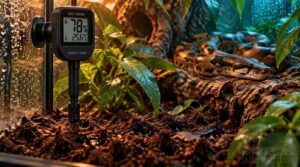
Knowing the right range means nothing if your readings are wrong. A digital hygrometer is the standard tool, but placement and method determine whether you’re capturing real conditions or ambient noise. The same principle applies across species—boa constrictor humidity and care requirements follow similar measurement rules, making accurate hygrometer placement just as critical there.
Here’s how to get reliable data:
- Mount the probe 2–4 inches above substrate, centrally in the enclosure, away from the basking spot and water dish.
- Keep the lid sealed during logging; open enclosures skew reptile enclosure humidity control readings.
- Record at two fixed times daily for a week to establish a true average.
- Calibrate before first use with a salt test, and cross-check against a second unit for a few days.
Digital hygrometer accuracy drops with age. Replace any sensor that drifts more than 5% in a week.
For a full breakdown of when and why to swap out your gauge, this guide on reptile humidity gauges for ball pythons covers replacement timelines and what to watch for between changes.
How Enclosure Setup Stabilizes Boa Constrictor Humidity
Once you’ve locked in accurate readings, the real work is structural. Equipment helps, but enclosure design does most of the heavy lifting for humidity control.
Four setup elements that stabilize moisture passively:
- Substrate dampening with coconut husk or peat mix buffers fluctuations over 24–72 hours without constant intervention.
- A well-built humid hide setup gives your boa a localized high-humidity pocket without saturating the whole enclosure.
- Low-to-moderate enclosure ventilation at opposite ends with baffling slows moisture loss while preventing stagnation.
- Cork panels and live plants retain surface moisture, smoothing diurnal swings so your misting system doesn’t have to compensate constantly.
Stack these right and you’ll spend less time adjusting equipment, more time watching your animal thrive.
How to Raise or Lower Humidity Safely
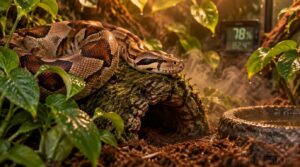
Once you’ve identified the problem, the fix is usually straightforward. Whether your enclosure is running too dry or too damp, specific adjustments target each issue without destabilizing the rest of your setup. Here’s what works for both scenarios.
For a deeper breakdown of both methods, snake enclosure humidity management walks through exactly when and how to apply each correction.
Fixing Low Humidity
Dry air is a fixable problem. Switch to moisture-retentive cypress mulch, 2–4 inches deep, and add a humid hide packed with damp sphagnum moss. Misting two to three times daily pushes RH to 45–60% within 30 minutes.
If you can’t stay consistent, an automatic misting system or reptile fogger usage removes the guesswork and keeps levels stable around the clock.
Fixing High Humidity
When humidity climbs above 65%, your first fix is improved ventilation. Adding cross-ventilation panels or switching to a mesh-sided enclosure moves stagnant air out before mold prevention becomes an urgent problem.
Check your substrate dampening too, because saturated substrate is almost always the culprit. Dial back your misting system frequency, and let the enclosure dry out fully between cycles.
How Humidity Affects Shedding and Respiratory Health

Picture old skin peeling away in one clean, papery sleeve. That only happens when moisture at the skin surface stays adequate throughout the full shedding cycle. Drop humidity too low during the opaque eye phase, and the epidermis dries and grips before it can separate cleanly.
Low humidity during the shed cycle turns skin into a trap, not a sleeve
Respiratory health follows the same logic. Your boa’s airway mucosa needs ambient moisture to function. Without it, secretions thicken, clearance slows, and respiratory infection risk climbs.
Watch these five humidity-related warning signs:
- Retained eye caps after shed
- Shed in multiple pieces
- Audible wheezing or clicking
- Mucus around the nostrils
- Incomplete sheds despite correct thermostat settings
Your hygrometer doesn’t lie. Consistent readings outside the target range are always a clinical signal, not a minor inconvenience.
Frequently Asked Questions (FAQs)
What is the ideal humidity level for a boa constrictor?
The best boa constrictor humidity range is 40 to 60 percent for everyday care. Bump it to 60–70% during active shedding cycles. Keep it there briefly; anything sustained above 70% risks serious respiratory tract infections.
What is the best bedding for a boa constrictor?
Bedding is the backbone of your enclosure’s moisture control. Cypress mulch or coconut fiber is the ideal substrate for boas. Avoid aspen shavings and cedar; neither retains humidity well, and cedar actively irritates their airways.
How hot is too hot for a boa constrictor?
Ambient air above 90°F (32°C) causes neurological damage and death. Your basking spot surface can reach up to 95°F (35°C), but the ambient air temperature must stay well under that ceiling. A thermostat isn’t optional.
What is too hot for a red tail boa?
Anything above 92°F at the basking spot pushes into heat stress territory. Once your thermal gradient exceeds 95°F, expect appetite collapse and respiratory distress. That’s not basking; that’s cooking.
If you’re unsure whether your setup is running too warm, this guide on how to tell when a snake’s tank is too hot walks through the early warning signs and quick fixes.
How much humidity does a boa constrictor need?
A rescued boa came in once with retained eye caps from a chronically dry enclosure. Your ideal boa constrictor humidity range is 55-75%, rising to 75-85% when your snake is preparing to shed its skin.
What temperature should a boa heat mat be?
Keep your heat mat surface at 90°F maximum, and always pair it with a thermostat. Without one, surface temps creep dangerously high. Cooler enclosure zones should hold steady between 75 and 85°F for thermal regulation.
What is low humidity for Boas?
A boa presented with patchy retained shed after two weeks at 38% RH. Below 50% is simply too dry for safety. Your target’s 55–65%; drop under that, and incomplete sheds and dull skin follow quickly.
How humid is too humid for a snake?
Above 70%, you’re inviting mold and respiratory infection risk. Brief spikes are fine, but sustained excess humidity is a clinical problem, not just a comfort issue.
How to travel with a boa constrictor safely?
Pack your boa in a secure, escape-proof travel container padded to absorb road vibration. You’ll want the enclosure temperature at 75-85°F; skip feeding 48 hours before departure and limit handling. Stress escalates fast in transit.
Can boas adapt to seasonal climate changes indoors?
Yes, within limits you control. Hold the enclosure’s temperature gradient and humidity within target bands. Biweekly RH swings under 20% are tolerable, but larger seasonal adjustments, particularly sharp winter drops, will disrupt their shedding cycles.
Conclusion
Precise parameters protect your boa. Boa constrictor care sheet humidity isn’t a suggestion you revisit when something looks wrong; it’s a daily metric you manage before problems develop. Consistent readings between 60 and 75 percent mean clean sheds, clear lungs, and a snake that isn’t quietly fighting an infection you can’t see yet. Get the numbers right, keep them stable, and your boa won’t need a vet visit to fix what humidity should have prevented.