This site is supported by our readers. We may earn a commission, at no cost to you, if you purchase through links.

Your kid falls in love with a ball python at the pet store, and suddenly you’re Googling enclosure temps at midnight. happens fast.
And the heating mat question trips up a lot of first-time reptile families—because not all mats are built with safety in mind, and the stakes are higher when curious hands are involved.
A good reptile heating mat holds a steady 104–122°F on the warm side without spiking, shorting, or turning your kid’s bedroom into a fire hazard. The wrong one? It might not even come with overheat protection. These seven picks change that math entirely.
Table Of Contents
- Key Takeaways
- Top 7 Family-Safe Reptile Heating Mats
- Safety Features Families Should Prioritize
- Why Overheat Protection Matters in Homes With Kids
- Choosing Mats With Thermostat Compatibility
- Checking for UL Certification or Similar Safety Testing
- Moisture-resistant Designs for Spills and Water Bowls
- Automatic Shut-off and Thermal Fuse Protection
- Safe Cord Management Around Children and Pets
- Using GFCI Outlets for Added Electrical Protection
- Thermostats and Temperature Control
- Why Every Reptile Heat Mat Needs a Thermostat
- Ideal Warm-side Temperatures for Common Pet Snakes
- Maintaining a Cooler Side for Thermal Gradients
- Digital Thermostat Settings for Family-friendly Use
- Where to Place The Thermostat Probe
- Preventing Temperature Spikes and Hot Spots
- Teaching Children Not to Adjust Controls Unsupervised
- Installation and Placement Guidelines
- Installing Heat Mats Under The Enclosure Safely
- Covering Heat Sources to Prevent Direct Contact
- Using Ceramic Tile for Even Heat Distribution
- Avoiding Excessive Substrate Depth on The Warm Side
- Leaving Airflow Gaps to Reduce Overheating Risk
- Securing Mats Properly to Glass or Acrylic Tanks
- Placement Mistakes Families Should Avoid
- Maintenance and Kid-Safe Care Habits
- Monthly Inspections for Cords, Discoloration, and Damage
- Cleaning Reptile Heating Mats Safely
- When to Replace an Old Heating Mat
- Warning Signs of Uneven Heating or Scorching
- Creating a Family Reptile Care Checklist
- Teaching Children Safe Handling Around Enclosures
- Energy-efficient Use Without Compromising Reptile Health
- Frequently Asked Questions (FAQs)
- Conclusion
Key Takeaways
- heating mat without a thermostat is a safety risk — always pair one with an external or built-in controller to prevent dangerous temperature spikes around kids and reptiles.
- Look for overheat protection, IPX7 moisture resistance, and UL or ETL certification before buying — these aren’t extras, they’re the baseline for a family-safe setup.
- Placement matters as much as the mat itself — use a ceramic tile for even heat spread, keep substrate under half an inch on the warm side, and always plug into a GFCI outlet.
- Monthly checks on cords, surface discoloration, and heat distribution catch problems early — most mats last 3–5 years, but don’t wait for a failure to replace one.
Top 7 Family-Safe Reptile Heating Mats
Not every heating mat is built with families in mind — but these seven are. Each one made the cut for its safety features, ease of use, and reliability around kids and pets.
If you’re navigating this purchase for the first time, this guide to reptile heat mats safe for kids with pet snakes walks through exactly what to look for before you buy.
Here’s what’s worth your attention.
1. BN-LINK Reptile Under Tank Heat Pad
BN-LINK Reptile Under Tank Heat Pad is a solid starting point for families new to reptile keeping.
It’s 8 × 12 inches — the right fit for 10–20 gallon tanks — and draws just 16 W at 120 V. Surface temps reach 104°F–122°F within minutes.
No built-in thermostat, though, so pair it with an external one. The peel-and-stick backing makes setup easy, and the waterproof surface wipes clean fast.
Backed by a 15-month warranty.
| Best For | Beginner reptile owners with a 10–20 gallon tank who want a simple, low-cost heating solution. |
|---|---|
| Power Draw | 16W |
| Voltage | 120V AC |
| Waterproof | Yes |
| Adhesive Backing | Yes |
| Tank Size | 10-20 gal |
| Warranty | 15 months |
| Additional Features |
|
- Heats up fast — reaches 104°F–122°F in minutes with a low 16 W draw
- Peel-and-stick setup takes seconds, and the waterproof surface is easy to wipe down
- Works with external thermostats for better temperature control
- No built-in thermostat, so you’ll need to buy one separately
- Adhesive edges can lift over time and may need extra tape to stay put
- Some units run hotter at the edges than the center, which can cause uneven heating
2. Aiicioo Reptile Heating Pad
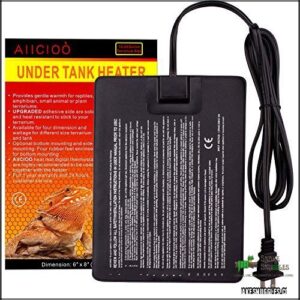
Next up is the Aiicioo Reptile Heating Pad — a slightly smaller option at 10.8 × 4.9 inches, but don’t let the size fool you.
It runs on 8 W and hits surface temps between 104°F and 122°F consistently.
The dual-mount design is a nice touch — adhesive back for side mounting, rubber feet for underneath.
Like the BN-LINK, it needs an external thermostat to dial in temps precisely.
Great fit for 10–20 gallon tanks housing geckos or hermit crabs.
| Best For | Reptile and invertebrate owners with 10–20 gallon tanks who want a simple, low-cost heat source for species like geckos or hermit crabs. |
|---|---|
| Power Draw | 8W |
| Voltage | 120V AC |
| Waterproof | Yes |
| Adhesive Backing | Yes |
| Tank Size | 10-20 gal |
| Warranty | Not stated |
| Additional Features |
|
- Dual-mount design gives you flexibility — stick it to the side or set it underneath
- Runs at 8 W, so leaving it on 24/7 won’t hurt your electricity bill
- Consistent heat output between 104°F and 122°F with no hot spots
- Fixed temperature means you’ll need an external thermostat for precise control
- Adhesive near the power cord can weaken over time, and some users have reported unit failure
- Not a good fit for plastic or acrylic tanks, or anything larger than 20 gallons
3. BNLINK Seedling Heat Mat Thermostat
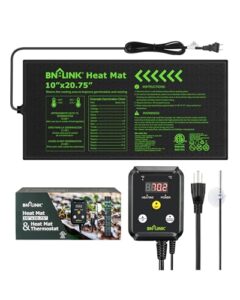
If you want built-in temperature control without buying a separate thermostat, the BNLINK Seedling Heat Mat Thermostat combo is worth a look.
The mat runs 20 W and sits at 10 × 20.75 inches — roomy enough for a 20-gallon setup. Its digital controller covers 40°F to 108°F in single-degree steps, with a bright LED display that’s easy to read.
ETL-listed for safety, IP67-rated for moisture resistance.
One heads-up — keep the probe away from water bowls for accurate readings.
| Best For | Gardeners and hobbyists who want all-in-one temperature control for seed starting, fermentation, or small reptile enclosures without the hassle of a separate thermostat. |
|---|---|
| Power Draw | 20W |
| Voltage | 120V AC |
| Waterproof | IP67-rated |
| Adhesive Backing | Yes |
| Tank Size | Seed trays |
| Warranty | 15 months |
| Additional Features |
|
- Built-in digital thermostat with a wide 40–108°F range means you’re not guessing — just set it and forget it.
- IP67-rated waterproof construction holds up well in humid greenhouse or hydroponic environments.
- ETL-listed safety certification and a 15-month warranty give you solid peace of mind.
- The suction cup mount is pretty flimsy — don’t count on it staying put for long.
- Probe and cord lengths are fixed, so tight or multi-device setups can get awkward fast.
- Only works on 120V North American outlets, which is a dealbreaker if you’re abroad without a transformer.
4. Lucky Herp Reptile Heating Pad
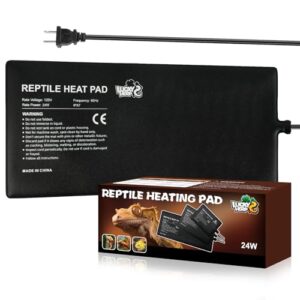
The Lucky Herp packs a solid punch for its size — 8 × 18 inches, 24 W, and waterproof PVC that actually wipes clean. That matters when little hands are nearby.
It heats up fast and sticks directly to the tank bottom with built-in adhesive — no extra hardware needed. One catch: that adhesive is single-use, so measure twice before you press it down.
Pair it with an external thermostat to keep warm-side temps right around 88°F–90°F.
| Best For | Small reptile or amphibian owners who want a simple, affordable heating solution for tanks up to 20–30 gallons. |
|---|---|
| Power Draw | 24W |
| Voltage | 120V AC |
| Waterproof | Yes |
| Adhesive Backing | Yes |
| Tank Size | Medium tanks |
| Warranty | Not stated |
| Additional Features |
|
- Heats up fast and stays consistent — great for snakes, lizards, and other reptiles that need reliable belly heat
- Waterproof PVC wipes down easily, which is a nice bonus when things get messy
- Built-in adhesive means no brackets or clips — just stick it on and you’re done
- The adhesive is single-use, so if you misplace it during setup, you’re buying a new one
- Doesn’t work well for larger tanks — a 55-gallon enclosure is too much for this pad to handle
- The thermostat can run inaccurate, and some users have had the heating element give out within a year
5. Hamiledyi Reptile Heating Pad
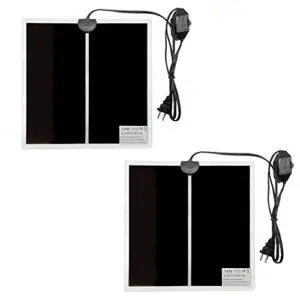
The Hamiledyi covers a solid 8×12 inches — roomy enough for a 30–40 gallon tank — and runs at 23W with carbon film heating that spreads warmth evenly.
That even heat distribution is especially useful in cooler environments, as heating mats for basement reptile setups warm the substrate directly rather than the surrounding air.
No hot patches, no guessing.
The IPX7 waterproof rating means accidental splashes won’t cause a crisis.
It has built-in overheat protection, which is exactly what you want in a home with curious kids around.
You’ll still want an external thermostat to keep warm-side temps dialed in around 88°F–90°F.
| Best For | Reptile and small pet owners who want an affordable, low-maintenance heat source for terrariums, breeding boxes, or tanks year-round. |
|---|---|
| Power Draw | Low-power |
| Voltage | 120V AC |
| Waterproof | Yes |
| Adhesive Backing | No |
| Tank Size | Varies |
| Warranty | Not stated |
| Additional Features |
|
- Comes as a two-pack for $17.99 — solid value if you have multiple enclosures or want a backup
- Built-in temperature control (up to 35°C/95°F) and waterproof surface make it easy to use and clean
- Ultra-low power draw means you can leave it running 24/7 without worrying about your electric bill
- Doesn’t include a thermostat, so you’ll need to buy one separately to avoid overheating risks
- Heat can be uneven across the pad, with some spots running hotter than others
- Smaller 11×11 in size may not cut it for larger tanks or setups that need more coverage
6. BN LINK Reptile Heating Pad Thermostat
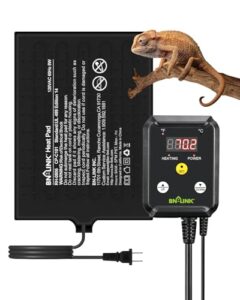
BN LINK’s combo kit is one of the easier setups you’ll find — pad and digital thermostat included, no hunting for separate parts. The thermostat runs from 40°F to 108°F with a simple 3-button control, so you’re not drowning in settings.
LED indicators glow in the dark, which is a nice touch.
At just 8W, it’s best suited for 10–25 gallon tanks.
The 15-month warranty and built-in overheat protection make it a solid, family-friendly pick.
| Best For | Beginner reptile and small pet owners who want an easy, all-in-one heating solution for 10–25 gallon tanks without any technical hassle. |
|---|---|
| Power Draw | 8W |
| Voltage | 120V AC |
| Waterproof | Yes |
| Adhesive Backing | Yes |
| Tank Size | 10-20 gal |
| Warranty | 15 months |
| Additional Features |
|
- Comes with everything you need — pad and digital thermostat in one kit, no extra shopping required.
- Simple 3-button control with a clear LCD display makes temperature adjustments quick and painless.
- LED indicator lights and a 15-month warranty give you solid peace of mind day-to-day.
- At only 8W, it struggles to heat larger tanks or spaces with poor insulation.
- Some users report the pad doesn’t always hit or hold the temperature you set.
- Packaging can arrive beat up, and the two-piece setup sometimes causes confusion about what temps apply to what component.
7. VIVOSUN Reptile Heating Pad Thermostat
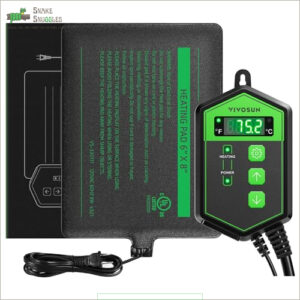
The VIVOSUN combo does a lot of the heavy lifting for you. The 6×8 inch far-infrared pad heats evenly — no hot spots, no guessing — and the digital thermostat locks temps between 40°F and 108°F with a clear LCD readout.
Setup is straightforward: peel, stick, plug in. IP67 waterproofing means the occasional water bowl spill won’t ruin your day.
One heads-up — the pad maxes out around 104°F, so it’s best for snakes and lizards, not high-heat species.
| Best For | Reptile keepers with snakes, lizards, turtles, or frogs that need steady, gentle belly heat — plus hobbyists using it for seedling trays or bread proofing boxes. |
|---|---|
| Power Draw | 8W |
| Voltage | 120V AC |
| Waterproof | Yes |
| Adhesive Backing | Yes |
| Tank Size | 10-25 gal |
| Warranty | 15 months |
| Additional Features |
|
- Even far-infrared heat means no hot spots burning your animals
- IP67 waterproofing keeps it safe from spills and humidity
- Peel-and-stick setup takes minutes — no tools, no fuss
- Tops out around 104°F, so high-heat basking species are out of luck
- The thermostat LCD can wear out if you’re adjusting temps constantly
- Adhesive is tough to remove cleanly, so plan your placement before you stick it
Safety Features Families Should Prioritize
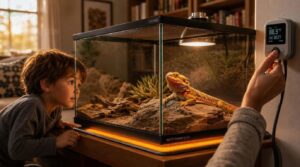
Not every heating mat is built the same — and when kids are in the picture, the difference really matters. Some features are just nice to have, but others are genuinely non-negotiable for family homes.
Here’s what to look for before you buy.
Why Overheat Protection Matters in Homes With Kids
A curious toddler and a hot heating mat — that’s a combination no parent wants.
Overheat protection is your first line of defense for Child Burn Prevention and Fire Hazard Reduction at home.
Here’s what’s actually at stake without it:
- Fingers on warm enclosure glass can cause real burns
- Electrical Shock Safety breaks down fast near spills or chewed cords
- Mats without auto shut-off can scorch substrate — and nearby skin
- No thermal fuse means no Family Risk Management backup when temps spike
- Parental Peace disappears when safety guidelines for reptile heating products are ignored
Built-in overheat protection cuts power automatically — before things go wrong.
Choosing Mats With Thermostat Compatibility
Not every heating mat plays well with every thermostat — and that mismatch can cost your reptile dearly.
Always confirm Thermostat Wattage Matching before buying; your mat’s wattage must stay within the controller’s load limit. Check Thermostat Voltage Compatibility too.
A digital thermostat with solid Thermostat Sensor Integration gives real-time readings you can actually trust.
Run Thermostat Calibration Procedures after setup — temperature accuracy matters more than most families realize.
PID‑controlled thermostats reduce cycling
Checking for UL Certification or Similar Safety Testing
A UL mark isn’t just a sticker — it’s proof someone tested that mat before it reached your kid’s bedroom.
Start your Certification Verification Process by checking for the UL Mark Identification directly on the product or packaging.
Then run a quick Online Certification Lookup at UL’s official directory.
No UL? Alternative Safety Marks like ETL work too.
Save your Documentation Retention copy — seriously, keep it.
Moisture-resistant Designs for Spills and Water Bowls
Reptiles love tipping water bowls — it happens constantly. That’s why moisture-resistant mats matter.
Look for IP67-rated, waterproof designs with moisture-sealed connections to keep electricity away from spills.
Silicone matting beneath bowls absorbs drips fast. Edge lip channels redirect water before it spreads.
Anti-slip bottom mats stop bowls from shifting. Smart bowl rim design and sealed tank surfaces make child-friendly pet care and electrical safety for reptile heating equipment much easier.
Automatic Shut-off and Thermal Fuse Protection
Water-resistance keeps spills outside the mat — but what happens when heat builds up inside? That’s where overheat sensors and automatic shut-off earn their keep.
Most quality mats cut power within seconds of detecting a fault.
A thermal fuse adds backup protection — though unlike a thermostat, there’s no thermal fuse reset. It’s one-and-done.
For families prioritizing electrical safety for reptile heating equipment, that redundancy is everything.
Safe Cord Management Around Children and Pets
Thermal fuses handle internal heat — but loose cords are a whole different hazard.
Cord Concealment Strategies matter here.
Run cords through Pet‑Proof Cable Covers or PVC raceways so there’s nothing to chew or yank.
Add Child‑Safe Outlet Covers on unused sockets.
Tuck excess length with Velcro straps.
Chew‑Resistant Materials and an accessible Emergency Power Shut‑off keep child‑friendly pet care genuinely safe — not just surface-level safe.
Using GFCI Outlets for Added Electrical Protection
Cord management addresses the physical risks — but GFCI installation basics cover what you can’t see.
These outlets detect tiny current imbalances (around 4–6 milliamps) and cut power instantly.
For child‑friendly pet care, plug every heat mat into a GFCI or AFCI/GFCI combination outlet.
Monthly GFCI testing takes ten seconds — press Test, press Reset, done.
Teach kids GFCI awareness early: it’s the button that stops shocks.
Thermostats and Temperature Control
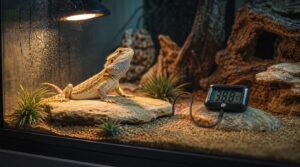
A thermostat isn’t optional — it’s the one thing standing between a safe enclosure and a dangerous one. Without it, your heat mat runs unchecked, and temperatures can climb way past what any reptile should tolerate.
Here’s what you need to know to keep things dialed in.
Why Every Reptile Heat Mat Needs a Thermostat
A heat mat without a thermostat is like a stove with no knob — it just runs hot. That’s a real problem when you’ve got kids nearby.
A heat mat without a thermostat is just a stove with no knob — and that’s dangerous when kids are nearby
A thermostat manages automatic regulation 24/7, preventing thermal runaway before it starts. It also delivers energy savings by cycling power smartly.
For choosing safe reptile heat mats for kids, redundant safety through thermostat control isn’t optional — it’s essential.
Ideal Warm-side Temperatures for Common Pet Snakes
Different snakes need different warmth — and getting it wrong stresses them out. Here’s what daytime setpoint accuracy looks like for common species:
- Ball pythons: warm side around 88–92°F
- Corn snakes: warm side in the 85–90°F range
- Leopard geckos: aim for 88–90°F
- General rule: keep the full temperature range 68°F to 108°F thermostat-ready
- Night drop: don’t let temperatures fall below 72°F
Your thermostat regulates species temperature ranges automatically — just set it right.
Maintaining a Cooler Side for Thermal Gradients
Your snake needs more than just a warm spot — it needs a cool side too. Aim for 75°F–80°F on the cold side to create a solid thermal gradient.
Place a Cool Zone Hide there, keep substrate conductivity low with tile or light sandy mix, and monitor with a calibrated thermometer.
Room Temperature Stability does most of the heavy lifting on that end.
Digital Thermostat Settings for Family-friendly Use
A good digital thermostat does more than just control temperature — it keeps curious kids from accidentally cooking your reptile. Look for Child Lock Mode, App Alerts for temperature drifts, and Multi-Zone Scheduling to manage warm and cool sides simultaneously.
Enable Nighttime Cooldown and Gradual Temperature Ramps for stress-free heat distribution uniformity. That’s child-friendly pet care and electric safety for pet equipment, handled.
Where to Place The Thermostat Probe
Probe placement makes or breaks your thermostat’s accuracy. Put it in the wrong spot and your temperature control means nothing.
- Warm Zone Positioning – Set the probe on the enclosure surface at the hotspot, 1–2 cm from glass edges.
- Hide Microclimate Check – Place a second probe inside the warm hide to monitor that burrow temperature.
- Cool End Reference – Add a probe on the cool side to confirm your thermal gradient stays stable.
Preventing Temperature Spikes and Hot Spots
Hot spots don’t just happen — they creep up when substrate insulation traps heat or your thermostat probe drifts. Run infrared scanning weekly across the full floor. Temperature logging daily catches spikes before your snake does.
Zone calibration after any substrate shift keeps readings honest. Power cycling the mat monthly helps prevent element buildup.
Solid heat mat placement and consistent temperature control stop burns before they start.
Teaching Children Not to Adjust Controls Unsupervised
Your thermostat isn’t a toy — kids need to hear that clearly. Use Visual Warning Labels near the Control Panel Locks and post Safety Cue Cards at eye level.
Build Adult‑Only Access into your house rules. Set Routine Supervision Timers as reminders.
Teaching children reptile safety and care early makes child‑friendly pet care second nature — and keeps electric safety for pet equipment actually safe.
Installation and Placement Guidelines
Getting the placement right makes a bigger difference than most people expect. A heating mat in the wrong spot can mean cold reptiles, hot spots, or worse — a safety hazard in a home with curious kids.
Here’s what you need to know before you plug anything in.
Check the full reptile heat lamp guide for college dorms to make sure your fixture, wattage, and setup are actually safe before your first use.
A digital thermostat paired with an under tank heater built for hatchlings lets you fine-tune warmth precisely, since even a few degrees off can stress a young snake.
Installing Heat Mats Under The Enclosure Safely

Slip the mat under the enclosure — exterior bottom, warm side only. Good mounting adhesive selection matters here: 3M heat-resistant tape keeps it from shifting.
Leave a small air gap between the mat and tank floor to avoid heat buildup. Keep substrate shallow on that side for better substrate conductivity.
Plug everything into a GFCI outlet and run thermostat calibration steps before your reptile moves in.
Covering Heat Sources to Prevent Direct Contact
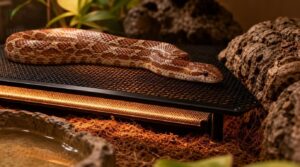
Even with the mat secured underneath, your snake can still find ways to press against warm surfaces. That’s where non-conductive covers and heat guard mesh come in — they block direct contact without trapping heat.
For burn prevention, an insulating sheet of at least 1.5mm thickness works well. Reflective shield layers also help keep surface temps from spiking against your reptile’s skin.
Using Ceramic Tile for Even Heat Distribution
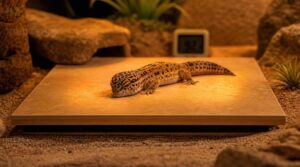
A ceramic tile over your heat mat is a quiet significant improvement. Its thermal conductivity — generally 1.0 to 3.0 W/mK — pulls heat up evenly, smoothing out spikes before they reach your reptile.
Three things to get right:
- Tile thickness — ½ inch porcelain works best
- Grout line integrity — cracks disrupt even heat distribution
- Tile color — lighter shades prevent localized overheating
Avoiding Excessive Substrate Depth on The Warm Side
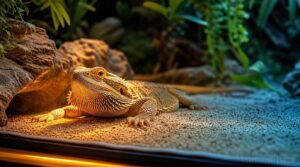
Too much substrate on the warm side acts like a blanket — smothering the heat mat and throwing off your thermal gradient. Keep substrate depth under half an inch, using shallow substrate guidelines.
Flat, compacted materials work best for substrate material choice.
Layering heat barriers like reptile carpet prevents substrate insulation effects.
Your thermostat can’t fix what’s buried — so depth measurement techniques actually matter here.
Leaving Airflow Gaps to Reduce Overheating Risk
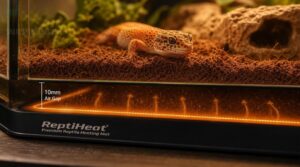
Think of the space beneath your heat mat like a tiny highway — air needs room to move. Gap Size Guidelines suggest 5–15 mm works best for steady Convection Cooling Benefits without creating drafts.
- Follow an Airflow Path Design from cool to warm zones
- Check Substrate Compatibility — lightweight coco fiber keeps gaps clear
- Apply a smart Vent Placement Strategy near mesh panels
That small gap? It’s doing serious work.
Securing Mats Properly to Glass or Acrylic Tanks
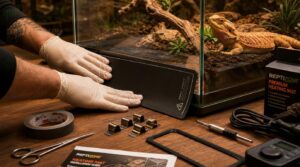
Securing your heat mat starts with smart adhesive selection — 3M adhesive works reliably on both glass and acrylic without warping. Use stainless steel clip mounting techniques along tank edges for extra hold.
Keep mounting plate alignment flat — no folds, no bubbles. An anti-slip gasket used between mat and surface prevents shifting. Always respect edge seal integrity, staying clear of silicone seams.
Placement Mistakes Families Should Avoid
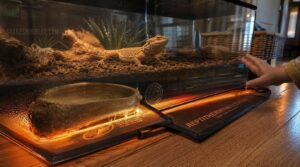
Small placement mistakes can turn a safe setup sideways fast. Direct glass contact concentrates heat dangerously — always use an adequate barrier underneath.
Never position overlapping water bowl placement near the mat. multiple zone mats without a thermostat. Incorrect mat orientation breaks your thermal gradient.
proper heat mat installation and placement guidelines — your reptile and your kids will thank you.
Maintenance and Kid-Safe Care Habits

Once the mat is installed, the real work is keeping it safe long-term — especially with kids in the picture. A little routine care goes a long way toward preventing problems before they start.
Here’s what every family should know.
Monthly Inspections for Cords, Discoloration, and Damage
Once a month, give your heat mat a proper once-over — it takes five minutes and catches problems before they become emergencies.
- Cord Cracks Detection: Flex the cord gently near the mat connection; hidden breaks show up fast.
- Discoloration Trend Logging & Surface Damage Mapping: Photograph any yellowing or bubbling and date it.
- Infrared Hotspot Scanning: Use an IR thermometer to flag uneven heat across the surface.
Good Inspection Record Keeping keeps your setup reliable — and your family safe.
Cleaning Reptile Heating Mats Safely
Cleaning your heat mat doesn’t need to be complicated. Unplug it, let it cool — then wipe it down with a damp microfiber cloth. Never spray liquids directly; mist the cloth instead.
Skip bleach or harsh cleaners. Drying before power-on is non‑negotiable — moisture and electricity don’t mix. Run a quick post‑clean heat test before your reptile goes back in.
When to Replace an Old Heating Mat
Even a well-maintained mat has a lifespan. Most heat mats last 3–5 years — but age-related wear starts showing sooner.
Watch for these replacement timing signals:
- Heat output loss below 70% of original rating
- Energy consumption rise without matching warmth
- Component degradation like loose connectors or delayed thermostat response
Don’t wait for a failure. Replace proactively — your reptile’s safety depends on it.
Warning Signs of Uneven Heating or Scorching
Replacing a worn mat is step one — but catching problems early keeps things safer day-to-day.
Uneven Heat Patterns are a red flag: if one spot hits above 95°F while nearby areas stay cool, your heat distribution is off.
Watch for Scorching Skin Signs — redness or blistering on your snake’s belly.
Burn Mark Evidence on substrate, Thermal Probe Errors, and Temperature Gradient Gaps all signal immediate action.
Creating a Family Reptile Care Checklist
A simple simple checklist keeps everyone on the same page. Track appetite and shedding weekly in a Health Observation Log — it catches problems fast.
Pin your Emergency Contact List nearby. Set clear Child Safety Rules around cords and controls.
Note feeding dates for Nutrition Tracking, and schedule monthly Enclosure Enrichment checks.
Small habits, big payoff.
Teaching Children Safe Handling Around Enclosures
Your checklist sets the foundation — now build on it with hands-on habits. Before kids get near the enclosure, walk through the rules out loud.
Rule Reinforcement works best when it’s consistent, not occasional. Supervision Techniques like sitting on the floor together reduce fall risks.
Teach Gentle Touch early, and show kids how Stress Signal Recognition — like hissing or retreating — means hands off. Have an Emergency Response Plan ready.
Energy-efficient Use Without Compromising Reptile Health
Running a heat mat around the clock isn’t necessary — or efficient. Use a thermostat to hold warm-side temps steady at 88–92°F, and pair it with Smart Timer Integration to cycle heat during active periods only.
Low-Wattage Elements with proper Insulation Optimization keep costs down. That’s Thermal Zoning done right: reptile health protected, energy waste cut, and child‑friendly pet care made simple.
Frequently Asked Questions (FAQs)
Can heating mats work inside the enclosure walls?
Yes, they can.
Mount the mat along an interior wall to improve your thermal gradient. Use a barrier material and moisture seal to protect against contact and spills. Always pair with a thermostat.
Which reptile species benefit most from belly heat?
Bearded dragons, leopard geckos, corn snakes, ball pythons, and box turtles benefit most. Belly heat aids digestion, metabolism, and thermal gradient needs — core to solid snake and reptile husbandry.
How long should a heating mat run daily?
Aim for 8–12 hours daily. Use a thermostat for temperature control — it cycles the mat automatically. In winter, run closer to 12 hours; in summer, 8 is usually plenty.
Do heating mats raise room temperature noticeably?
Think your little heat mat is warming the whole room? Hardly. Most mats pull just 4–12 watts — creating a cozy microclimate effect, not noticeable room temperature drift.
Are heating mats safe during extended family vacations?
Most heating mats run safely for days unattended — if paired with a reliable thermostat.
Before leaving, check your temperature log, confirm power reliability, and consider remote monitoring, so nothing surprises you mid-trip.
Conclusion
Looks like your family is in it for the long haul—no cold feet here. Choosing the right reptile heating mats for kids and families isn’t just about keeping a snake warm.
It’s about keeping everyone safe, confident, and actually enjoying the experience.
Stick with mats that have overheat protection, pair them with a reliable thermostat, and do those monthly cord checks.
Your kid’s new best slithery friend—and your peace of mind—depends on it.