This site is supported by our readers. We may earn a commission, at no cost to you, if you purchase through links.

Most heat-related snake deaths do not come from a faulty mat—they result from incorrect placement. Positioning the mat too far under the center, against a side wall, or buried under substrate disrupts thermostat functionality, endangering the animal.
The physics of belly heat are unforgiving: snakes thermoregulate by moving across a temperature gradient, not by remaining in a static warm zone. Proper setup demands strategic placement to enable this natural behavior.
Achieving correct placement requires understanding three critical factors: where the mat should be located, the appropriate size for the enclosure, and how to establish a stable, usable gradient.
Table Of Contents
- Key Takeaways
- Place Heat Mats Under One End
- Choose The Right Mat Size
- Install The Heat Mat Safely
- Set Up Thermostat Control
- Place Hide and Substrate Correctly
- Frequently Asked Questions (FAQs)
- Where does a heat mat go in a vivarium?
- Can you leave a heat mat on 24/7?
- Does a heat mat go inside the tank?
- Can heat mats be used in wooden enclosures?
- How often should heat mats be replaced?
- Are heat mats safe for all snake species?
- What happens if the heat mat gets wet?
- Can two heat mats run in the same tank?
- Conclusion
Key Takeaways
- Place the heat mat under the outside edge of the glass at one end only — this creates the warm-to-cool gradient your snake needs to self-regulate.
- Keep mat coverage between 25–30% of the enclosure floor. Juveniles need even less, around 10–15%, to avoid overheating their smaller bodies.
- Never run a heat mat without a thermostat — its the only thing standing between a stable setup and a burned snake or a fire hazard.
- Set substrate depth at a maximum of two inches and position your warm hide directly above the mat, with the cool hide at the opposite end, to make the gradient actually usable.
Place Heat Mats Under One End
Placement is everything with heat mats — get it wrong, and your snake loses the temperature gradient it depends on. There are a few key rules that separate a safe setup from a risky one.
Getting the placement right also depends on your overall tank design — a bioactive corn snake setup guide can help you plan where the mat fits without disrupting your substrate layers.
Here’s what you need to know before you stick anything down.
Underside of Glass Tank

Heat mats belong on the underside of glass — always. Glass conducts heat efficiently, and the silicone sealing along the base holds up well under sustained low heat.
Follow these placement basics:
- Stick the mat directly to the exterior glass bottom
- Confirm glass thickness (6–10 mm) before applying
- Use protective padding beneath the tank
- Never bypass the reinforcing frame area
That foundation keeps your setup safe.
Warm Side Placement
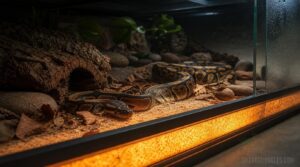
Once the mat’s under the glass, placement angle matters. Push it toward one end, that’s your warm side—the foundation of your thermal gradient. Your snake needs a clear basking spot orientation, so the heat distribution pattern runs from warm to cool in a straight line, not scattered.
Good heat mat placement guidelines mean temperature mapping becomes simple: warm zone on one end, escape route on the other.
Never Inside Enclosure
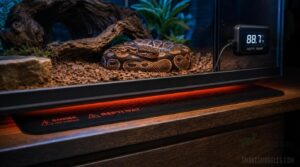
Never place the mat inside the enclosure—full stop. Moisture protection and electrical safety aren’t negotiable: humidity inside the tank corrodes heating elements quickly.
Snake injury prevention is critical: a snake pressed against an internal heat source can burn before you notice anything’s wrong.
External placement keeps temperatures stable, maintenance convenient, and your setup following every heat mat placement guideline that matters.
Avoid Side-wall Mounting
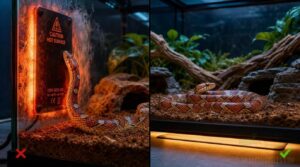
Side-wall mounting creates Edge Heat Buildup—heat gets trapped between the pad and glass, pushing surface temperatures well past safe limits. This poses a direct heat mat overheating risk and a real burn risk for snakes pressed against the wall. It also causes Cord Abrasion Risk where the cable contacts the glass edge.
Uniform Base Heating and Airflow Preservation only occur with proper safe placement of heating equipment flat underneath. Heat-shielding walls cannot replace a solid heat source placement at the floor.
Leave Cool Side Open

The cool side must remain clear — no hide, dense substrate, or bulky decor should obstruct it. This open space functions as your Ventilation Pathway, enabling fresh air circulation and supporting Airflow Management. Blocking this pathway risks collapsing the thermal gradient.
Without proper airflow, the thermal gradient collapses, undermining the enclosure’s temperature regulation. Maintain the Ventilation Pathway to ensure consistent heat distribution and prevent stagnation.
Implement Temperature Gradient Monitoring using a digital thermometer on the cool side. Verify it remains cooler than the warm side to Prevent Heat Buildup and validate gradient stability.
Choose The Right Mat Size

Mat size isn’t one-size-fits-all — get it wrong and you’ll either cook your snake or leave it without enough warmth to digest properly. The goal is matching the pad to both the tank’s dimensions and the snake’s life stage.
Pairing your mat with the right controls makes all the difference — this guide to snake cage heat sources and thermostats walks you through exactly what to use at each stage.
Here’s what to keep in mind before you buy.
Cover 25–30% Maximum
Your heat mat should cover no more than 25–30% of the enclosure floor — that’s your Heat Distribution Ratio target. Exceeding this range compromises the gradient calculation essential for proper thermoregulation.
To calculate this, use basic area estimation: multiply the enclosure’s length by its width, then take 25–30% of the result. This method ensures accurate heat distribution alignment with safety standards.
Adhering to this percentage is not optional — it forms the core of heat mat safety and serves as your primary defense against burns.
Juvenile Tanks Need Less
Young snakes have sensitive thermoregulation — their small bodies heat up fast and can’t escape a poorly managed thermal gradient. For early growth needs, keep your heat mat under tank coverage to just 10–15% of the floor.
Lower wattage pads provide gradual heat without hot spots, supporting heat mat safety, heat mat thermostat integration, and offering real energy savings as your juvenile grows.
Match Tank Dimensions
Every mat needs a tank that fits it properly — not the other way around. Measure your interior floor area before buying anything.
- Floor area calculation: multiply interior length by width in inches.
- Footprint percentage: target 25–30% of that total.
- Length excess: your tank should extend at least 6 cm longer than the mat.
- Width buffer: keep 2 cm of clearance on each mat edge.
Tight margins cause overheating. Proper clearance margins protect your glass tank’s heat retention and simplify heat mat thermostat integration.
Example for 36-inch Tanks
A 36-inch tank makes the math easy. Target 9 to 11 inches of mat length — that’s your 25–30% sweet spot for heat distribution testing, avoiding excessive floor heating.
Match the mat width to your tank’s interior width and integrate it with a thermostat for energy efficiency. This setup ensures precise control over heat distribution.
By aligning these elements, the system manages seasonal adjustments without guesswork, maintaining optimal performance year-round.
Avoid Full-floor Heating
Covering the entire floor kills the thermal gradient — and that undermines the whole point. Your snake needs a warm zone and cool retreat to self-regulate.
Full-floor substrate heating shortens mat lifespan, strains energy efficiency, and turns temperature logging into guesswork. Keep the heat mat inside the cage footprint to 30% max. That boundary is non-negotiable.
Install The Heat Mat Safely
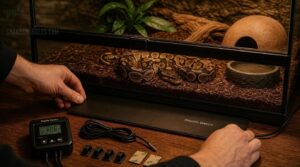
Getting the mat down correctly takes maybe ten minutes — but skipping any step can cause problems that are hard to fix later. There’s a right order to this, and it matters.
Here’s how to install it safely from start to finish.
Clean Glass Before Attaching
Proper surface preparation is critical for successful adhesion. Begin by wiping the bonding area with isopropyl alcohol and lint-free wipes, avoiding ammonia-based cleaners—these leave residue that weakens adhesive bonds.
Fingerprint removal is more critical than many realize; invisible skin oils can sabotage adhesion. After cleaning, allow the surface to dry completely, waiting at least five minutes. Don’t rush this step to ensure optimal results.
Apply Adhesive Pad Flat
Once the glass is clean and dry, you’re ready to lay down the heat mat — and flatness matters more than you’d think. Edge lifting prevention starts here.
- Peel the backing slowly for full adhesive tack activation
- Run your palm across it firmly for 10–20 seconds
- Do a pad flatness check — press every corner down
- Smooth surfaces need no primer; rough ones do
Bond longevity depends on zero air pockets.
Add Tank Feet for Airflow
Once the mat is flat and bonded, attach the plastic feet—those tiny bumpers included in most kits. Foot material choice matters: use rubber or silicone only, never metal. Follow feet size guidelines: 8–12 mm for smaller mats and 15–20 mm for larger ones. This airflow enhancement creates a 3–6 mm gap, ensuring steady airflow underneath and minimizing hot spots.
Placement best practices require one foot per corner, pressed firmly. Make it part of your maintenance routine: check monthly to ensure the heat mat under glass stays elevated and feet haven’t worn down flat.
Check Cord Exit Space
With the feet in place, turn your attention to cord routing. The power cord needs a clean exit path — no tight bends, no substrate piled on top. Slide a protective sleeve over the cord where it leaves the enclosure rim. This combats moisture and abrasion in one move.
Keep the exit clearance unobstructed, run the cord above substrate level, and route it straight to the plug socket.
Regular weekly inspections catch wear early.
Inspect Adhesion Regularly
Check adhesion every week — it only takes a minute. Run your fingers along the perimeter and press down any edge lifting or air bubbles immediately.
Inspect for adhesive pad wear each time: thinning or peeling means it’s time to replace.
Surface cleanliness matters too — oils and dust kill adhesive durability fast.
Catch problems early, and your heat pad adhesion stays rock solid.
Set Up Thermostat Control
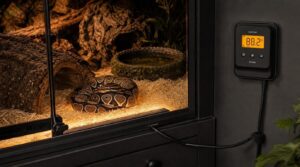
A heat mat without a thermostat is just a fire hazard waiting to happen. Getting this part right means your snake stays comfortable — and your enclosure stays safe.
A heat mat without a thermostat is a fire hazard waiting to happen
Here’s exactly how to set up thermostat control the right way.
Always Use a Thermostat
Running a heat mat without a thermostat is like leaving your stove on with no timer — something will eventually go wrong.
A thermostat provides digital monitoring, automatic cycling, and a built-in safety cutoff that disconnects power before temperatures spike dangerously. It also delivers real energy savings.
Build in thermostat redundancy and maintain a regular calibration routine — your snake’s safety depends on it.
Probe Above Heat Mat
Where you place the thermostat probe determines everything about reading accuracy. For safe thermostat probe placement, position it directly on the substrate surface above the heat mat — never buried under thick bedding. Proper probe mounting, combined with smart cable management, keeps your readings honest.
- Secure probe above mat surface
- Fix cable away from foot traffic
- Use calibration method weekly
- Cross-check with independent thermometer
- Address fluctuation troubleshooting by removing insulating substrate
Keep Probe Near Surface
Depth matters more than most keepers realize. Keep your probe tip just below the substrate surface — a few millimeters at most — for accurate Surface Probe Calibration and Thermal Inertia Reduction. Burying it deeper creates lag, masking real surface swings.
With heat mats and undertank heaters, Microclimate Monitoring depends on Probe Contact Integrity. Proper thermal probe placement ensures your thermostat reacts to what your snake actually feels.
Verify With Digital Thermometer
Your thermostat is only as trustworthy as your last Calibration Routine. Don’t assume it’s right — confirm it with a Reference Thermometer and solid digital thermometer accuracy.
- Set your digital thermometer probe just above the heat mat surface.
- Run Weekly Validation checks after any adjustments.
- Use Hotspot Mapping — record readings across the warm zone.
- Stay within a 0.5–1.0°C Temperature Tolerance between sensors.
- Log results to catch thermal probe placement drift early.
Aim for a reading in the species-appropriate range — a thermostat paired with a reptile heat mat makes hitting those precise targets much easier and safer.
Program Nighttime Temperature Drops
Snakes aren’t active under the same conditions around the clock — their bodies expect a drop. Use a dual day/night thermostat for drop scheduling, programming nighttime temperature drops of 5–10°F below your daytime setpoint.
Setpoint programming keeps thermal gradient stability intact without manual adjustments. Factor in insulation impact and make seasonal adjustments as room temps shift.
Temperature monitoring confirms the heat mat holds its target through the night.
Place Hide and Substrate Correctly

Getting the hide placement and substrate depth right pulls everything else together. Done well, your snake will actually use the temperature gradient you’ve worked hard to create.
Here’s what to set up before you consider the enclosure ready.
Warm Hide Over Mat
Your warm hide goes directly above the heat mat — that’s non-negotiable for proper heat transfer and a stable thermal gradient. Position the opening toward the warm side so your snake can access it without effort — call it snout access by design.
Material selection matters too; choose hides that won’t warp under sustained contact.
Keep a ventilation gap at the hide edges, and build an inspection routine to catch any degradation early.
Proper thermostat probe placement ensures precise temperature control.
Cool Hide Opposite Side
The cool hide must be placed on the opposite end of the heat mat—no exceptions. This positioning establishes a critical temperature gradient, enabling your snake to self-regulate body temperature without risking overheating. A gradient is ineffective if both hides retain warmth.
To maintain a stable thermal gradient on the cool side:
- Place the cool hide directly opposite the heat pad installation zone.
- Maintain a 5–10°F differential for effective behavioral thermoregulation.
- Eliminate drafts—gaps can rapidly elevate cool-side temperatures.
- Balance humidity control without saturating the substrate.
Maximum Two-inch Substrate
Keep substrate depth at two inches max. Exceeding this depth compromises thermal conductivity — the heat mat inside cage setups can’t push warmth through thick bedding efficiently, and the mat itself risks overheating.
For material selection, coconut coir hits the sweet spot: moisture balance, burrowing depth for natural behavior, and maintenance simplicity. It won’t compact, dries quickly, and helps maintain a consistent temperature gradient.
Prevent Direct Mat Contact
Your substrate acts as the first line of defense — but it’s not enough on its own. Add an insulation tape layer or barrier shield between the mat and glass to block direct exposure. Never let your snake reach the mat edge guard or the mat’s edge directly.
- Use a raised platform or ceramic tile over the heated zone
- Inspect the mat edge guard and mesh guard monthly for wear
- Never trim the mat — cut edges compromise heat pad safety
Monitor Warm and Cool Zones
Two thermometers — one on the warm side, one on the cool side — give you real data, not guesswork. Log readings daily to catch zone temperature drift before it becomes a problem.
Temperature probe accuracy matters: keep probes away from light sources and reflective walls.
Heat gradient stability depends on cool zone accessibility too, so confirm your snake can always reach both ends freely.
Frequently Asked Questions (FAQs)
Where does a heat mat go in a vivarium?
A heat mat belongs on the outside underside of one end of the glass tank — never inside.
This placement creates a stable thermal gradient, giving your snake a clear temperature differential to move between.
Can you leave a heat mat on 24/7?
Yes — but only with a thermostat. Continuous operation without one risks overheating and burns.
Use a thermostat with heat mats, enable overheat protection, and maintain consistent monitoring to ensure a reliable heat source safety.
Does a heat mat go inside the tank?
No, never inside. Placing it beneath the glass protects against snake burns, extends mat lifespan, and ensures temperature consistency — keeping heat pocket placement safe without risking power cord protection issues.
Can heat mats be used in wooden enclosures?
You can use a heat mat in a wooden enclosure — but only with a thermostat and a nonporous barrier material between the mat and bare wood.
This setup helps manage fire risk and prevent scorching.
How often should heat mats be replaced?
Most mats last 3–5 years, but your replacement timeline should follow wear indicators — not the calendar. Frayed cords, temperature instability, or performance degradation signal the need for replacement.
Monthly safety inspections catch problems before you pay for them.
Are heat mats safe for all snake species?
Heat mats work well for most snakes, but species sensitivity matters. Desert species, juveniles, and fossorial snakes require careful attention to mat sizing and regular temperature checks.
Always prioritize species-specific heating over a one-size-fits-all approach to ensure safety and well-being.
What happens if the heat mat gets wet?
Water and electricity don’t mix — and a wet heat mat risks electrical shock, short‑circuit fire, corrosion damage, temperature drift, and reduced lifespan. Unplug it immediately and inspect before reuse.
Can two heat mats run in the same tank?
Yes, but it is rarely necessary. If you do, run each mat on its own thermostat and outlet.
Dual-thermostat syncing and electrical load management prevent overheating risk and maintain gradient uniformity across both zones.
Conclusion
Think of yourself as an old-time apothecary—measuring placement like a precise compound, not eyeballing it. Knowing where to place a heat mat in a snake enclosure isn’t guesswork; it’s a system. Precise placement ensures the setup functions reliably.
One end should have 25–30% coverage, paired with a reliable thermostat and no more than two inches of substrate. Getting these variables right allows your snake to behave as nature intended—moving across a gradient to regulate its own temperature and thrive. Nailing the setup once means the enclosure effectively runs itself.