This site is supported by our readers. We may earn a commission, at no cost to you, if you purchase through links.
A bearded dragon can bask under the wrong light for months—appearing healthy, eating well, behaving normally—while quietly developing metabolic bone disease from the inside out. By the time the tremors start or the jaw softens, the damage is already done.
UVB isn’t optional for desert reptiles. It’s the biological trigger that converts skin precursors into vitamin D3, which drives calcium metabolism. Without the right wavelengths at the right intensity, your animal’s skeleton literally begins to fail.
Choosing reptile UVB lights for desert habitats is harder than it should be. Not every product on the market actually delivers what the label promises—and some of the most popular options fall dangerously short of what species like uromastyx and bearded dragons actually need. The following guide breaks down exactly what to look for, what to avoid, and which products hold up under scrutiny.
Table Of Contents
- Key Takeaways
- Top 10 Desert Reptile UVB Lights
- 1. Zilla Reptile UVB Fluorescent T8 Light Bulb
- 2. T5 UVB Reptile Light Fixture Kit
- 3. Jugbuy UVB 10.0 Reptile Bulbs
- 4. Zoo Med Desert UVB Heat Lighting Kit
- 5. GeeKoit High Intensity UVB LED
- 6. Lucky Herp Desert Reptile UVB Bulb
- 7. UVB Light for Bearded Dragons and Reptiles
- 8. ReptiZoo T5HO UVB Lighting Kit
- 9. T5 UVB Reptile Light Fixture Combo Kit
- 10. GeeKoit UVB Reptile Light for Bearded Dragons
- Desert Reptile UVB Requirements
- Best UVB Bulb Types
- Safe Enclosure Light Setup
- UVB Maintenance and Buying Tips
- Frequently Asked Questions (FAQs)
- Are bearded dragons more of a desert UVB or tropical UVB?
- Do desert tortoises need UVB light?
- Can too much UVB exposure harm my reptile?
- Does UVB affect appetite or activity levels?
- Can reptiles get vitamin D3 from food alone?
- Why does my reptile bask more in winter?
- Do glass enclosures need different UVB setups?
- Conclusion
Key Takeaways
- UVB exposure drives vitamin D3 synthesis and calcium metabolism, so insufficient UVB silently causes metabolic bone disease even in reptiles that look and act healthy.
- Bearded dragons need a UVI of 3.0–6.0 while uromastyx and chuckwallas require 4.0–7.0, so matching bulb output to your species’ specific Ferguson Zone is critical rather than relying on generic "reptile UVB" labeling.
- UVB output degrades invisibly long before bulbs stop glowing, so you should replace T5HO tubes every 12 months, mercury vapor bulbs every 8–10 months, and verify actual irradiance with a Solarmeter rather than trusting the bulb’s appearance or the box’s claims.
- Bulb placement and barriers dramatically affect dosing, since halving basking distance roughly doubles UVI, glass can block up to 90% of UVB, and mesh tops still require tighter mounting distances of 8–12 inches.
Top 10 Desert Reptile UVB Lights
Picking the right UVB bulb can feel overwhelming with so many brands claiming to be the best. I’ve narrowed the field down to ten options that actually meet desert species’ demanding UVI requirements. Here’s what you need to know about each one before you buy.
Before diving into specific brands, it’s worth understanding why proper UVB exposure matters so much for your reptile’s long-term health, since that context shapes which features actually matter in a bulb.
1. Zilla Reptile UVB Fluorescent T8 Light Bulb
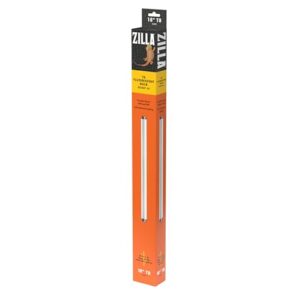
This 15-watt T8 bulb delivers 50 microwatts per square centimeter of UVB, putting it squarely in range for bearded dragons and Uromastyx. It pairs full-spectrum UVA and UVB for natural color enhancement and promotes calcium metabolism critical to bone health.
Built specifically for Zilla T8 strip fixtures, it’s a reliable budget pick. Just remember: T8 output drops fast with distance, so position basking zones carefully and replace every 12 months.
| Best For | This bulb is best for owners of desert-dwelling reptiles like bearded dragons and Uromastyx who need a reliable UVB source paired with a Zilla T8 strip fixture. |
|---|---|
| UVB Output | 50 mW/cm2 |
| Bulb/Lamp Type | T8 Fluorescent |
| Base/Mount Type | T8 Fixture Mount |
| Target Species | Bearded Dragons, Uromastyx |
| Replacement Interval | 6-12 months |
| Health Benefit | Calcium Metabolism |
| Additional Features |
|
- Delivers full-spectrum UVA and UVB to support calcium metabolism, bone health, and natural color enhancement
- Compact and lightweight design fits easily into standard T8 fixtures
- Helps maintain healthy day/night cycles in terrariums for desert species
- Needs replacement every 6 to 12 months, even if it still appears to light up normally
- UVB intensity drops off quickly with distance, so basking areas must be positioned carefully
- May not provide enough coverage for larger enclosures without additional lighting
2. T5 UVB Reptile Light Fixture Kit
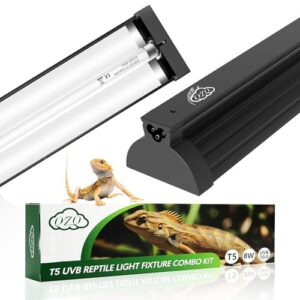
If you want gold-standard intensity, step up to a T5 HO fixture kit. These include a built-in ballast for stable, flicker-free output—a real upgrade from basic strip lights.
The included aluminum reflector boosts UVB reach greatly, while curved hood designs concentrate light directly over the basking zone. Mount it externally over mesh, 12–18 inches from your basking spot.
Tubes run 6–12 months before replacement. For desert species needing real intensity, this kit earns its place.
| Best For | This T5 HO fixture kit is best for owners of desert species like bearded dragons and uromastyx that need high-intensity, gold-standard UVB output for proper calcium absorption and Vitamin D3 synthesis. |
|---|---|
| UVB Output | 10.0 rating |
| Bulb/Lamp Type | T5 HO Fluorescent |
| Base/Mount Type | Mesh/Vivarium Mount |
| Target Species | Bearded Dragons, Tortoises |
| Replacement Interval | Not specified |
| Health Benefit | Calcium Absorption |
| Additional Features |
|
- Built-in ballast delivers stable, flicker-free output compared to basic strip lights
- Aluminum reflector and curved hood design concentrate UVB directly over the basking zone
- External mesh mounting makes setup straightforward for most vivarium styles
- Tubes need replacing every 6–12 months, adding ongoing maintenance costs
- Requires precise mounting distance (12–18 inches) to avoid under- or over-exposure
- Larger and more complex setup than basic strip lighting, which may not suit smaller enclosures
3. Jugbuy UVB 10.0 Reptile Bulbs
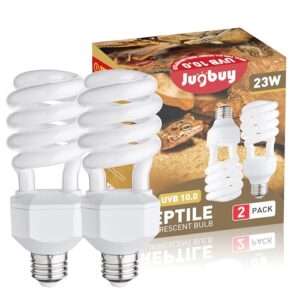
Compact fluorescent bulbs like this one offer a practical middle ground. The Jugbuy UVB 10.0 delivers 10% UVB and 30% UVA output through a 23W E26 screw-in design — no ballast required.
Keep it 12 inches from the basking surface. Beyond that distance, UVB drops sharply.
- Compatible with standard clamp lamps
- Quartz glass reduces UV loss
- Replace every 6–12 months regardless of visible output
For small to medium desert enclosures, it’s a straightforward, budget-conscious option.
| Best For | This bulb is best for owners of desert-dwelling reptiles like bearded dragons, tortoises, iguanas, and geckos who need reliable UVB output for calcium metabolism without a major investment in lighting equipment. |
|---|---|
| UVB Output | 10% UVB |
| Bulb/Lamp Type | CFL Spiral |
| Base/Mount Type | E26 Base |
| Target Species | Bearded Dragons, Geckos |
| Replacement Interval | Per usage life |
| Health Benefit | Calcium Metabolism |
| Additional Features |
|
- Delivers solid 10% UVB and 30% UVA output with zero harmful UVC
- Energy-efficient, with up to 80% savings and a lifespan of up to 10,000 hours
- No ballast required, fitting standard E26 clamp lamps for easy setup
- Must be kept within 12 inches of pets, or UVB output drops off quickly
- Heat output may be too much for very small enclosures
- Larger physical size might not fit certain standard lamp holders
4. Zoo Med Desert UVB Heat Lighting Kit
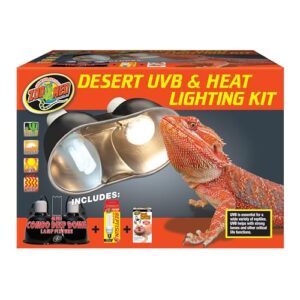
If you want everything in one box, the Zoo Med Desert UVB Heat Lighting Kit pairs a 75-watt basking bulb with a 13-watt UVB compact fluorescent rated at 10.0 intensity—solid for bearded dragons and other desert baskers. The Mini Combo Deep Dome runs dual switches, so you control heat and UVB independently.
Replace the UVB bulb every 6–12 months, even if it still glows. Phosphor coatings degrade quietly. Skip it for crested geckos; the heat output runs too hot for their needs.
Pair UVB use with snake habitat lighting requirements to maintain a consistent day-night cycle without nighttime light.
| Best For | This kit is best for desert-dwelling reptiles like bearded dragons and turtles that need strong basking heat alongside reliable UVB exposure. |
|---|---|
| UVB Output | 10.0 rating |
| Bulb/Lamp Type | CFL Mini Combo |
| Base/Mount Type | Ceramic Socket Dome |
| Target Species | Bearded Dragons, Turtles |
| Replacement Interval | Not specified |
| Health Benefit | Calcium/Shell Health |
| Additional Features |
|
- Dual on/off switches let you control the basking and UVB bulbs independently
- Double reflector design boosts heat and light output by 35% for efficient basking
- All-in-one kit pairs a 75W basking bulb with a 10.0 UVB CFL, covering both heat and lighting needs
- Some users have reported bulbs burning out early or fixture wiring problems
- Not suitable for crested geckos since the heat output is too intense for them
- Fragile bulbs can occasionally arrive damaged due to packaging issues
5. GeeKoit High Intensity UVB LED
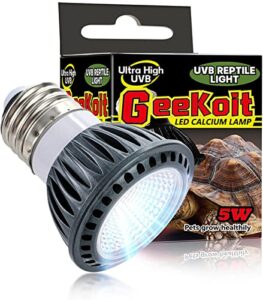
LED technology is finally catching up to fluorescent in the desert reptile world, and GeeKoit’s array proves it. Output sits at 1.0–2.5 mW/cm² from 12–18 inches—right in range for bearded dragons—with peak emission at 311–313 nm.
Positioning the fixture at the right distance matters just as much as wattage, so check out this guide to UVB lighting systems for desert reptiles before mapping out your enclosure’s basking and shade zones.
The integrated heatsink keeps output stable over a 6–12 month window, and the IP-rated seal resists humidity. Expect 8–15 watts of draw. Replace every 12–18 months, and verify irradiance with a Solarmeter before trusting it blind.
| Best For | This bulb is best for owners of desert-dwelling reptiles like bearded dragons and tortoises who need strong, stable UVB output without adding extra heat to the enclosure. |
|---|---|
| UVB Output | 10.0 rating |
| Bulb/Lamp Type | LED |
| Base/Mount Type | E26 Base |
| Target Species | Bearded Dragons, Tortoises |
| Replacement Interval | Longer than CFL |
| Health Benefit | Calcium Metabolism |
| Additional Features |
|
- High 10.0 UVB intensity that closely replicates natural desert sun exposure
- LED design lasts longer and decays slower than traditional CFL bulbs
- Low heat output reduces the risk of accidentally overheating your reptile
- Not appropriate for leopard geckos or other species with lower UVB needs
- Dim visible light at only 5 watts means you’ll likely need a separate light source
- UVB strength drops off quickly with distance, so careful placement is essential
6. Lucky Herp Desert Reptile UVB Bulb
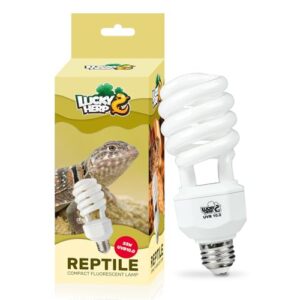
At 23 watts with 10% UVB output, the Lucky Herp CFL covers bearded dragons and similar desert species reasonably well. Its standard E26 screw base fits most dome fixtures, keeping setup simple.
The 30% UVA output promotes appetite and natural behavior — though it produces no heat, so pair it with a dedicated basking lamp. Replace every 8–12 months, even if it’s still glowing. Phosphor coatings degrade invisibly, and a Solarmeter 6.5 will confirm whether actual UVI still meets your animal’s needs.
| Best For | This bulb is best suited for owners of desert-dwelling reptiles like bearded dragons, tortoises, and iguanas who need reliable UVB output to support their pet’s vitamin D3 synthesis and overall health. |
|---|---|
| UVB Output | 10.0 rating |
| Bulb/Lamp Type | CFL |
| Base/Mount Type | E26 Base |
| Target Species | Bearded Dragons, Iguanas |
| Replacement Interval | 6-12 months |
| Health Benefit | Vitamin D3 Synthesis |
| Additional Features |
|
- High CRI of 90% renders colors realistically, making it easier to observe your reptile’s natural appearance and behavior
- Low degradation technology helps maintain stable UVA/UVB output over the bulb’s lifespan
- Standard E26 base and compact CFL design make it easy to install in most existing dome fixtures
- Produces no heat, so a separate basking lamp is required to complete your reptile’s lighting setup
- Needs replacing every 6–12 months to ensure UVB output stays effective, even if the bulb still appears to work
- Only compatible with 120V systems, which limits use outside standard North American electrical setups
7. UVB Light for Bearded Dragons and Reptiles
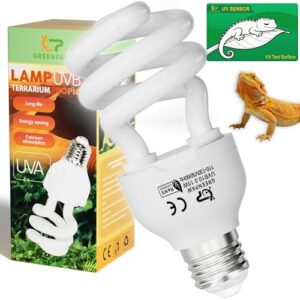
Generic options sold simply as "UVB Light for Bearded Dragons" deliver 4-6% UVB at close range, paired with 30-40 watts of heat. Basking distance matters more than wattage: keep dragons 20-30 cm from the lamp for accurate dosing.
These bulbs support appetite, exploration, and calcium metabolism, but output varies between brands. Verify actual UVI with a Solarmeter before trusting the label. Don’t assume "bearded dragon" branding guarantees proper desert-strength radiation.
| Best For | This light is best for owners of bearded dragons, tortoises, iguanas, and other desert reptiles who want a high-output UVB/UVA bulb to support healthy bone growth, calcium metabolism, and natural behavior in their terrarium. |
|---|---|
| UVB Output | 10.0 intensity |
| Bulb/Lamp Type | CFL Spiral |
| Base/Mount Type | E26 Base |
| Target Species | Bearded Dragons, Tortoises |
| Replacement Interval | 6-12 months |
| Health Benefit | Vitamin D3 Synthesis |
| Additional Features |
|
- Delivers strong, desert-strength UVA and UVB output with a 10.0 UVB intensity rating, far above generic options on the market
- Spiral compact fluorescent design boosts luminous surface area and adds shock resistance, while the quartz glass and electro-nickel base hold up well to heat
- Comes with a UV sensor card so you can visually confirm the bulb is emitting UVB
- The included sensor card only confirms UVB presence, not the exact intensity, so a proper meter is still needed for precise dosing
- Needs to be replaced every 6–12 months and kept at a strict 12-inch distance to work as intended, which limits placement flexibility
- Fit isn’t guaranteed across all fixtures, so you’ll need to check compatibility with your existing dome before buying
8. ReptiZoo T5HO UVB Lighting Kit
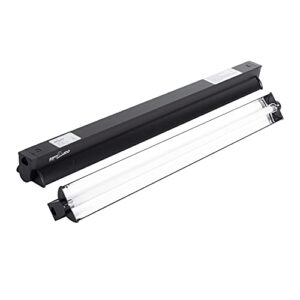
Low-profile doesn’t mean low-power here. This kit pairs a Desert 10.0 UVB T5 lamp with a curved reflector, reclaiming photons that flat designs waste outright.
The electronic ballast delivers rapid starts and steady output, while the detachable cord and plastic end caps simplify mounting under mesh tops. Expect 12 months of reliable service before replacement, though some users report early bulb failures. Verify intensity with a Solarmeter rather than trusting the box alone.
| Best For | Owners of bearded dragons and other desert-dwelling reptiles who need reliable, high-output UVB lighting for calcium metabolism and overall health. |
|---|---|
| UVB Output | 10.0 (Desert) |
| Bulb/Lamp Type | T5 HO |
| Base/Mount Type | T5 Fixture Mount |
| Target Species | Bearded Dragons, Desert Reptiles |
| Replacement Interval | Not specified |
| Health Benefit | Calcium Metabolism |
| Additional Features |
|
- Curved reflector design boosts UVB efficiency compared to flat fixture designs
- Electronic ballast provides rapid starts and steady, energy-efficient performance
- Detachable cord and plastic end caps make installation under mesh tops quick and safe
- Some users report occasional early bulb failures and costly replacement bulbs
- Limited to 100-120V input, so a transformer is needed for 220V regions
- A handful of users noted premature fixture failure after just a month of use
9. T5 UVB Reptile Light Fixture Combo Kit
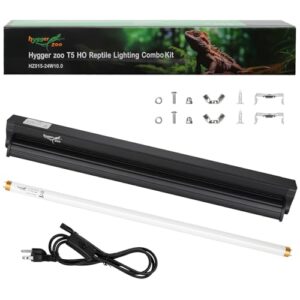
Two pieces, one purchase — that’s the appeal of this combo kit, pairing a T5HO fixture with a 10.0 UVB tube built for bearded dragons and other desert species.
The curved reflector concentrates output toward your basking zone, and the fixture fits standard G5 sockets between 24-39 watts. Mounting hardware and a power cord come included, simplifying setup over screen-top enclosures.
Replacement tubes sell separately, so budget for that down the road. Clean the reflector regularly to maintain peak UVB delivery.
| Best For | This combo kit is best for owners of desert reptile species like bearded dragons, turtles, chameleons, and tortoises who want a complete, ready-to-mount UVB lighting setup without sourcing parts separately. |
|---|---|
| UVB Output | 10.0 UVB |
| Bulb/Lamp Type | T5 HO LED-style |
| Base/Mount Type | Mesh/Vivarium Mount |
| Target Species | Bearded Dragons, Turtles |
| Replacement Interval | Not specified |
| Health Benefit | Vitamin D3 Synthesis |
| Additional Features |
|
- Includes both fixture and 10.0 UVB tube, plus mounting hardware and a power cord, so setup is straightforward right out of the box
- Curved reflector design concentrates light intensity toward the basking zone, boosting UVB delivery where it matters most
- Aluminum housing supports efficient heat dissipation, helping extend bulb life over time
- Replacement tubes are sold separately, so ongoing maintenance adds to the long-term cost
- Some users report inconsistent durability and electronic reliability over extended use
- Not rated as water or rust-proof, so it’s not ideal for high-moisture habitats without precautions
10. GeeKoit UVB Reptile Light for Bearded Dragons
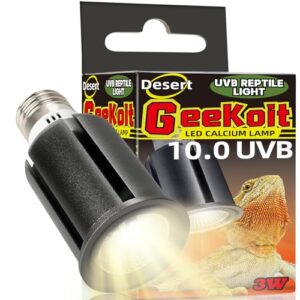
Rounding out our list, GeeKoit’s bearded dragon fixture skips the tube-and-ballast hassle entirely, running on a standard E26 socket instead.
At 10.0 UVB output, it’s built for desert species needing strong calcium support, and the LED design resists the steep decay rate fluorescent bulbs suffer.
Just don’t expect heat from this one. It’s UVB only, so pair it with a dedicated basking bulb, and remember: output drops fast with distance, so measure with a Solarmeter before trusting your setup.
| Best For | Owners of desert-dwelling reptiles like bearded dragons, tortoises, and uromastyx who need a reliable, long-lasting UVB source without the hassle of fluorescent tubes and ballasts. |
|---|---|
| UVB Output | 10.0 rating |
| Bulb/Lamp Type | LED |
| Base/Mount Type | E26 Base |
| Target Species | Bearded Dragons, Uromastyx |
| Replacement Interval | Extended LED life |
| Health Benefit | Calcium Metabolism |
| Additional Features |
|
- Slower UVB decay rate than compact fluorescent bulbs, meaning more consistent output over time
- Energy-efficient LED design that fits a standard E26 socket for easy setup
- Strong 10.0 UVB intensity that supports calcium metabolism and helps prevent metabolic bone disease
- Provides no meaningful heat, so a separate basking bulb is required
- UVB output drops off significantly as distance from the bulb increases
- Not compatible with dimmer switches, limiting fixture flexibility
Desert Reptile UVB Requirements
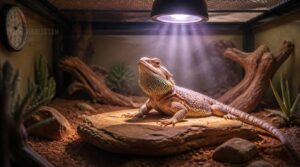
Before you pick a bulb, you need to know what your reptile’s body actually demands. UVB needs aren’t one-size-fits-all—they shift by species, zone, and even basking habits. Here’s what to check before you buy anything for your desert setup.
Ferguson Zone 3–4 Species
Ferguson Zone classifications sort reptiles by natural UVB exposure, not guesswork. Zone 3 species (woodland edge, dappled light) need moderate UVI; Zone 4 desert reptiles demand intense, direct exposure mimicking open grassland sun.
Understanding essential vitamin D3 synthesis is essential for maintaining long-term reptile health.
This isn’t optional categorization. Mismatched UVB lighting disrupts natural basking cycles, causing metabolic bone disease. Match your species’ zone precisely, and replace bulbs on schedule, since output degrades long before bulbs visibly fail.
Mismatched UVB lighting causes metabolic bone disease—match your species’ zone and replace bulbs before they silently fail
Ideal Desert Habitat UVI
Once you’ve matched your species to its zone, the next question is where to point your meter.
Desert enclosures should hold a UVB floor level around 0.3–0.5 UVI ambient, with the basking spot spiking to 2.0–3.5 UVI at proper basking height. That gradient lets reptiles self-regulate metabolic UV needs naturally, moving toward or away from intensity as their bodies demand.
Bearded Dragon UVB Needs
Bearded dragons need a UVI of 3.0–6.0 for proper Vitamin D3 synthesis and calcium absorption mechanics—light-sensitive morphs should stay below 3.0. Juveniles especially need consistent exposure to prevent metabolic bone disease.
Best sources:
- T5 HO fluorescent tubes
- UVB-rated mercury vapor bulbs
- Verified-output UVB LEDs
Pair with UVA for natural behavior support in your desert reptiles.
Uromastyx and Chuckwalla Needs
Uromastyx and chuckwallas push past bearded dragon levels entirely, needing a UVI of 4.0–7.0. These desert species evolved under brutal sun exposure, so their calcium absorption mechanics demand stronger UVB lighting. Skimp here, and you’re inviting metabolic bone prevention failures.
T5 High Output fluorescent tubes deliver this intensity reliably. Pair strong UVB with plant-based nutrition and proper thermal gradients, since calcium metabolism depends on the whole system, not light alone.
Basking Height Measurements
Vertical distance from your reptile’s back to the UVB source directly controls UVB intensity received. Most mid-sized desert species need 12–18 inches from a T5HO tube.
Measure at the actual basking zone, not the enclosure floor — those numbers differ greatly. Use a UVB meter to confirm readings, then adjust platforms until irradiance matches your species’ target UVI.
Best UVB Bulb Types
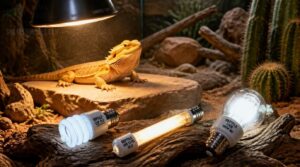
Not all UVB bulbs are built the same, and choosing the wrong type can quietly undermine your reptile’s health over time. Each technology comes with its own trade-offs in intensity, coverage, and installation requirements. Here’s what you need to know about the main options before making your choice.
T5HO Fluorescent Tubes
T5HO fluorescent tubes are the top choice for desert reptile enclosures. Their tri-phosphor coating delivers a CRI of 95 and 7000K color temperature, closely mimicking natural sunlight. Efficacy reaches 90–110+ lumens per watt.
They require an electronic ballast and a G5 bi-pin base. Replace every 12 months — phosphor coatings degrade silently, long before the light visibly dims.
Mercury Vapor Bulbs
Mercury vapor bulbs combine UVB, UVA, and radiant heat in a single unit. Inside, a quartz arc tube ionizes mercury vapor to produce broad-spectrum output — no separate heat lamp needed.
They require a compatible ballast and take 4–7 minutes to reach full intensity. Plan for 18–36 inch mounting heights in enclosures over 24 inches tall, and replace every 8–10 months.
Compact Coil Bulbs
Compact coil bulbs — those spiral-shaped compact fluorescent bulbs — look convenient, but they’re a poor fit for desert reptiles. Their lumen output tops out around 1,600 lumens, and UVB coverage is uneven, creating hotspots rather than a consistent gradient.
They also contain mercury, requiring careful mercury disposal. Use them as supplemental light only, never a primary UVB source.
UVB LED Options
LED UVB technologies are gaining traction, but desert reptiles demand scrutiny before you commit. These units offer LED lifespan ratings exceeding 25,000 hours and tight spectral precision at 305–312 nm. Watch for:
- Thermal management via metal base PCB boards
- Driver requirements using constant current supplies
- Mounting solutions with adjustable suspension brackets
- Output intensity often insufficient for Ferguson Zone 3–4 species
Verify UVI at basking height before relying on LEDs alone.
Reflector Efficiency
Half your bulb’s UVB never reaches your dragon—it scatters sideways unless photon reclamation captures it. Polished aluminum reflectors achieve 85–92% coating reflectance, redirecting wasted output back toward the basking zone.
Reflector geometry matters too: parabolic shapes tighten beam uniformity and boost UVB intensity by 5–20%. Pair this with solid thermal management, since overheated fixtures degrade lumen output faster, weakening your UVB spectrum simulation over time.
Safe Enclosure Light Setup
Buying the right bulb is only half the job. Where you place it, and how you let your reptile escape it, decides whether that UVB actually helps. Here’s how to set up your enclosure so the light works with your pet’s biology, not against it.
Basking Zone Placement
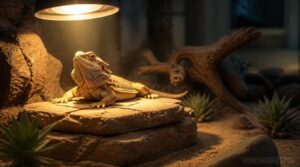
Where should the basking spot actually sit? Directly beneath your UVB lighting, on a stable surface large enough that your reptile won’t tip it.
- Basking surface stability prevents injury
- Position away from decor blocking access
- Match species specific heights (arboreal vs. ground-dwelling)
- Avoid substrates with high heat retention
- Support proper thermal gradient design
Secure rocks with non-toxic mortar—shifting platforms risk burns or falls.
Distance From Basking Spot
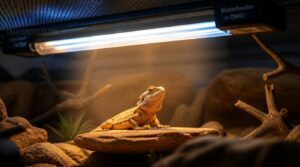
Once your platform’s secure, distance becomes the real lever for UVB intensity. For T5HO tubes, aim for 12–18 inches from basking height; mesh tops attenuate output, so tighten that gap to 8–12 inches.
Halving distance roughly doubles UVI at skin level. Always verify with a Solarmeter—never eyeball it. Adjust basking height whenever you rearrange decor.
Mesh Versus Glass Barriers
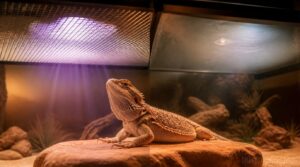
Your enclosure’s barrier material matters as much as bulb distance. Mesh tops allow higher UV transmission but reduce intensity slightly; glass blocks up to 60% of UVB wavelengths.
Quick comparison:
- Mesh: better UVB transmission rates
- Glass: excellent impact resistance
- Mesh: easier sectional repairs
- Glass: requires UV-filtering coatings
- Mesh: needs corrosion-resistant coatings
Shade and UV Gradients
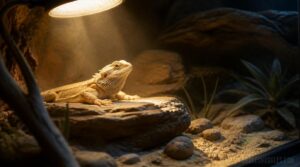
Your barrier choice only controls how much UVB enters — shade placement decides how your reptile uses it. Bearded dragons need a true gradient: intense basking zone tapering to deep shade, where UV index can drop over 90%.
Light substrate reflects extra UV into shaded corners, while plants and rock structures scatter rays naturally, letting your pet self-regulate exposure exactly like it would in the wild.
Timer-Based Photoperiods
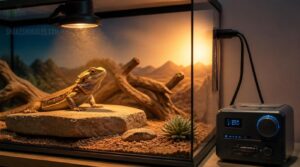
Twelve to fourteen hours of light, every single day, builds the circadian rhythm your desert reptile depends on. A quality digital timer automates this photoperiod, even simulating dawn-to-dusk transitions.
- Consistency reduces stress
- Seasonal adjustments support breeding
- Battery backup prevents gaps
That’s not optional polish — it’s biological scaffolding, keeping your UVB lighting system honest while you sleep.
UVB Maintenance and Buying Tips
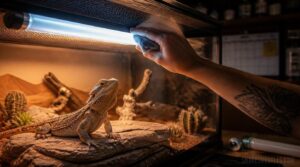
Buying the right bulb is only half the job; your maintenance routine matters just as much.
Bulbs lose their UVB output long before they look dim or stop working, which catches a lot of owners off guard. Here’s what you need to know to keep your reptile’s lighting safe and effective for the long haul.
Replacement Schedule
UVB bulbs don’t fail loudly — they fade quietly. T5HO tubes need replacement every 12 months; mercury vapor bulbs at 8–10 months. Phosphor coatings degrade invisibly, dropping UVB output well before the bulb burns out.
Keep a simple log: bulb type, install date, planned swap date. Write the date on the bulb base itself. Keep a spare on hand to avoid coverage gaps.
Visible Light Versus UVB
Your bulb might look bright, but brightness isn’t UVB. Visible light (400–700 nm) regulates circadian rhythms and behavior — it won’t produce vitamin D3.
That requires UVB wavelengths (290–315 nm), which carry higher photon energy and drive calcium metabolism. Full spectrum lighting delivers both, but always verify UVB output with a meter, not your eyes.
Cleaning Bulbs and Reflectors
Dust is silent but destructive — buildup on bulb surfaces can cut UVB output by 20–40%.
Clean bulbs every 3–6 months using a microfiber cloth dampened with 70% isopropyl alcohol. Never touch glass bare-handed; skin oils create hot spots. For reflectors, use distilled water and wipe outward in circles. Avoid ammonia-based cleaners — they damage reflective coatings. Always unplug first, let components cool completely.
Tracking Install Dates
Write the install date on the bulb base the moment it goes in — a permanent marker takes seconds, but the information lasts the bulb’s entire lifespan.
Digital logs with asset tags eliminate guesswork across multi-enclosure setups. Record the model, serial number, and installer initials. Automated replacement alerts then flag bulbs approaching their replacement window before UVB output quietly drops below safe levels.
Using a UVB Meter
A handheld Solarmeter 6.5 cuts through guesswork entirely. Hold it at your reptile’s basking height — not the enclosure floor — and angle it perpendicular to the lamp for accurate UVB irradiance readings in µW/cm².
Log each measurement alongside the bulb’s age. UVB strength degrades invisibly, so verifying UVI consistency monthly catches dangerous drops before your animal pays the price.
Frequently Asked Questions (FAQs)
Are bearded dragons more of a desert UVB or tropical UVB?
Picture a beardie basking like a tiny sunbathing gladiator under an open sky, not lounging beneath a rainforest canopy.
They’re firmly desert species, needing direct, high-intensity UVB for proper metabolic health, mimicking arid sun exposure rather than the filtered, gentler light found in humid tropical habitats.
Do desert tortoises need UVB light?
Yes. Desert tortoises depend on UVB exposure for vitamin D3 synthesis, calcium absorption, and shell mineralization. Without it, they risk metabolic bone disease. Natural sunlight works best, but indoor tortoises need a dedicated reptile UVB bulb daily.
Can too much UVB exposure harm my reptile?
Absolutely. Excess UVB radiation can trigger photokeratitis, skin burns, and oxidative stress damage. Watch for behavioral discomfort, like shade-seeking, signaling UV intensity mismatch.
Always match UVB strength to species needs and follow replacement schedules to prevent harm.
Does UVB affect appetite or activity levels?
It can. Correct UVB intensity triggers male ghrelin response and stronger appetite, while females show more variability.
UVB circadian signaling also drives hormonal activity shifts, encouraging natural basking behavior patterns and supporting overall reptile wellness through balanced daily rhythms.
Can reptiles get vitamin D3 from food alone?
Not reliably. Dietary D3 limits mean prey nutrient consistency varies too much for desert reptiles to depend on food alone—endogenous synthesis via UVB lighting remains essential for calcium absorption, calcium-phosphorus balance, and preventing metabolic bone disease.
Why does my reptile bask more in winter?
Think of it as chasing a shrinking pool of sunlight.
Cooler air triggers ectothermic winter regulation, so your desert reptile maximizes basking zone time, exploiting thermal microhabitats and conserving its energy budget while shorter days drive circadian winter adjustments toward concentrated, efficient warming sessions.
Do glass enclosures need different UVB setups?
Yes. Glass causes major UVB transmission loss, blocking up to 90%. Compensate with stronger UVB lighting systems, closer placement, and a Solarmeter for measuring glass-shielded UVI—essential for desert reptiles needing precise gradient management strategies.
Conclusion
The most dangerous bulb is the one that looks fine and does nothing—that’s the paradox of UVB: invisible light, visible consequences.
Choosing the right reptile uvb lights for desert habitats isn’t about brand loyalty. It’s about wavelength accuracy, intensity, and replacement discipline. Measure your UVI. Track install dates. Respect the gradient.
Your dragon can’t tell you its bones are failing, so that bulb above the basking spot has to do its job. Get it right.
- https://arcadiareptile.com/lighting/guide
- https://reptifiles.com/bearded-dragon-care/bearded-dragon-temperatures-uvb
- https://www.cttlight.com/post/desert-reptile-lighting-guide-choosing-the-right-uvb-for-health-and-longevity
- https://www.beardeddragon.org/articles/uvb-lighting-setup
- https://beanfarm.com/blogs/reptile-ramblings/how-much-uvb-should-i-have