This site is supported by our readers. We may earn a commission, at no cost to you, if you purchase through links.

A 400-square-foot studio heats up fast when the sun hits those west-facing windows, and your ball python’s basking spot can swing 15 degrees before dinner. That’s the trouble with small spaces — HVAC vents, shared walls, and thin insulation turn temperature control into a daily guessing game. Standard thermostats built for houses often can’t keep pace with these swings.
The right reptile thermostats for apartment living solve this by pairing precise relay control with safety features that protect both your animal and your rental deposit. Get the match between thermostat and heat source wrong, though, and you’re looking at burned probes or worse.
Table Of Contents
- Key Takeaways
- Top 10 Reptile Thermostats for Apartments
- 1. Inkbird ITC308 Digital Temperature Controller Outlet
- 2. VIVOSUN Digital Heat Mat Thermostat
- 3. Bayite Dual Stage Temperature Controller
- 4. BN LINK Digital Heat Mat Thermostat
- 5. Inkbird Heat Mat Temperature Controller Thermostat
- 6. Inkbird Dual Relay Temperature Controller
- 7. Hydrofarm JumpStart Heat Mat Thermostat
- 8. iPower Digital Heat Mat Thermostat
- 9. VIVOHOME Heat Mat Controller
- 10. Zoo Med ReptiTemp Thermostat
- Why Apartment Reptiles Need Thermostats
- Best Thermostat Types for Rentals
- Match Thermostats to Heat Sources
- Apartment Safety Features to Prioritize
- Species Needs for Snake Keepers
- Setup Tips for Small Spaces
- Frequently Asked Questions (FAQs)
- Conclusion
Key Takeaways
- Match your thermostat’s control type—on/off, dimming, pulse proportional, or PID—to your specific heat source, since pairing the wrong combination (like a dimmer with a ceramic emitter) risks equipment failure or fire.
- Prioritize safety features like high/low alarms, probe-failure auto shutoff, ETL certification, fire-retardant housing, and power-outage memory retention, since apartments’ shared walls and older wiring raise the stakes on any heating malfunction.
- Use dual-probe or dual-relay thermostats for larger enclosures (20+ gallons) or setups needing both heating and cooling, since a single probe often misses cold corners and temperature gradients.
- Test any new thermostat setup empty for 48–72 hours before adding your reptile, confirming stable calibration and proper heat distribution to avoid costly mistakes later.
Top 10 Reptile Thermostats for Apartments
Apartment living means tight quarters, shared walls, and zero tolerance for heating mishaps, so your thermostat choice matters more than usual.
That’s why picking safe heat lamps designed for apartment living can give you cozy warmth without risking your landlord’s wrath—or your safety.
You need reliable accuracy, quiet operation, and safety features that won’t let you down while you’re at work or asleep next door to it. Here are ten models worth your consideration, each suited to different setups and budgets.
1. Inkbird ITC308 Digital Temperature Controller Outlet
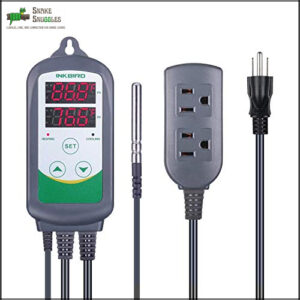
Two relays, one controller, zero guesswork — that’s the ITC308’s real selling point for apartment setups. It runs dual relay output, handling heating and cooling independently, so a snake tank and a nearby cooling fan can share one brain.
You get ±0.5°F accuracy, a 1,000W capacity, and alarms for sensor faults or runaway temps. For studio or one-bedroom reptile keepers juggling limited outlets, that combination of precision and safety features earns its mid-range price tag.
| Best For | Reptile owners, home brewers, and small-space growers who need one controller to manage both heating and cooling for tanks, fermenters, or grow spaces. |
|---|---|
| Temperature Range | -58 to 230°F |
| Max Power Load | 1200W |
| Display Type | Dual display |
| Unit Toggle | C/F selectable |
| Probe Included | Yes |
| Input Voltage | 110V |
| Additional Features |
|
- Dual relay output lets you run heating and cooling equipment at the same time from a single unit
- Built-in alarm alerts you to high/low temperature swings or sensor problems before they become costly
- Versatile enough for fermentation, greenhouses, reptile habitats, and aquariums alike
- The temperature probe can’t be replaced if it fails, so the whole unit becomes unusable
- Menu symbols and settings aren’t intuitive, so there’s a real learning curve when first setting it up
- Saving settings requires specific button-hold sequences, and the manual doesn’t always explain them clearly
2. VIVOSUN Digital Heat Mat Thermostat
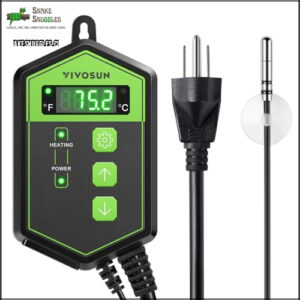
Simpler needs work here — no dual relays, just steady, reliable warmth for a single mat setup. The dual LCD display shows set and current temps side by side, so you’re never guessing whether your gecko’s warm side actually hit 90°F.
It runs 40-108°F, using on/off cycling through a 6-ft external probe. Buttons feel tactile, backlit for dim rooms, and setup takes minutes: press SET, adjust, confirm. Budget-friendly and apartment-practical for corn snakes or leopard geckos on basic heat mats.
| Best For | Hobbyists running a single heat mat setup—like reptile keepers, seedling growers, or small-scale incubators—who want simple, reliable temperature control without extra frills. |
|---|---|
| Temperature Range | 40-108°F |
| Max Power Load | 1000W |
| Display Type | LCD display |
| Unit Toggle | F/C selectable |
| Probe Included | Yes, 6 ft |
| Input Voltage | 120V |
| Additional Features |
|
- Simple 3-button interface makes setting and switching between °F/°C quick and easy
- 6-ft sensor probe allows accurate root-zone or terrarium monitoring
- Flexible mounting options (hanging tab, wall brackets, angled outlet) keep installation tidy
- Only one power outlet, so running multiple mats requires an extra splitter or power strip
- Some units have reported LCD display issues, including incomplete digits
- A few users note occasional loss of the Fahrenheit readout, requiring manual conversion
3. Bayite Dual Stage Temperature Controller
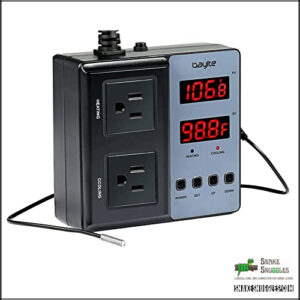
Once you need heating and cooling working together — say, a bioactive setup with a fan for cooling — the Bayite BTC201 earns its keep. Its dual relay outputs run both devices independently, each rated for 10A, so you’re not juggling two separate controllers on one crowded power strip.
The 3-meter waterproof probe and compressor start-delay protection guard against rapid cycling that’d wear out a cooling fan fast. Just know you’re setting one differential manually, not multi-zone precision.
| Best For | hobbyists running bioactive enclosures, aquariums, incubators, or fermentation setups who need automated heating and cooling working together in one plug-and-play unit. |
|---|---|
| Temperature Range | -58 to 230°F |
| Max Power Load | 1100W |
| Display Type | Dual display |
| Unit Toggle | C/F selectable |
| Probe Included | Yes, 3m waterproof |
| Input Voltage | 110-240V |
| Additional Features |
|
- Dual relay outputs let you control heating and cooling devices independently, each rated for a sturdy 10A
- Compressor start-delay protection and a 3-meter waterproof probe help prevent rapid cycling and equipment wear
- Simple plug-in setup means no wiring know-how needed, with dual displays showing temp and setpoint at a glance
- Only one setpoint, so heating and cooling differentials must be dialed in manually — no true multi-zone control
- The controller housing itself isn’t waterproof, so it needs to be kept away from wet or salt-water environments
- Some users find the manual and alarm settings confusing, occasionally needing a power cycle to get changes to stick
4. BN LINK Digital Heat Mat Thermostat
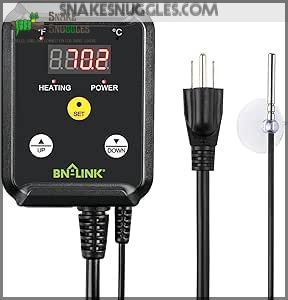
Not every setup needs dual relays or Wi-Fi. If you’re just running a single heat mat for a corn snake or leopard gecko, the BN-LINK Digital Controller covers the basics without extra cost.
It’s ETL-listed, aids up to 1,000W, and controls temps from 40–108°F using a simple on/off relay. You’ll get audible clicking as it cycles, but for budget-conscious apartment setups, that’s a fair trade for reliable, no-frills heat mat control.
| Best For | Reptile keepers with a single terrarium setup, like corn snakes or leopard geckos, who want reliable heat mat control without paying for extra features. |
|---|---|
| Temperature Range | 40-108°F |
| Max Power Load | 1000W |
| Display Type | LCD display |
| Unit Toggle | F/C selectable |
| Probe Included | Yes, 4.92 ft |
| Input Voltage | 120V |
| Additional Features |
|
- ETL-listed and rated for up to 1,000W, so it safely handles standard heat mat loads
- Simple three-button interface with Fahrenheit/Celsius toggle makes setup quick and easy
- Compact, rugged housing with a hanging tab and long power cord/probe for flexible placement
- Uses a basic on/off relay, so you’ll hear audible clicking as it cycles on and off
- Temperature range tops out at 108°F, which won’t work for higher-heat applications
- Only compatible with standard 120V AC outlets, so it’s not an option for 230V or battery setups
5. Inkbird Heat Mat Temperature Controller Thermostat
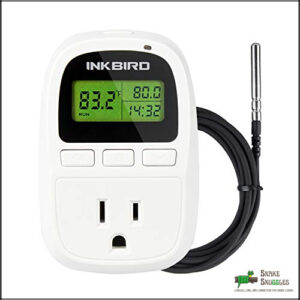
For single-zone setups with a bit more precision, Inkbird’s basic controller delivers ±1°F accuracy using a built-in digital sensor, with calibration options to fine-tune readings if your probe reads slightly off.
It aids up to 250W, plenty for a standard heat mat, and displays current versus target temperature side by side. High and low alarms flag trouble early, while probe-fault detection cuts power if the sensor disconnects—solid protection for apartment enclosures where you’re not always home to catch a malfunction.
| Best For | Reptile keepers and hobbyists who need reliable day/night temperature control for a single enclosure, whether that’s maintaining cage warmth, protecting outdoor pipes from freezing, or keeping a plant storage box stable through winter. |
|---|---|
| Temperature Range | -58 to 212°F |
| Max Power Load | 1500W |
| Display Type | Three-window display |
| Unit Toggle | F/C selectable |
| Probe Included | Yes, waterproof IP68 |
| Input Voltage | 110V |
| Additional Features |
|
- Independent day and night temperature settings make it easy to mimic natural cycles for reptiles or adjust for seasonal needs
- Waterproof IP68-rated NTC probe with a generous 6.56-foot length holds up well in humid or outdoor setups
- Three-window display keeps current temperature, set temperature, and time visible at a glance
- Instructions can be vague, making initial setup more time-consuming than expected
- Relies on a "Heating Differential Value" system rather than a simple fixed target, which takes extra effort to program correctly
- Risk of fire if paired with devices that exceed the unit’s rated current capacity
6. Inkbird Dual Relay Temperature Controller
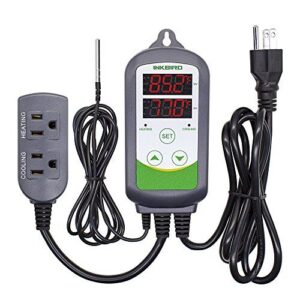
Two heat sources, one controller—that’s the appeal here. This unit runs independent heating and cooling outputs, so you can manage a heat mat and a small fan or chiller from a single box, useful if your apartment swings warm in summer.
If you’re wiring both sides up for the first time, this guide to setting up a reptile thermostat walks through probe placement and calibration for accurate readings.
Each channel gets its own differential settings, with 0.1°F resolution and alarms for high, low, and sensor faults. Compressor-delay protection stops rapid cycling if you’re running cooling gear.
It’s plug-and-play, retains settings through outages, and aids up to 1000W per outlet.
| Best For | Homebrewers, gardeners, and hobbyists who need to manage both a heat source and a cooling source from one controller for things like fermentation, greenhouse regulation, or kegerator setups. |
|---|---|
| Temperature Range | -58 to 248°F |
| Max Power Load | 1100W |
| Display Type | Dual display |
| Unit Toggle | C/F selectable |
| Probe Included | Yes, 1.8m NTC |
| Input Voltage | 100-240V |
| Additional Features |
|
- Independent dual-relay outputs let you run heating and cooling gear at the same time from a single unit
- Retains all settings after a power loss, so there’s no reprogramming needed after an outage
- Compressor-delay protection helps protect refrigeration equipment from short-cycling damage
- Max output load of 1100 W at 110 V may not be enough for larger heaters or high-wattage appliances
- Only one sensor is included, so monitoring multiple zones means buying extra controllers
- No built-in Wi-Fi or smart-home connectivity, despite what some marketing suggests
7. Hydrofarm JumpStart Heat Mat Thermostat
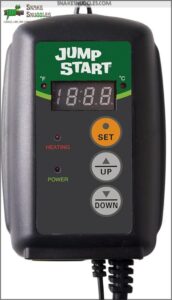
Originally built for seed starting, this thermostat works surprisingly well for low-wattage reptile setups. It controls up to 1000W, running heat mats between 68–108°F with a 6-ft water-resistant probe—plenty of reach for under-tank placement.
On/off cycling means 1–2°F swings, fine for corn snakes or leopard geckos but not precision-critical species. The digital display switches between Fahrenheit and Celsius, and auto-shutoff kicks in if temps exceed your set point.
For apartment budgets, it’s a practical, no-frills option—just don’t expect ceramic heat emitter compatibility.
| Best For | Reptile and amphibian keepers with low-wattage heat mats who want an affordable, ETL-certified thermostat for species that don’t require precise, swing-free temperature control. |
|---|---|
| Temperature Range | 68-108°F |
| Max Power Load | 1000W |
| Display Type | Digital display |
| Unit Toggle | C/F selectable |
| Probe Included | Yes, 6 ft suction cup |
| Input Voltage | 120V (3-prong) |
| Additional Features |
|
- ETL-certified safety thermostat controls up to 1000W heating elements
- Digital display with switchable Fahrenheit/Celsius readout and a 6-ft water-resistant probe for flexible placement
- Adjustable range of 68–108°F suits seed starting, fermentation, and most reptile or amphibian setups
- On/off cycling causes 1–2°F swings, not ideal for precision-critical species
- Max setpoint of 108°F won’t work for high-heat applications like ceramic heat emitters
- Probe’s suction cup mount may lose adhesion over time and need alternative mounting
8. iPower Digital Heat Mat Thermostat
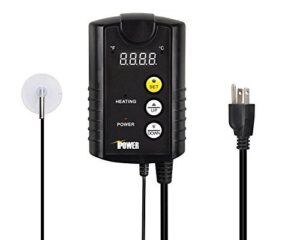
Simple, dependable, and easy to program—this thermostat suits apartment keepers who want reliability without a learning curve. It controls up to 1000W across a 40–108°F range, with Fahrenheit or Celsius display switchable at the push of a button, and 1-degree increments for fine-tuning.
The probe monitors mat temperature directly, and settings save automatically through power outages—handy if your building has flickering circuits. A three-prong grounded plug adds basic protection, making this a solid budget pick for corn snakes or leopard geckos on under-tank mats.
| Best For | Apartment dwellers and small-space reptile or plant keepers who want a simple, no-fuss thermostat for seed mats, terrariums, or brooders without needing precision lab-grade accuracy. |
|---|---|
| Temperature Range | 40-108°F |
| Max Power Load | 1000W |
| Display Type | Digital display |
| Unit Toggle | C/F selectable |
| Probe Included | Yes, metal-tipped |
| Input Voltage | 120V |
| Additional Features |
|
- Easy set/reset controls with a switchable Fahrenheit/Celsius display for straightforward everyday use
- Metal-tipped probe sensor delivers reliable contact readings from the heat source
- Handles up to 1000W/8.3A, enough for most standard heat mats and small heating setups
- Only switches power on and off—it won’t boost the heating strength of whatever it’s connected to
- Readings can drift ±2–5°F compared to precision thermostats, so it’s not ideal for sensitive setups
- The sensor must stay dry, so it’s not suited for wet soil or humid enclosures without careful placement
9. VIVOHOME Heat Mat Controller
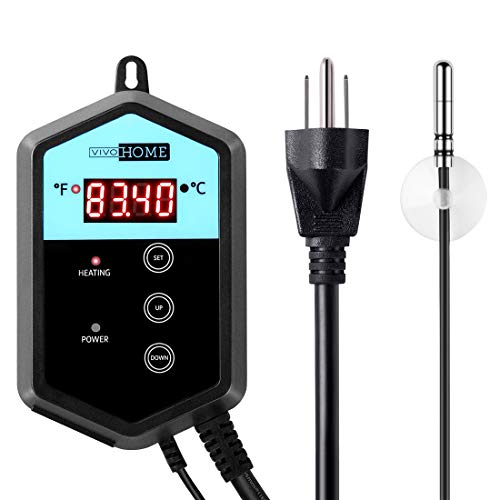
Not every apartment setup needs bells and whistles—sometimes you just need a mat controller that does its job quietly. The VIVOHOME unit covers 80–95°F warm-side targets, perfect for geckos or corn snakes on under-tank mats.
Its probe reads substrate temperature directly, cycling power on and off to hold your set point within a few degrees. Auto shutoff kicks in if the probe fails, and many models carry ETL or UL listing.
Simple up/down buttons keep programming painless, even for first-time keepers.
| Best For | apartment-dwelling reptile keepers who want a simple, no-fuss controller to maintain steady warm-side temperatures for geckos, corn snakes, and similar under-tank setups. |
|---|---|
| Temperature Range | 40-108°F |
| Max Power Load | N/A |
| Display Type | LED display |
| Unit Toggle | C/F selectable |
| Probe Included | Yes, 6.4 ft suction cup |
| Input Voltage | 120V |
| Additional Features |
|
- Wide adjustable range (40°F–108°F) covers most reptile, germination, and fermentation needs
- Auto shut-off protects against probe failure, adding a layer of safety
- Simple three-button interface makes calibration and daily use painless
- Only controls one heat mat at a time, so multi-mat setups need extra controllers or a power strip
- Some users report durability issues like cord corrosion or circuit failure over time
- Switching between °C and °F isn’t always intuitive and may not match the printed instructions
10. Zoo Med ReptiTemp Thermostat
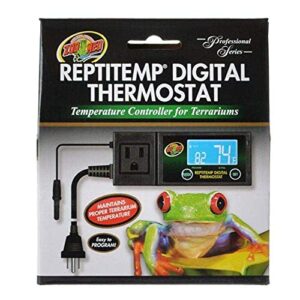
Rounding out this list is a thermostat built for keepers running both sides of the thermal equation. The Zoo Med ReptiTemp aids 600W heating and 150W cooling, making it one of the few units that controls fans and heat sources through the same controller.
Set points run 50–122°F, switching automatically between heat and cool modes as your apartment’s ambient temperature shifts with the seasons. The 6-foot probe cable gives you flexibility for gradient placement, while built-in memory retention keeps your settings intact through any power hiccup.
| Best For | Keepers of reptiles, amphibians, or small aquatic setups like shrimp bowls who need precise, automated control over both heating and cooling in one device. |
|---|---|
| Temperature Range | 50-122°F |
| Max Power Load | 600W |
| Display Type | Backlit digital display |
| Unit Toggle | F/C selectable |
| Probe Included | Yes, 6 ft remote |
| Input Voltage | Standard AC |
| Additional Features |
|
- Handles both heat and cool modes with a wide 50–122°F range, adapting to seasonal shifts automatically
- Built-in memory retains your settings after a power outage, so you don’t have to reconfigure everything
- Includes a visual and audible alarm to warn you of extreme temperature swings before they harm your animals
- Only one power outlet, so running multiple devices means adding a power strip and watching total wattage
- The backlit display can’t be dimmed, which may disturb nocturnal animals sensitive to light
- Audible clicking when the unit cycles on or off can be distracting in quiet rooms
Why Apartment Reptiles Need Thermostats
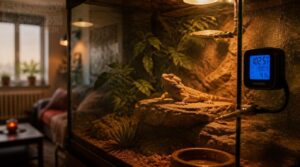
Apartments run smaller and warmer than houses, which changes how your reptile’s heat setup behaves. A thermostat isn’t just a nice-to-have here—it’s what keeps a small room from turning into a hazard. Here’s exactly why that matters, and where the risks show up most.
Prevent Overheating in Small Rooms
Because apartments trap heat fast, a small bedroom can swing 10°F warmer than your thermostat’s set point once summer sun hits the glass.
Prevent overheating with:
- Window shading to block direct sun
- LED bulb upgrades (90% less heat than incandescent)
- Better airflow to vent trapped warmth
- A quality temperature controller with alarms
These layers work together, protecting your reptile’s habitat stability when room conditions shift unexpectedly. You can also use internal blinds or shutters to further manage rising indoor temperatures.
Stabilize Enclosure Temperature Gradients
A stable basking spot means nothing if the rest of the tank drifts wildly. Vertical heat distribution matters as much as horizontal—warm air rises, leaving floor levels cooler.
Fix this with smart probe placement strategy: one at basking height, one at the cool end. Add thermal shields to redirect heat downward, and use dimming thermostats for precision temperature monitoring—true habitat stability depends on catching gradient drift before it disrupts thermal management.
Reduce Fire and Burn Risks
Gradients matter, but a shared wall and thin flooring raise the stakes on heat safety. Overheat protection starts with proper mounting—never let mats touch flammable substrate, keep 2 inches clearance around wiring, and inspect cords monthly for fraying.
Add surge-protected outlets for intermittent heaters, and keep a Class C extinguisher nearby. These habits prevent thermal burns before they happen.
Support Safe Nighttime Heating
When the lights go out, thermostat control stands between safe warmth and silent danger. Set a digital controller with auto shutoff—never trust manual timers overnight.
Calibrate sensors, keep the probe clear of drafts, and log enclosure temperatures twice nightly. Use insulated lids, maintain safe heat source distance, and schedule energy-saving setbacks to prevent overheating while ensuring your reptile’s comfort.
Protect Snakes During Power Changes
When power flickers or fails, snakes are vulnerable to sudden temperature drops. A digital temperature controller with rapid-drop alarms is essential—set alerts for changes over 2°C per hour. Keep an emergency heating backup ready, maintain a thermal gradient buffer, and follow strict outage response protocols. Log data for fourteen days to spot patterns and improve your safety strategy.
- Emergency heating backup
- Thermal gradient buffer
- Rapid-drop alarm
- Data log for pattern analysis
Best Thermostat Types for Rentals
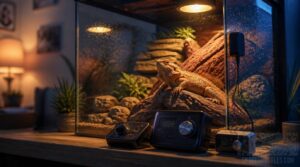
Choosing the right thermostat for your apartment setup comes down to matching safety, precision, and quiet operation. Each type offers unique control for reptiles in small spaces, so it’s worth knowing what fits your needs best. Here’s how the main thermostat options stack up for rental environments.
On/off Thermostat Basics
Think of an ON/OFF thermostat as your enclosure’s gatekeeper—using a thermistor probe to sense temperature, it commands a relay to switch heat sources on or off. The process is binary: either heating, or not.
The deadband setting prevents rapid cycling, so you don’t hear constant clicks. Probe placement is key for accurate temperature regulation and safe reptile husbandry.
Dimming Thermostat Benefits
When you switch to a dimming thermostat, you gain gradual heat modulation—it lowers power smoothly, avoiding the sudden spikes that stress reptiles. This leads to stable basking zones, tighter temperature control, and energy efficiency gains.
Your bulbs last longer, and night-time heating stays consistent. Alarms for probe issues help you spot trouble early, preventing overheating and keeping your apartment habitat safe.
Pulse Proportional Control
Pulse proportional thermostats bring fine temperature control to apartment reptile setups by sending rapid pulses of electricity—each pulse adjusts based on the error magnitude between setpoint and actual temperature.
This method scales output dynamically, so the heat source adjusts smoothly, avoiding overshoot. You get ±0.5–1 °F stability, making these controllers ideal for ceramic emitters and radiant panels—quiet, efficient, and safe.
PID Precision Control
PID technology is the smartest option out there—it doesn’t just react, it predicts. Using error anticipation logic, a PID digital temperature controller adjusts proportional gain, cumulative correction, and derivative damping together, catching swings before they happen.
This trio delivers steady state accuracy and dampens temperature oscillations far better than dimming thermostats alone, giving precision sensing that keeps enclosures rock-stable, even through drafts or door openings common in apartments.
Quiet Operation for Apartments
Thin walls mean every click and hum travels straight to your neighbor’s living room. That’s why solid state relays matter so much—no mechanical clacking, just smooth switching.
In thin-walled apartments, solid state relays deliver smooth, silent switching instead of mechanical clacking that disturbs neighbors
Dimming thermostats and pulse proportional thermostats both use this silent relay technology, minimizing electrical hum and dampening mat resonance. Any digital temperature controller with these safety features gives you real temperature stability without the noise complaints.
Match Thermostats to Heat Sources
Not every heat source plays by the same rules, and your thermostat needs to match the one you’re using. Pair the wrong type together, and you’ll end up with a burnt-out bulb, a fried heating element, or worse. Here’s how the most common heat sources line up with the right controller.
Heat Mats and Heat Tape
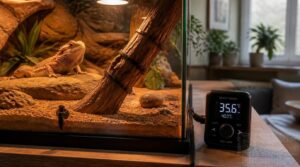
Under the tank, a heat mat’s resistive element—a flat sheet sealed in moisture-resistant polymer—needs a dedicated heat mat thermostat, not a wall outlet timer. On/off models suit mats and heat tape fine, since low wattage means slower swings.
Wrap tape snugly, full contact only, no bunching. Test both dry runs before adding animals, confirming the gradient holds steady, mat edges secured against digging.
Ceramic Heat Emitters

Ceramic emitters radiate infrared heat with zero visible light, which makes them ideal for nocturnal geckos and snakes. The solid ceramic body can take high temps without cracking, though bumps still risk damage.
Pair yours with a pulse proportional thermostat for ±0.5°F accuracy—dimming models won’t work here, since there’s no bulb to dim. Mount with a reflector, and wipe dust off monthly.
Deep Heat Projectors

Screw a deep heat projector into a ceramic socket and you get something different from a CHE: carbon filament technology pushing infrared-B and infrared-C wavelengths deeper into tissue, with zero glare. That’s real tissue warming, not just surface heat—useful for snakes needing nighttime warmth without light.
Skip dimming thermostats here; pulse proportional or PID control keeps output precise and safe.
Radiant Heat Panels
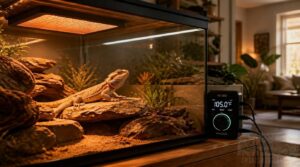
Radiant heat panels use an embedded heating element to push infrared energy straight into the room, warming surfaces and bodies instead of air—great for terrarium temperature regulation in drafty apartments. Wall or ceiling panel mounting keeps footprints small.
Since these aren’t light-emitting, skip dimming thermostats entirely; pair panels with pulse proportional or PID control for accurate, safe temperature control and even heat distribution.
Basking Bulbs and Lamps
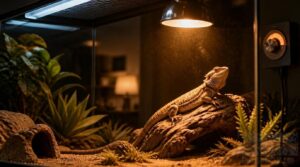
Sunlight through a basking lamp gives your reptile that focused warmth it craves for digestion and activity.
- Dimming thermostats modulate voltage smoothly
- Preserve UVB spectrum output
- Extend bulb lifespan a lot
- Support beam focus onto basking spots
- Simulate radiant heat naturally
LED vs incandescent matters too—LEDs run cooler, needing wattage tweaks. Replace bulbs regularly; UV output fades before visible light does.
Apartment Safety Features to Prioritize
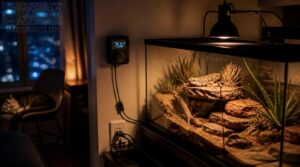
Living in an apartment means shared walls, older wiring, and neighbors who won’t appreciate a heat lamp malfunction at 2 a.m. That’s why the safety features on your thermostat matter just as much as its accuracy rating. Here are the five you shouldn’t skip when picking a unit for your setup.
High and Low Alarms
Your thermostat should shout before things go wrong, not after. Highlow temperature alarms flag unsafe swings instantly, letting you fix issues before pet safety is at risk.
| Alarm Type | Trigger | Response |
|---|---|---|
| High | Above set limit | Immediate check |
| Low | Below set limit | Corrective action |
| Deadband | Minor fluctuation | No alert (prevents nuisance) |
Multi-level alarm hierarchies with proper deadband settings mean critical threshold design triggers real automated safety responses, not false alarms.
Probe-failure Auto Shutoff
When your probe fails, a good temperature controller cuts power fast—no waiting around. Redundant sensing paths catch sensor drift, moisture ingress, or a chewed cable before thermal runaway starts.
Watch for:
- Fault codes flashing on the display
- Relay clicking off unexpectedly
- Heat mat staying cold despite settings
- Repeated shutoffs needing manual reset
That safety relay protects pet safety when other alarms can’t react fast enough.
ETL-listed Electrical Safety
ETL certification isn’t a marketing sticker—it’s proof an independent lab tested the unit for shock and fire hazards.
That matters in apartments, where outlets are shared and space is tight. Look for the mark on BN-LINK or WILLHI temperature controllers; it confirms insulation resistance, grounding, and overcurrent protection all passed muster.
For ON/OFF thermostats especially, that documentation backs up warranty claims and gives you real confidence around electrical safety for pets.
Fire-retardant Housing
A cracked housing near your snake’s tank isn’t just cosmetic—it’s a fire risk waiting to happen. Look for ABS housing rated fire-retardant, paired with electrical fault protection and fire-rated sealants around wiring gaps.
- Fire-retardant ABS casing
- Noncombustible enclosures
- Fire-rated sealants for wire entry
- Built-in safety relay protection
These features aren’t overkill; they’re baseline safety for pets in tight apartment wiring setups.
Power-outage Memory Retention
Apartment power blips happen more than you’d think—breaker trips, storm outages, or a neighbor’s bad wiring.
Your digital thermostat controller should hold its settings through all of it, thanks to non-volatile storage that doesn’t need continuous power. Look for firmware with reliable memory retention and, ideally, capacitor hold-up time or battery backup, so your safety relay resumes exactly where it left off, no reprogramming required.
Species Needs for Snake Keepers

Not every snake wants the same setup, and that’s especially true in an apartment where space and airflow are limited. Ball pythons, corn snakes, and boa constrictors each come with their own heating quirks, from precision needs to warm-side placement. Here’s what to keep in mind for each one.
Ball Python Heating Control
Why do ball pythons need such precise heat control? Their metabolic heat regulation depends on a stable gradient, not swings. Use pulse proportional thermostats for ceramic heat emitters, holding ±0.5°F accuracy.
- Watching your snake stress under fluctuating heat
- Trusting your setup during overnight cycles
- Confidence in consistent digestion
- Peace of mind from ceramic emitter stability
Nighttime cycling down to 72–75°F mimics nature safely.
Corn Snake Warm-side Setup
Corn snakes are far more forgiving than ball pythons, but they still need a defined thermoregulation gradient. Pair a heat mat with an ON/OFF thermostat, keeping the warm-side substrate at 82-85°F. Bury the probe at snake-level for accurate readings.
Add 3 inches of substrate for burrowing, and place a hide directly over the warm zone. Let nights drop to 65-72°F naturally.
Boa Constrictor Enclosure Stability
Boas need serious floor space—at least the snake’s length plus 1.5 times its width—paired with a warm side hitting 88-92°F and a cool side at 74-78°F.
Bury your probe mid-substrate, not surface-level, for accurate readings. Anchor climbing branches securely; a shifting perch stresses boas fast.
Keep humidity at 55-65%, using moisture-retentive substrate to avoid swings that undermine your thermal gradient.
Nighttime Temperature Management
Once your boa’s gradient is set, don’t ignore the clock. Snakes still track day/night temperature cycling—a 5-8°F nighttime drop helps maintain natural circadian rhythms without stressing thermoregulation.
Use pulse proportional or PID control for nocturnal thermal stability; ON/OFF units cause swings that disrupt rest. Watch humidity too—warm, moist air amplifies discomfort. Real-time probe monitoring catches drift before it affects your snake’s sleep cycle.
Avoiding Dangerous Hot Spots
Where’s your snake’s temperature actually reaching skin level? A basking spot that runs hotter than the display shows is how thermal burns happen. Run infrared thermography or a second probe at substrate height to verify—don’t trust one reading.
Keep 5°F+ separation between zones, lift heat sources off loose substrate, and pair proper heat source regulation with alarms for real temperature control.
Setup Tips for Small Spaces
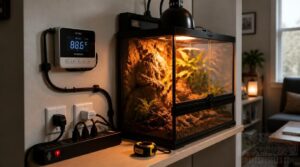
Small apartments come with their own set of headaches—tight outlets, thin walls, roommates who bump into cords. Getting your thermostat set up right the first time saves you from redoing it later, or worse, dealing with a burned-out heater at 2 a.m.
Here’s what actually matters when you’re working with limited square footage.
Secure Thermostat Probe Placement
Your thermostat is only as smart as its probe placement. Put the tip at the basking surface, not behind decor or under the heater, where false readings cause overheating. Avoid water bowls and loose substrate—both skew accuracy.
Once your probe placement is dialed in, pair it with a properly sized enclosure—this boa terrarium size and setup guide walks through matching tank dimensions to your snake’s length so temperatures stay accurate and stable.
For renters juggling lease restrictions and safety, this apartment-friendly guide to under tank heater setup shows how proper probe and cord placement work together without damaging floors.
Use heat-resistant tape to secure the waterproof probe against enclosure walls, keeping full contact for reliable microclimate sensor accuracy during calibration.
Manage Cords Safely
Tidy cords aren’t just neat—they’re a safety relay against tripping and fire risk near your reptile enclosure. Keep cords off carpets to cut moisture exposure risks, and inspect monthly for cracks.
- Mount clips every 12-18 inches
- Install cable raceways behind furniture
- Use velcro wraps, not tight tape
- Avoid daisy chaining strips
Route your heat mat’s cord away from walking paths entirely.
Avoid Shared Overloaded Outlets
Ever plugged a heat mat into the same strip as your TV and router? That’s asking for nuisance tripping.
| Device | Watts | Shared Outlet? |
|---|---|---|
| Heat mat | 40W | No |
| Space heater | 1500W | Never |
| Lamp | 60W | Sparingly |
Check amperage ratings—most outlets handle 15-20 amps. Balance loads across circuits, not just outlets, to prevent overheating and protect your thermostat’s safety relay.
Monitor Room Temperature Swings
One thermostat probe can’t tell you everything. Room temperature swings 2-3°F just from placement near vents, windows, or that sunny corner.
- Check desk-height vs. ceiling readings
- Watch HVAC cycles (1-4°F shifts in 15 minutes)
- Note sunlight exposure and drafts
- Log data for 30 days minimum
Multiple sensors reveal microclimates your single probe misses, protecting long-term environmental stability.
Test Before Adding Snakes
A dry run beats a costly mistake. Run the enclosure empty for 48–72 hours, watching for temperature fluctuations and confirming calibration accuracy before your snake arrives.
This window doubles as quarantine prep—your wellness checks, pathogen testing, and airflow separation should already be underway. Add a traceability identifier now, so habitat management and health records stay linked from day one.
Frequently Asked Questions (FAQs)
How many outlets can one thermostat safely control?
Like a fuse box, your thermostat has a hard ceiling. Most 120V units handle 1,800 watts (15 amps) safely—beyond that, you need a rated relay or contactor before adding more heat sources to prevent overload.
Do reptile thermostats work with smart home apps?
Yes—most digital thermostat controllers offer WiFi connectivity for remote monitoring, app notification alerts, and multi-enclosure control. You’ll get historical data trends and smart home setup, though hub compatibility varies by brand, so check specs before buying.
What size enclosure needs a dual-probe thermostat?
Picture a 40-gallon boa tank with one probe near the lamp — the far corner stays too cold. Once enclosures hit 20 gallons or larger, or use multiple heaters, dual-probe temperature gradients keep basking and cool zones properly balanced.
How often should thermostat calibration be checked?
Check calibration twice yearly—before heating and cooling seasons—plus anytime after a power outage or unexplained temperature swings. DIY testing with a reference thermometer works for small drifts; call a pro if readings differ by more than 5°F.
Conclusion
Your next heat wave won’t catch you off guard once the right controller’s wired in. The best reptile thermostats for apartment living don’t just react to temperature swings—they anticipate them, holding your basking spot steady while your building’s HVAC does whatever it wants.
Match the relay to your heat source, set your alarms, and test everything before your snake moves in. That’s not extra caution. That’s the difference between a stable home and a costly mistake.
- https://www.krawlo.com/best/best-reptile-thermostats-review-best
- https://www.nytimes.com/wirecutter/reviews/the-best-thermostat?eafs_enabled=false
- https://internetreptile.com/blogs/product-guides/do-i-really-need-a-thermostat-which-thermostat-should-i-buy
- https://beanfarm.com/blogs/reptile-ramblings/tips-for-choosing-a-thermostat-for-your-reptile-enclosure
- https://mramphibian.com/best-reptile-thermostats