This site is supported by our readers. We may earn a commission, at no cost to you, if you purchase through links.
That needle sitting at 65% could be lying to you by 10 points—and your ball python won’t forgive the mistake. Retained sheds and respiratory infections trace back to one culprit more than any other: bad humidity data.
Here’s the problem. Analog dials rely on hair or coil expansion, a mechanical process that lags behind real changes and drifts further out of true with every passing month. Digital sensors, built on capacitive sensing, react to dielectric shifts almost instantly, catching a humidity spike before it turns your enclosure into a fungal breeding ground.
Knowing the difference between digital and analog reptile hygrometer tech isn’t trivia—it’s the line between a thriving snake and a stressed one. Get ready to see exactly where each device earns its keep, and where it quietly fails you.
Table Of Contents
- Key Takeaways
- What Reptile Hygrometers Measure
- Analog Reptile Hygrometers Explained
- Digital Reptile Hygrometers Explained
- Digital Vs Analog Accuracy
- Response Time Differences
- Display and Feature Comparison
- Power and Maintenance Needs
- Calibration for Reptile Enclosures
- Best Uses for Each Type
- Choosing a Snake Hygrometer
- Frequently Asked Questions (FAQs)
- Is an analog hygrometer better than a digital?
- What is the best hygrometer for reptiles?
- Which hygrometers are the most accurate?
- What are the two types of hygrometers?
- Can I use two hygrometers in one enclosure?
- Do hygrometers work for other reptile species too?
- How much do reptile hygrometers typically cost?
- Where can I buy a reliable reptile hygrometer?
- Can hygrometer sensors interfere with heating equipment?
- Conclusion
Key Takeaways
- Digital hygrometers use capacitive or resistive sensors to deliver fast, accurate readings (±2-5% RH) with real-time updates, while analog dials rely on slower mechanical coils that drift ±5-10% off true humidity.
- Relative humidity is a ratio of moisture to air’s maximum capacity at a given temperature, not a raw measurement, so temperature swings directly affect readings on both device types.
- Digital hygrometers catch sudden humidity spikes—like those from misting—within seconds, while analog needles lag behind by minutes due to mechanical inertia and hysteresis.
- Matching the hygrometer to your snake’s needs matters most: analog works fine for hardy desert or temperate species, but tropical snakes require digital precision, temperature compensation, and regular salt-test calibration to avoid shedding and respiratory problems.
What Reptile Hygrometers Measure
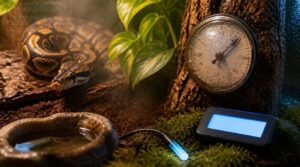
Your hygrometer’s job sounds simple—measure moisture in the air—but that number carries real weight for your snake’s health. Get it wrong, and you’re risking dehydration, bad sheds, or respiratory trouble without even knowing it. Here’s what that reading actually means, and why your enclosure setup depends on it.
Knowing your species’ target range is only half the battle, so check out this breakdown of ideal humidity levels for snake enclosures to fine-tune your setup with confidence.
Relative Humidity Basics
Here’s the number every keeper needs tattooed on their brain: relative humidity is a ratio, not a raw count. It’s the water vapor in your enclosure’s air measured against that air’s maximum vapor capacity at the current temperature—its saturation point. Hit 100%, and the air’s saturated, no more moisture allowed in. Your digital hygrometer or analog dial reads that percentage, not the actual moisture load.
Relative humidity isn’t a raw moisture count—it’s a ratio measuring vapor against the air’s maximum capacity at that temperature
Understanding air temperature’s influence is key since it directly changes the air’s moisture-holding capacity.
Humidity Versus Temperature
Warm air holds more moisture—simple as that. As temperature climbs, moisture capacity shifts upward, and the same vapor load reads as lower relative humidity.
Cool that air back down and dew point behavior kicks in: condensation risk climbs fast. This is exactly why analog vs digital humidity monitors respond so differently to shifting enclosure temps.
Snake Enclosure Moisture Needs
Every species has a number to hit—miss it, and shedding problems follow fast.
- Tropical snakes: 70–90% RH
- Temperate species: 50–70% RH
- Desert dwellers: 20–40% RH
Substrate like coco coir stabilizes these targets, while humid hides create microclimates for shedding support. Misting schedules and moisture control devices—whether analog vs digital humidity monitors—determine whether your snake enclosure hits its mark or drifts into dangerous territory.
Why Readings Matter
Hitting that RH target isn’t cosmetic—it’s the difference between a clean shed and a health crisis. Accurate readings mean preventing respiratory issues, catching mold before it spreads, and managing shedding cycles before stuck skin becomes a vet visit.
Whether you trust analog hygrometers or digital hygrometers, sensor accuracy drives every decision in reptile husbandry, from monitoring substrate moisture to guiding cleaning intervals.
Analog Reptile Hygrometers Explained
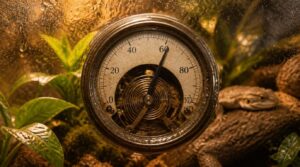
Analog hygrometers look simple, and that’s the point—no circuits, no screens, just old-school mechanics doing the work. But "simple" doesn’t mean "basic," and there’s more going on inside that dial than most keepers realize. Here’s what actually makes these units tick.
Mechanical Sensor Parts
Crack open an analog hygrometer and you’ll find no circuits at all — just physics doing the work. A hygroscopic coil expands and contracts with moisture, pulling a small mechanical linkage. Some units use hair elements or salt-impregnated paper instead.
There’s no strain gauge, no piezoresistive material, no MEMS microstructure here. It’s pure mechanical transduction: humidity in, physical movement out, nothing electronic involved.
Needle-and-dial Display
A dial with a needle sweeping across it — that’s the whole readout, no decimals, just visual estimation. Parallax error creeps in fast if you’re not looking dead-on.
| Feature | Analog Detail | Risk |
|---|---|---|
| Scale | Linear increments | Misjudged values |
| Needle | Slow sweep | Delayed reading |
| Zeroing | Calibration screws | Drift if skipped |
Visual glance monitoring works, but only with careful eyes.
No Battery Required
No wiring, no battery bin, no risk of dead cells fogging up a humidity monitor overnight. Passive sensor mechanics — hygroscopic material expanding and contracting — power the whole readout for free.
- Zero-electricity reliability near misting systems
- Safer remote enclosure placement
- No corrosion-prone battery contacts
- Simpler reptile enclosure setup
- Truly batteryfree operation, indefinitely
Powerless monitoring just works, quietly, for years.
Slower Humidity Response
That needle doesn’t lie—it just stalls. Mechanical inertia in analog hygrometers means heavier sensing parts resist quick change, while thermal mass and airflow lag slow equilibration further. Hysteresis compounds the delay, causing readings to trail actual relative humidity by minutes, not seconds.
Digital hygrometers, built on faster sensor technology, expose this gap—critical when humidity control decisions can’t wait.
Digital Reptile Hygrometers Explained
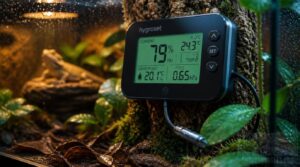
Digital hygrometers flip the script on humidity monitoring entirely. No guessing, no squinting at a dial—just hard numbers backed by real electronics. Here’s what’s actually running under the hood.
Electronic Humidity Sensors
Under the hood, digital hygrometers rely on capacitive or resistive sensors to read moisture instead of guessing off a needle.
Capacitive sensing tracks dielectric shifts in a polymer layer, while resistive film drift can creep in over time. Both fight hysteresis effects, and microprocessors handle temperature cross-sensitivity through built-in compensation—delivering readings you can actually trust.
LCD or LED Display
Screen tech matters more than you’d think. LCD panels use LED backlighting for crisp, low-glare readouts—far easier on the eyes than squinting at a dial in dim lighting.
You get steady nighttime visibility, stable viewing angles, and accurate color rendering even after years of use. LED backlights offer long lifespan and efficient power draw, so your digital display stays sharp without draining batteries fast.
Fast Real-time Readings
Speed is where digital hygrometers earn their keep. Most units refresh every second—some as fast as 0.5 seconds—giving you true realtime measurements instead of guesswork.
That sensor polling frequency means humidity spike detection happens in under a second, sharpening misting cycle precision and automation trigger speed. Your digital readout reflects actual air moisture, not yesterday’s conditions—critical for rapid dewpoint context and catching trouble before it snowballs.
Built-in Temperature Tracking
Humidity’s only half the equation—your snake’s health hinges on temperature and humidity control working together, and digital hygrometers deliver both on one screen.
Solid-state thermistors track:
- Basking spot accuracy (peak heat zones)
- Ambient refuge tracking (cool-side stability)
- Thermal gradient assessment across the enclosure
Timestamped data helps with thermoregulation cycle monitoring and daily stability evaluation—no fuss, just a reliable digital readout you can trust.
Digital Vs Analog Accuracy
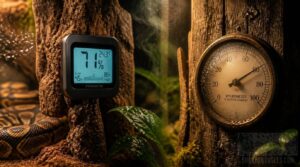
Numbers don’t lie, but not all hygrometers give you honest ones. When accuracy makes or breaks your snake’s health, guesswork isn’t an option. Here’s where digital and analog readings really start to pull apart.
Typical Error Margins
Numbers don’t lie, but they can definitely stretch. Analog hygrometers tend to drift ±5-10 points off actual humidity, while digital hygrometers hold tighter, around 2-5 points MOE.
| Type | Typical MOE |
|---|---|
| Analog | 5-10% RH |
| Digital | 2-5% RH |
Sensor drift, calibration accuracy gaps, and placement deviation add further slippage—meaning your margin of error compounds fast without proper upkeep.
Needle Estimation Problems
Parallax distortion makes analog dials lie by angle alone—read from the side, and the needle can look 5-8% off true. Add needle drift from mounting slack and mechanical friction bias, plus nonuniform scale spacing, and estimation guesswork stacks up fast.
| Problem | Cause | Effect |
|---|---|---|
| Parallax | Viewing angle | False reading |
| Drift | Loose mount | Position lag |
| Hysteresis | Friction/memory | Delayed response |
Temperature Compensation Benefits
Here’s where digital pulls ahead: temperature compensation built into the microprocessor. As enclosure temps swing after feeding or misting, thermal drift skews readings—compensation corrects it in real time, preserving reading integrity.
| Method | Mechanism | Result |
|---|---|---|
| Passive | Fixed resistors | Basic drift offset |
| Active | Secondary sensor | Precise correction |
| None (analog) | No correction | Thermal-driven error |
Analog units lack this entirely—no fuss, no fix. That gap directly threatens microclimate stability.
Calibration Impact
Skip calibration, and even the best sensor lies to you—slowly, then completely.
Sensor drift creeps into both types, but analog needle looseness makes it worse during salt test checks. Digital units hold within ±3% RH post-calibration; analog often can’t.
| Device | Post-Calibration Accuracy |
|---|---|
| Digital | ±1-3% RH |
| Analog | ±5-8% RH |
| Uncalibrated | Setpoint errors, drift risk |
Response Time Differences
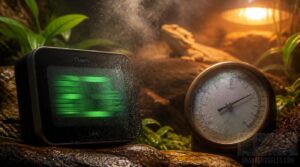
Speed matters just as much as accuracy—especially when conditions shift fast inside your enclosure. A hygrometer that lags behind reality leaves you reacting too late, and with reptiles, timing is everything. Here’s where digital and analog really part ways.
Fast Digital Updates
Blink, and the reading’s already changed. Digital hygrometers push sensor refresh rates of 1–2 seconds, thanks to capacitive sensing ICs built for real-time data throughput. That’s razor-thin latency in monitoring — critical when misting spikes humidity fast.
Add automated threshold alerts, and your microclimate update speed keeps pace with your snake’s actual environment, not yesterday’s guess.
Slow Analog Movement
That needle glides, never jumps — mechanical inertia effects in analog hygrometers force gradual movement through springs and dampers. This dampening mechanism function creates smooth, continuous sweep perception rather than sudden shifts.
The tradeoff? Accuracy and precision suffer during rapid swings. Any humidity monitor built this way excels at gradual trend monitoring, not quick catches — useful for hysteresis study potential, dangerous when you need answers now.
Sudden Misting Changes
Mist a fogger and watch the spike hit peak in 30 to 60 seconds flat. Evaporative cooling drops nearby temps, while fog pockets blind analog needles entirely. Substrate moisture spikes too, absorbed fast by coconut fiber.
Analog hygrometers overshoot or miss it; digital hygrometers with proper sensor placement catch it—critical for real humidity control, not guesswork, during habitat maintenance.
Humid Hide Monitoring
A humid hide hides its secrets from an analog needle every time. Microclimate probe placement matters here—wired digital probes slip inside without disturbing the reptile, tracking real moisture level shifts as they happen.
Analog units can’t fit that space at all. That’s why digital hygrometers pair naturally with substrate mold prevention, catching hide temperature gradients and moisture retention methods before mold takes hold.
Shedding Season Adjustments
Shedding season demands tighter humidity control, and digital hygrometers earn their keep here. Humidity misting schedules shift as day length changes trigger molt hormones.
- Raise humidity 5-10% pre-shed
- Track hydration during molts
- Support nutrition for shedding
- Inspect post-shed skin fully
Analog units lag behind fast shifts, risking stuck shed in snake enclosures when photoperiod cues demand quick response.
Display and Feature Comparison
Numbers only tell half the story—what you see on screen matters just as much. Digital hygrometers pack in extra features analog dials simply can’t touch. Here’s what to look for on that display.
Backlit Screen Benefits
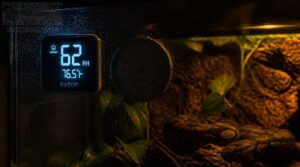
Backlit screen benefits matter more than most keepers realize when your snake’s enclosure sits in a dim corner. Nighttime monitoring becomes fuss-free—no flashlight needed, no disturbing your reptile. Digital hygrometers offer much better visual clarity and viewing angle stability versus analog humidity monitors’ parallax-prone dials.
| Feature | Digital | Analog |
|---|---|---|
| Night readability | Excellent | Poor |
| Eye strain | Low | Higher |
| Viewing angle | Stable | Distorted |
Dual Temperature Display
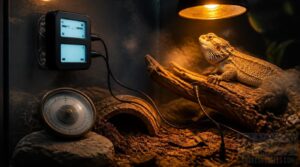
One display, two truths. Many digital hygrometers now pair humidity with dual channel precision—tracking ambient air against substrate temperature simultaneously.
| Zone | Reads | Danger Sign |
|---|---|---|
| Ambient | Air temp | Overheating |
| Substrate | Ground temp | Cold burns |
Smart probe placement strategies separate these microclimates, giving you real numbers instead of guesswork across your enclosure.
Min-max Memory Tracking

Numbers alone don’t tell the whole story—min-max memory tracking fills the gap by logging the lowest and highest humidity readings since your last reset.
| Value | Reveals |
|---|---|
| Min | Dry-out risk |
| Max | Moisture spikes |
This catches extreme value detection while you’re at work—transient spikes single reads miss entirely. Analog hygrometers can’t do this. Digital hygrometers can, turning historical data analysis into real prevention.
Wireless Monitoring Options
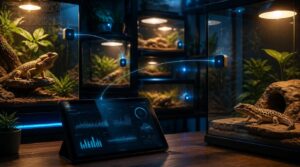
Ever wonder how keepers track multiple enclosures without opening a single door? Wireless monitoring solves it—Wi-Fi, Bluetooth, or Zigbee mesh handle Wireless Protocol Selection based on your setup’s size.
| Protocol | Best For |
|---|---|
| Wi-Fi | Single rooms |
| Zigbee | Multi-enclosure labs |
| LoRaWAN | Remote facilities |
Cloud Dashboard Features add remote viewing, while Data Encryption Security and smart Battery Management Strategies keep data safe and devices running—no fuss, real environmental monitoring.
Humidity Alert Alarms
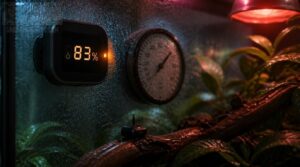
Why wait for disaster before you notice? A humidity alarm flags trouble the second RH drifts outside your set range—no guessing.
| Feature | Function |
|---|---|
| Threshold Setting Strategies | Custom high/low RH limits |
| Alarm Event Logging | Timestamped history review |
Dwell timers prevent nuisance alarms from brief spikes, while Remote SMS Notifications and dew point context keep your humidity control airtight—digital hygrometers deliver this; analog hygrometers can’t.
Power and Maintenance Needs
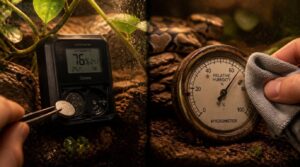
Every hygrometer demands upkeep — no fuss, no exceptions. Skip it, and you’re risking bad readings right when your snake needs accuracy most. Here’s what keeping these devices running actually looks like, day to day.
Digital Battery Replacement
Every digital hygrometer runs on batteries—and swapping them wrong invites real risk. Always match the correct battery chemistry to manufacturer specs; mismatched cells strain built-in battery management systems and can trip safety faults.
Watch polarity connection errors during reassembly—reversed terminals damage circuits instantly. Test the unit afterward, and dispose of old batteries through proper hazardous waste channels, never household trash.
Analog Dust Buildup
Dust is silent, but it’s relentless. It slips through vents and seams every time you open the enclosure, settling on the sensor drum and linkage until friction slows needle movement.
Humidity turns it sticky—harder to clean, easier to jam. Buildup on the dial face dims contrast, too, so those numbers you’re squinting at? Already compromised.
Sensor Wear Over Time
Wear doesn’t stop at dust—it goes molecular. Membrane hydrolysis breaks down sensing surfaces in digital hygrometers, cutting sensitivity up to 15% after two years in humid tanks. Component oxidation adds resistor drift and capacitance loss, shifting baselines slowly.
Analog needles suffer too: friction wear knocks accuracy ±2 to ±5% within 24 months. Chemical vapors from substrates worsen calibration drift in both types—no sensor’s immune.
Regular Inspection Habits
Consistency beats intuition. Build a routine: same time daily for readings, weekly comparisons for anomalies, quarterly deep-dives for hardware.
- Daily logging routines to catch drift early
- Sensor placement errors from shifted decor or airflow
- Hardware wear checks on brackets, seals, and cables
Catching identifying reading anomalies fast means less guesswork later—and a solid corrective action plan keeps pet habitat maintenance from becoming reactive scrambling.
Long-term Reliability
Long-term reliability comes down to what’s inside. Corrosion resistant plastics and sealed housings hold up 5 to 10 years, but sensor membranes only handle around 100,000 data cycles before drift creeps in.
Digital hygrometers risk biofilm buildup on probes—clean them often. Firmware compensation updates and salt slurry verification keep readings honest, no fuss, for years to come.
Calibration for Reptile Enclosures
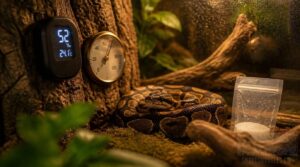
No hygrometer stays accurate forever—drift happens, even to the good ones. Calibration is how you catch that drift before it costs you a shed or a sick snake. Here’s what keeping your readings honest actually involves.
Salt Test Method
Grab your salt test kit before trusting any hygrometer blindly. The salt test calibration method works the same for analog hygrometers and digital hygrometers: precise saline solution preparation (5% NaCl), controlled salt deposition rates, then corrosion pattern inspection and mass loss analysis against testing standard compliance.
For snake enclosures, this catches drift early—no fuss, just verified accuracy before it costs you a shed cycle or worse.
Digital Calibration Schedule
Passing the salt test once isn’t enough—digital hygrometers need a set schedule, usually quarterly, based on manufacturer guidance and drift trends. Automated reminder software takes care of the nagging part, logging traceability documentation standards for compliance.
Environmental impact factors—humidity swings, shedding season—shorten that window fast. Smart keepers build in contingency backup planning too: a spare unit keeps monitoring running while sensor drift gets addressed.
Analog Recalibration Needs
Digital drift gets caught by software. Analog hygrometers have no such luxury—cumulative drift creeps in from aging hygroscopic coils, demanding hands-on fixes.
Quarterly to semiannual saltwater saline testing realigns the needle. Watch the temperature-humidity relationship closely, too.
Recalibration basics:
- Reset with a 75% RH salt reference
- Adjust mechanical needle alignment
- Log results for drift detection trends
Checking Inaccurate Readings
Why does a hygrometer suddenly seem "off"? Usually it’s not sensor drift at all—it’s draft interference, sensor fouling from substrate residue, or condensation distortion after cool nights.
Before blaming the unit, check placement and run a quick microclimate verification across several enclosure spots. Rule out seasonal drift, too. Only after eliminating these factors should you suspect real sensor accuracy problems in digital humidity monitors or analog hygrometers.
When to Replace Units
How long should a hygrometer last before you toss it? Once salt-test calibration fails twice running, replace it—don’t keep patching.
- Sensor drift beyond ±5% RH after recalibration
- Needle sticking or dial cracking (analog)
- Digital display flickers or dies early
- Unit older than 2-3 years, heavy use
Repair costs versus a $15-20 replacement rarely favor patching aging hardware.
Best Uses for Each Type

Not every enclosure needs the same tool—matching the hygrometer to the setup is where keepers go wrong. Some tanks call for simple, no-fuss monitoring, while others demand precision down to the percentage point. Here’s how to sort out which type earns a spot in your reptile’s home.
Analog for Simple Setups
Not every enclosure needs a computer chip to tell you it’s humid. For arid or budget setups — ball pythons, kingsnakes, minimalist terrariums — an analog hygrometer’s hygroscopic coil does the job with zero batteries and no fuss.
It’s slow, sure, but that’s fine for stable environments. Think of it as a no-power sanity check, and a genuinely useful teaching tool for new keepers learning humidity basics.
Digital for Tropical Snakes
Boiga and corallus species don’t forgive guesswork. Their tropical humidity range demands precision instrumentation — capacitive sensors reading in real time, catching every misting event as it happens.
Shedding cycle monitoring gets easier too: a humidity alarm flags drift before it stalls a shed. Add microclimate sensor placement near hides, and you’re managing the enclosure like a pro, not guessing at a dial.
Probes for Humid Hides
Ambient readings lie by omission — they miss what’s happening inside the hide itself. Microclimate probe placement matters: position sensors at head-depth, moisture-sealed against damp substrate.
Waterproof sleeves prevent corrosion. Compare hide humidity against enclosure air regularly. Set humidity alert thresholds to catch drying pockets before shedding problems start — no fuss, just accurate microclimate data where your reptile actually lives.
External Display Placement
Where you mount that screen decides whether you catch trouble early or miss it entirely. Best viewing height sits around 60-65 cm, angled 30-45 degrees to prevent distortion.
- Offset from basking lights (glare reduction)
- Use anti-glare covers
- Secure cables away from lids
Splash-resistant housing and sturdy brackets protect digital humidity monitors near humid terrarium setups—no fuss, just reliable microclimate management.
Using Both Together
Why pick a side? Running analog and digital hygrometers together gives you cross-verification without guesswork.
Place one near the humid hide, one up top—compare response speeds during misting, note any drift, and validate trends over weeks. This dual-sensor setup catches false readings fast, sharpening your microclimate management and giving your habitat the precision serious exotic pet care demands.
Choosing a Snake Hygrometer
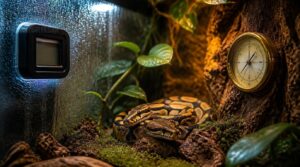
Picking the right hygrometer isn’t about brand loyalty—it’s about matching the tool to your snake’s actual needs. Species, tank size, budget, and mounting safety all pull weight in that decision. Here’s what to weigh before you buy.
Match Your Snake Species
Where your snake calls home, geographically speaking, should drive your hygrometer choice more than habit or price tag. Desert species tolerate analog humidity monitors fine, given their forgiving 20-40% range.
But Southeast Asian snakes needing 70-90% for tropical monsoon mimicry, or arboreal species requiring precise microclimates, demand digital humidity monitors—no fuss, no guesswork, just accurate exotic pet care built for their biology.
Prioritize Accuracy Needs
Species matching gets you in the right ballpark. Accuracy needs get you precision.
For monsoon-mimicking tropicals, demand ±3% RH margin with active temperature compensation—drift beyond that risks respiratory issues. Desert setups tolerate wider swings, but check sensor linearity across the full range regardless. Calibrate monthly using the salt test; document every offset. Precision humidity solutions aren’t optional for critical species—they’re survival tools.
Consider Enclosure Size
Bigger tanks change the math entirely. More floor space means broader thermal gradient mapping and multiple microclimate zones—each needs its own reading. A single hygrometer can’t cover a 4-foot enclosure; airflow stagnation risks hide in corners.
Scale substrate volume and misting frequency to match square footage, then place sensors per zone. Undersized readings breed false confidence.
Balance Cost and Features
Money talks, but don’t let it shout down accuracy. Analog hygrometers run –20 cheaper upfront—fine for simple, arid setups. Digital humidity monitors cost more but add temperature sensing, alarms, and logging.
Weigh long-term operating expenses: batteries every 6–24 months versus recalibration drift. For tropical species, sensor accuracy justifies the premium every time.
Pick Safer Mounting Options
Where you mount it matters as much as which type you buy. Use corrosion resistant hardware—stainless steel or zinc-plated screws—since humid enclosures chew through cheap metal fast.
Skip adhesive strips near basking spots; UV stabilized materials and powder-coated brackets hold up better. Keep secure cable management in place, avoid heat sources, and inspect mounts quarterly to prevent hardware fatigue before it compromises your snake’s safety.
Frequently Asked Questions (FAQs)
Is an analog hygrometer better than a digital?
Picture a needle drifting like a lazy compass while your snake’s skin dries out unnoticed. Analog wins on budget and simplicity, but digital delivers the precision vs reliability balance tropical species demand—accuracy matters more than nostalgia when shedding’s on the line.
What is the best hygrometer for reptiles?
For tropical species and humid hides, digital wins for accuracy and microclimate monitoring. Budget arid setups can rely on analog. Match your snake’s species-specific needs, weigh cost against performance, and prioritize long-term sensor reliability.
Which hygrometers are the most accurate?
Trust, but verify — digital hygrometers with capacitive sensors and temperature compensation deliver pinpoint accuracy (±1-3% RH), crushing analog’s ±5-8% error margin. Parallax and needle drift make analog guesswork risky. Always confirm with a salt test before trusting any reading.
What are the two types of hygrometers?
Two primary device categories exist: analog hygrometers, using mechanical, hygroscopic parts that expand with moisture, and digital hygrometers, relying on electronic sensors—capacitive or resistive—paired with microprocessors for precise, real-time humidity monitor readings.
Can I use two hygrometers in one enclosure?
Yes—like having a second set of eyes on your terrarium. Using dual hygrometers catches sensor placement bias, reveals vertical humidity stratification, and helps with cross-validation between zones—critical for spotting moisture pockets in tropical snake enclosures before they become real problems.
Do hygrometers work for other reptile species too?
Absolutely—hygrometers work across chameleons, geckos, frogs, and tortoises alike.
Microclimate species variation matters most: desert reptile hydration needs low RH, arboreal species and amphibian moisture needs demand higher humidity, and aquatic habitat monitoring requires specialized waterproof probes for accurate terrarium readings.
How much do reptile hygrometers typically cost?
Budgeting for setups runs wide: basic analog hygrometers cost $5–15, while feature-packed digital models with alarms or dual sensors hit $40– Bundles, seasonal sales, and brand variance shift pricing further—so match cost to your terrarium equipment’s actual moisture measurement demands.
Where can I buy a reliable reptile hygrometer?
Amazon and Chewy offer wide selection with buyer reviews; manufacturer sites like Zoo Med sell direct with warranties. Prioritize sensor accuracy (±1-3% RH digital) over price—specialty terrarium shops help verify calibration and mounting fit before you buy.
Can hygrometer sensors interfere with heating equipment?
Here’s a surprise: EMI from heaters can inject noise straight into your sensor’s electronics. Sensor self-heating, power fluctuations, and poor shielding all create thermal bias risks, skewing temperature readings and destabilizing environmental stability for small pets.
Conclusion
A dial guesses. A sensor knows. That’s the real difference between digital and analog reptile hygrometer tech—one drifts silently while the other catches trouble in seconds.
Your python doesn’t care about convenience; it cares about precise humidity control, day after day, shed after shed. Choose the tool that matches the stakes: a digital probe for tropical species, a calibrated dial for simple setups. Get the reading right, and everything else in the enclosure falls into place.