This site is supported by our readers. We may earn a commission, at no cost to you, if you purchase through links.
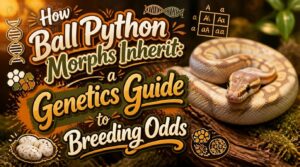
Breed two Pastels together, and you won’t get a bigger Pastel by accident. You’ll get one on purpose, because the math behind it is fixed. Every ball python morph, from a simple het carrier to a flashy Super form, follows rules laid down in the DNA, not chance.
That predictability is what separates a hobbyist rolling dice from a breeder who books clutches with confidence. Understanding how ball python morphs inherit turns guesswork into strategy, letting you predict odds before the first egg drops.
Get the genetics right, and every pairing becomes a calculated bet, not a gamble.
Table Of Contents
- Key Takeaways
- Ball Python Morphs Follow Predictable Genetics
- Dominant and Incomplete-Dominant Morph Inheritance
- Recessive Morphs and Het Carriers
- Calculate Offspring Morph Probabilities
- Plan Healthy, Traceable Morph Pairings
- Frequently Asked Questions (FAQs)
- What is the rarest morph of ball python?
- Which ball python morphs to avoid?
- What ball python genes are recessive?
- What determines a ball python’s morph?
- How many ball python morphs exist today?
- Can outcrossing lower the risk of genetic disorders?
- Why does Spider morph cause head-shaking symptoms?
- How long does a recessive morph breeding project take?
- Conclusion
Key Takeaways
- Morph inheritance follows fixed genetic rules, so knowing whether a gene is dominant, incomplete-dominant, or recessive lets you predict breeding odds before you ever pair two snakes.
- Gene dosage matters just as much as inheritance type—one copy often gives a milder look (like Pastel or het carriers), while two copies push toward a fuller expression (like Super Pastel or visual Albino).
- Recessive traits like Albino and Pied hide silently in het carriers, so pairing het x het only yields 25% visual, 50% het, and 25% clear, with DNA testing being the only reliable way to confirm carrier status.
- A responsible breeding plan goes beyond running the numbers—it means tracking lineage, avoiding harmful gene combos, and rotating bloodlines to protect genetic diversity and animal health.
Ball Python Morphs Follow Predictable Genetics
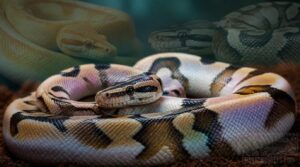
Every morph you’ll ever breed follows rules laid down at the DNA level, not chance. Once you understand how genes get passed on, those breeding odds stop feeling like guesswork. Here’s the foundation you need before running any pairing.
Before pairing any pair of morphs, it’s worth reviewing this step-by-step guide to breeding ball pythons for specific traits to confirm your genetic assumptions hold up.
Genes, Alleles, and Mutations
Before you predict a single hatchling, you need the vocabulary. A gene is a DNA sequence coding a trait. Alleles are gene versions, one from each parent. Each allele occupies the same fixed locus on a chromosome, which is why paired versions of a gene can be compared directly. Mutations create new alleles, the raw material for every morph you’ll ever breed:
- Point mutations swap single DNA letters
- Deletions drop sequences entirely
- Duplications copy segments
- Insertions add new material
Genotype Versus Phenotype
Now that you know where mutations live, ask what they actually do. Genotype is the allele pair itself; phenotype is what you see in the shed skin and scales.
| Genotype | Phenotype |
|---|---|
| Two normal alleles | Normal pattern |
| One Pastel allele | Pastel colors |
| Two Pastel alleles | Super Pastel |
| One Albino allele | Normal (carrier) |
One Copy Versus Two
Dosage matters as much as inheritance type. One copy often gives you a heterozygous intermediate form; two copies push toward full homozygous expression.
- One copy: partial trait, softer intensity
- Two copies: saturated, stronger phenotype
- Dosage effect: visual intensity scales with allele count
Same gene, different volume. Pastel to Super Pastel shows this scaling perfectly.
Visual Traits Versus Carriers
Not every snake carrying a gene looks the part. Visual traits show up in coloration; het carriers hide the same allele silently.
| Status | Genotype | Phenotype |
|---|---|---|
| Visual | Two copies | Full expression |
| Het | One copy | Normal-looking |
| Normal | Zero copies | No trait |
| Carrier | Unconfirmed | Testing needed |
| Confirmed | qPCR verified | Breeding-ready |
Genetic testing settles the guesswork.
Dominant and Incomplete-Dominant Morph Inheritance
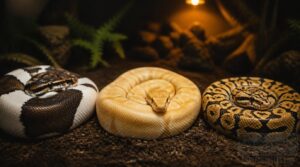
Dominant and incomplete-dominant genes play by the easiest rules in the book. One copy is often all it takes to change how a snake looks, and two copies can push that look even further. Here’s how that plays out across some of the industry’s most recognizable morphs.
Pairing a pastel with a fire, for instance, can layer incomplete-dominant traits into a brighter, blended morph — a great example of how snake color and pattern inheritance shapes what breeders see in the clutch.
Dominant One-Copy Expression
One copy is all it takes. With dominant allele expression, a single mutated gene produces the full visual morph, no second copy needed.
Take Spider: breed it to a normal, and heterozygous offspring look exactly like homozygous ones. Phenotype matches genotype here.
- One parent carries the gene
- Half of offspring inherit it
- Those offspring show it visually
- No hets hide in the mix
Incomplete-Dominant Super Forms
Gene dosage changes everything with incomplete dominance. One copy gives a baseline look; two copies push phenotype intensity further, think Super Pastel brightness and bolder pattern blending.
| Genotype | Phenotype | Trait Heritability |
|---|---|---|
| Wild type | Standard | Baseline |
| Single copy | Intermediate | Stable |
| Double copy | Super form | Consistent |
Spider and Pinstripe Examples
Spider and Pinstripe show two inheritance styles side by side.
Spider follows co-dominant inheritance, one copy gives balanced webbing, two copies push finer reticulation, though watch for Spider Wobble in het carriers.
Pinstripe acts as a true dominant, one copy narrows striping instantly.
Combine both, and dosage stacks: expect intricate patterns ranging from bold webbing to clean stripes.
Pastel and Super Pastel
Pastel is your classic codominant workhorse. One copy brightens ground color and sharpens pattern edges; two copies (Super Pastel) push melanin reduction further, yielding uniform, washed-out brilliance.
Key allele dosage effects:
- Het carriers show mild lightening
- Homozygous form intensifies brightness
- Pattern clarity increases with dosage
- Head speckling reduces visually
- Lineage tracking affects resale value
Mojave and Lesser Interactions
Mojave and Lesser belong to the same allele family, the Mojave Complex, so pairing them triggers real allele interaction, not just addition. Expect color blending effects: reduced yellow wash, softer bands. Pattern softening replaces sharp edges with waviness.
Clutch consistency holds, though some hatchlings show pure phenotype expression. Genotype tracking and carrier identification matter, since Mojave lineage can hide Lesser genes invisibly.
Recessive Morphs and Het Carriers
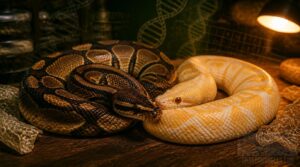
Recessive genes play the long game, hiding in plain sight until you pair the right two snakes. That’s what makes morphs like Albino and Piebald so satisfying to produce, but also the slowest to plan for. Here’s what you need to know about spotting carriers and stacking the odds in your favor.
If you’re not sure whether a morph is recessive or dominant, this breakdown of codominant vs recessive ball pythons clears up the confusion fast.
Two-Copy Visual Expression
Two copies of a recessive allele reveal the phenotype hiding behind every het. This is homozygous expression in action: gene dosage flips from silent to visible.
That doubling isn’t just on/off. Allele amplification boosts visual intensity and trait saturation, producing stable, heritable double recessive phenotypes you’ll see consistently, generation after generation, in every visual offspring carrying both copies.
Albino and Pied Examples
Albino gives you the textbook case: two copies strip melanin entirely, leaving ivory skin and pink eyes.
Pied works differently, an incomplete dominant pied pattern where one copy shows partial white patching. Stack both traits in an Albino pied hybrid, and you get pink eyes framed against bold white patches, a genotype worth planning around carefully.
Visual Versus Het Pairings
Once you know your genotype, pairing strategy decides your odds. Visual x visual crosses stack the trait in every offspring’s genotype, guaranteeing visual pythons.
Het x het pairs work differently. Run the Punnett square, and Mendelian ratios show 25% visual, 50% het, 25% normal, phenotype hiding genotype in that middle group entirely.
Since that recessive gene stays invisible until paired up, breeders often turn to a ball python morph combination odds calculator to map out probabilities before committing to a pairing.
Possible Het Percentages
Not every het pairing carries the same odds. That "50%" figure only applies to specific crosses.
- Het x normal: 0% chance, no guaranteed carriers
- Het x het: 25% visual, 50% het
- Visual x het: 50% visual, 50% het
- Visual x normal: 100% het
Know your parents’ genotypes before promising buyers anything.
Confirming Carrier Status
Those percentages are only as good as your proof. DNA testing confirms zygosity through molecular methods like qPCR, measuring gene copies directly.
| Method | Reliability |
|---|---|
| Visual guess | Low |
| Pedigree records | Moderate |
| DNA/qPCR test | High |
Pair breeding records with lab work. A het that "might" be het isn’t a het you can sell with confidence.
Calculate Offspring Morph Probabilities
Punnett squares only get you so far once real pairings enter the picture. You need actual math to know your odds before you commit a season to a clutch. Here’s how to run the numbers on four common breeding scenarios.
Het-to-Het Recessive Outcomes
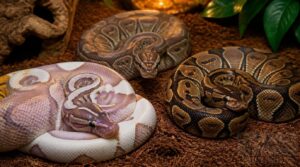
Pair two carriers and you’re rolling loaded dice toward recessive traits. Punnett Squares show classic Mendelian ratios: 25% double recessive, 50% het carriers, 25% clear.
That carrier offspring ratio holds true across large clutches:
- Visual morph expression (25%)
- Heterozygous het babies (50%)
- Normal, non-carrier hatchlings (25%)
- Genetic outcome prediction guiding your pairings
Het carrier identification still needs testing or proven lineage.
Double-Recessive Breeding Odds
Stacking two recessive morphs raises the stakes considerably. Double recessive offspring appear only when both parents carry both target genes, each locus following its own Mendelian ratio independently.
| Parent Genotypes | Offspring Outcome | Probability |
|---|---|---|
| Het × Het (Gene A) | Homozygous recessive | 25% |
| Het × Het (Gene B) | Homozygous recessive | 25% |
| Combined double recessive | Both traits visual | 6.25% |
| Single trait only | One visual, one het | 18.75% each |
| Neither trait | Clear, non-carrier | 56.25% |
That 6.25% figure demands patience and proper record-keeping.
Calculating Multi-Gene Pairings
Want three genes at once? Multiply each gene’s probability independently, since independent assortment means loci don’t influence each other.
A het Pastel, het Albino, het Clown cross gives 25% x 25% x 25% for triple homozygous, roughly 1.56%.
Complex Punnett squares become unwieldy fast, that’s exactly why breeders lean on calculators for stacked phenotype combinations.
Using Online Genetics Calculators

Doing that math by hand invites errors, so let the MorphMarket Genetics Calculator carry the load. Enter each parent’s genotype using standard notation, toggle het or visual status, and it builds the Punnett square instantly.
You’ll get phenotype and genotype breakdowns as percentages, plus trait probability for stacked genes. Cross-check against pedigree records before trusting any single result.
Plan Healthy, Traceable Morph Pairings

Punnett squares tell you the odds, but odds alone don’t make a good breeding plan. Healthy pairings take more than math—they take intention, records, and a little restraint. Here’s how to build a plan that protects your animals as much as it grows your project.
Start With Target Morphs
Every successful project begins with one clear target morph, not a wish list. Confirm its inheritance type first: dominant, incomplete-dominant, or recessive.
Identify lineages that reliably produce it, verify stable phenotype across generations, and avoid early backcrossing into unrelated morphs. Run Punnett squares before pairing. Genotype should match phenotype, every time, before you commit a breeding season to it.
Avoid Harmful Gene Pairings
Not every morph pairing deserves a green light. Some gene combos carry a lethal embryo risk, from spinal curvature to poor ventral scaling. Watch for:
- Overlapping toxin pathways stressing hatchlings
- Known Spider Wobble lineages
- Repeated failed clutches from one pairing
- Deformity patterns tied to two-gene matches
Pilot small clutches first. Genetic compatibility protects your whole project.
Track Lineage and Genetics
Piloting clutches only works if you know what’s actually in the gene pool. Pedigree verification across three-plus generations catches hidden inbreeding before it starts.
Track dates, breeder names, and unique scale markings for lineage authenticity checks. Registries assign verification codes for a reason.
Solid records turn Punnett square predictions into confirmed heterozygous carrier IDs, not guesswork.
Maintain Genetic Diversity
Good records mean nothing if your whole collection traces back to three sires. That’s genetic drift in action, alleles vanishing simply because you kept breeding the same lines.
Breeding the same lines from just three sires quietly erases alleles—that’s genetic drift at work
Rotate bloodlines deliberately. Track allele frequency across your pedigree, and outcross when heterozygosity dips. Diverse pairings dodge inbreeding risks and keep your program’s gene pool deep, not stagnant.
Verify Traits Before Breeding
Diverse genes mean nothing if your pairing plan is wrong from the start. Before any breeding, confirm each snake’s phenotype matches its paperwork, then trace lineage for hidden carriers.
Run genetic testing on carrier status claims. Punnett squares only work with accurate inputs. Parent verification and trait documentation aren’t paperwork, they’re your safeguard against costly, unexpected clutches.
Frequently Asked Questions (FAQs)
What is the rarest morph of ball python?
Rarity shifts with genetic combinations, but Blue Eyed Leucistic often tops the list, its pure white body and bright blue eyes stemming from recessive inheritance.
Scaleless morphs and complex patterns like Monsoon push genetic rarity even further into collector territory.
Which ball python morphs to avoid?
Which morphs carry hidden risk? Watch for Spider Wobble Risk (Spider Syndrome’s neurological defects) and vision-impairing white lineages. Health screening required before pairing; ethical breeding practices and genetic carrier tracking protect welfare, not just profit margins.
What ball python genes are recessive?
Albino, Pied, Clown, and Kalatoa top the recessive gene list. Each needs two copies (homozygous) for visual expression. Het carriers show no trait but pass genes on, making pedigree tracking essential for confirming carrier status before pairing.
What determines a ball python’s morph?
Your snake’s morph comes down to specific alleles mutating pigment genes at fixed chromosome loci. Whether that allele’s dominant, co-dominant, or recessive, and whether it’s homozygous or heterozygous, dictates the visual outcome you actually see.
How many ball python morphs exist today?
Counting morphs is like counting stars, you’ll never land on one true number.
Market listings, breeder naming conventions, and constant new morph discoveries push credible estimates past 4,000 recognized morphs, with official versus informal counts varying widely.
Can outcrossing lower the risk of genetic disorders?
Yes. Bringing in unrelated bloodlines boosts genetic diversity, masking harmful recessive alleles with healthy ones. This lowers homozygous disease odds, delivers hybrid vigor, and aligns with ethical breeding strategies focused on long-term health over short-term morph trends.
Why does Spider morph cause head-shaking symptoms?
Picture wiring crossed like tangled Christmas lights: that’s Spider genetics at work.
This genetic mutation creates neurological sensitivity affecting motor signaling, not a lethal gene, so environmental triggers and steady care management ease inherited head-shaking symptoms tied to visual processing quirks.
How long does a recessive morph breeding project take?
Budget 18 to 36 months across two to three breeding seasons. You’ll wait 30-60 days per clutch for hatchling emergence, plus 6-12 months confirming carrier status through lineage tracking before locking in true homozygous recessive traits.
Conclusion
Every clutch is a hand of cards dealt long before the eggs hatch, and now you know how to read them.
Once you understand how ball python morphs inherit, you stop hoping for hits and start stacking the odds. Punnett squares replace guesswork. Percentages replace luck. That’s the real power of genetics: it turns breeding from a gamble into a craft. Your next pairing isn’t chance. It’s calculated, and it’s yours to command.