This site is supported by our readers. We may earn a commission, at no cost to you, if you purchase through links.
A ball python’s thermostat can read 88°F on the warm side and still leave the animal stressed if humidity sits 20 points off target. That’s the trap so many keepers fall into: they watch one variable and ignore the other, then wonder why shedding turns messy or respiratory infections show up months later. Temperature and humidity move together, not separately, since warmer air holds more moisture and shifts the dew point right on your enclosure walls.
Learning how to monitor humidity and temperature together means treating your enclosure like a small climate system, with sensors, gradients, and thresholds that work in concert rather than isolation. Get the placement and calibration right, and the payoff shows up in cleaner sheds, steadier digestion, and a snake that never has to fight its own habitat.
Table Of Contents
- Key Takeaways
- Why Monitor Both in Snake Enclosures
- Choose The Right Monitoring Method
- Place Sensors for Accurate Readings
- Monitor Enclosure Conditions Step by Step
- Interpret Trends and Correct Problems
- Top 7 Temperature and Humidity Monitors
- 1. Ambient Weather Wireless Thermo Hygrometer
- 2. SensorPush HTP.xw Environmental Monitor
- 3. Sainlogic WiFi Weather Station with Alerts
- 4. GoveeLife WiFi Hygrometer Thermometer 3 Pack
- 5. GoveeLife Wi-Fi Gateway Thermo Hygrometer 3 Pack
- 6. LFF Indoor Outdoor Weather Station
- 7. Protmex PT6508 Digital Hygrometer Thermometer
- Frequently Asked Questions (FAQs)
- How to monitor temperature and humidity?
- What is worse, high humidity or high temperature?
- How can I monitor temperature and humidity remotely?
- What is the best humidity and temperature monitor?
- How often should I replace hygrometer and thermometer batteries?
- Whats the average lifespan of a digital hygrometer sensor?
- Conclusion
Key Takeaways
- Temperature and humidity aren’t separate readings—warmer air holds more moisture, so a shift in one always affects the other, and treating them as independent numbers is how keepers miss trouble brewing.
- Where you place your sensors matters as much as which device you buy: probes need to sit at eye level near the basking spot and away from vents, water sources, and direct sunlight to give you readings that actually reflect what your snake experiences.
- Humidity above 60% during shedding helps your snake molt cleanly, but the same range held too long invites mold within a day or two, so the sweet spot requires active monitoring, not a "set it and forget it" mindset.
- A single snapshot reading tells you almost nothing—logging data every few minutes, tracking daily min/max swings, and recalibrating sensors every few months is what turns raw numbers into a system you can actually trust and act on.
Why Monitor Both in Snake Enclosures
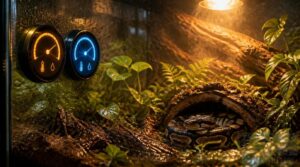
Temperature and humidity don’t work in isolation inside a snake enclosure; they constantly influence each other, and getting one wrong throws off the other. Your snake’s health depends on you tracking both together, not as separate numbers on separate gauges. Here’s what you need to understand before you pick up a single monitor.
A well-built humid hide for your snake gives you a controlled microclimate, making it easier to stabilize both readings at once.
Temperature and Humidity Interactions
Why do temperature swings hit your snake’s enclosure harder than you’d expect? Because heat and moisture are locked together. Warmer air raises moisture holding capacity, pushing dew point up and increasing condensation risk on glass and décor. High humidity also blocks evaporative cooling, spiking heat index and straining respiratory comfort, even when your thermostat reads normal.
In fact, a rise of just 10°C can double the air’s capacity to hold moisture, a fundamental part of the dew point and humidity relationship that keeps enclosure conditions unpredictable.
Species-specific Climate Requirements
No two species share a climate blueprint. A ball python’s warm side runs 88 to 92°F with 50-60% humidity, while arid species tolerate 40%. Species-specific climate requirements dictate everything: reptile thermal gradients, humidity shedding needs, species hydration levels.
Sensor placement and data logging reveal whether your healthy humidity range actually matches what your snake needs to thrive.
Warm and Cool Zones
Matching those species targets means building a real zone temperature gradient, not a single averaged reading. Basking surface temp near 88-92°F on one side, a cool zone retreat at 70-85°F on the other.
Sensor placement at both ends, feeding multiroom systems with real-time data, is how you confirm thermal zoning balance and humidity zoning control actually hold, with smartphone alerts flagging drift fast.
Shedding and Hydration Needs
Balanced zones matter for more than comfort, they also drive shedding cycles. Most snakes need humidity above 60% during molt, with brief spikes to 70-80% easing eyelid and spectacle shedding. Track this with smart sensors delivering real-time data.
Check hydration through skin elasticity tests and steady water source access. Weight checks, moist prey, and misting cycles all support healthy sheds.
Mold and Respiratory Risks
Since snakes can’t tell you their throat feels tight, you have to watch conditions for them. Prolonged humidity above 80% invites mold spore exposure, risking allergic reaction signs and respiratory symptom tracking becomes essential.
Since snakes can’t tell you their throat feels tight, prolonged humidity above 80% quietly invites mold spores and respiratory trouble
Watch for:
- Musty odors
- Wheezing or labored breathing
- Visible surface mold
Smart sensors flag humidity health impact early, supporting condensation prevention and long-term respiratory health.
Choose The Right Monitoring Method
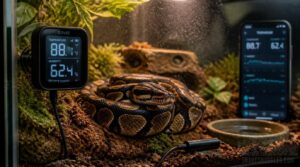
Not every monitoring setup fits every snake keeper’s needs, budget, or number of enclosures. You’ll want to weigh accuracy, sensor placement, and connectivity before settling on a system. Here’s what to think about as you compare your options.
Digital Versus Analog Monitors
Reptile enclosures live and die on sensor accuracy, so your first real decision is digital versus analog. Digital hygrometers process signals in binary, giving sharper, more stable readings, while analog dials drift with age.
| Factor | Digital | Analog |
|---|---|---|
| Accuracy | High, consistent | Drifts over time |
| Power | Low draw | None needed |
| Connectivity | Wi-Fi/Bluetooth options | None |
Probe Versus Built-in Sensors
Where you place the sensor matters as much as which one you buy. Probe placement accuracy captures true microclimates near hides, while built-in units average larger zones. Probes respond faster to spikes but need waterproofing.
- Probes: precise, mobile, faster response
- Built-ins: durable, sealed, simpler wiring
- Probes: cable wear risk
- Built-ins: fixed placement limits
Built-in sensor durability wins on low-maintenance enclosure fitting.
Smart Remote Monitoring
Ever check your snake’s humidity from a hotel room? Wireless monitoring makes it possible. Wi-Fi and Bluetooth sensors sync temperature and humidity readings to your phone, enabling remote humidity checking anywhere. Cloud data sync keeps historical trends accessible, while firmware updates deliver automatically.
Just watch battery life management, since constant transmission drains cells faster than standalone hygrometers, usually needing replacement every 6-12 months.
Data Logging and Alerts
A snapshot tells you little; a trend tells you everything. Set your log interval to capture readings every 1-5 minutes, storing timestamped data with sensor ID for accurate attribution.
Configure alert thresholds (humidity below 40%, temps above 85°F) with hysteresis to avoid notification fatigue. Track sensor health monitoring, audit trail logging, and retention policy alongside your realtime data for reliable wireless monitoring.
Multi-enclosure Monitoring Systems
One rack, ten snakes, one dashboard: that’s the payoff of a proper hub.
Each enclosure keeps its own sensor trio, feeding a central hub over wired or wireless network with sensor synchronization across all zones.
- Scales up to 20 enclosures per hub
- Local display panels for onsite checks
- Battery backup during outages
- CSV data export options for trend analysis
Set alert thresholds per enclosure since species requirements differ.
Place Sensors for Accurate Readings
Your monitor’s accuracy depends entirely on where you put the sensor, not just what device you buy. A probe sitting in the wrong spot will feed you numbers that don’t reflect what your snake actually experiences. Here’s exactly where each sensor needs to go for readings you can trust.
Warm-side Sensor Placement

Getting warm-side readings right starts with sensor height placement at the snake’s eye level, 2-3 inches below the basking hotspot, 6 inches from the heat pad edge, clear of substrate and airflow paths.
| Factor | Target |
|---|---|
| Height | Eye level |
| Heat distance | 6 in. |
| Substrate | No contact |
Choose non-absorbing housings; avoid metal or glossy surfaces that skew readings.
Cool-side Sensor Placement
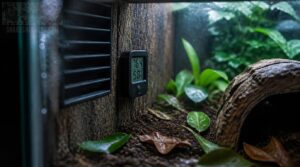
The cool side works differently than the warm side. Mount the sensor 1-2 inches above substrate, aligned with vent airflow, using vertical mounting orientation for accurate sensor accuracy. Keep 2 inches clearance from humidifiers and avoid LED heat sources.
This precise reptile enclosure monitoring approach mirrors indoor humidity recommendations, ensuring temperature and humidity readings reflect true microclimate conditions, not skewed local anomalies.
Measuring Ambient Humidity
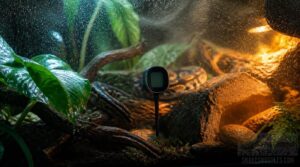
Beyond warm and cool zones, you need a true read on ambient humidity, the overall relative humidity filling the enclosure’s open air space.
- Place one sensor centrally, away from both heat sources
- Sample air at mid-height, not floor or ceiling level
- Log readings hourly for reliable trend data
- Cross-check with a secondary hygrometer for sensor accuracy
Avoiding Misleading Sensor Locations
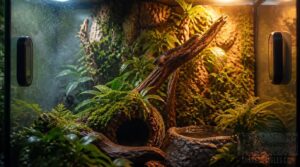
Even a well-calibrated sensor lies to you if it’s in the wrong spot.
Avoid direct sunlight, water sources, and vent placement, all of which create artificial heat or moisture spikes. Watch for enclosure decorations casting shade on probes.
Keep sensors at eye level, in breathing zones, not tucked into corners, and let each one acclimate for 15 minutes before trusting the readings.
Securing Probes Safely
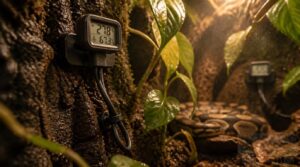
Once a sensor’s in place, don’t let it drift. Use heat resistant, non-conductive clips, add cable strain relief, and angle probes downward to avoid condensation pooling.
Keep sensor housing protection intact against substrate debris, space probes 15 cm apart to prevent interference, and inspect clip points quarterly, this small habit keeps your microclimate readings honest for months.
Monitor Enclosure Conditions Step by Step
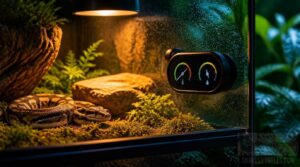
Once your sensors are placed correctly, the real work of monitoring begins. You need a consistent process to turn raw numbers into useful data about your snake’s environment. Here’s how to move from setup to a routine you can trust, step by step.
Set Species-specific Target Ranges
Every species has its own comfort zone, and guessing wastes time. Enter species preference ranges for your snake’s ideal temperature zones and humidity setpoints, covering both day and night. Build in daily range adjustments for seasonal shifts, then let target window monitoring flag drift automatically.
- Warm side: 26-32°C
- Cool side: 20-26°C
- Humidity: 40-70% RH
Calibrate Each Sensor
Trust starts with truth, and your sensors won’t tell it unless you check them. Compare each reading against a certified reference standard, then apply the offset for accurate correction. Recalibrate every 3-6 months, or after replacement.
Watch for drift detection: a sensor lagging 2°C behind reference readings needs immediate attention, not tolerance.
Record Initial Readings
Once calibrated, get a baseline temperature setup within the first hour: place a digital thermometer two inches from the substrate at enclosure level. Log initial humidity measurement with the same timestamp, plus your enclosure ambient reference reading.
Document date and time for traceability, and note any condensation observed on enclosure walls, an early clue to relative humidity problems ahead.
Check Daily Fluctuations
Snakes don’t read clocks, but their enclosures follow one anyway. Daily temp swings of 3-6°F and humidity range tracking of 5-15% are normal, driven by heat cycling and ventilation. Log morning readings and evening readings separately for trend analysis.
Watch for:
- Warm-side spikes signaling heater drift
- Humidity crashes during dry seasonal humidity shifts
- Overnight condensation hinting at poor airflow
Consistency reveals what single readings miss.
Review Minimum and Maximum Readings
Daily logs matter, but the extremes tell the real story. Pull your minmax memory weekly to catch dips below tolerance or spikes risking overheating.
Cross-check readings against adjacent spots for cold pockets, run a quick sensor accuracy check, and recalibrate anything drifting past 5%. That’s how temp range tracking and humidity trend analysis actually protect your snake, not just document conditions after the fact.
Interpret Trends and Correct Problems

Once you’ve logged a few days of readings, patterns start to reveal themselves, and those patterns tell you exactly where your setup is falling short. Fluctuating temps, sticky humidity, or foggy glass all point to specific fixes you can make with confidence. Here’s how to read those signals and correct each problem, one adjustment at a time.
Diagnose Temperature Fluctuations
When your readings jump around, don’t panic, start diagnosing. Gradient mapping with sensors in both zones reveals whether it’s real thermal cycling or bad placement.
- Check timestamp logging against HVAC cycles
- Verify ambient shielding from drafts
- Confirm sensor calibration hasn’t drifted
Daytime enclosures run warmer than night, that’s normal. Sudden spikes usually mean equipment issues, not your snake.
Address High Humidity
Once equipment issues are ruled out, tackle elevated RH head-on. Mold can colonize damp substrate within 24 to 72 hours above 60%, so act fast: boost cross ventilation, run a small dehumidifier, swap soaked substrate, cut back misting, and wipe down condensation during routine cleaning.
Digital hygrometers confirm results within 3-5% accuracy, same tools your indoor weather station or home humidity monitor already use.
Correct Low Humidity
On the flip side, dry air brings its own headaches. Below 30% RH, respiratory infections and irritated mucous membranes become real risks, and shedding cycles suffer too.
- Run misting systems on timers
- Add damp sphagnum moss
- Increase substrate depth
- Seal enclosure gaps
- Track dew point shifts
Humidity recovery starts with substrate moisture control, not just spraying water.
Manage Condensation and Mold
Fogged glass on the enclosure walls signals a dew point problem: warm, humid air meeting cooler surfaces. Left unchecked, that moisture invites mold within 24-48 hours.
| Warning Sign | Fix |
|---|---|
| Foggy glass | Add insulation |
| Damp corners | Increase ventilation |
| Musty smell | Clean, then reseal |
| Wet substrate | Reduce misting |
| Visible spots | Discard, disinfect |
Adjust Heating and Ventilation
Once you’ve diagnosed the problem, act on it. Thermostat adjustment paired with ventilation balance corrects most drift: raise setpoints 2-3°F for cool zones, or boost exhaust fan speed.
- Reposition heat source placement away from vents
- Rebalance intake and exhaust for airflow optimization
- Add duct insulation for thermal comfort
- Fine-tune humidity control via desiccants
- Test ventilation effectiveness after each change
Top 7 Temperature and Humidity Monitors
Once you know where and how to place your sensors, the next step is picking hardware that actually delivers on accuracy and reliability. Not every device experiences the humidity swings and heat gradients of a snake enclosure equally well, so the right pick depends on your setup and how closely you want to track conditions.
Here are seven monitors worth considering, each suited to different keeper needs and budgets.
1. Ambient Weather Wireless Thermo Hygrometer
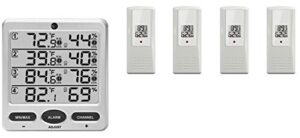
For keepers running several enclosures, the Ambient Weather Wireless Thermo Hygrometer earns its keep through sheer channel capacity. The base console displays four F007TH sensors simultaneously and expands to eight, so a rack of hatchlings or a multi-species collection stays visible from one dashboard.
Scroll mode cycles readings every five seconds, and adjustable alarms flag when temps or RH drift outside your set thresholds. Battery life runs short, and the screen lacks backlighting, so nighttime checks may require a flashlight.
| Best For | Reptile and amphibian keepers managing multiple enclosures who need to monitor temperature and humidity across several tanks or rooms from a single console. |
|---|---|
| Wireless Range | Standard RF range |
| Power Source | Battery/AC adapter |
| App Connectivity | No app |
| Alert System | Audible/visual alarms |
| Data Logging | Min/max reset |
| Multi-Sensor Support | Up to 8 |
| Additional Features |
|
- Displays up to four sensors at once and expands to eight, making it easy to track multiple enclosures simultaneously
- Customizable audible and visual alarms alert you the moment temperature or humidity drifts outside safe ranges
- Scroll mode automatically rotates through all connected sensors every five seconds for quick, hands-free monitoring
- Battery life is short, meaning frequent replacements or the need for an optional AC adapter
- No display backlight, which makes nighttime readings difficult without extra lighting
- Humidity readings receive mixed feedback, with some users reporting inconsistent accuracy over time
2. SensorPush HTP.xw Environmental Monitor
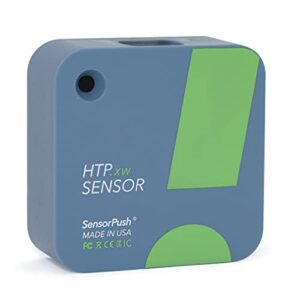
Precision is the SensorPush HTP.xw’s whole pitch. Temperature accuracy holds within ±0.5°C, humidity within ±3% RH, tight enough to trust for shedding and respiratory health.
The water-resistant, O-ring sealed body works for direct enclosure placement, even in high-humidity setups, without degrading accuracy. Readings log every minute, feeding a cloud dashboard through the optional gateway. Custom alerts flag threshold breaches at any hour, and CSV export lets you analyze long-term trends outside the app.
| Best For | Reptile keepers, greenhouse growers, and anyone monitoring wine cellars or humidors who needs precise, dependable temperature and humidity readings. |
|---|---|
| Wireless Range | 100m Bluetooth |
| Power Source | Battery 1-2 yrs |
| App Connectivity | Bluetooth app |
| Alert System | App alerts |
| Data Logging | 30-day onboard |
| Multi-Sensor Support | Single sensor |
| Additional Features |
|
- High accuracy (±0.5°C temperature, ±3% RH humidity) suitable for sensitive environments like terrariums and grow spaces
- Water-resistant, O-ring sealed design allows safe placement directly in humid or enclosed setups
- Custom alerts and CSV export make it easy to catch problems early and track long-term trends
- Full remote access and cloud features require the G1 WiFi Gateway, sold separately
- Bluetooth range and reliability can suffer due to building materials, interference, or extreme conditions
- Fixed 1-minute app polling interval can drain phone battery faster than necessary
3. Sainlogic WiFi Weather Station with Alerts
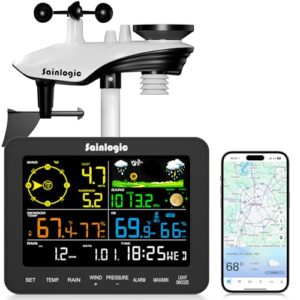
Think of the Sainlogic as your enclosure’s weather bureau. It links to home WiFi at 2.4GHz, pushing readings to a console with audible high and low alerts for both temperature and humidity, exactly what you want when a heat lamp fails overnight.
Historical logs track daily, weekly, and monthly trends, and settings survive power cycles, so alerts stay active. Weather Underground compatibility is a nice bonus, though largely irrelevant indoors. One catch: 5GHz networks won’t connect.
| Best For | This weather station is best for gardeners, hobby farmers, and outdoor enthusiasts who want reliable, easy-to-read weather data along with long-term trend tracking. |
|---|---|
| Wireless Range | WiFi range |
| Power Source | Plug-in sensor |
| App Connectivity | WiFi app |
| Alert System | AI alerts |
| Data Logging | 2-year storage |
| Multi-Sensor Support | Single outdoor sensor |
| Additional Features |
|
- High-contrast display with bold, enlarged fonts makes readings easy to see, even for elderly users
- Stores up to two years of weather data and integrates with Weather Underground for personal station tracking
- Professional-grade rain gauge offers strong accuracy for rainfall monitoring and irrigation planning
- Only works with 2.4GHz WiFi networks, so it won’t connect to 5GHz setups
- Data exports are capped at 30-day intervals, which can be limiting despite the two-year storage
- Some users report spotty connectivity and mixed experiences with the app and Bluetooth features
4. GoveeLife WiFi Hygrometer Thermometer 3 Pack
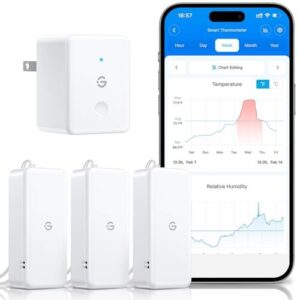
Three sensors, no gateway required. That’s the appeal of GoveaLife’s setup for keepers running multiple enclosures, since each unit connects straight to your Govee app over WiFi.
Accuracy sits at ±0.54°F and ±3% RH, solid enough for tracking a corn snake’s basking spot or a ball python’s humid hide. Three AAA batteries run each sensor for several months, with low-battery alerts saving you from surprise gaps in your logs.
Compact LCDs and stand or wall-mount options make placement across a rack straightforward.
| Best For | Reptile and pet keepers, hobbyists, or homeowners who want to remotely monitor temperature and humidity across multiple enclosures, rooms, or storage spaces with real-time alerts. |
|---|---|
| Wireless Range | WiFi range |
| Power Source | 2 AA batteries |
| App Connectivity | WiFi app |
| Alert System | App/email alerts |
| Data Logging | 2-year storage |
| Multi-Sensor Support | Up to 10 |
| Additional Features |
|
- Swiss-made sensors deliver precise readings (±0.54°F / ±3% RH) with a 2-second refresh rate
- App and email alerts help prevent damage from temperature or humidity swings before they become costly
- Up to 2 years of local, exportable data storage makes long-term trend tracking easy
- Only works with 2.4GHz WiFi networks, so it won’t connect to 5GHz-only routers
- Gateway must stay plugged in at all times, limiting placement flexibility
- Humidity readings may need manual calibration for sensitive uses like wine or cigar storage
5. GoveeLife Wi-Fi Gateway Thermo Hygrometer 3 Pack
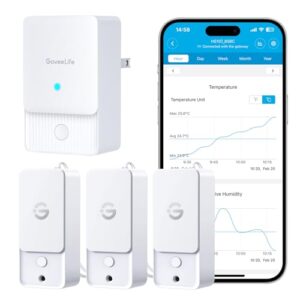
Running a rack of ten enclosures with individual sensors gets messy fast. GoveeLife’s gateway version solves that by linking up to 30 sensors to one hub, feeding everything into a single app dashboard.
Range hits 1,312 feet via LoRa, so basement or garage setups stay connected. Sensors carry an IP65 rating, useful if humidity trays occasionally splash. Battery life stretches to a year, though updates only refresh every ten minutes, worth knowing if you’re chasing rapid humidity spikes.
| Best For | Reptile keepers, greenhouse growers, and anyone managing multiple enclosures or rooms who needs centralized temperature and humidity monitoring across a large space. |
|---|---|
| Wireless Range | 1312 ft LoRa |
| Power Source | 2 AAA batteries |
| App Connectivity | WiFi app |
| Alert System | Customizable alerts |
| Data Logging | Historical graphs |
| Multi-Sensor Support | Up to 30 |
| Additional Features |
|
- Connects up to 30 sensors to a single gateway, making it easy to monitor a whole rack of enclosures from one dashboard
- Long wireless range (up to 1,312 feet) keeps basements, garages, and outbuildings connected without signal issues
- IP65-rated sensors and up to a year of battery life mean less maintenance and worry about splashes or humidity trays
- Data only refreshes about every 10 minutes, so it may miss fast humidity or temperature spikes
- Requires a 2.4 GHz Wi-Fi network, which won’t work with 5 GHz-only routers
- The gateway’s shape can block neighboring outlets on a standard duplex receptacle
6. LFF Indoor Outdoor Weather Station
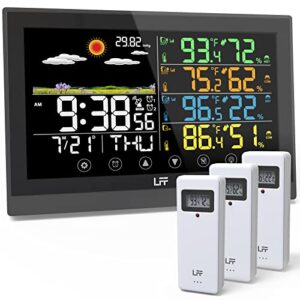
If your gateway hub feels like overkill for a single rack, the LFF station takes a different approach: one 7-in-1 outdoor sensor covering temperature, humidity, wind, rainfall, and light, paired to a color LCD console.
Range reaches 492 feet, plenty for garage or basement setups. Outdoor readings span -40°F to 158°F, with humidity tracked from 1-99% RH. WiFi syncing and min/max logging round out the package, though you’re managing one enclosure zone at a time, not thirty.
| Best For | Homeowners or hobbyists who want to track temperature and humidity across multiple outdoor zones—like a garden, garage, or greenhouse—from one central display. |
|---|---|
| Wireless Range | 330 ft |
| Power Source | AC/2 AAA |
| App Connectivity | No app |
| Alert System | Dual alarms |
| Data Logging | Min/max records |
| Multi-Sensor Support | 3 included |
| Additional Features |
|
- Comes with three wireless sensors for monitoring several locations at once
- Large 7.5-inch color touchscreen with adjustable brightness makes readings easy to see
- Atomic clock sync keeps time accurate without manual adjustment
- Screen shuts off after about 10 seconds when running on battery power
- Some users notice inconsistent readings between sensors and the base station, with no way to calibrate
- Setup can be tricky, especially assigning channels and seating the power adapter
7. Protmex PT6508 Digital Hygrometer Thermometer
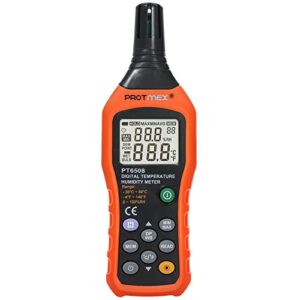
For handheld spot-checks rather than fixed monitoring, the PT6508 earns its place. This unit reads temperature, humidity, dew point, and wet bulb temperature off a dual backlit LCD, running -4°F to 140°F and 0-100% RH.
Its SHT35 sensor stabilizes within 30 seconds moving between enclosures, though larger temperature gaps can stretch that to five minutes. Data hold and min/max recording help you log daily swings across a rack, and auto shutdown after 30 minutes preserves battery life between rounds.
| Best For | IT professionals, HVAC technicians, and hobbyists who need quick, accurate spot-checks of temperature and humidity in server rooms, wine cellars, or other climate-sensitive spaces. |
|---|---|
| Wireless Range | N/A handheld |
| Power Source | Standard batteries |
| App Connectivity | No app |
| Alert System | No alerts |
| Data Logging | Min/max recording |
| Multi-Sensor Support | Single unit |
| Additional Features |
|
- Dual backlit LCD displays temperature, humidity, dew point, and wet bulb readings at a glance, even in low light
- SHT35 sensor delivers fast stabilization, typically within 30 seconds when moving between rooms or enclosures
- Data hold, min/max recording, and 30-minute auto shutdown make it easy to track daily swings while conserving battery
- Defaults to Celsius on every startup, so you’ll need to manually switch to Fahrenheit each time
- Some users report occasional inaccuracies that require calibration against a reference device
- Larger temperature differences between environments can take up to 5 minutes to stabilize
Frequently Asked Questions (FAQs)
How to monitor temperature and humidity?
Pair a digital thermo hygrometer with a probe on each thermal zone, checking readings at consistent times daily. Accuracy runs about ±0°C and ±3-5% RH, giving you reliable data for adjusting heat sources and ventilation.
What is worse, high humidity or high temperature?
At 90°F, 70% humidity feels like 105°F to a snake’s body. Combined heat and humidity is worse: it blocks effective cooling, raising overheating risk faster than dry heat alone, especially during warm-up basking periods.
How can I monitor temperature and humidity remotely?
WiFi or Bluetooth smart sensors sync readings to a mobile app, giving you real-time alerts and historical graphs.
Cellular LTE backups work where WiFi drops out, and Zigbee mesh networks link multiple sensors reliably across larger reptile rooms.
What is the best humidity and temperature monitor?
Like choosing between a cheap kitchen scale and a lab-grade one, precision matters. The SensorPush HTP.xw delivers ±1% RH and ±5°F accuracy, giving keepers reliable, app-based readings for confident husbandry decisions.
How often should I replace hygrometer and thermometer batteries?
Plan on swapping batteries every 6 to 12 months, sooner if you’re running backlights or wireless transmission. Extreme enclosure temperatures accelerate drain, too. Don’t wait for failure, replace at the first sign of drift, dimming, or inconsistent readings.
Whats the average lifespan of a digital hygrometer sensor?
Even the sharpest sensor dulls with time. Expect 5 to 10 years of reliable service from a digital hygrometer under normal conditions, though moisture exposure and airborne contaminants inside the enclosure can shorten that window considerably.
Conclusion
Here’s what most keepers never expect: the sensor isn’t the fix, your response to it’s.
A dual-probe display means nothing if you ignore the trend line building behind it. Mastering how to monitor humidity and temperature together turns guesswork into a system you actually control, one where warm-side spikes and damp substrate stop feeling random.
Your snake reads its enclosure every second. Once your data logging catches up, so will you.