This site is supported by our readers. We may earn a commission, at no cost to you, if you purchase through links.

Ball pythons die from bad temperatures, not old age. A basking surface that runs five degrees too hot, or a cool side that never drops below 85°F at night, compounds stress silently until your snake stops eating, starts wheezing, or worse.
Choosing the right heat lamp means more than picking the brightest bulb. It means matching wattage to enclosure size, sealing heat leaks, placing your thermostat probe at animal level, and verifying your gradient with equipment that actually reads scales accurately.
This guide covers the four best accessories, three lamp types, and every setup variable worth knowing.
Table Of Contents
- Key Takeaways
- Top 4 Ball Python Heat Lamp Accessories
- Best Heat Lamp Types for Ball Pythons
- How to Choose The Right Heat Lamp Wattage
- Ball Python Heat Lamp Placement and Safety
- Temperature Targets, Thermostats, and Monitoring
- Frequently Asked Questions (FAQs)
- What is the best heat lamp for ball pythons?
- Do ball pythons like heat lamps?
- How many watts should my ball python heat lamp be?
- What is the best way to heat ball pythons?
- What heat lamp is best for ball python?
- What is the best heating element for a ball python?
- Can you leave a heat lamp on 24 7 for ball python?
- How many watts for ball python heat lamp?
- Do ball pythons need a light bulb?
- Can a ball python be heated?
- Conclusion
Key Takeaways
- Poor temperature control — not old age — is the leading cause of ball python health decline, making precise thermal management your most critical responsibility as an owner.
- Matching lamp wattage to enclosure size, sealing heat leaks, and placing your thermostat probe at animal level are all essential steps that work together; getting one wrong undermines the rest.
- Deep heat projectors and ceramic heat emitters outperform standard bulbs because they deliver warmth into tissue and maintain stable gradients without disrupting your snake’s natural nocturnal cycle.
- A thermostat isn’t a bonus accessory — it’s your safety net, and without one, even a correctly chosen bulb can spike temperatures past safe limits before you notice.
Top 4 Ball Python Heat Lamp Accessories
Getting the heat right isn’t just about the bulb you choose. The accessories you pair with it determine whether your setup stays safe, stable, and accurate. These four picks cover everything you need to complete a reliable heating system.
Pairing the right accessories with a well-chosen bulb becomes even more straightforward once you understand your full range of ball python heat source options and how each one interacts with thermostats and enclosure placement.
1. Flukers Heavy Duty Clamp Light
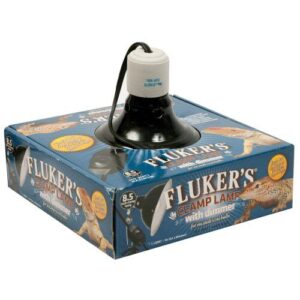
The Flukers Heavy Duty Clamp Light is a solid foundation for any reptile enclosure setup. Its high-strength steel clamp grips rims up to 1.5 inches thick, so it won’t slip when your snake moves.
The housing takes continuous basking without warping. Position it 6 to 12 inches above your ball python’s hotspot, then pair it with a thermostat for control.
2. GE 24 Hour Mechanical Timer
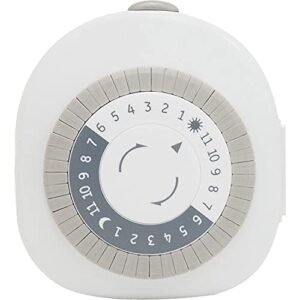
Once your lamp is positioned, day/night cycle control is next. The GE 24 Hour Mechanical Timer controls that without batteries or digital menus.
- Rotate the dial to current time
- Push pins down for your on-hours
- Pull pins up for your off-hours
- Pair it with a thermostat for temperature control
That’ll keep your ball python’s 24-hour heat source running on schedule.
3. Infrared Thermometer Temperature Gun
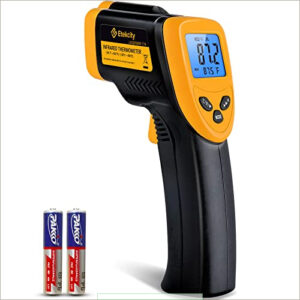
With your timer set, you’ll want to verify those temperatures actually hit your target zones. That’s where this infrared thermometer earns its place.
Its 12:1 distance-to-spot ratio lets you read your ball python’s warm spot accurately from about 14 inches away without any contact. The adjustable emissivity range (0.1 to 1.0) experiences reflective scales without skewing your readings.
Take three readings per hotspot and check both the warm side and cool side to confirm your thermal gradient is dialed in.
- The 12:1 distance-to-spot ratio lets you measure temperatures accurately from about 14 inches away, keeping you and your equipment safely clear of heat sources.
- Adjustable emissivity (0.1–1.0) means you get reliable readings on everything from shiny metal to reptile scales, not just matte surfaces.
- A 0.5-second response time and max temperature display make spot-checking multiple zones fast and straightforward.
- Not suitable for measuring human body temperature, so it won’t double as a medical thermometer.
- Accuracy is only as good as your technique — the 14-inch recommended distance and the 1% or 1°C repeatability tolerance mean sloppy positioning can skew your results.
- Runs on AAA batteries, which adds an ongoing cost and the risk of dying mid-session if you forget to check them.
4. Inkbird Temperature and Humidity Monitor
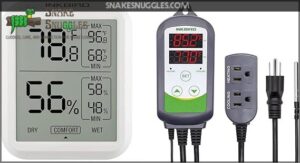
Spot-checking gives you only a quick snapshot, but the Inkbird gives you continuous temperature and humidity data all day long. Its LCD screen displays both values at once, complete with DRY, COMFORT, and WET status icons that flag environmental shifts before they impact your snake’s shed.
If you want to see how it compares to other compact options, this roundup of reptile thermometers for kids with pet snakes breaks down which monitors are easiest for young keepers to read and use.
The dual relay output connects to your heat source and automates control without any manual intervention. With the sampling interval fixed at 10 seconds, you’re always getting steady reliable readings throughout every light cycle.
- Continuous 10-second sampling keeps you ahead of temperature and humidity swings that could disrupt your snake’s shed cycle.
- The dual relay output automates your heat source directly, removing the need for manual intervention.
- A clear LCD with DRY, COMFORT, and WET status icons makes environmental conditions easy to read at a glance.
- No data logging or remote monitoring means you can’t review historical trends or check readings when you’re away.
- The fixed 10-second sampling interval can’t be adjusted if you need faster response times.
- Wall-mount and tabletop-only design limits placement options in tight or unconventional setups.
Best Heat Lamp Types for Ball Pythons
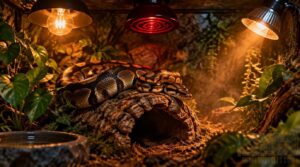
Not every heat source works the same way, and choosing the right type makes a real difference in how well your ball python thermoregulates.
Each option below delivers heat differently — affecting penetration depth, light output, and how your snake’s body actually absorbs warmth.
Here are the three most effective heat lamp types for ball pythons.
Halogen Flood Bulbs
heat up in minutes, not hours, making them one of the best heat lamps for ball pythons when you need quick, consistent warmth. They produce broad-spectrum infrared that mimics natural sunlight and use 20-30% less electricity than standard incandescent bulbs.
That delivers control over your temperature gradients and gives your snake a warm basking spot it can use. For ball python care, pair them with a ceramic fixture and a protective guard. Properly maintained, they’ll run over 2,000 hours.
Ceramic Heat Emitters
Choose ceramic heat emitters when your ball python needs warmth around the clock without light disruption. They radiate infrared heat silently, supporting reliable temperature gradients across the entire enclosure while leaving your snake’s nocturnal cycles completely undisturbed. For a deeper look at pairing these with the right wattage and thermostat settings, the ball python lighting and heating guide walks through building a stable, gradient-friendly setup from scratch.
Here’s what makes them worth using:
- No light output keeps sleep cycles and behavior intact
- Surface temps of 1000–1500°C produce steady infrared heat
- 5–10 year lifespan with proper mounting and cooling fins
- Pairs well with thermostat control for precise enclosure climate control
Always run one on a dedicated thermostat. Without it, your enclosure temperatures can spike past safe limits before you notice.
Deep Heat Projectors
Picture your ball python pressed against warm, sun-baked earth, heat radiating slowly up into its body.
A ball python pressed against sun-baked earth feels heat radiating slowly into its body
Deep Heat Projectors replicate that by pushing infrared heat through your snake’s tissue rather than just warming the air. Mount one 15-30 cm overhead, aim for a 40-50°C hotspot, and always pair it with a thermostat for reliable overhead heating and temperature gradient control.
How to Choose The Right Heat Lamp Wattage
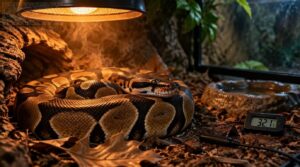
Choosing the right wattage isn’t guesswork—it’s a process of matching your specific setup to proven guidelines. Several key factors determine how much heat output your enclosure actually needs. Work through each one to dial in a safe, stable thermal gradient.
Match Enclosure Size
Wattage isn’t a guess. Your enclosure size determines the heat output your setup needs.
- 12–18-inch enclosures: position the heat source 6–8 inches above substrate, using 40–60 W.
- 18–24-inch enclosures: run dual heat sources to maintain a stable thermal gradient.
- 36-inch enclosures: distribute 60–100 W total across multiple points.
Undershooting leaves your snake cold; overshooting creates hotspots a thermostat can’t correct.
Account For Heat Loss
Don’t overlook heat loss when sizing your bulb. Screen lids, thin walls, and gaps all bleed warmth into the room, forcing your heat lamp to work harder to maintain a stable thermal gradient setup.
Sealing gaps can cut that leakage by 20-40%, meaningfully reducing wattage demand. A well-insulated reptile enclosure holds temperature more efficiently, so factor insulation in before committing.
Consider Room Temperature
Your room temperature directly affects how much work your heat lamp for ball pythons needs to do.
- 68-72°F room: target an 88-92°F basking spot
- Below 68°F: risk overheating the cool end
- Above 75°F: lower lamp wattage accordingly
- Track ambient temperature shifts every day
- Reassess when room drifts more than 5°F
A thermostat keeps ball python care consistent despite fluctuating conditions.
Match Heat Source
Once you’ve adjusted for room temperature, heat source selection determines how your ball python heat lamp actually performs.
Halogen floods produce broad-spectrum infrared heat and should mount 10-20 cm from the basking spot.
Ceramic emitters work best placed at 5-8 cm, delivering steady infrared heat without visible light.
For localized heating, deep heat projectors push long-wave IR directly into tissue.
Verify Thermal Gradient
Once your heat source is set, confirm the thermal gradient is working. Point your infrared temperature gun at the basking surface, targeting a basking surface temperature of 38-42°C, then sample mid-enclosure and the far side.
You want at least an 8-12°C spread. Use a calibrated digital thermometer at head-height to verify consistency. If that gap collapses, your snake can’t thermoregulate.
Use Thermostat Control
That gradient only holds with active thermostat control. Duty-cycle temperature control keeps the basking zone stable and is the backbone of heat lamp safety.
- Place the probe at ambient height, not under the bulb
- Set a 2-4°F hysteresis band to limit rapid cycling
- Match your thermostat wattage to the heat source
- Log snake enclosure temperature every 15 minutes after calibration
Ball Python Heat Lamp Placement and Safety
Once you’ve locked in the right wattage, placement determines whether your ball python heat lamp works safely. Position it above the enclosure, not inside it, and keep the source 2-4 inches from enclosure walls to prevent burns and guarantee fire safety.
Mount it on a secure, non-tip clamp fixed to the back panel. This keeps it stable during cleaning and minimizes fall hazards. Never position it where your snake can make direct contact.
Separate your heat source from your UVB fixture. Combining both in one unit creates ocular and dermal stress; independent sources give you better control over your overhead heat and thermal gradient.
Keep cords off the substrate, use a grounded GFCI outlet, and inspect them regularly for cracks.
Temperature Targets, Thermostats, and Monitoring
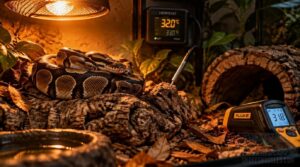
Precision matters more than most keepers realize. Your basking temperature should hold at 88–92°F, and your nighttime temperature should drop to 75–82°F for proper respiratory health. A proportional thermostat keeps these ranges within ±1–2°F, far tighter than any on/off model.
Sensor placement is critical. Position your thermostat probe at animal level, mid-enclosure, and keep it away from direct heat to avoid false readings. Calibrate with an infrared temperature gun before first use and verify weekly.
Temperature monitoring doesn’t end at setup. Log basking and ambient readings daily, and set an alert if your basking zone drifts more than 5°F from target for over 30 minutes. That early warning gives you time to correct problems before they can harm your snake.
Frequently Asked Questions (FAQs)
What is the best heat lamp for ball pythons?
The deep heat projector is the best ball python heat lamp for most setups. It hits the right basking surface temperature while sending warmth deep into tissue, which ordinary surface-only heat bulbs simply can’t match.
Do ball pythons like heat lamps?
Picture a ball python as a living thermometer, always chasing the right warmth. They don’t prefer heat lamps over other sources, but they do need temperature gradients to thrive. A well-placed lamp delivers exactly that.
How many watts should my ball python heat lamp be?
Wattage isn’t one-size-fits-all. Your 20-gallon enclosure usually needs a 40–60 W ball python heat lamp, while a 40-gallon calls for 75–100 W. Larger four-foot setups often need 100–150 W to hold a proper thermal gradient.
What is the best way to heat ball pythons?
Most keepers assume a single heat bulb covers everything. It doesn’t. Heating ball pythons well means pairing a quality radiant heat source with a thermostat to build stable temperature gradients your snake can actively navigate.
What heat lamp is best for ball python?
One keeper switched to a ceramic heat emitter and nailed stable temperature gradients overnight. For ball python care, ceramic emitters and deep heat projectors both deliver consistent warmth without light disrupting your snake’s nocturnal rhythm.
What is the best heating element for a ball python?
Ceramic heat emitters and deep heat projectors are the best heating elements for ball python care. Both provide consistent warmth without visible light, so your snake’s natural day-night cycles stay intact while temperatures hold steady.
Can you leave a heat lamp on 24 7 for ball python?
Running your ball python heat lamp nonstop is easily the fastest route to heat stress and a truly miserable snake. Nocturnal snakes depend on thermal cycling, so always switch to a ceramic emitter at night.
How many watts for ball python heat lamp?
Your ball python heat lamp wattage depends on enclosure size. Small tanks need 60–75 W, while 24–36 inch enclosures usually call for 75–100 W. Cold rooms below 65°F may push those requirements to 150 W.
Do ball pythons need a light bulb?
Ironically, visible light is the last thing your nocturnal ball python actually needs. Skip the bulb and use a ceramic heat emitter to deliver steady warmth without light stress or disrupting their natural day-night cycle.
Can a ball python be heated?
Virtually every single ball python health issue links directly to inadequate heating. Yes, your snake can definitely be heated using ceramic heat emitters or infrared bulbs, paired with a thermostat for precise enclosure temperature monitoring.
Conclusion
Ball pythons that don’t thrive almost always trace the problem back to temperature management. Getting the best heat lamps for ball pythons right means choosing the correct bulb type, sizing wattage to your enclosure, accounting for heat loss, and verifying your gradient with reliable equipment.
A thermostat isn’t optional; it’s your most important safety net. Do all of this right, and your snake eats well, sheds clean, and lives the long, healthy life it deserves.