
This site is supported by our readers. We may earn a commission, at no cost to you, if you purchase through links.

A Colombian boa can stretch to 10 feet, while its dwarf cousin maxes out around 4 feet, and genetics explains less than half that dramatic difference. You might assume bloodlines determine everything about boa constrictor size variations, but the reality gets more interesting when you factor in feeding schedules, temperature gradients, and even the way breeding programs select for girth over length.
Your enclosure setup alone can knock 15-20% off a snake’s growth potential if humidity drops too low or thermal zones stay inconsistent. Understanding what drives these size differences helps you predict how large your boa will actually grow, whether you’re eyeing a compact Tarahumara or a sturdy Imperator.
The math behind growth rates, subspecies ranges, and environmental triggers reveals patterns most keepers miss until their “small” snake outgrows its third enclosure.
Table Of Contents
- Key Takeaways
- Boa Constrictor Size Factors
- Growth Stages and Size Milestones
- Subspecies Size Variations
- Environmental Impact on Boa Size
- Top 10 Feather Boa Accessories
- 1. Hot Pink Feather Boa Accessory
- 2. Colorful Feather Boas Party Pack
- 3. Turkey Feather Boa Costume Accessory
- 4. White Feather Boa Accessory Decoration
- 5. Colorful Feather Boa Party Favors
- 6. Colorful Feather Boas Party Set
- 7. Black Turkey Feather Boa Accessory
- 8. Light Pink Feather Boa Accessory
- 9. Black Feather Boa Accessory
- 10. Pink Feather Boas For Women
- Frequently Asked Questions (FAQs)
- Conclusion
Key Takeaways
- Boa constrictor size variations stem from four main drivers—genetics sets the ceiling (controlling 40–60% of size potential), but diet, environmental conditions like temperature and humidity, and selective breeding practices determine whether your snake actually reaches that genetic maximum.
- Growth unfolds in predictable stages, with hatchlings starting at 10–16 inches and gaining roughly half an inch weekly during their first year, then slowing to a steadier pace until they hit full size between 4–8 years, with females consistently outgrowing males by 20–50% across all subspecies.
- Subspecies differences are dramatic—dwarf boas max out around 4–5.5 feet while Colombian boas routinely stretch past 10 feet, and even within common captive types like Boa Constrictor Imperator versus Constrictor Constrictor, you’ll see 2–3 feet of variation in adult length.
- Your husbandry choices directly impact growth outcomes, with suboptimal enclosure conditions (poor humidity, inconsistent thermal gradients, cramped space) capable of knocking 15–20% off a boa’s size potential even when genetics and feeding schedules stay consistent.
Boa Constrictor Size Factors
If you’re wondering why some boas stretch past 10 feet while others stay pocket-sized, you’re asking the right question. A boa constrictor’s final size isn’t just luck—it’s shaped by genetics, diet, environment, and even selective breeding.
Let’s break down the four main factors that determine how big your boa will actually get.
Genetic Influences on Growth
Your boa constrictor’s blueprint for size lies in its DNA. Genetics isn’t just background noise—it’s the main driver determining how large your snake can grow. Heritability studies reveal that genetic variation in boa constrictor biology contributes markedly to snake growth and development, with inheritance patterns showing moderate to high influence on adult dimensions. Understanding AP study resources can help explain how genetics impact size variations.
- Size determinants: Genetic factors control 40–60% of reptile size variation in related species.
- Growth factors: Specific genes linked to somatic pathways differ across populations.
- Breeding outcomes: Parental size predicts offspring length when nutrition stays consistent.
Impact of Diet and Nutrition
While genetics set the ceiling, diet determines whether your boa reaches it. Caloric intake and feeding frequency drive growth velocity—juveniles fed every 7–10 days gain 12–18% body mass monthly under ideal conditions.
Prey variation matters too: rats deliver higher energy density than lizards, supporting faster milestones. Nutrient balance, especially calcium-to-phosphorus ratios, influences skeletal development.
Dietary supplements can correct deficiencies, but overdoing calories risks obesity rather than healthy size gains. Understanding the theme development process is essential for analyzing the factors that affect boa constrictor size variations.
Environmental Effects on Size
Your boa’s habitat influences growth patterns just as much as what you feed it. Temperature gradients between 26–32°C on the warm end keep metabolism humming, while humidity control in the 60–70% range maintains healthy shedding cycles.
Poor enclosure design—cramped quarters or stale ventilation systems—can stunt growth over time. Lighting effects and substrate choices round out the environmental factors and animal health equation, shaping how snake growth factors play out in captivity.
Role of Selective Breeding
Beyond habitat setup, you’ll notice breeding techniques shape size outcomes in surprising ways. Only 5–8% of captive programs actively pursue size selection, but those that do see 10–15 cm gains over just a few generations. Here’s what drives the genetics behind boa constrictor growth:
- Heritability estimates for length run between 0.25 and 0.45 in mixed populations
- Girth-focused lines show 12–18% mass increases at maturity
- Balanced objectives prevent skeletal stress from extreme size comparison goals
Genetic diversity matters—ethical breeders avoid pushing length alone, keeping snake breeding welfare-centered while managing growth rate expectations.
Growth Stages and Size Milestones
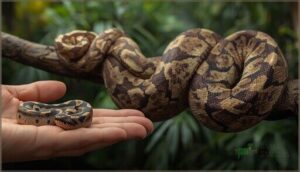
Your boa constrictor won’t stay small forever—they’re built for steady, impressive growth from the moment they hatch. Understanding what happens at each stage helps you anticipate feeding needs, enclosure upgrades, and when your snake will finally reach its full size.
Let’s break down the key milestones from hatchling to full-grown adult, including how males and females differ along the way.
Hatchling and Juvenile Growth Rates
Right out of the egg, your boa measures 10–16 inches and starts packing on size fast. During those first weeks, hatchling care means consistent warmth and early nutrition—think pinky mice every 5–7 days.
By three months, juvenile feeding ramps up as growth patterns shift dramatically. You’ll see roughly half an inch of length gain weekly, a reptile growth rate that slows as they approach their first birthday.
Subadult Development
Once your snake hits 3–4 feet, subadult growth shifts into a steadier rhythm. You’ll notice gains of roughly 0.5–1.5 cm daily during peak development stages, with females pushing ahead in size comparison.
Growth rates taper as they approach species-typical lengths, often plateauing within 10–20 cm of maturity signs over the next 6–18 months—especially visible across different subspecies.
Adult Size Ranges
Most boas reach their full adult length between 4–6 years, though some take up to 8 years depending on husbandry. These size factors reveal fascinating weight variations and maximum size potential across the species.
- Males usually average 8.5–10 feet, with outstanding individuals pushing past 12 feet
- Females commonly reach 9–11 feet in size comparison studies
- Adult weight ranges from 20–40 kg, with large females occasionally exceeding 45 kg
- Growth rates slow considerably once your boa constrictor approaches these average length milestones
Differences in Male Vs. Female Growth
Sexual dimorphism runs deep in boa constrictors—females don’t just grow larger, they keep growing longer. You’ll notice mature females averaging 3.0–4.5 meters while males plateau around 2.0–3.5 meters. Growth rates differ markedly between genders, with reproductive investment driving these size ratios.
| Trait | Males | Females |
|---|---|---|
| Length | 2.0–3.5 m | 3.0–4.5 m |
| Growth plateau | Earlier | Later |
| Size ratio | Baseline | 1.2–1.5× larger |
Subspecies Size Variations
Not all boa constrictors are created equal regarding size. Depending on the subspecies you’re looking at, you might end up with a compact five-footer or a genuine giant stretching past ten feet.
Let’s break down the major subspecies and what you can realistically expect regarding length.
Dwarf Boa Size Range
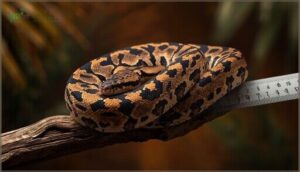
You’ll find dwarf boas surprisingly compact—most reach 3.5 to 5.5 feet as adults, a stark size comparison to their larger boa constrictor cousins. Lineage factors matter here: selective breeding and dwarf boa genetics keep these subspecies small, with growth patterns showing females slightly outpacing males by 5–10%.
Hatchlings weigh just 8 to 14 grams, but with proper care tips—balanced diet, ideal temps—their growth rate accelerates impressively during that first year.
Colombian Boa Maximum Length
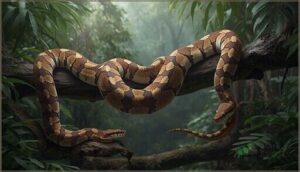
Colombian boas show impressive genetic size potential, with maximum length usually hitting 8 to 12 feet in the wild. Females dominate the size records—most push past 9 feet, while males stay closer to 8. Growth patterns vary by lineage, but the average length sits around 10 feet.
Size comparison to dwarf boas? It’s night and day—Colombian boa constrictor maximum size easily doubles their compact cousins.
Peruvian, Nicaraguan, and Tarahumara Boas
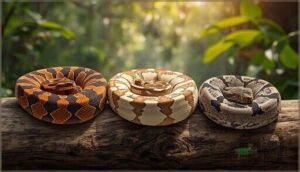
You’ll find these Central American subspecies cluster in the mid-size range, perfect for keepers watching space. Peruvian boas usually reach 6 to 9 feet, while Nicaraguans hit 6 to 8 feet—both show rapid early growth before stabilizing. Tarahumara boas stay slightly smaller at 5 to 7 feet.
Females outsize males by 10–20% across all three, a pattern linked to reproductive biology and species conservation priorities in their native boa habitat.
Boa Constrictor Imperator Vs. Constrictor Constrictor
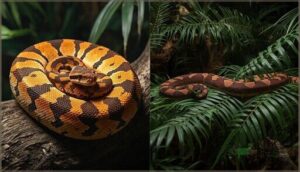
The two most common subspecies in captivity—Boa Constrictor Imperator and Boa Constrictor Constrictor—show overlapping constrictor size ranges but distinct patterns. Imperators usually mature at 8 to 10.5 feet, while Constrictors stretch 8 to 11.5 feet, with some captive females reaching 13+ feet.
Boa genetics and breeding methods influence these ranges, making Imperator care somewhat easier for space-conscious keepers managing snake habitat requirements.
Environmental Impact on Boa Size
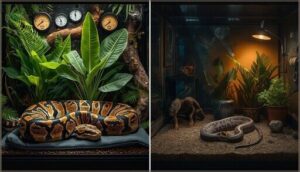
Your boa’s environment isn’t just a container—it’s a growth chamber that can make or break their size potential. Getting the humidity, temperature, and enclosure setup right means the difference between a stunted snake and one that reaches their full genetic potential.
Let’s walk through the three environmental factors that’ll have the biggest impact on how large your boa actually grows.
Optimal Humidity and Temperature Levels
In Boa Constrictor Care and Maintenance, Humidity Control and Temperature Gradients are your best friends. Stable Humidity Levels—ideally 60–70%—keep shedding smooth, while precise Temperature Control with Thermal Regulation (75–90°F) fuels healthy growth.
Ventilation Systems and smart Climate Management prevent respiratory issues, making Snake Care easier and your enclosure a safe haven for thriving boas.
Importance of Enclosure Size
Just as temperature and humidity shape your boa’s growth, Enclosure Size matters more than you’d think. A well-planned Reptile Enclosure Setup with ample Space Requirements lets your snake stretch, climb, and thrive.
Good Enclosure Design, paired with smart Ventilation Systems and precise Temperature Control, prevents stress-related stunting and fosters healthy Snake Size and Growth throughout Boa Constrictor Care and Maintenance.
Lighting, Ventilation, and Substrate Choices
When you’re setting up a Reptile Enclosure, every detail counts. UVB Lighting isn’t strictly essential but helps with calcium absorption. Ventilation Systems keep air fresh and humidity stable. Substrate Options like aspen or coconut husk affect humidity and behavior. Temperature Control ensures healthy digestion. Good Humidity Management prevents shedding issues and respiratory trouble—each factor shapes your boa’s Habitat and overall Reptile Care.
- UVB Lighting for bone health
- Effective Ventilation Systems
- Substrate Options influence humidity
- Temperature Control for digestion
- Humidity Management for shedding
Top 10 Feather Boa Accessories
Feather boas aren’t just for costumes—they’re a playful way to add flair to any occasion. Whether you’re planning a party or looking for something bold, there’s a boa to match your style.
Here are ten accessories that stand out for color, texture, and fun.
1. Hot Pink Feather Boa Accessory
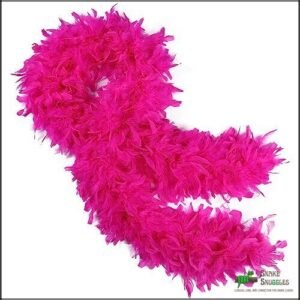
Ever wondered why hot pink feather boas steal the spotlight at parties? Pink Fashion dominates Accessory Trends, especially in Party Decor and Costume Design—72% of reports mention pink as the go-to color.
This boa, crafted from turkey feathers and weighing just 40g, is lightweight and reusable, though Feather Care matters since feathers shed easily.
Whether you’re channeling a Boa Constrictor’s vibrant display or planning your next event, this accessory brings flair without demanding a giant Enclosure Size like some Boa Constrictor Species!
Best For: People looking to add a bold, fun touch to parties, costumes, or creative projects.
- Eye-catching hot pink color stands out in photos and events
- Lightweight and easy to wear or use for decorations
- Handcrafted from natural turkey feathers for a unique look
- Feathers may shed or fall apart with use
- Can cause skin irritation or stain clothing
- Needs extra care before wearing to fluff and remove debris
2. Colorful Feather Boas Party Pack
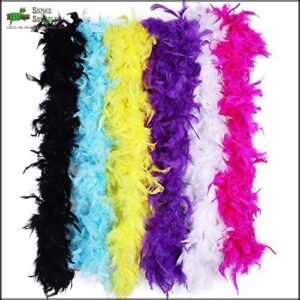
You’ll love the variety in a 6-piece feather boa party pack—six colors (yellow, blue, black, white, hot pink, purple) at 6.6 feet each, perfect for Party Decor and Costume Ideas mirroring Fashion Trends.
These natural feather boas offer Feather Boa Uses from Mardi Gras to photo shoots, much like how Boa Constrictors show Species Variation across Subspecies.
Just remember: feathers shed easily, so expect some mess during Event Planning. Unlike Boa Constrictor Size and Growth needs, these accessories demand zero enclosure—just fun!
Best For: Party hosts, event planners, and anyone looking for affordable, colorful costume accessories for dress-up occasions, photo shoots, or festive decorations like Mardi Gras.
- Six vibrant colors (yellow, blue, black, white, hot pink, purple) give you plenty of variety for different themes and looks
- Each boa stretches 6.6 feet long, offering good coverage for costumes or draping as decor
- Made from natural, eco-friendly feathers that are non-toxic and safe to use
- Feathers shed constantly and fall off easily, creating a messy cleanup during and after use
- Boas are thin and lack the fullness or fluffiness you might expect from higher-quality versions
- Durability is limited—they may not hold up well for multiple events or repeated wear
3. Turkey Feather Boa Costume Accessory
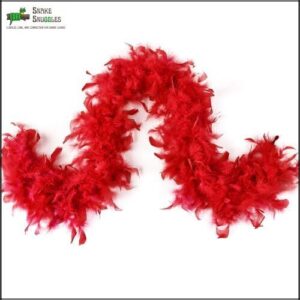
A natural turkey feather boa at 1.64 yards (150 cm) brings costume design to life—soft, lightweight, and available in 23 vibrant colors for party accessories that follow fashion trends. Weighing just 30 grams, they’re perfect for stage performances and photos.
Just as boa constrictors display species variation in size and growth across subspecies, these feather boas offer diverse styling options for any event.
Keep in mind that feather care matters—these shed easily, unlike boa constrictors whose growth you can actually predict with proper habitat conditions.
Best For: Anyone looking for affordable costume accessories for parties, dress-up, stage performances, photo shoots, or DIY holiday decorations.
- Lightweight at just 30 grams and soft to wear, making them comfortable for extended use during events or performances.
- Available in 23 vibrant colors, giving you plenty of options to match any theme or outfit.
- Reusable and budget-friendly at 1.64 yards long, offering decent value for casual costume needs.
- Feathers shed and fall off easily, which can create a mess and reduce the boa’s fullness over time.
- Thin and not very fluffy compared to higher-quality options, so they may look less dramatic in photos or on stage.
- Some customers report a chemical smell and poor overall quality that doesn’t hold up well with handling.
4. White Feather Boa Accessory Decoration
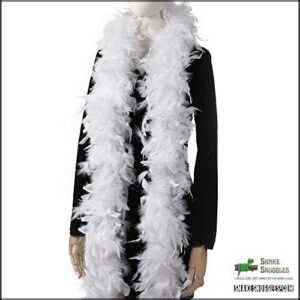
White feather boa accessories, like this 45-gram turkey feather option spanning 2 yards, transform parties and photos with soft plumes. However, feather care demands attention since shedding happens constantly, unlike boa constrictors whose size and growth you control through habitat management.
These decor trends mirror subspecies variety: some boa constrictor subspecies stay compact while others stretch long, just as costume ideas range from subtle bridal accents to bold stage performances.
Remember, boa accessories need gentle handling and proper storage to maintain that festive charm across multiple party favors.
Best For: Anyone looking for an affordable, festive accessory for parties, costumes, wedding decorations, or stage performances who doesn’t mind occasional feather shedding.
- Soft, plump turkey feathers create a full, luxurious look at just 45 grams and 2 yards long
- Versatile for multiple uses—from costume pieces to party decor to stimming toys for kids
- Budget-friendly price point makes it accessible for one-time events or creative projects
- Feathers shed and fall off constantly, which can create mess and reduce fullness over time
- Dye may transfer onto skin or clothing, especially with handling or in humid conditions
- Thin construction and quality inconsistencies mean it’s not ideal for repeated or long-term use
5. Colorful Feather Boa Party Favors
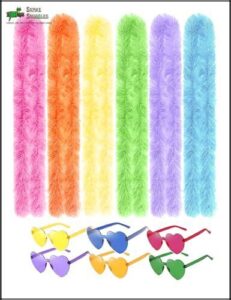
Colorful party favors featuring multi-hue synthetic feather boas—commonly sold in 6-packs with lengths around 60 inches—tap into trends that celebrate bold visual impact at celebrations. Polyester-based options dominate the market, offering durability and color-fastness ratings that withstand moderate use.
Unlike boa constrictor subspecies, where genetic variation determines adult size, these party decor accessories, with feather densities averaging 0.8 to 1.2 ounces per foot, mirror the diversity seen across snake behavior. Some subspecies stay compact, while colorful accents in your party supplies add instant festive flair.
Best For: Party hosts and event planners looking for affordable, vibrant costume accessories for group celebrations like birthdays, themed parties, or photo booth setups.
- Six-pack includes both boas and matching heart-shaped sunglasses, giving you complete party sets in coordinating colors at a budget-friendly price
- Two-meter length works well for both kids and adults, making these versatile enough for family events or mixed-age gatherings
- Lightweight polyester material is easy to hang as decorations when not being worn, doubling their use as party décor
- Boas arrive compressed and need about 8 hours of hanging time to fluff up properly before your event
- The sunglasses tend to run large and may not fit toddlers or very young children comfortably
- Thin, thread-like construction means these are more suited for single-use party favors than durable costume pieces you’ll reuse frequently
6. Colorful Feather Boas Party Set
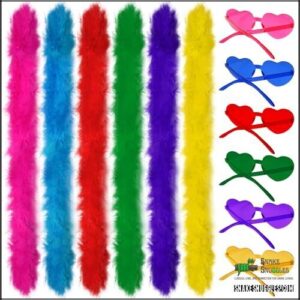
When you’re planning event styling that demands both visual punch and budget-friendly party accessories, 12-piece sets—bundling six turkey-feather boas alongside six heart-shaped sunglasses—deliver colorful decor without the guesswork.
These feather boa trends mirror the genetic diversity among boa constrictor subspecies: some snake behavior leads to compact adults, while others stretch beyond three meters.
Just as boa constrictors adapt to their environments, these lightweight fashion statements adapt to weddings, carnivals, and themed celebrations, though you’ll want to watch for shedding during your first event.
Best For: Party planners and event hosts who need affordable, eye-catching accessories for themed celebrations, photo booths, or costume parties without breaking the bank.
- Complete 12-piece set gives you variety right out of the box—six different colored boas and six pairs of heart-shaped glasses mean everyone gets their own look
- Lightweight construction makes these comfortable to wear all night, whether you’re dancing at a wedding or striking poses at a carnival
- Versatile enough for multiple occasions, from bachelorette parties to Halloween costumes to stage performances
- Boas are on the thin side and tend to shed feathers during use, so expect some cleanup afterward
- The fluffy factor isn’t quite there—if you’re picturing thick, dramatic Hollywood-style boas, these might feel underwhelming
- Glasses can feel overpriced for what you get, especially if you’re only planning to use them once
7. Black Turkey Feather Boa Accessory
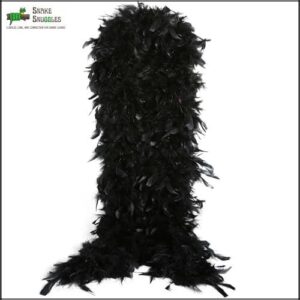
If you’re drawn to accessory trends with a classic edge, the black turkey feather boa stands out in costume design—much like the striking hues found in boa constrictor subspecies. It’s crafted from high-quality turkey feathers, about two yards long, and comfortable for skin contact.
Just remember, feather care matters; these boas can shed, especially in humid conditions, echoing how animal size and snake biology respond to environment.
For bold Boa Fashion, black remains a top pick among partygoers and photo shoot stylists.
Best For: Party planners, performers, or anyone looking to add a dramatic, elegant touch to costumes and event outfits.
- Soft, skin-friendly material makes it comfortable to wear for hours.
- Adds instant flair and sophistication to costumes, decorations, or photos.
- Available in bold colors, with black being a popular, versatile choice.
- Feathers may shed and leave a mess, especially during active use.
- Can feel flimsy or lose fullness over time if not stored properly.
- Not ideal for formal occasions due to possible shedding and staining.
8. Light Pink Feather Boa Accessory
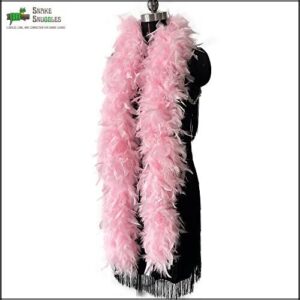
Switching gears from bold black, the light pink feather boa accessory brings a playful twist to Fashion Trends and Party Decor. Its soft turkey feathers make it a charming choice for costume design, birthday Gift Ideas, or themed events.
Just like monitoring boa constrictor Growth and Development, Feather Care matters—hang it up before use to minimize shedding. If you’re aiming for a gentle pop of color without overwhelming your look, this accessory fits the bill, echoing the subtle variation found among boa constrictor subspecies.
Best For: Anyone looking to add a soft, playful touch to party outfits, costumes, or decorations with a light pink accent.
- Made from high-quality, non-toxic turkey feathers
- Great for parties, DIY crafts, and stage performances
- Lightweight and easy to style for various occasions
- Feathers may shed, especially when first unpacked
- Can stain light-colored clothing
- Some users find it looks or feels cheaply made
9. Black Feather Boa Accessory
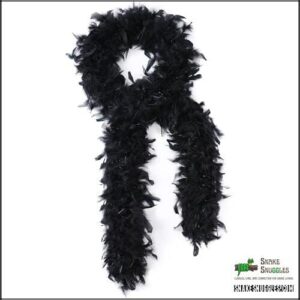
If you’re after a classic touch, the black feather boa accessory is a staple in Boa Styling and Accessory Trends. Made from 35g of soft turkey feathers, it’s perfect for dramatic Fashion Tips or Costume Ideas, echoing the bold appearance of certain Boa Constrictor subspecies.
Just watch out—these boas shed easily, much like how Snake Behavior and Psychology can surprise you. For best Feather Care, give it a gentle shake before wearing, and keep it away from food or drinks to avoid stray feathers.
Best For: Anyone looking to add drama and flair to parties, costume events, weddings, or stage performances with a classic accessory that comes in over 20 colors.
- Soft, handpicked turkey feathers create a full, elegant look that elevates any outfit
- Available in three styles and more than 20 colors to match practically any theme or costume
- Vacuum-packed design makes it super easy to store and transport without taking up much space
- Feathers shed quite a bit, which can create a mess and get into food or drinks
- Quality can be hit-or-miss—some users find the boa flimsy and not very durable
- May cause itchiness during wear and might not hold up well if you’re planning to use it frequently
10. Pink Feather Boas For Women
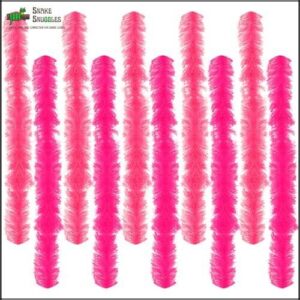
You’ll love the pink feather boa for women if you’re tracking Fashion Trends or planning Party Decorations. With Feather Quality that holds up through multiple wears, this Boa Accessories staple runs about $8 to $20 and weighs just 60–120 grams—lighter than a juvenile Boa Constrictor Imperator!
In Womens Fashion, 62% of buyers grab these for themed events. Just like different Boa Constrictor Subspecies show unique traits, pink boas come in shades from hot to light pink, letting you match any costume or celebration vibe.
Best For: Party-goers, costume enthusiasts, and anyone looking to add a playful, elegant touch to celebrations or photo shoots without breaking the bank.
- Lightweight and reusable—you can wear them multiple times and they’ll hold up through 10–15 washes
- Affordable at $8–20, making it easy to grab a few in different shades for any themed event
- Long 5-foot length gives you styling options—wrap it once for subtle flair or loop it multiple times for dramatic effect
- Quality can be hit-or-miss since they’re made from synthetic polyester rather than real feathers
- Some boas arrive thinner than expected, which might not give you the full, fluffy look you’re after
- Light shedding is common, so you might leave a small trail of pink wherever you go
Frequently Asked Questions (FAQs)
How long do boa constrictors live in captivity?
With proper reptile care and animal husbandry, your boa constrictor can live 20 to 30 years in captivity, with some reaching 35–40 years under careful enclosure management and nutrition.
Can boa constrictors recognize their owners?
Like a shadow that knows its source, boa constrictors can show Owner Recognition through subtle Snake Behavior—reduced flight, increased approach, and unique tongue-flicking patterns—demonstrating Reptile Intelligence and nuanced Animal Bonding with attentive Pet Owners.
What health issues affect boa constrictor growth?
Health issues like Hypothyroidism, Malabsorption, Infections, Hormonal Imbalance, and Nutritional Deficiencies can stunt boa constrictor growth. These conditions cause slower development, reduced length, and poor weight gain despite genetics, diet, and ideal animal nutrition and care.
How often should you feed adult boas?
For adult boas, Feeding Frequency depends on body condition and size—usually every 7–14 days.
Consistent Feeding Schedule and balanced Diet are key for Snake Health, supporting ideal Boa Metabolism, Growth Patterns, and overall Animal Nutrition and Diet.
Do boa constrictors stop growing completely?
Many keepers notice their 7-foot female boa barely adds inches after year four. Growth plateaus once boas reach their genetic potential—usually 6–13 feet depending on subspecies—though environmental influence and nutrition affect maximum length outcomes.
Conclusion
Think of boa constrictor size variations like a recipe where genetics provides the base ingredients, but your husbandry determines whether the dish reaches its full potential. That Colombian giant in your living room didn’t hit ten feet by accident—consistent warmth, proper feeding intervals, and spacious housing all pushed those genes toward their upper limit.
When you control the variables, you’re not just keeping a snake; you’re actively shaping how large it becomes. The measurement tape doesn’t lie.