This site is supported by our readers. We may earn a commission, at no cost to you, if you purchase through links.

Most first-time breeders lose a clutch before they see a single hatchling. Not to bad genes, but to missed signals and skipped steps that compound fast.
Breeding ball pythons rewards precision. Female weight minimums, nighttime temperature drops timed to the day, follicle development windows that close before you notice them opening. Miss one checkpoint and you’re watching your female strain for 48 hours while you wait on a vet callback.
The margin is narrow. Get each stage right and you’ll have a healthy clutch, viable eggs, and hatchlings that eat on schedule. The difference is process, applied in the right order.
Table Of Contents
- Key Takeaways
- Prepare Ball Pythons for Breeding
- Cycle The Breeding Environment
- Pair Ball Pythons Safely
- Monitor Ovulation and Egg Laying
- Incubate Eggs and Raise Hatchlings
- Frequently Asked Questions (FAQs)
- Are ball pythons easy to breed?
- How do you breed ball pythons for beginners?
- How much money can you make breeding ball pythons?
- What month do ball pythons lay eggs?
- How do you get ball pythons to breed?
- How long does it take for ball pythons to breed?
- How do you know when to breed your ball python?
- Is it hard to breed ball pythons?
- How long does it take to breed ball pythons?
- What are the requirements for breeding ball pythons?
- Conclusion
Key Takeaways
- Females must hit 1,500g and 3 years old before any pairing happens — breed too early and you’re not cutting corners, you’re ending the season.
- Environmental cycling does the heavy lifting: precise nighttime temperature drops, a gradual photoperiod ramp, and 60–70% humidity are what actually trigger reproductive instinct, not just putting two snakes together.
- Pre-lay shed is your clearest countdown marker — once it’s done, egg laying follows within 28–30 days, so your incubator and egg-laying box need to be ready before that shed even starts.
- From conditioning through hatchling emergence, the full process runs 12–24 months, and every skipped checkpoint — missed disease screening, wrong incubation temps, ignored egg-binding signs — compounds into a failed clutch or a vet emergency.
Prepare Ball Pythons for Breeding
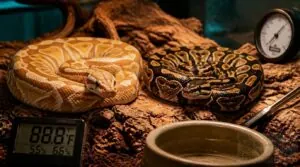
Before a single lock happens, your snakes need to be ready — physically and genetically. Breeding an underprepared animal is the fastest way to end up with failed clutches, sick females, or worse. Here’s what to check off before you even think about pairing.
Reviewing a full ball python breeding preparation guide can help you catch overlooked readiness factors before the season begins.
Assess Age and Weight
Three numbers decide everything here: age, weight, and trajectory. Don’t breed a female until she hits 1,500 grams minimum and clears 3 years old. Males can go a bit earlier, but 800 grams and 2.5 years is still the floor. Pull your monthly weight logs and confirm steady, consistent gains. A flat or dropping growth curve means one thing: wait.
Just as researchers use data-centered reading approaches to track measurable progress over time, your weight logs serve as the raw data that tells you whether your animal is truly ready.
Schedule Veterinary Health Screening
Weight clears the first gate. Now confirm the animal’s internal health with a prebreeding vet screening before any pairing happens.
Your vet will pull baseline bloodwork covering:
- Hematology panel to assess red and white blood cell counts
- Biochemistry panel to check liver and kidney function
- Body condition score
- Physical exam findings
Vet screenings catch what your weight logs simply can’t.
Test for Infectious Diseases
Bloodwork alone won’t catch everything. Extend your prebreeding vet screening to include PCR for Nidovirus and a targeted test for Cryptosporidiosis, both run separately from your baseline bloodwork panel. These pathogens spread fast once breeding starts, and infected adults often show no visible symptoms at all. Any positive result triggers strict quarantine protocol. Don’t pair that animal. Period.
Review Genetics and Lineage
Once your animals clear disease screening, pull their lineage records. Before pairing, run through:
- Genetic morph testing to confirm alleles
- Pedigree analysis for accurate trait prediction
- Relatedness DNA testing to flag shared ancestry
- Inbreeding risk assessment across at least three generations
- Outcross pairing strategy to maintain genetic diversity
Surprises on hatch day are expensive. Know your genetics before you pair.
Condition With Proper Feeding
Conditioning a ball python for breeding starts with the scale. Females need 1,200–1,500 grams minimum; males, 700–1,000 grams. Feed adults every 10–21 days, sizing prey to body width. Frozen-thawed only.
For a deeper look at how enclosure setup supports healthy growth and breeding readiness, a proper ball python terrarium setup plays just as big a role as diet.
Weekly weigh-ins for juveniles, monthly for adults. Track the trend, not single readings. Overfeeding builds fat, not breeding condition.
Cycle The Breeding Environment
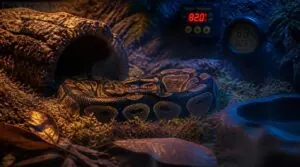
Ball pythons don’t breed on demand — they breed on cue, and you’re the one who sets that cue. Environmental cycling is how you replicate the seasonal shifts that trigger their instincts in the wild. Here’s how to dial in each variable, step by step.
Ball pythons don’t breed on demand — they breed on cue, and you control the cue
Set Safe Temperature Gradients
A thermal gradient isn’t optional — it’s the foundation of everything.
Set your basking temperature between 32 and 34°C on the warm end, and hold the cool end temperature at 28 to 30°C. That spread gives your snake control. Use two independent thermometers. One isn’t enough. Install a thermostat with feedback loop to keep variance within 1 to 2°C.
Introduce Seasonal Nighttime Cooling
Drop the cool end temperature to 22 to 24°C after sunset. That shift triggers seasonal cycling in your snake’s reproductive system.
- Lower the cool end to 22°C overnight
- Let the thermal gradient compress naturally
- Restore daytime temps by 8 a.m.
Night temp stability is non-negotiable. Steady temperature cycling drives results.
Adjust Photoperiod Gradually
Light matters as much as heat. Adjust photoperiod gradually, starting at 10 hours and adding 30 minutes each week.
| Week | Daily Light |
|---|---|
| 1 | 10 hours |
| 2 | 10.5 hours |
| 3 | 11 hours |
| 4 | 11.5 hours |
| 5 | 12 hours |
This signals the breeding season timeline. Sudden shifts spike stress and disrupt ovulation detection. Pair with steady temperature cycling and stable humidity levels.
Monitor Humidity and Temperatures
Your sensors tell the whole story. Place them at breathing height, never directly over heating elements, or you’ll read heat instead of air. Target a thermal gradient of 88–92°F warm, 78–82°F cool.
Keep humidity levels at 60–70% during breeding; check substrate moisture weekly. Log readings every 5–15 minutes for solid temperature regulation. Weekly graphs catch drift before it costs you.
Reduce Stress Before Pairing
Ball pythons read every change in their environment. Stop handling both snakes 48-72 hours before pairing. Keep enclosure setup identical, no rearranging hides or substrate.
Hold temperatures steady within your established gradient and humidity at 60-70%. Watch for relaxed body posture and slow, regular tongue flicking. Tight coiling or erratic movement tells you the snake isn’t ready. Wait it out.
If you’re unsure what a particular posture or flick pattern means, this guide to corn snake body language helps you read your snake’s mood before you act.
Pair Ball Pythons Safely
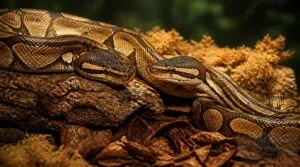
Getting the pairing process right separates a successful breeding season from a stressful one. Before you put two snakes together, there’s a specific sequence of steps that keeps both animals safe and maximizes your odds of a fertile lock. Here’s what you need to do.
Confirm Sex Before Pairing
Pairing two females wastes a breeding season. Confirm sex by checking the tail base shape and ventral scales near the cloaca. Males carry hemipenes, producing a noticeably longer, thicker tail taper. Still unsure? Have a herp vet use cloacal probing, carefully. Done wrong, it causes real injury. Behavioral observation during supervised contact can reveal cloacal locking attempts, which only males initiate.
Introduce The Breeding Pair
Once sex is confirmed, move both snakes into a neutral, unfamiliar enclosure. Neither animal should have prior claim to the space. Drop the male in first, wait 10 minutes, then introduce the female.
Keep warm side temps at 80 to 85°F. Watch both animals closely for the first 30 minutes. Stress kills momentum fast. Separate them immediately if aggression escalates.
Recognize Courtship and Receptivity
Once the pair settles, watch the male. Head bobbing and tongue flicking start within minutes if she’s interested.
Three receptivity signals to watch:
- She holds still and raises her head, tracking his movement
- Her body aligns parallel to his
- Tail base swelling signals approaching ovulation
If she arches away or retreats, separate and rest them. Retry in 48 hours.
Identify Successful Mating Locks
When she stops moving and flattens her tail base, the male makes his move. Cloacal locking happens fast. He aligns his vent to hers, achieves hemipenal insertion, and both bodies go still. Sperm transfer begins.
A successful lock holds 10 minutes to over an hour. Steady coiling and a stable dorsal posture confirm it. Longer locks improve fertilization odds.
Schedule Rest Between Pairings
After a lock, give both snakes 4 to 6 weeks before the next introduction. This recovery period isn’t optional. Stress reduction matters as much as the pairing itself.
Keep housing stable, maintain temperature cycling consistent with your seasonal cycling protocol, and weigh weekly. If either snake drops over 10% bodyweight, pause. Postcooling care applies here too: don’t rush.
Monitor Ovulation and Egg Laying
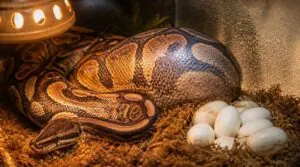
Once your female has locked successfully, the waiting game begins — and knowing what to look for makes all the difference. Her body will move through several distinct stages before she lays, each one a signal you need to catch and act on. Here’s what to track from follicle development through egg drop.
Track Follicle Development Signs
Follicle development doesn’t announce itself loudly. Before ovulation swelling appears, subtle behavioral and physical changes tip you off. Watch for these four early markers:
- Follicle size 10mm: a faint linear bulge along the posterior body
- Reduced feeding response
- Increased soaking behavior
- Follicle stimulating hormone activity driving early mid-body firmness
Weight thresholds apply here: females under 1,500 grams rarely cycle reliably.
Identify Ovulation Swelling
When does ovulation swelling actually hit? Once follicle development peaks, follicle stimulating hormone drops, and vitellogenesis wraps, the ovulation bulge appears mid-to-lower body within 24–48 hours. It often tilts toward whichever side held the dominant follicle.
| Sign | Location | Timing |
|---|---|---|
| Visible bulge | Mid-lower abdomen | Day 1–2 |
| Peak swelling | Dominant follicle side | Day 2 |
| Softening begins | Abdomen | Day 3–4 |
Watch for Pre-Lay Shed
The ovulation swelling fades, and roughly 2-4 weeks later, your gravid female will enter her pre-lay shed. Eyes cloud over, the spectacle dulls, and her chin darkens visibly. Bump humidity to 70-85% for 24-72 hours and minimize handling. Follicle development is behind her now. This shed is your clearest breeding readiness signal, and egg laying commonly follows within 28-30 days.
Prepare The Egg-Laying Box
The pre-lay shed ends and your clock starts. Have the egg-laying box ready before she needs it. A dark, lidded container with a hide-sized entry hole works.
Fill it with 2-4 inches of moist substrate, sphagnum moss or coconut fiber. Keep it away from heat sources and drafts. Add a small breathable vent to control humidity and prevent mold.
Recognize Egg-Binding Emergencies
Your female straining 48 hours past the pre-lay shed with no egg is a code red. Watch for:
- Tail pumping with no egg production
- Lethargy and a distended cloaca
- No feces or urates for 24+ hours
Impaired oviduct function, poor calcium metabolism, low hydration status, and abnormal follicle development all drive egg binding. Call a vet.
Incubate Eggs and Raise Hatchlings
Getting eggs to hatchlings is where all your prep work either pays off or falls apart. Every decision from this point — how you handle the eggs, how you set up the incubator, how you house each hatchling — directly shapes their survival and long-term health. Here’s exactly how to do it right.
Collect and Weigh Eggs
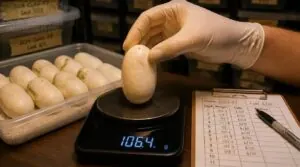
The moment your female lays, collect eggs immediately. Handle each one with two fingers, never rotate them; the air cell up orientation sets from the start and must stay fixed to help egg viability.
Weigh every egg on a tared digital scale and log each gram. Label trays with clutch data to support weight monitoring through the full incubation run.
Candle Eggs for Fertility

With weights logged, candle each egg within 24 hours of collection. Press a focused LED light against the shell in a completely dark room. A fertile egg shows a pink vascular web and a developing embryo mass. Clear eggs stay uniformly translucent, no veins, no movement. Pull those and discard.
Mark confirmed fertile eggs before returning them to the tray.
Set Up The Incubator
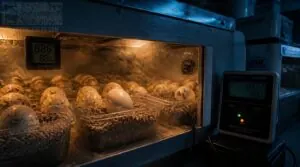
With fertile eggs marked, get your incubator dialed in before a single one goes inside.
Set temperature to 88-90°F and lock humidity between 90 and 100 percent. Run a separate data logger, not just the built-in probe, and calibrate both before loading eggs.
The thermal gradient across the egg zone can’t exceed 0.5°F. Stable conditions from day one, no exceptions.
Prepare Individual Hatchling Enclosures
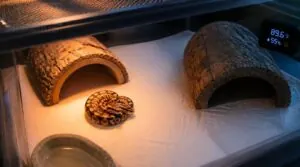
Eggs run 55 to 60 days. Individual hatchling enclosures need to be ready before the first one pips.
Start with a 12x12x6-inch box per snake. Paper towels or reptile carpet only, no loose substrate. Warm side at 88-90°F, cool side at 78-80°F. Humidity between 40 and 60 percent. One hide per side.
Time First Sheds and Feedings
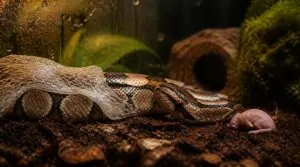
The first shed arrives 7 to 14 days post-hatch. Hold humidity at 70 to 90 percent. One-piece, clean skin means you’re on track.
Hatchling feeding kicks in within 24 to 72 hours. Match prey size to the snake’s widest point and feed every 5 to 7 days. Log it; your growth history is how you spot problems before they compound.
Frequently Asked Questions (FAQs)
Are ball pythons easy to breed?
Like learning to drive a manual car, the basics come fast. Ball pythons reward patient preparation, but mastering ovulation detection, incubation temperature, egg candling, hatchling care, and genetic diversity takes genuine skill and commitment.
How do you breed ball pythons for beginners?
Start with healthy, weight-ready snakes, cycle temperatures seasonally, and pair them with patience. Ball python snakes reward methodical precision. Master incubation temperature, egg candling, hatchling care, and feeding frequency before you attempt your first clutch.
How much money can you make breeding ball pythons?
Think of it like a vending machine: low overhead, recurring output. Small operations clear $5,000 to $25,000 net per year. High-end morphs pull $1,000 to $3,000 per pair, but morph quality and volume drive everything.
What month do ball pythons lay eggs?
In the wild, ball pythons usually lay eggs late fall to early winter, with most clutches appearing in November through January. Captive programs often see laying shift slightly, depending on how you manage the breeding season cooling cycle.
How do you get ball pythons to breed?
Patience, persistence, and precise preparation pay off. Get both animals to ideal weight, cycle their environment seasonally, pair them correctly, and let natural instinct do the rest.
How long does it take for ball pythons to breed?
From prep to hatchlings, the full breeding cycle spans roughly six to eight months. That covers conditioning, pairing, a 55-to-60-day incubation, and hatchling emergence.
How do you know when to breed your ball python?
Your female needs to hit 1,200 grams and clear 2 to 3 years. Males require 700 grams minimum. Once both animals meet their thresholds and pass a health check, your breeding season timeline can begin.
Is it hard to breed ball pythons?
A locksmith isn’t born knowing every lock. Breeding ball pythons is no different. Track ovulation detection, nail egg incubation, prevent parasites, maintain genetic diversity, and hatchling care becomes second nature. It takes knowledge, not luck.
How long does it take to breed ball pythons?
Some processes reward speed. This isn’t one of them. From the breeding season timeline through ovulation detection, the gravid timeline, egg incubation, and the hatching window, expect 12 to 24 months total.
What are the requirements for breeding ball pythons?
Think of it like getting a sports car race-ready: weight, health, and timing all must align. Females need 1,500g minimum, males 800g, with a clean vet check confirming both are disease-free and fit.
Conclusion
A first-time breeder pairs in November, nails every temperature drop, catches ovulation swelling on day one, and pulls a clean clutch of eighty days later. That’s not luck at all. That’s what breeding ball pythons by the numbers looks like.
Every checkpoint in this guide exists because someone before you skipped it and paid the price. You don’t have to. Follow the sequence, trust the data, and the clutch will take care of itself.