This site is supported by our readers. We may earn a commission, at no cost to you, if you purchase through links.

A hognose slips through a ¼-inch gap faster than you can say "oops." One loose seam on a collapsible tank, and your breeding project becomes a house-wide search party.
Snake breeding rewards preparation and punishes shortcuts. Your essential supplies for snake breeding protect the animals, your gear, and your sanity. Skimp on a thermostat, and eggs cook. Skip a humid hide, and a ball python struggles through shed. Pick cedar bedding, and lungs pay the price.
Good news: the right setup is simple to build. Start with the enclosure, the hides, and three standout picks that earn their shelf space.
Table Of Contents
- Key Takeaways
- Secure Snake Breeding Enclosures, Hides, and Substrates
- Top 3 Equipment Picks for Your Snake Breeding Setup
- Heating, Humidity, and Monitoring Supplies for Snake Breeding
- Feeding, Hygiene, and Record-Keeping Supplies for Breeders
- Egg-Laying, Incubation, and Hatchling Care Supplies
- Frequently Asked Questions (FAQs)
- What do I need to be a snake breeder?
- What not to use for snake bedding?
- How to breed snakes for beginners?
- What do snakes need to be happy?
- What do you need to be a snake breeder?
- How much does the average snake breeder make?
- What is the easiest snake breed to own?
- What supplies do I need for a pet snake?
- What are the best tools for sexing snakes?
- How to safely transport snakes during breeding?
- Conclusion
Key Takeaways
- Escape-proof your enclosure with locking lids, fine mesh vents, and no gaps wider than ¼ inch, and give every snake two snug hides (one warm, one cool) plus a humid hide for shedding.
- Skip cedar and pine bedding because they irritate your snake’s lungs, and use coconut husk or cypress mulch 3 to 4 inches deep instead (or aspen for dry-climate species).
- Control your heat and humidity with an undertank heater on a thermostat, a basking zone around 88–92°F, 60–80% humidity for tropical species, and a timer-run lamp to keep a steady day and night cycle.
- Incubate eggs at 88–90°F and 90–95% humidity in moist vermiculite, run the incubator for 24 to 48 hours before adding eggs, and never rotate them once they’re placed.
Secure Snake Breeding Enclosures, Hides, and Substrates
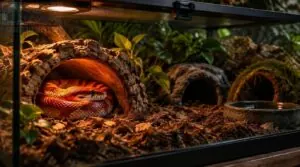
The best breeding setup starts with secure enclosures. Snakes are escape artists, so you need locking lids, fine mesh vents, and no gaps wider than 1/4 inch. A collapsible reptile tank can work too, as long as every seam stays tight. Safe snake, safe you. Non-negotiable.
Before you add any breeding pairs, it helps to review these snake husbandry best practices so temperature, humidity, and enclosure sizing are dialed in from day one.
Next, add at least two hiding spots per snake, one warm and one cool. Keep them snug, so your snake touches the walls while coiled. Add a humid hide on the cool side to help shedding.
Pick your substrate with real care. Coconut husk or cypress mulch, 3 to 4 inches deep, suits most species. Aspen shavings work for dry-climate snakes like rosy boas. Skip cedar and pine entirely. They quickly irritate delicate lungs.
Top 3 Equipment Picks for Your Snake Breeding Setup
Ready to build a snake breeding setup that works as hard as you do? These top 3 equipment picks are essential for keeping your snakes safe, comfortable, and thriving. Check out the list below and see which ones belong in your setup.
1. Collapsible Reptile Tank Terrarium Enclosure
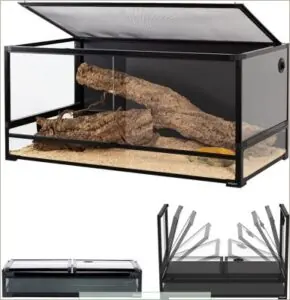
A collapsible 120-gallon tank is your essential first buy. At 48 x 24 x 24 inches, it gives your snakes room to stretch, climb, and explore. (Think of it as a roomy studio apartment.)
The patented fold-flat design sets up in three minutes, and the one-hand front doors make feeding easy. A black-out PVC back panel calms stressed breeders. The tempered glass base sits 0.5 inches up, so your substrate heater fits underneath.
Security matters. Lock the lid buckle and the door locks, every time.
Check the swing tabs for brittleness, and keep cords thin, since the cord manager works only with slim ones.
If you keep a snake tank, remember the heat mat needs room too, so check how much heat mat a ball python needs before arranging cords and hides.
| Best For | Reptile and amphibian keepers who want a roomy 120-gallon enclosure that is quick to assemble and easy to access for feeding and maintenance. |
|---|---|
| Product Type | Collapsible tank |
| Best Use | Reptile enclosure |
| Safety Features | Lid buckle and door locks |
| Material | Tempered glass and PVC |
| Power Limits | N/A |
| Main Limitation | Brittle plastic tabs |
| Additional Features |
|
- Patented collapsible design folds flat and sets up in about 3 minutes
- Black-out PVC back panel helps reduce stress for reptile and amphibian pets
- Security buckle on the lid and door locks help prevent escapes and accidental openings
- Plastic swing tabs may become brittle with age and can break if misaligned
- Cord manager in the side glass fits only thin power cords and struggles with multiple cords
- Some customers report durability problems, such as glass doors falling out or side panels shaking
2. Mini Deep Dome Lamp Fixture
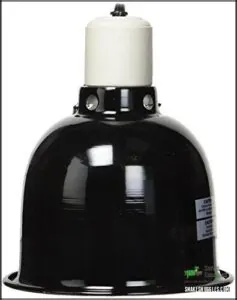
Your big tank needs a warm end, and this fixture delivers it. The polished aluminum dome sends light and heat straight down, and the deep dome hides the lamp so it never sticks out. Its 14 cm opening suits mini lamps nicely.
Check your wattage. The ceramic socket grips incandescent bulbs up to 100 watts and ceramic heat emitters up to 60 watts. Compact fluorescent bulbs? Skip them, because they won’t work here.
Mount the hook over one end to build a thermal gradient, so your snakes can move between warm and cool zones. Keep it out of reach and keep flammable decor away from the heat path.
Once the gradient is set up, a reliable reptile thermometer for desert species helps you confirm those basking and cool-zone temperatures stay accurate.
Small enclosure? Pick a lower wattage. Outside the EU? Grab a plug adapter.
| Best For | Reptile keepers who want a simple, adjustable basking light and heat source over one end of a terrarium to create a warm zone. |
|---|---|
| Product Type | Heat lamp fixture |
| Best Use | Basking heat source |
| Safety Features | Keep flammables away |
| Material | Polished aluminum and ceramic |
| Power Limits | 100 W bulb, 60 W emitter |
| Main Limitation | No CFL bulbs |
| Additional Features |
|
- Polished aluminum dome directs light and heat downward, and the deep dome keeps the lamp from sticking out
- Ceramic socket handles incandescent bulbs up to 100 watts and ceramic heat emitters up to 60 watts
- Built-in hanging hook makes it easy to suspend inside the enclosure
- Not compatible with compact fluorescent bulbs
- Heat output may be too much for small terrariums
- European plug may need an adapter outside the EU
3. Programmable Power Strip with Timer
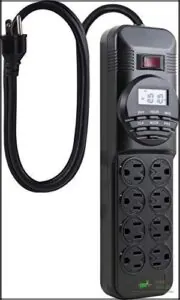
Your dome lamp is only half the job. Something has to switch it on and off, and that’s where this power strip earns its spot.
Four outlets run on the 7-day timer, programmable down to the minute, so your lamp and heat emitter follow a steady day and night cycle. The other four stay always on for gear that can’t sleep. Twist-to-lock covers keep humid air out of the sockets.
Know the limits. The combined load tops out at 15 A or 1800 W. It’s indoor only, offers no surge protection, and never belongs near aquariums. Programming may need a 12-hour cycle to kick in, so test it first. Battery backup also saves your settings during outages.
| Best For | Reptile keepers, indoor gardeners, and hobbyists who need lamps, grow lights, or seasonal decor to follow a steady daily or weekly schedule without manual switching. |
|---|---|
| Product Type | Outlet timer |
| Best Use | Automating lights and equipment |
| Safety Features | Twist-to-lock outlet covers |
| Material | ABS and polycarbonate |
| Power Limits | 15 A / 1800 W |
| Main Limitation | No surge protection |
| Additional Features |
|
- Four timer-controlled outlets use a 7-day schedule that can be set down to the minute, while four always-on outlets keep other gear running.
- Battery backup preserves your timer settings during power outages.
- Twist-to-lock safety covers help protect the outlets in humid spaces like grow tents.
- It has no surge protection, so connected devices are not shielded from power surges.
- The combined load is capped at 15 A / 1800 W, so it can’t handle high-draw appliances.
- Programming may need a 12-hour cycle to activate, and initial glitches can occur, so you should test it before relying on it.
Heating, Humidity, and Monitoring Supplies for Snake Breeding
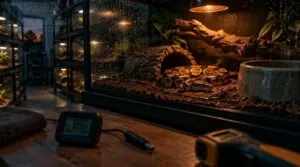
The right heat and humidity make or break your breeding season.
Start with undertank heaters. Cover about one-third of the floor to build a gradient, and run them through a pulse proportional thermostat. A thermostat is non-negotiable. Put the probe directly on the substrate surface for floor readings.
Add heating lamps overhead for a basking zone around 88–92°F. Ceramic emitters keep nights dark and your photoperiod intact.
Humidity regulation is just as essential. Aim for 60–80% for tropical species. Mist walls and hides, and set a big water bowl on the warm side.
Want to stop guessing? Install a digital hygrometer with remote probes, then check surfaces with an infrared temperature gun. Know your numbers, and you’ll breed with confidence.
Feeding, Hygiene, and Record-Keeping Supplies for Breeders

The right feeding setup keeps you safe and your snakes thriving. Start with quality feeders, offered pre-killed with 10-inch stainless steel tongs. Defensive snakes? Studded gloves are non-negotiable.
Hygiene is essential. Wipe your tools with hand sanitizer and paper towels between meals, and use cotton transport bags to contain shed skin and debris. Keep a reptile first aid kit within arm’s reach, too.
Now, the paperwork. Detailed breeding records pay off every season. Track feedings, weights, and sheds in a notebook, or let reptile breeding software handle the heavy lifting with low-stock feeder alerts. Better data means smarter genetic tracking, and smarter pairings. Ready to level up? Your future clutches will thank you for every single logged detail you record.
Egg-Laying, Incubation, and Hatchling Care Supplies
Think of your incubator as a cozy nest you build yourself. Get it right, and the babies do the rest.
Build your incubator like a cozy nest, and once it’s right, the babies will take care of the rest
Start with sturdy breeding boxes: opaque tubs with small vent holes, roomy enough for a gravid female to turn around. Fill them with moist vermiculite at a 1:1 water-to-substrate ratio by weight. A simple squeeze test for moisture confirms the substrate holds its shape without dripping.
Reliable temperature and humidity control is non-negotiable. Aim for 88°F to 90°F and 90% to 95% RH. Run the incubator for 24 to 48 hours before adding eggs. Place digital hygrometers inside the egg box, because display readings alone can fib.
Mark each egg’s top with soft pencil, then move eggs to egg trays without rotating them. Never turn them. Ever.
Let hatchlings settle five to seven days.
Frequently Asked Questions (FAQs)
What do I need to be a snake breeder?
You need a mountain of gear, honestly! Start with secure enclosures, breeding boxes, and reliable temperature control. Add humidity regulation and a digital incubator.
Skip any, and your clutch suffers. Your snakes deserve nothing less.
What not to use for snake bedding?
Picture your snake gasping in a cloud of cedar fumes. Skip cedar, pine, and sand.
Bioactive substrates are living soil ecosystems where isopods break down waste. NOT for snakes.
Cypress mulch, moistureholding substrate, rots scales.
How to breed snakes for beginners?
Breeding snakes is like running a tiny hotel: guests must stay put. Start with secure enclosures, then pair healthy adults.
Add breeding boxes, strict temperature control and humidity control, and an incubator for eggs.
What do snakes need to be happy?
Happy snakes feel safe. Give them secure enclosures with proper ventilation, snug hiding spots on both sides, and steady temperature and humidity control. Add quality feeders, like tongs and right-sized prey. Safety comes first. Always.
What do you need to be a snake breeder?
Picture a quiet room lined with warm, humming racks, each snake settled in its own secure space. You’ll need healthy snakes, escape-proof breeding boxes, reliable temperature control, humidity control, an incubator for egg incubation, and careful records.
How much does the average snake breeder make?
Most hobby breeders earn under $10,000 a year. Pros hit six figures. Your snake breeding setup matters: an incubator and breeding boxes fit a budget 250 to 400, so smart breeding supply budgeting protects profit.
What is the easiest snake breed to own?
Corn snakes are the easiest snake to own. They rarely bite and handle well. Beginners love their calm nature. Master temperature control, and your snake breeding setup, incubation boxes, and reptile breeding supplies stay simple.
What supplies do I need for a pet snake?
Think a snake needs a fortune in gear? It doesn’t.
Start with a secure collapsible reptile tank, heat mats on a thermostat, two snug hides, hygrometers, paper-towel substrate, a heavy water bowl, and frozen prey.
What are the best tools for sexing snakes?
Ready to sex your snakes with confidence? Start with a probing kit, then confirm hemipenes pockets. Always handle snakes gently.
Log results in breeding records and reptile breeding software for genetic tracking and snake pairing.
How to safely transport snakes during breeding?
Picture Mia driving her male corn snake to a breeding date.
Use escapeproof enclosures with locked lids, a collapsible reptile tank. Keep temperature control steady at 75–85°F, add proper ventilation, and watch hygrometers. Handle gently.
Conclusion
Imagine this: it’s 2 a.m., your incubator thermostat fails, and a clutch of ball python eggs starts to overheat. Because you installed a backup probe and alarm, you catch it in minutes and lose nothing.
That’s the payoff of smart preparation. The essential supplies for snake breeding aren’t glamorous, but they’re your safety net. Secure the tank, control the heat, track every pairing. Do that, and you’ll spend your nights sleeping instead of sweating bullets.