This site is supported by our readers. We may earn a commission, at no cost to you, if you purchase through links.

A local news crew once filmed a "sea monster" washed up on a Texas beach — mottled, fanged, and eerily snakelike. It turned out to be a fangtooth snake eel, a burrowing predator most beachgoers never knew existed. That mix-up says a lot about this creature: bizarre-looking, rarely seen, and easy to misjudge.
Found from the Gulf of Mexico down to Brazil, it spends its life buried in soft sand, striking prey with curved, hooked fangs. Bites happen, though rarely from aggression.
Here’s what makes this eel’s anatomy, hunting style, and bite risk worth understanding before your next trip to the shoreline.
Table Of Contents
- Key Takeaways
- What is a Fangtooth Snake Eel?
- Appearance, Size, and Burrowing Adaptations
- Range, Habitat, and Burrow-Dwelling Behavior
- Diet, Hunting, and Interesting Facts
- Fangtooth Snake Eel Bite Information
- Frequently Asked Questions (FAQs)
- What is a fangtooth snake eel?
- How big does a fangtooth snake eel get?
- Where do fangtooth snake eels live?
- What does a fangtooth snake eel eat?
- What are some interesting facts about the fangtooth fish?
- What are some interesting facts about snake eels?
- Do fangtooth eels have teeth?
- Are fangtooths aggressive?
- Are fangtooth moray eels aggressive?
- What’s unique about Fangtooth Moray eels?
- Conclusion
Key Takeaways
- The fangtooth snake eel (Aplatophis chauliodus) is a scaleless, burrowing fish found from the Gulf of Mexico to Brazil, not an actual snake despite its serpent-like looks.
- It hides in soft-sand burrows 33–91 meters deep, using curved fangs, expandable jaws, and a keen sense of smell to ambush fish and crustaceans at night.
- A 2017 Texas beach carcass went viral as a "sea monster" before experts identified it as this ordinary, shy eel.
- Bites are rare and nonvenomous but can cause painful lacerations and infection risk from marine bacteria, so it’s best to give the eel’s burrow plenty of space.
What is a Fangtooth Snake Eel?
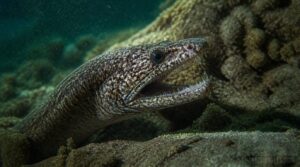
You’ve probably never heard of this eel, but its name alone tells you it means business. Behind that name is a story of sharp teeth, scientific classification, and a case of mistaken identity along the Gulf Coast. Here’s what makes this creature tick, starting with the basics.
If you’re curious about other striking predators with a knack for camouflage, the Amazon tree boa’s varied color morphs offer a fascinating parallel from the rainforest.
Scientific Name and Classification
A name tells a story. Aplatophis chauliodus, coined by ichthyologist James Böhlke in 1956, follows strict binomial nomenclature under ICZN rules. It sits within family Ophichthidae, order Anguilliformes, class Actinopterygii.
That taxonomic hierarchy places this eel firmly among ray-finned fishes, distinct from any true serpent despite its snake-like build.
Snake Eel, Not Snake
Slither past the label, and you’ll find a true fish. The fangtooth snakeeel (also called tusky eel) only mimics serpents through evolutionary convergence, not ancestry. Its elongated, scaleless body evolved independently for burrowing life. This misidentification causes confusion among many beachgoers in the western Atlantic Ocean. Taxonomic clarification matters: eel vs snake anatomy differs completely, despite public perception favoring the "sea serpent" narrative. These fish are part of the diverse snake eel family known for burrowing in sandy substrates.
Fangtooth Name Meaning
Call it truth in advertising. Those curved, oversized teeth are exactly what earned this fish its common name, no embellishment needed.
Aplatophis chauliodus lives up to the label throughout the western Atlantic Ocean, burrowing at depths of 33–91 m. "Tusky eel" works as a nickname for the same reason: the dentition does the talking, making the name one of the more literal ones in marine biology.
If you’re curious about how to stay safe around creatures with dramatic fangs like the tusky eel, this guide to snake bite emergencies offers practical advice for handling unexpected encounters.
Species Naming History
James Erwin Böhlke formally described this species in 1956, giving science the name Aplatophis chauliodus. That follows the binomial system Linnaeus established in 1758, replacing clunky descriptive phrases with two-part names.
A type specimen anchored the description, keeping "tusky eel" and its scientific name stable ever since, per nomenclature rules set by the International Commission on Zoological Nomenclature.
Appearance, Size, and Burrowing Adaptations
Everything about this eel’s body seems built for a life spent hidden in sand. From its jaws to its tail tip, each feature has a clear purpose in ambush and burrowing. Here’s what makes its appearance so distinct.
Curved Upper-Jaw Fangs

Two curved fangs at the front of the upper jaw define this Ophichthidae predator. The arc guides prey inward during a strike, then hooks it before withdrawal. That curvature adds power, letting the marine eel secure slippery fish and crustaceans without breaking its grip. Embedded in a stabilizing canal, each fang withstands rapid jaw expansion, an adaptation built for ambush precision, not just for looks.
Maximum Length and Body Shape

A ruler tells only part of the story here. Males top out at 84 cm, a modest size among Atlantic marine life, though the species can approach a full meter.
That jaw flexibility becomes clear when you check this boa constrictor prey size chart, which puts their surprising gape into perspective.
What stands out is the shape: fusiform, cylindrical, built for tunnels rather than open water. Juveniles start slender near 20–30 cm, and growth favors length over girth for years.
Scaleless Skin and Coloration
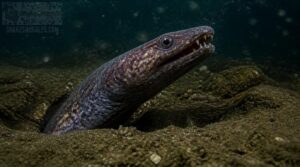
No armor plating here. Aplatophis chauliodus wears scaleless skin, smooth and mucus-coated, letting it slide through Gulf of Mexico sediment with minimal friction.
Coloration runs mottled brown to purplish-black, broken by faint speckling. That’s camouflage doing its job, blending the eel against muddy burrows while chromatophores beneath the epidermis fine-tune the pattern for whatever murky bottom it’s calling home.
Pointed Tail for Digging
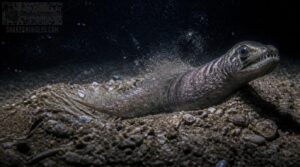
That tail isn’t just for swimming. Aplatophis chauliodus uses its hardened, pointed tail to pierce soft sediment, carving entrance shafts through muscular swipes and body undulations.
Nighttime digging sessions shape a stable burrow, pushing fines aside while compacting walls. Reinforced connective tissue resists gritty substrate wear, letting this predatory fish maintain burrows on a permanent or semipermanent basis, ready for ambush.
Camouflage in Murky Water
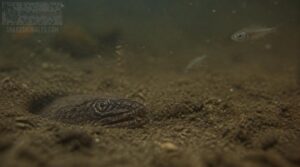
Blending in matters as much as burrowing. Dark brown to purplish-black skin mirrors turbid, sediment-rich water, giving this burrowing eel near-invisible cover in estuarine habitat.
- Sediment color matching
- Light pattern mimicry
- Body outline disruption
- Texture-based concealment
- Depth-based pigment adjustment
Such camouflage in murky water helps ambush prey central to its fish diet, proof of marine biodiversity’s quiet ingenuity.
Range, Habitat, and Burrow-Dwelling Behavior

Fangtooth snake eels don’t wander far from home once they’ve found the right patch of seafloor. Their range and habits actually go hand in hand, shaping everywhere from Carolina waters to Brazilian coastlines. Here’s what defines where this eel lives and how it makes itself at home.
Western Atlantic Distribution
How far does one eel’s range really stretch? Quite far. Aplatophis chauliodus spans the entire Western Atlantic, from the southeastern U.S. down to Brazil’s northeastern coast.
That range isn’t uniform, though. Population density shifts with coastal currents, prey availability, and structurally complex habitats, creating patchy occurrence patterns rather than a continuous presence across this vast geographic distribution.
Gulf, Caribbean, and Brazil
Three regions anchor this eel’s range: the Gulf of Mexico, the Caribbean Sea, and Brazil’s northeastern coast, first documented there in 2017.
- Gulf of Mexico populations
- Caribbean Sea sightings
- French Guiana’s coastal waters
- Northeastern Brazil records
Coastal connectivity through shared currents explains this habitat overlap, linking distant shorelines across Atlantic Ocean biodiversity hotspots and enabling gradual geographic range expansion over time.
Depth and Bottom Habitat
That coastal overlap sets the stage for depth zonation, since these eels favor 33–91 meters on soft-bottom substrates.
Continental slope habitats offer shelter, where seafloor topography channels prey into predictable ambush zones. You’ll find them tucked into soft sediment burrows, dug on a permanent or semipermanent basis, letting deep water currents deliver meals right to their doorstep.
Marine and Brackish Waters
Not every fangtooth eel stays put in open ocean. Some push into brackish estuaries, where river mouths meet tidal salt water, tolerating salinity gradients between 0.5 and 30 parts per thousand.
That kind of tolerance echoes the osmoregulatory tricks described in estuarine snake brackish water tolerance adaptations, where salt balance is critical.
That marine-freshwater shift demands real physiological work, yet these eels manage it, extending their burrowing behavior and predatory fish diet into coastal zones few snake eels bother exploring.
Permanent and Semipermanent Burrows
That estuary life still needs a home base. Whether in marine waters or brackish estuaries, fangtooth eels dig burrows on a permanent or semipermanent basis, choosing stable sediment for structural integrity.
- Burrow reinforcement via compacted tunnel walls
- Ventilation maintained through entrance modification
- Chamber expansion triggered by rising prey density
- Sediment stability guiding placement at depths within the 33–91 m range
Adults reach a maximum length of 84 cm, hunting bony fish and crustaceans from these shelters.
Diet, Hunting, and Interesting Facts
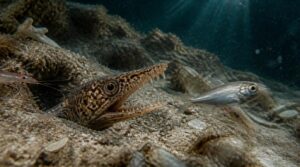
Once you know where a fangtooth snake eel hides, the next question is how it eats. This eel isn’t a picky feeder, and its hunting style is stranger than you’d expect. Here’s what makes its diet and daily habits so fascinating.
Fish, Shrimp, and Crustaceans
A fangtooth snake eel doesn’t fuss over its menu: bony fish and crustaceans, including shrimp, make up its diet.
Shrimp offer more than a meal here, packing protein, selenium, and zinc, protected by a molting exoskeleton.
Hunting through marine waters and brackish estuaries down to 91 meters, this eel, topping out at 84 cm, exploits a sustainable, well-managed food source.
Nighttime Ambush Hunting
When darkness falls, the fangtooth snake eel gets to work. It waits at its burrow entrance, coiled beneath sediment, nearly invisible.
- Strikes launch in milliseconds once prey nears
- Poor night vision in prey favors the ambusher
- Turbid water masks the eel’s approach
- Sediment concealment hides its silhouette completely
- Predator-prey relationships favor patience over speed
This nighttime ambush hunting strategy, well-documented in ichthyology, defines this marine eel species’ success.
Smell-Guided Prey Detection
Since burrow life limits visibility, this eel leans on chemical cue detection instead. Odor molecules drift through water, and it reads plumes with a zigzag search pattern, narrowing in on bony fish and crustaceans.
Nighttime scent hunting works well in murky estuaries. Even Echiophis punctifer, a close relative found near similar depths (33–91 m), relies on comparable olfactory tracking methods for smell-guided prey detection.
Fangs and Expandable Jaws
A "fanged monster" isn’t far off: two curved upper-jaw fangs impale slippery bony fish and crustaceans on contact. Expandable jaws widen the gape, letting this eel—maxing out at just 84 cm—swallow prey nearly its own width.
Worn fangs get replaced through continuous dental renewal, keeping bite force sharp for every ambush strike this Ophichthidae member launches from its burrow.
Texas Sea Monster Misidentification
A washed-up carcass near Texas City, Texas, in September 2017, right after Hurricane Harvey, triggered viral social media spread and "Texas sea monster" headlines.
Expert eel identification settled it fast: head shape analysis and dentition comparison confirmed Aplatophis chauliodus. Misleading news framing had turned a fanged monster narrative into a story—when biology, not myth, explained the eel all along.
Biology, not myth, unmasked the Texas sea monster as an ordinary fangtooth snake eel
Fangtooth Snake Eel Bite Information
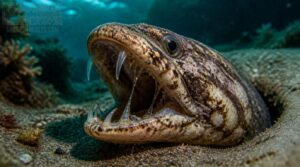
Fangtooth snake eels aren’t out looking for trouble, but that doesn’t mean a bite is harmless. Those curved fangs and the bacteria they carry can turn a small encounter into a real problem if you’re not careful. Here’s what you need to know about the risks and how to handle one safely.
Are Fangtooth Eels Aggressive?
Picture a shy predator that would rather vanish into its burrow than pick a fight. Fangtooth eels rarely show aggression toward divers or swimmers.
Most defensive behavior triggers come from provocation, not predatory intent — sudden movements near a burrow, cornering, or handling. This carnivorous, predatory fish reserves its bite for stress-induced strikes, making bite avoidance simple: keep your distance, move slowly, and respect its space.
Painful but Nonvenomous Bites
So what happens if provocation wins out and the bite lands? You’re not dealing with venom, but it still hurts.
- Pain peaks within minutes, lasting hours
- Swelling and redness develop within 1–24 hours
- Wound healing spans 3–7 days with proper first aid
Marine bacteria in estuarine waters raise infection risk, so clean punctures promptly.
Curved Fangs and Lacerations
That healing timeline owes a lot to the wound shape itself. Those curved fangs don’t just puncture, they tear on withdrawal, leaving ragged edges instead of one clean hole.
The curve concentrates bite force along a narrow line, driving deep penetration while shredding surrounding tissue. Fangtooth snake eels evolved this for their carnivorous diet, gripping slippery fish and crustaceans. On you, it just means messier lacerations.
Marine Bacteria Infection Risk
Those torn edges aren’t just painful, they’re an open door for bacteria. Marine waters and brackish estuaries harbor Vibrio species, which cause rapid swelling, redness, and fever.
Left untreated, infections can turn serious fast. Doctors usually confirm with a wound culture, then prescribe targeted antibiotic treatment. Anyone with liver disease or diabetes faces sharply higher risk from these coastal water hazards.
Bite First Aid and Prevention
Rinse the wound in clean seawater for five minutes, then apply firm pressure to stop bleeding. Disinfect with povidone-iodine, cover with a sterile dressing, and watch for infection signs. Get checked within 24 hours.
Prevention beats treatment: wear puncture-resistant gloves near burrows in marine waters and brackish estuaries, and give a 84 cm predator its space.
Frequently Asked Questions (FAQs)
What is a fangtooth snake eel?
Picture a living booby trap buried in the seabed. That’s Aplatophis chauliodus, a snakelike tropical fish in the eel order, growing to 84 cm, dwelling 33–91 m deep, and ambushing bony fish and crustaceans.
How big does a fangtooth snake eel get?
Males top out at a maximum total length of 84 cm, though most stay smaller. Growth depends on food and burrow stability, with little difference between sexes—both reach similar sizes over years in stable habitats.
Where do fangtooth snake eels live?
From North Carolina to Brazil, spanning thousands of coastal miles, they favor soft-bottom substrates at 33–91 m depth. You’ll find them across the Gulf, Caribbean, French Guiana, and Brazil’s northeastern coast, in both marine and brackish estuarine waters.
What does a fangtooth snake eel eat?
Your typical menu item here: bony fish and crustaceans, shrimp especially. Nighttime ambush hunts from the burrow let jaw flexibility and expandable mouths swallow prey nearly its own width, a predator-prey trick honed by marine biology research.
What are some interesting facts about the fangtooth fish?
Like a living relic from a lightless world, the fangtooth wears its oversized teeth as armor. Its sensory system evolution favors smell over sight, while slow reproduction depth variation and a juvenile morphology shift reveal a truly alien life history.
What are some interesting facts about snake eels?
Snake eels burrow tail-first into sand, relying on smell over sight. Many reach a meter in length, hunt nocturnally, and thrive in tropical waters worldwide, their scaleless bodies and camouflage making them nearly invisible predators.
Do fangtooth eels have teeth?
Funny you should ask, right after that Texas "sea monster" turned out to be one. Yes: curved fangs, fixed and needle-sharp, built for prey grip on bony fish and crustaceans, not chewing.
Are fangtooths aggressive?
Not really. Aggression isn’t a defining trait here. Living at 33–91 m depth, this carnivorous hunter (max 84 cm) relies on stealth for its bony fish and crustacean diet, only biting defensively when handled or provoked during human encounters.
Are fangtooth moray eels aggressive?
Think of them as underwater samurai, sheathed and calm until provoked. Generally not aggressive, they’ll retreat or flash defensive jaw-widening if harassed, but cornered eels—especially in tanks—may nip or bite as a provoked response.
What’s unique about Fangtooth Moray eels?
A dual jaw mechanism, curved fangs with a locking grip, and night ambush tactics set them apart. They tolerate brackish water, use turbid camouflage, and hunt bony fish and crustaceans across a 33–91 m depth range.
Conclusion
Picture a trapdoor hidden in the sand, waiting for the right vibration to spring open — that’s this eel’s whole existence.
You now know the fangtooth snake eels interesting facts and bite information that most beachgoers never learn.
It isn’t a monster; it’s a shy ambush predator built for burrowing, not confrontation.
Bites happen only when hands wander too close.
Respect its space, and you’ll walk the shoreline with sharper awareness, not fear, of what’s buried just beneath your feet.