This site is supported by our readers. We may earn a commission, at no cost to you, if you purchase through links.

That tan patch on your snake’s lip isn’t stuck shed. It’s often the first visible sign of infectious stomatitis, better known as mouth rot, and it won’t clear up on its own. Within days, a small lesion can spread into deep tissue, jaw bone, and systemic infection.
Snakes hide oral pain well, so by the time you notice drooling, a foul odor, or refusal to eat, the infection is already established. Waiting costs you treatment options and costs your snake weight, hydration, and sometimes its life.
Here’s how to identify and treat snake mouth rot at each stage, from early warning signs to culture-guided antibiotics, surgical debridement, and the husbandry fixes that keep it from coming back.
Table Of Contents
- Key Takeaways
- What is Mouth Rot in Snakes?
- Snake Mouth Rot Causes and Risk Factors
- How to Identify Snake Mouth Rot
- How Veterinarians Diagnose Mouth Rot
- How Snake Mouth Rot is Treated
- Preventing Snake Mouth Rot From Returning
- Frequently Asked Questions (FAQs)
- How to treat mouth rot in snakes at home?
- How to identify mouth rot in snakes?
- Can I treat mouth rot at home?
- What does snake rot look like?
- How to tell if your snake has mouth rot?
- How to treat snake mouth rot at home?
- What is the best treatment for mouth rot?
- What antibiotics treat mouth rot in reptiles?
- How can I safely handle a sick snake?
- What are long-term effects of untreated mouth rot?
- Conclusion
Key Takeaways
- Mouth rot progresses from subtle lip discoloration to deep tissue and bone infection within days, so any gray or tan patch on your snake’s gums warrants same-day veterinary contact — not watchful waiting.
- Because snakes mask oral pain effectively, visible signs like drooling, foul odor, or food refusal usually mean the infection is already well established by the time you notice them.
- Most cases trace directly back to fixable husbandry failures — wrong temperatures, poor enclosure hygiene, live prey injuries, or nutritional gaps — meaning prevention is largely within your control.
- Home care alone cannot cure mouth rot; prescription antibiotics, and often surgical removal of dead tissue, are non-negotiable parts of treatment, with at-home support only accelerating what veterinary care starts.
What is Mouth Rot in Snakes?

Mouth rot in snakes isn’t cosmetic. It’s infectious stomatitis, a bacterial oral infection that attacks the oral mucosa and won’t resolve on its own. Left alone, it spreads from red, swollen gums into ulcerated tissue packed with caseous debris.
Because mouth rot often traces back to underlying digestive or husbandry issues, this guide to snake digestive problems is worth a read.
Here’s what makes it dangerous: the infection damages mucosa, opportunistic bacteria colonize the wound, and healing stalls. That cycle produces necrotic tissue damage that feeds more bacterial growth. Severe cases push infection deeper into jaw structures.
You’ll see the consequences fast. Pain makes your snake refuse food. Swallowing becomes difficult. Dehydration follows quickly in anorexic animals, and weight loss accelerates.
The takeaway? This condition progresses from localized lesions to deep tissue involvement in days, not weeks. Early recognition and immediate veterinary care determine whether you’re managing a minor infection or a life-threatening one.
Snake Mouth Rot Causes and Risk Factors

Mouth rot rarely comes out of nowhere. Something broke your snake’s defenses first, whether that’s bacteria, bad husbandry, injury, or a weakened immune system. Below are the six root causes you need to rule out, starting with the pathogens themselves.
Bacterial And Fungal Pathogens
Complexity defines this disease. Mouth rot is rarely one microbe; it’s a polymicrobial mess. Expect:
- Bacterial infection from opportunistic bacteria like Pseudomonas and Aeromonas.
- Bacterial biofilm sheltering pathogens under necrotic debris.
- Fungal colonization, especially after antibiotics disrupt normal flora.
A fungal infection in reptiles often hides beneath crusted exudate, so treating bacteria alone leaves pathogens behind. Culture, don’t guess.
Poor Husbandry Conditions
Here’s the hard truth: poor husbandry causes most mouth rot. Pathogens need a weak host, and bad care creates one.
Check your basics:
- Thermal gradient wrong? Digestion and immunity crash.
- Enclosure hygiene slipping? Waste and biofilm coat surfaces your snake’s mouth touches.
- Humidity high, airflow poor? Bacteria thrive.
- Dirty water bowls? Direct oral exposure.
Fix these before anything else.
Oral Trauma
Now look at your snake’s mouth itself. Oral trauma opens the door pathogens are waiting for. Sharp cage edges, rough substrate, stuck shed caps, and prey bite injuries all break mucosa. Even sealed punctures hide deeper contamination. Run an oral lesion assessment after any strike or fall.
Left untreated, these small wounds can escalate into serious infections, so it’s worth understanding what causes mouth rot in snakes before it takes hold.
Remove sharp décor, feed frozen-thawed, and treat physical trauma before infection takes hold.
Nutritional Deficiencies
Feeding an inadequate diet quietly sets the stage for infectious stomatitis. Here’s what malnutrition does to your snake’s mouth:
- Vitamin A deficiency thins oral mucosa, weakening its barrier.
- Low B-vitamins slow repair of tiny lesions.
- Poor calcium:phosphorus balance weakens tissue regeneration.
- Protein-energy deficits stall collagen deposition and wound closure.
Chronic nutritional deficiencies let small abrasions progress into necrotic, bacterial-laden lesions. Fix the diet.
Immune Suppression
turns minor mouth irritation into full-blown infectious stomatitis. Chronic stress, illness, dehydration, or organ dysfunction (kidney, liver) weaken your snake’s defenses, letting opportunistic bacteria colonize open ulcers.
Watch for red flags: lesions that spread fast, recur despite treatment, or pair with lethargy. These signal a weak immune system, not just dirty water.
Fix the systemic problem first, or the mouth rot won’t stay gone.
Cross-Contamination Risks
Here’s a sobering fact: in multi-snake collections, pathogen transmission via shared tools accounts for a large share of recurring infections, even after a bacterial culture confirms treatment worked.
Break the cycle with reptile quarantine:
- Handle healthy animals first, affected snake last.
- Dedicate forceps, tubs, and brushes per enclosure.
- Disinfect gloves and surfaces between every snake.
Enclosure sanitation isn’t optional. It’s your outbreak firewall.
How to Identify Snake Mouth Rot
Mouth rot can kill a snake in days, so you can’t afford to miss it. Below, you’ll learn the early warning signs, the emergency symptoms that demand immediate veterinary care, and how to tell mouth rot apart from normal shedding. Catch it early and your snake has a real fighting chance.
Early Warning Signs

Mouth rot rarely announces itself loudly. It whispers first. Your snake may show subtle mouth rot symptoms days before anything looks dramatic: a tan or gray patch on the lips, red swollen gums, or wetness pooling at one mouth corner.
Mouth rot whispers before it shouts—watch for subtle signs like gray lip patches or swollen gums days ahead
Watch for early disease detection clues like reluctant feeding, repeated nipping and releasing, or jaw asymmetry. Catch it now, and treatment stays simple.
Advanced Emergency Symptoms

Your snake’s mouth looks worse every day. That’s not something to watch and wait on.
Facial swelling along the jaw means infection has left the surface and invaded deep tissue. Openmouth breathing or drooling signals pain and possible respiratory distress. Add lethargy, refusal to eat, or foul necrotic odor, and you’re looking at a systemic infection. Get to an exotics vet now.
Mouth Rot Versus Shedding
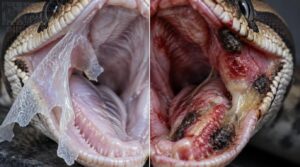
Is that white film in your snake’s mouth a shed or something worse? Look closer. Retained shed comes off as intact, removable skin. Mouth rot doesn’t. It produces spreading ulcers, foul odor, and exudate that bleed when touched. Shedding complications stay tied to the shed cycle; true oral mucosa inflammation progresses and destroys tissue. If it bleeds, smells, or spreads, schedule a veterinary diagnosis immediately.
How Veterinarians Diagnose Mouth Rot
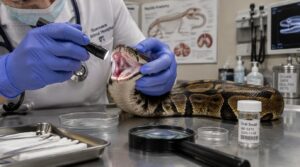
You’ve spotted the signs. Now your vet confirms them. Expect a veterinary diagnosis built on history first: lesion duration, humidity levels, recent mouth injuries, and whether tankmates share the enclosure. Then comes the oral exam, where your vet maps every lesion and checks the gum line and palate for depth.
Testing goes beyond eyeballing:
- Cytology on lesion swabs distinguishes bacterial from fungal overgrowth
- Bacterial cultures guide antibiotic choice in severe or recurrent cases
- Clinical pathology bloodwork uncovers immune suppression or systemic illness
If infection looks deep or the jaw feels unstable, diagnostic imaging like radiographs reveals bone involvement you can’t see. Your vet also rules out mimics: retained shed, chemical burns, foreign bodies. Rechecks track lesion margins and exudate, confirming treatment is actually working.
How Snake Mouth Rot is Treated
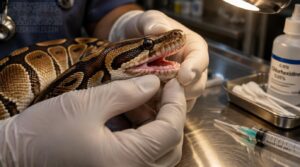
Mouth rot won’t fix itself, and delays cost your snake bone, teeth, sometimes its life. Your vet will choose between antibiotic therapy, antifungal treatment, and surgical debridement depending on how deep the infection runs. Here’s what each involves, plus the at-home care that makes those treatments actually work.
Medications and Surgical Debridement
Expect antimicrobial therapy suited to your snake. If infection runs deep, your vet performs a surgical debridement under anesthesia, scraping away necrotic tissue so antibiotics can reach living tissue. Cultures guide drug choice; expect systemic antibiotics or antifungals dosed over weeks.
Severe abscesses demand aggressive oral debridement procedure plus longer courses. Skimp on any step, and relapse follows fast.
Safe At-Home Support
Your vet takes care of the drugs, but supportive care at home decides recovery speed.
- Raise enclosure temps to 90–95°F, day and night.
- Offer a shallow water bowl; never syringe water into the mouth.
- Spot-clean daily with a dilute bleach wash, rinsed thoroughly.
Minimize handling, add hides for reducing stress, and log appetite changes. Anorexia signals relapse. Keep in mind that anorexia also cuts off the prey-based water route, so watch for signs of snake dehydration such as firmer, chalky, or discolored urates.
Preventing Snake Mouth Rot From Returning

Treatment clears the infection, but only your husbandry keeps it gone. Recurrence almost always traces back to the enclosure, not the snake.
Fix the environment first:
- Dial in your thermal gradient. Cold snakes can’t mount an immune defense.
- Drop humidity to species-correct levels. Damp substrate re-seeds oral bacteria.
- Replace shared water dishes and feeding tools. Contaminated gear reinfects healed tissue.
Then address the triggers:
| Risk | Fix |
|---|---|
| Live prey bites | Switch to f/t, use soft tongs |
| Incomplete shed | Raise humidity during cycles only |
| Poor nutrition | Correct calcium/vitamin gaps |
Don’t stop antibiotics early. Stopping mid-course breeds antibiotic resistance and leaves surviving pathogens behind.
Recheck healed mouths monthly. Any redness, thick saliva, or reopened ulcer? Call your vet that day. Poor husbandry caused this. Habitat management prevents it.
Frequently Asked Questions (FAQs)
How to treat mouth rot in snakes at home?
Here’s the honest answer: home treatment only backs up vet care. Gently rinse with sterile saline, wipe away exudate, fix temperatures, keep the enclosure spotless, and see an exotic vet for antibiotics.
How to identify mouth rot in snakes?
This can kill your snake fast. Check for oral inflammation, redness or swelling at the lips, foul-smelling discharge, pooled saliva, and appetite loss. Late-stage cases show necrotic tissue, gray-yellow plaques, and deepening ulcers.
Can I treat mouth rot at home?
A rotting fencepost spreads rot inward. So does mouth rot. Can I treat mouth rot at home? Only partially. Home care helps healing; prescription antibiotics and debridement from a reptile vet remain essential.
What does snake rot look like?
Snake mouth rot looks like a red flag waving: gray or yellow necrotic tissue on gums or tongue, ulcers, swelling, and foul-smelling discharge. Unlike shedding, these oral lesions in snakes bleed easily and worsen fast.
How to tell if your snake has mouth rot?
Even one tiny cheesy yellow plaque along the gum line is a screaming red flag for stomatitis. Look for gum swelling, foul-smelling oral discharge, or any jaw asymmetry. Those are your clearest mouth rot symptoms.
How to treat snake mouth rot at home?
Can at-home care actually cure mouth rot alone? No. Oral debridement with dilute chlorhexidine, supportive care, and proper reptile husbandry all help, but systemic antibiotics from reptile veterinary care are non-negotiable for a real recovery.
What is the best treatment for mouth rot?
Most cases worsen fast without early veterinary intervention. Oral debridement procedure combined with reptile antibiotic treatment is the best approach. Your vet removes necrotic tissue, runs cytology, prescribes antibiotics, and adds supportive care when needed.
What antibiotics treat mouth rot in reptiles?
A ball python I treated needed three antibiotic switches before clearing. Fluoroquinolones and penicillins are your vet’s go-to choices for infectious stomatitis, but reptile antibiotic treatment works best after a culture targets the oral infection.
How can I safely handle a sick snake?
Reptile zoonoses affect thousands annually. Always wear gloves and avoid oral splashes first, then quarantine the sick snake immediately. Use dedicated feeding tongs and tools. Wash hands thoroughly before touching anything else in your collection.
What are long-term effects of untreated mouth rot?
Untreated mouth rot progresses into tissue necrosis, jaw bone infection, and immune suppression. Feeding stops, weight collapses, and wound healing impairment makes full recovery nearly impossible. Secondary pneumonia can follow. Delay costs your snake everything.
Conclusion
A corn snake brought in on a Wednesday had refused food for two weeks. By Friday, jaw bone necrosis required surgical debridement. Two weeks of early warning signs went unnoticed.
That’s the real cost of a missed catch. You now have the tools to identify and treat snake mouth rot before it reaches that stage. Inspect the mouth weekly, correct every husbandry gap, and contact your exotic vet the same day symptoms appear. Act now.