This site is supported by our readers. We may earn a commission, at no cost to you, if you purchase through links.

A kingsnake earns its name by eating other snakes, rattlesnakes included, thanks to a resistance to venom that still puzzles researchers studying its blood chemistry. That single trait shapes everything about how this animal lives, from the burrows it digs to the temperature swings it tolerates between a Canadian summer and an Argentine rainforest floor.
Understanding king snake natural habitat and care means starting with that wild backdrop: the sandy deserts, hardwood forests, and open grasslands where these snakes have adapted over millions of years. Get the habitat right, and health problems in captivity tend to disappear on their own.
What follows breaks down exactly how to bring that range indoors, piece by piece.
Table Of Contents
- Key Takeaways
- King Snake Natural Habitat and Range
- Replicating a Kingsnake’s Natural Habitat
- Kingsnake Feeding, Health, and Handling
- Top 5 Kingsnake Habitat Products
- Frequently Asked Questions (FAQs)
- Does a California kingsnake need heat at night?
- Can kingsnakes be housed together safely?
- What signs indicate a kingsnake is shedding?
- How often should kingsnakes be handled?
- Do kingsnakes require special winter care?
- What substrates are toxic to kingsnakes?
- How long do kingsnakes typically live in captivity?
- How often do kingsnakes shed their skin?
- How do you safely handle a kingsnake?
- When do kingsnakes reach reproductive maturity?
- Conclusion
Key Takeaways
- Your kingsnake’s resistance to venom lets it hunt rattlesnakes and other dangerous prey, and this single trait drives nearly every habitat and care decision you’ll make.
- Recreating a proper temperature gradient (32–34°C basking, 22–24°C cool side) and 40–60% humidity matters most, since getting this wrong is what causes most captive health problems.
- Feed prey sized to your snake’s girth on a steady schedule (weekly for juveniles, every 10–14 days for adults), since inconsistent portions or timing damages both digestion and trust.
- With attentive care—stable temperatures, proper hydration, and annual vet checkups—your kingsnake can live 15 to 20 years or more, far beyond the roughly nine years it would see in the wild.
King Snake Natural Habitat and Range
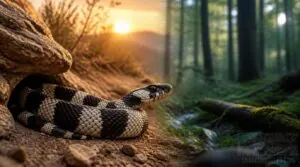
Kingsnakes don’t pick their homes at random—every desert burrow and rocky crevice has a purpose. Understanding where they live in the wild tells you exactly what to recreate in captivity. Here’s a look at the habitats and ranges that shape how these snakes survive, from the Mojave’s dry scrub to the humid stretches of the Southeast.
Once you know which range your snake hails from, this detailed king snake care sheet walks you through matching that native climate in a captive setup.
Deserts, Forests, and Grasslands
Sand, shade, sod: kingsnakes call all three home. They thrive across deserts, forests, and grasslands, from arid scrub below 254mm rainfall to shaded, humid forest microclimates and fire-maintained grasslands with deep, moisture-rich soils. Forest floors in particular benefit from rich organic soil layers formed by decomposing leaf litter, creating cool, humid retreats kingsnakes favor.
Three defining traits shape where you’ll find them:
- Habitat range spans southern Canada to northern Argentina
- Elevation shifts temperature roughly 6.5°C per 1,000 meters
- Soil moisture varies drastically by habitat
Burrows and Rocky Retreats
Below ground tells its own story. Kingsnakes dig burrows 12 to 60 centimeters deep, with side tunnels leading to resting chambers, often tucked near logs or rocky outcroppings for camouflage.
| Shelter Type | Key Benefit |
|---|---|
| Burrows | Stable temps, predator escape |
| Rock crevices | Shade, passive cooling |
| Dense cover | Higher shelter density |
Moist, root-stabilized soil prevents collapse. Seasonally, snakes favor crevices in summer, burrows for brumation.
Geographic Range by Species
No two kingsnakes share a map. Species distribution range shifts with soil, elevation, and prey.
- California kingsnake: Oregon to Baja
- Eastern kingsnake: Great Lakes to Florida
- Mexican Black Kingsnake: arid desert scrub
- Prairie kingsnake: Texas to Nebraska
Coastal populations hug estuaries; mountain elevations run 500–2,500 meters. Where ranges meet, overlap zones form, rarely producing interbreeding.
Seasonal Activity and Brumation
Overlap zones aside, timing still rules a kingsnake’s year. Shortening daylight and dropping nighttime temperatures trigger brumation, not hunger.
Wild populations may stay dormant for months; burrowing species stay semi-active, using deep substrate as thermal refuges. Tropical relatives often skip brumation entirely.
Feeding stops weeks prior, activity turns largely nocturnal, and health monitoring matters since improper cooling risks dehydration before post-brumation feeding resumes.
Wild Survival Adaptations
Survival for a kingsnake hinges on layered defenses. Batesian mimicry fools predators into mistaking harmless bands for coral snake venom, while tail vibration against leaf litter adds to the bluff.
Since color alone can mislead, checking this guide to identifying popular snake species helps you spot the head shape and scale cues that truly separate kingsnakes from their venomous look-alikes.
Mimicking a coral snake’s deadly bands and vibrating its tail in leaf litter, the kingsnake bluffs its way past predators
- Burrow utilization for quick escape
- Thermal regulation via sun and shade
- Prey constriction subduing rattlesnakes safely
- Natural immunity to pit viper venom
That immunity, paired with ophiophagous habits, makes kingsnakes formidable, opportunistic hunters.
Replicating a Kingsnake’s Natural Habitat
A kingsnake’s wild range doesn’t fit in a tank, but you can still get the essentials right. Every choice you make—size, temperature, humidity, substrate—needs to echo what that snake would find in a burrow or under a rock ledge. Here’s what your setup actually requires, piece by piece.
Enclosure Size and Security
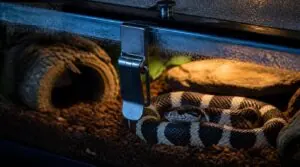
A loose lid is an invitation. Kingsnakes are escape artists, so aim for 2.5 times their total length in linear space, housed in a 40 to 75 gallon enclosure with secure latches on every opening.
Glass tanks need a tight U seal; no gaps, no rubbing, no wiggle room for a determined nose to pry through.
Temperature and Humidity Gradient
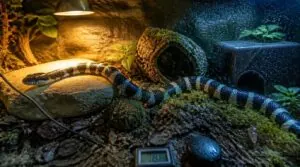
Since kingsnakes can’t generate their own body heat, thermoregulation depends entirely on you. Set the basking zone at 32–34°C, cool side 22–24°C: that 6°C+ gradient drives natural movement. Nights should dip to 20–22°C.
Humidity control matters too, 40–60% via misting or moist hides. Use digital probe thermometers and hygrometers, not stick-on gauges, for accurate gradient measurement.
Safe Burrowing Substrates
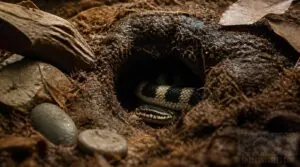
Substrate selection makes or breaks burrowing behavior. Mix fine sand and peat at 1–3mm particle size, 6–8 inches deep, avoiding coarse grit that collapses tunnels.
Keep moisture damp, not wet, misting surfaces only. Add coconut fiber or pesticide-free leaf litter for structure. Skip cedar and pine.
Replace substrate every 6–12 months; spot-clean weekly to curb mold and parasites.
Hides, Branches, and Enrichment
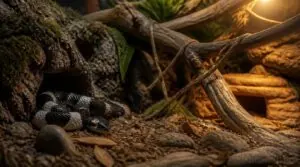
A bare tank breeds stress. Give your king snake two distinct hides, one warm, one cool, so it chooses shelter by temperature, not desperation.
Add branches 0.5–2.5 inches thick, secured firmly, for climbing. Rotate hides, textures, and cork bark every 1–2 weeks. Scent trails and buried hides spark natural foraging instincts, turning habitat enrichment into genuine behavioral wellness.
Lighting and UVB Needs
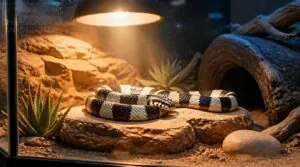
Does a desert-dwelling snake need a sunlamp? Yes. Provide a basking zone gradient of 90–95°F under a quality UVB bulb, mounted 12–18 inches away.
- Use a photoperiod timer for 12–14 hour cycles
- Check output monthly with a UV meter
- Replace bulbs every 6–12 months
- Add shaded retreats for thermoregulation
This habitat simulation helps with vitamin D3 synthesis and natural behavior.
Kingsnake Feeding, Health, and Handling
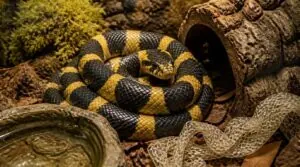
Feeding a snake that hunts other snakes takes more precision than people expect. Beyond diet, keeping your kingsnake healthy comes down to consistent habits around hydration, shedding, and handling. Here’s what you need to know to keep yours thriving for decades.
Natural Diet and Ophiophagy
What makes a kingsnake a kingsnake? Its ophiophagous diet. These constrictors hunt rattlesnakes and copperheads using thermal cue hunting, relying on venom immunity to survive strikes other predators couldn’t.
| Prey Type | Method | Benefit |
|---|---|---|
| Venomous snakes | Constriction technique | Venom immunity |
| Rodents/lizards | Ambush from burrows | Backup food source |
| Birds/eggs | Opportunistic feeding | Dietary flexibility |
Prey Size and Schedule
Hunting rattlesnakes takes strength, but feeding your kingsnake takes precision. Match prey girth to your snake’s widest point, never bigger.
If you’re weighing a kingsnake against another species, our ball python care and enclosure guide breaks down how their gentler feeding needs compare.
- Skipping a meal cracks their trust in you
- Overfeeding invites obesity and organ strain
- Wrong-sized prey risks regurgitation and fear
- Steady schedules build a calmer, healthier snake
Juveniles eat weekly on frozen-thawed rodents. Adults stretch to 10-14 days. Present prey calmly, mimicking natural constriction cues.
Hydration and Healthy Shedding
Getting portions right builds trust. Hydration builds the body underneath.
Your kingsnake needs a water bowl wide enough for full submersion, refilled at least twice weekly. Watch humidity too: 40-60% prevents rough sheds. Expect 4-6 sheds yearly, each taking 7-14 days.
| Sign | Meaning |
|---|---|
| Cloudy eyes | Shed starting |
| Increased soaking | Days away |
| Dry skin | Dehydration |
| Retained cap | Vet visit |
Handling and Stress Reduction
Shedding aside, trust is built skin to skin. Keep sessions short and predictable, same time daily, so your kingsnake learns to expect calm hands, not surprises.
Gentle initial contact before feeding curbs guarding behavior. A quiet enclosure limits startle pacing. Watch for relaxed jaw, smooth breathing, non-retreating posture: your snake’s own language telling you it feels safe.
Lifespan and Health Monitoring
Nine years is the ceiling in the wild. In your care, that number can nearly quadruple, with verified captive lifespans reaching 33 years.
Watch for glossy skin, steady weight, and alert basking behavior. Dull color outside of shedding, appetite loss, or lethargy warrants attention.
Annual veterinary checkups catch trouble early, keeping growth, weight, and organ health on track for decades.
Top 5 Kingsnake Habitat Products
Knowing what your kingsnake needs is one thing—finding gear that actually delivers it’s another. The right terrarium and lighting setup can make or break your snake’s health, so quality matters more than price tags suggest. Here are five products worth your attention, each one built to handle a specific piece of the habitat puzzle.
1. Carolina Custom Cages Glass Reptile Terrarium
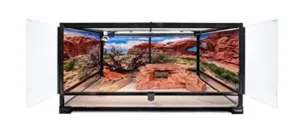
A three-foot kingsnake needs room to stretch, and this glass enclosure delivers it. At 35.9 x 17.9 x 18 inches, it sits right at the floor space adult kingsnakes require, giving a snake in the 3-4 foot range enough length to explore without feeling cramped.
Tempered glass panels resist claw scratches and keep visibility sharp for daily health checks. The hinged front doors use a key-lock system, which matters more than it sounds. Kingsnakes are notorious escape artists, and a secure closure beats sliding tracks any day.
The four-inch waterproof base tray keeps substrate and spilled water contained, while the full steel mesh top allows airflow and works with your heat lamp setup.
| Best For | owners of adult 3-4 foot kingsnakes (or similarly sized reptiles like bearded dragons and blue tongue skinks) who want a secure, easy-to-clean enclosure for a bioactive setup. |
|---|---|
| Product Type | Glass enclosure |
| Primary Use | Secure habitat |
| Format | 36 x 18 x 18 in |
| Setup Needs | Ready enclosure |
| Best For | Adult kingsnakes |
| Key Limitation | Heavy glass build |
| Additional Features |
|
- Key-lock hinged doors provide secure closure, ideal for escape-prone kingsnakes
- Tempered glass panels resist scratches and offer clear visibility for daily health checks
- Waterproof 4-inch base tray supports deep substrate for burrowing and bioactive setups
- Key lock mechanism can be stiff and difficult to operate smoothly
- Heavy at 60.4 lbs, often requiring two people to move or position
- Glass panels may arrive damaged during shipping despite protective packaging
2. Zoo Med ReptiSun T5 UVB Lamp
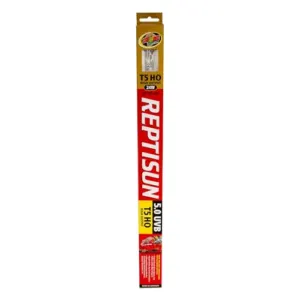
Kingsnakes don’t strictly need UVB to survive, but skip it and you’re gambling with bone density over the long run. The Zoo Med ReptiSun T5 HO 5.0 runs 24 watts across a 22-inch tube, pushing usable UVB out to roughly 12 inches, plenty for a standard 36-inch enclosure.
That output drives vitamin D3 synthesis, which your snake needs to actually absorb the calcium it eats. Skip this step and you’re looking at metabolic bone disease down the road, a slow, preventable condition that’s far easier to avoid than treat.
One catch: it’s bulb-only. You’ll need a T5 HO fixture with a reflector to get full value from it. Zoo Med’s German-engineered phosphor coating holds output steady, though a few users report shorter-than-expected lifespans, so keep a spare on hand.
| Best For | keepers of kingsnakes and other mid-to-large reptiles who want zoo-grade UVB coverage for a standard 36-inch enclosure. |
|---|---|
| Product Type | T5 HO UVB bulb |
| Primary Use | D3 support |
| Format | 22 in tube |
| Setup Needs | Needs fixture |
| Best For | 36-inch habitats |
| Key Limitation | Fixture sold separately |
| Additional Features |
|
- High UVB output supports strong vitamin D3 synthesis and calcium metabolism, helping prevent metabolic bone disease
- 22-inch, 24-watt tube covers larger habitats more effectively than standard ReptiSun 5.0 lamps
- Trusted and used by zoos, veterinarians, and reptile professionals
- Requires a separate T5 HO fixture with reflector, since the lamp is bulb-only
- Some units reportedly burn out within a month, so a spare bulb is a smart backup
- Nonstandard bulb size may not fit all existing fixtures
3. Arcadia Forest D3 UVB Reptile Lamp
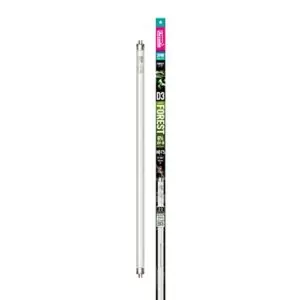
Why settle for basic UVB when you can mimic actual dappled sunlight? The Arcadia Forest D3, running at 54 watts with 6% UVB and 30% UVA, does exactly that, replicating the filtered light of a forest canopy rather than harsh open desert.
That 6,500K color temperature isn’t just for looks. It renders your kingsnake’s true colors under viewing light while supporting the same D3 synthesis pathway your snake relies on for calcium metabolism.
Rated for 12 months of continuous use, the bulb needs a compatible T5 HO fixture and reflector, sold separately. Flicker-free operation keeps your snake calm during active hours.
One caution worth flagging: several buyers reported units arriving damaged or failing within 10 days, so inspect yours on arrival and don’t skip that warranty registration.
| Best For | Keepers of forest-dwelling reptiles like leopard geckos, crested geckos, and chameleons who want to replicate natural dappled sunlight for healthy D3 synthesis and vibrant coloration. |
|---|---|
| Product Type | T5 HO UVB bulb |
| Primary Use | D3 and coloration |
| Format | 54W tube |
| Setup Needs | Needs fixture |
| Best For | Forest species |
| Key Limitation | Damage risk |
| Additional Features |
|
- Delivers a gentle 6% UVB output paired with 30% UVA, ideal for Ferguson Zone 1–3 forest species
- 6,500K color temperature enhances natural coloration for true-to-life viewing
- Flicker-free HO-T5 design keeps animals calm and stress-free during active hours
- Multiple reports of units arriving broken or damaged
- Some bulbs have failed after just 10 days of use
- Achieving the full 12-month lifespan depends on correct installation and a compatible fixture, sold separately
4. Arcadia Jungle Dawn Full Spectrum LED Bar
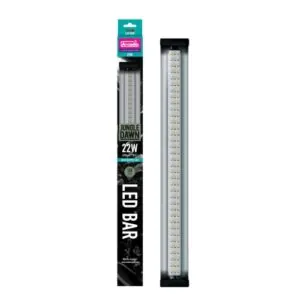
Good lighting isn’t just about visibility, it’s about spectrum quality, and the Jungle Dawn LED Bar nails that balance. Mixing high-output diodes instead of relying on simple red-and-blue combos, it produces true full-spectrum daylight without the purple cast that plagues cheaper units.
Installation is straightforward: mount it over a mesh-topped enclosure and pair it directly with your ProT5 UVB kit for integrated UVB lighting. That 120-degree flood beam spreads light evenly across the enclosure, avoiding harsh hot spots while still reaching high PAR values, ideal for bioactive enclosure lighting with live plants.
Built-in overvoltage and overheating protections add peace of mind for long-term use. Just remember, this bar helps with plant growth and visual clarity, but it doesn’t replace dedicated UVB output.
| Product Type | LED grow light |
|---|---|
| Primary Use | Plant lighting |
| Format | 9W lamp |
| Setup Needs | Needs mounting |
| Best For | Bioactive setups |
| Key Limitation | No heat or UVB |
| Additional Features |
|
5. Bio Dude Terrarium Plant Growth LED Bulb
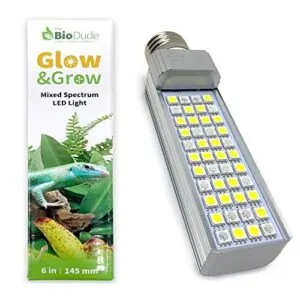
Live moss and small tropicals can survive right alongside your kingsnake, provided the light source pulls its weight. The Bio Dude Plant Growth LED Bulb runs at roughly 6000K, drawing just 9 watts while throwing off 60-watt equivalent brightness through paired red and blue diodes, exactly the wavelengths photosynthesis depends on.
Mount it in a standard socket, rotate the fixture up to 180 degrees, and aim light precisely where your pothos or moss patch needs it most. The aluminum housing controls heat dissipation well, though it’s not a heat source itself, so your basking setup still needs separate equipment.
Keep enclosure height under 18 inches for best results. Beyond that, coverage weakens. It’s a supplemental layer for bioactive builds, not a UVB or thermal replacement, but for keepers chasing that lush, naturalistic look, it delivers.
| Best For | Keepers building bioactive vivariums or terrariums under 18 inches tall who want to support live moss, tropical plants, or desert species without adding extra heat. |
|---|
- Full mixed spectrum with red and blue diodes targets the exact wavelengths plants need for photosynthesis
- Energy-efficient design draws only 9 watts while producing 60-watt equivalent brightness
- 180-degree rotational mounting lets you direct light exactly where your plants need it most
- Limited effectiveness in enclosures taller than 18 inches, so coverage weakens beyond that height
- Doesn’t provide any heat or UVB output, meaning it can’t replace dedicated basking or UVB equipment
- Some users have reported units failing after a relatively short period of use
Frequently Asked Questions (FAQs)
Does a California kingsnake need heat at night?
Yes, provide gentle overnight warmth. Keep temperatures above 70°F, never letting them dip toward freezing. A thermostat-controlled pad or guarded lamp maintains stability, preventing sluggish digestion and stress-related complications.
Can kingsnakes be housed together safely?
A shared cage is a stage too small for two predators. Kingsnakes are ophiophagous, meaning tankmates read as prey, not company. One snake will eventually eat the other, so individual housing remains the only truly safe setup.
What signs indicate a kingsnake is shedding?
Watch for milky blue eyes, dull faded scales, and a sudden drop in appetite. Your kingsnake will also hide more and rub against rough surfaces, signaling a clean shed is just days away.
How often should kingsnakes be handled?
Think of trust as a bridge built one plank at a time. Handle your kingsnake 1 to 2 times weekly, sessions of 10–15 minutes, skipping feeding days and shedding. Consistency, not frequency, earns lasting calm.
During those sessions, using the right approach with prey presentation can make all the difference — feeding tools that reduce handler scent and mimic natural movement help shy kingsnakes build the routine confidence they need.
If your kingsnake starts corkscrewing or spiraling with no clear direction, pause the session and review these signs of discomfort during snake handling before trying again.
Do kingsnakes require special winter care?
Kingsnakes don’t hibernate, but they do benefit from a cooler winter phase. Drop the cool zone to 70°F, dim the lights to 10–12 hours, and feed smaller meals less often to match their slower metabolism.
What substrates are toxic to kingsnakes?
One wrong shaving could kill your snake faster than any predator. Cedar and pine release toxic aromatic oils causing respiratory distress. Skip fine sand, dusty soils, and untreated bark too, they cause impaction risk and fungal growth in enclosures.
For a safer shortlist of what actually works, this ball python bedding buyer’s guide walks you through tested substrates that balance humidity, hygiene, and burrowing instinct.
How long do kingsnakes typically live in captivity?
With attentive care, captive kingsnakes commonly reach 15 to 20 years, and some individuals push past 25. Consistent temperatures, proper hydration, and routine vet checkups make the biggest difference in reaching those upper numbers.
How often do kingsnakes shed their skin?
Don’t assume a shed means something’s wrong, it’s just growth in action. Juveniles molt every 3 to 6 weeks, adults 2 to 4 times yearly. Cloudy eyes signal it’s coming; keep humidity steady for clean, complete sheds.
How do you safely handle a kingsnake?
Approach slowly from the side, never the face. Support the full body with both hands, keep it near a solid surface, and avoid squeezing. Skip handling right after feeding, and always wash your hands beforehand.
When do kingsnakes reach reproductive maturity?
Sexual maturity depends more on size than age: most kingsnakes mature between 2 and 4 years, once females hit roughly 200 to 300 grams. Well-fed captives reach breeding condition earlier, sometimes within their second year.
Pairing size milestones with proper housing—like those outlined in this kingsnake care and enclosure guide—helps ensure your snake grows steadily toward breeding condition.
Conclusion
A kingsnake’s burrow is a blueprint, not a suggestion. Every gradient, hide, and substrate choice you make should echo the wild places this animal evolved to conquer.
Master king snake natural habitat and care, and you’re not just avoiding illness, you’re honoring millions of years of adaptation.
Watch the shed cycles, respect the temperature swings, and offer prey that matches instinct.
Do that, and your snake won’t just survive. It’ll thrive, coiled and confident, right where it belongs.