This site is supported by our readers. We may earn a commission, at no cost to you, if you purchase through links.

Kingsnakes eat rattlesnakes for breakfast. That fact alone hooked me on this genus years ago, and it still makes new keepers do a double take when they hear it. But here’s the real kicker for beginners: the same snake that shrugs off pit viper venom in the wild turns into one of the most laid-back pets you’ll ever handle.
Not every kingsnake fits a first-timer’s setup, though. Some grow big, some stay feisty longer, some just need a bit more finesse.
That’s where picking the right king snake species for beginners makes all the difference between a smooth start and a stressful one.
Table Of Contents
- Key Takeaways
- Best Kingsnake Species for Beginners
- Why California Kingsnakes Stand Out
- Mexican Black Kingsnake Basics
- Florida, Eastern, and Desert Kingsnakes
- Beginner Kingsnake Care Checklist
- Frequently Asked Questions (FAQs)
- Are king snakes good beginner snakes?
- What is the easiest pet snake for a beginner?
- What is the best pet king snake?
- Are Mexican king snakes beginner friendly?
- What is the best king snake for beginners?
- What is the most beginner friendly snake?
- What is the best setup for a king snake?
- What is the best pet snake for a first time owner?
- Do king snakes require special lighting setups?
- Can king snakes be housed together safely?
- Conclusion
Key Takeaways
- The California Kingsnake stands out as the top beginner pick thanks to its docile temperament, reliable feeding, manageable 3-4 foot size, and wide availability of morphs and captive-bred stock.
- Kingsnakes are naturally resistant to pit viper venom, which lets them hunt rattlesnakes and also explains their unusually calm, low-strike temperament as pets.
- Beyond the California King, the Mexican Black, Florida, Eastern, and Desert Kingsnakes each offer beginner-friendly care with their own size, climate, and handling quirks worth matching to your setup.
- Proper husbandry is essential and non-negotiable: house kingsnakes solo since they’ll eat other snakes, use an escape-proof enclosure, maintain stable temperature and humidity gradients, feed frozen-thawed prey on a set schedule, and wait 48 hours after feeding before handling.
Best Kingsnake Species for Beginners
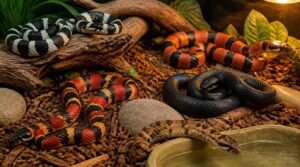
Now, with around 45 subspecies out there, picking your first kingsnake can feel like a lot. Good news is, only a handful are actually beginner-friendly, easygoing, and easy to find from breeders. Here are the five that’ll treat you right as a first-time keeper.
Their laid-back nature and steady moods make it easy to see why so many keepers fall for kingsnakes, and this guide to kingsnake temperament traits breaks down what to expect before you bring one home.
California Kingsnake
Ask ten reptile keepers to name a beginner-friendly snake, and most will say the California Kingsnake. With a docile temperament, strong feeding response, and manageable 2-4 foot size, it’s forgiving for new hands.
They’ll hiss and rattle their tails to mimic rattlesnakes when spooked, but that’s mostly bluff — solid, low-drama reptile husbandry for anyone starting out. This non-venomous snake species is also uniquely immune to pit viper venom.
Mexican Black Kingsnake
Now, if solid black is more your style, meet the Mexican Black Kingsnake — glossy, jet-black scales with zero pattern. Hailing from Mexico’s desert range, juveniles show faint yellow throat spots that fade with age.
They keep that handy venom resistance and hunt using chemical cues from their tongue. Docile temperament, simple care needs — a solid pick for beginner hobbyists per any good Kingsnake Care Sheet.
Florida Kingsnake
Not into solid black? The Florida Kingsnake brings back the pattern game, with 40+ crossbands in brown-to-yellow tones. Adults hit 36-54 inches, smooth and glossy.
They love marshy, humid habitats and munch on rodents, lizards, and even other snakes thanks to that handy venom immunity. Great pick for beginner hobbyists wanting variety.
Eastern Kingsnake
Now here’s a classic: the Eastern Kingsnake rocks that black body with creamy-white crossbands, like nature’s racing stripes.
Native to Southeast woodlands and marshes, these guys are:
- Venom-resistant rattlesnake hunters
- Calm once mature (though juveniles get feisty)
- Constrictors that swallow prey whole
They’ll musk and vibrate tails when spooked, but overall? Solid beginner temperament.
Desert Kingsnake
Picture a snake, glossy black with cream speckles, built for desert survival across Arizona, New Mexico, and northern Mexico.
Desert Kingsnakes eat lizards, rodents, even rattlesnakes, thanks to natural venom resistance. They’re shy, calm once settled, and stay active mostly in spring and fall. A solid pick if you love that rugged, arid-habitat vibe in a beginner-friendly package.
Why California Kingsnakes Stand Out
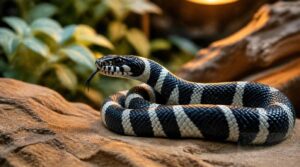
Now, if you’re just getting started with snakes, the California Kingsnake is where most folks land, and for good reason. This one checks a lot of boxes at once, from temperament to looks to how easy it is to find. Here’s what makes it such a solid pick for beginners.
Docile Beginner Temperament
Ever hold a snake that just… chills? That’s a California kingsnake for you.
That laid-back attitude comes partly from a built-in resistance to venom, letting these snakes calmly overpower rattlesnakes without a second thought — check out this California kingsnake habitat and care guide if you’re curious what makes them such easygoing pets.
Minimal startle responses make daily handling easy, even for nervous first-timers. They tolerate routine maintenance—cage cleaning, water changes—without flinching or striking.
Moving slow and steady keeps things calm. Watch for handling stress signs like tight coiling or tail rattling; you won’t see much of that here. Predictable, gentle, and downright easy-going.
Strong Feeding Response
These snakes eat like it’s their job. Most strike within seconds of prey hitting the enclosure, tongue flicking fast, coiling tight before the swallow even starts.
Frozen-thawed prey works great here, especially warmed to that 100-105°F range that triggers visual strike cues. Weekly feeding keeps that drive consistent, and mixing rodent types curbs pickiness down the road.
Manageable Adult Size
Here’s the sweet spot: California Kings top out around 3 to 4 feet, with a few pushing toward 5. That’s easy to handle, easy to house, no wrestling match required.
They hit full maturity in 2 to 3 years under good husbandry, staying sleek rather than bulky. Steady feeding and solid temps keep that growth trajectory smooth, no weird size spikes or lazy plateaus.
Popular Morph Variety
Color is where Cal Kings really flex. Red True morphs bring bold black outlines over deep red, while Desert Ghost and Lemon Blast lines lean pale caramel or bright lime.
Toss in Sunset and Mojave hues, and you’ve got a subspecies with serious morphology range. Any exotic pet care fan finds something to fall for.
Captive-bred Availability
Finding a Cal King is rarely a hassle, and that’s a big win for beginner-friendly exotic pet care.
High demand keeps breeders churning out steady stock, though regional numbers can dip seasonally. Reputable sellers offer health guarantees and lineage documentation, so ask questions.
Expos are great for meeting breeders face-to-face. Ethical captive breeding also means fewer wild-caught snakes, which any subspecies-loving keeper should appreciate. Grab a solid Kingsnake Care Sheet before buying.
Mexican Black Kingsnake Basics
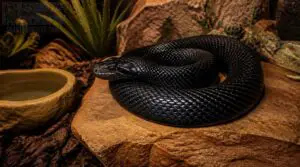
Now, if the California King is the friendly golden retriever of the snake world, the Mexican Black Kingsnake is more like that cool, quiet kid who somehow still gets along with everybody. This one’s got looks, brains, and a chill attitude all rolled into one glossy black package.
If the California King is snakedom’s golden retriever, the Mexican Black Kingsnake is the cool, quiet kid everyone still likes
Let’s break down what makes this guy tick, starting with the basics you need to know.
Calm Handling Potential
Rarely does a subspecies earn a reputation for being this chill, but the Mexican Black Kingsnake does.
Temperature stability matters most, keeping warm and cool zones consistent so your snake stays relaxed.
Good habits for calm handling:
- Support the body fully, no dangling
- Handle 5-10 minutes, gently
- Wait 48 hours after feeding for digestion
Trust building takes patience, but this subspecies rewards it fast.
Striking Black Coloration
That jet-black look isn’t just for show; it’s melanin doing its job, packing pigment densely into every scale for a deep, matte finish. Some snakes even get help from tiny surface structures that trap light, making the black look richer.
Diet plays a part too, since good nutrition fuels pigment production, keeping that coloration bold as your snake matures.
Simple Care Needs
Beyond that coloration, care stays refreshingly simple. Set up a snake enclosure with 4 inches of substrate for burrowing, a warm hide and cool hide, and low-level UVB.
Quick checklist:
- Basking temp 85-90°F
- Humidity 40-60%
- Digital thermometer/hygrometer
- Calcium supplementation monthly
Grab any solid Kingsnake Care Sheet and you’re set.
Feeding and Growth Rate
Now, for chow time: stick with frozen-thawed mice, sized so prey width matches your snake’s girth. Juveniles do best on weekly feedings around 8-12% body weight, which keeps growth steady without packing on fat.
Track progress with simple growth monitoring metrics—weight and length—weekly. Consistent schedules mean fewer digestive hiccups and predictable weight gain over time.
Best Keeper Fit
So who’s this snake actually good for? Honestly, almost anyone willing to do basic homework first. It checks the boxes beginners need:
- Predictable feeding habits on frozen-thawed mice
- Calm temperament assessment results, even during handling
- Steady growth management within a 4-5 foot range
Add solid species availability through breeders, and you’ve got a forgiving starter subspecies.
Florida, Eastern, and Desert Kingsnakes
Now, if California and Mexican Black Kings didn’t quite catch your eye, don’t worry, you’ve got more solid options. Florida, Eastern, and Desert Kingsnakes each bring their own personality and quirks to the table. Let’s break down what makes each one tick, starting with their traits and care needs.
Florida Kingsnake Traits
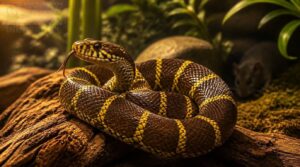
Florida Kingsnakes flash 40-plus yellow crossbands over brown, forming that classic degenerate chain look, with checkerboard bellies underneath. They hit 36-48 inches as adults, sometimes pushing 69 inches. Calm and non-aggressive, they tolerate handling well once settled.
Like other kingsnakes, they’ve got venom resistance, letting them hunt rodents, lizards, and even other snakes without issue—a handy trait for any beginner-friendly predator.
Eastern Kingsnake Personality
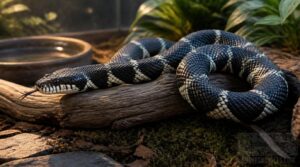
Rarely does a beginner snake feel this laid-back once settled. Eastern kingsnakes show calm, deliberate coiling over strikes, though juvenile temperament shifts mean young ones stay feisty at first.
Watch for:
- Soft hissing
- Defensive tail vibration
- Neck inflation
- Defensive musking
- Tight coiling
They’re crepuscular, staying active at dawn and dusk—handy for daily handling routines.
Desert Kingsnake Care Level
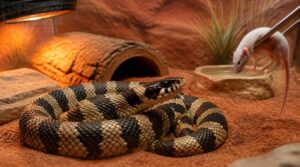
Think of desert kingsnakes as the easygoing cousin who just needs a good escape-proof setup. They tolerate temperatures from 75 to 88°F, don’t fuss over humidity (40% is plenty), and dive at frozen-thawed prey with tongs, no hesitation.
Once acclimated, temperament acclimation happens fast. Regular handling routines keep them predictable, making this species genuinely beginner-friendly for anyone building confidence with kingsnake care.
Size and Activity Differences

Size varies more than you’d guess across these three. Eastern kingsnakes stay modest at 3 to 4 feet, Florida kings run 3 to 4.5 feet, and desert kingsnakes can stretch past 5 feet.
Activity-wise, all three are daytime foragers, though Florida kings get crepuscular when it’s scorching, and desert kingsnakes prowl actively after dusk once temps drop.
Beginner Pros and Cons
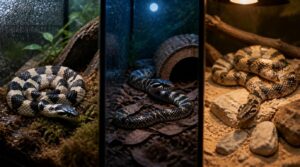
Every snake’s got a trade-off, and these three are no exception.
- Florida: chill temperament, but humidity needs trip up beginners
- Eastern: steady feeder, active at night, so watch nighttime temps
- Desert: low humidity, but growth rates demand strong basking heat
- All show solid feeding adaptability with frozen-thawed prey
- Subspecies quirks make a kingsnake care sheet genuinely handy
Beginner Kingsnake Care Checklist
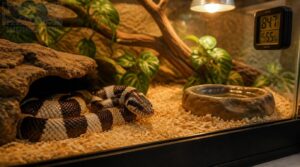
Now that you know which kingsnake fits your style, let’s talk about keeping one happy and healthy long term. Good care isn’t complicated, but it does come down to a few key habits you’ll want to nail early on. Here’s your quick checklist to get set up right from day one.
Solo Housing Only
Rarely does a snake come with a warning label, but kingsnakes basically do: one snake per enclosure, always. These guys are ophiophagous, meaning they’ll eat other snakes given the chance.
| Housing Type | Result |
|---|---|
| Solo | Safe, stress-free |
| Paired | Injury or death risk |
| Grouped | Territorial fights |
| Communal | Regurgitation likely |
Cohabbing invites stress and blown meals. Keep it solo, keep it simple.
Secure Escape-proof Enclosure
King snakes are notorious escape artists, so your enclosure setup needs real teeth, not just a lid.
- Latch security with double latches and full-depth locking bolts
- Fine ventilation mesh under 2mm, no snout gaps
- Tight panel integrity at every seam
- Solid foundation stability, sealed to the ground
- Weekly maintenance monitoring for loose screws or warping
Temperature and Humidity Range
Once that enclosure’s locked down tight, dial in the climate. Kingsnakes need a basking zone around 29-32°C, ambient air near 25-28°C, dropping to 20-24°C at night.
| Zone | Temp | Humidity |
|---|---|---|
| Basking | 29-32°C | 40-50% |
| Ambient | 25-28°C | 50-60% |
| Shedding | N/A | 60-65% |
Keep gradients stable, use a probe hygrometer, and watch for thermal swings over 5°C.
Frozen-thawed Prey Schedule
Now that your climate’s dialed in, let’s talk grub. Stick to frozen-thawed mice only, thawed in the fridge for 12-24 hours, never at room temp past two hours (bacteria loves that window). Warm prey in water around 110°F until it hits 100-105°F—snake body temp.
Juveniles eat twice weekly, adults once. Keep tools separate, wash hands after, and you’re golden.
Gentle Handling Routine
Your snake’s stomach dictates the schedule: wait 48 hours after feeding before any handling, since squeezing a full belly can cause regurgitation.
Start with short, passive sessions, always supporting the midsection with both hands. Watch for tongue flicking or tail thrashing—signs of stress, your cue to stop.
Wash hands before and after. Build trust slowly, and your kingsnake learns handling means safety, not danger.
Frequently Asked Questions (FAQs)
Are king snakes good beginner snakes?
Ready to snake your way into reptile keeping? Yes, absolutely—these non-venomous constrictors offer excellent beginner temperament traits, easy dietary requirements, and forgiving species adaptability levels, making them ideal for first reptile ownership and learning proper handling basics.
What is the easiest pet snake for a beginner?
Most beginner snake selection guides point to the California Kingsnake for good reason. It’s got a docile temperament, eats reliably, stays manageable in size, and experiences routine care without fuss—making it the easiest first reptile for new keepers.
What is the best pet king snake?
For most keepers, the California Kingsnake takes the crown—docile, feeds reliably, and stays a manageable 3 to 5 feet. Its calm personality and wide morph variety make it the ideal first species for building confidence with King Snakes.
Are Mexican king snakes beginner friendly?
These easygoing scaled companions are basically the friendly neighbors of the snake world. With calm handling potential, steady feeding on thawed mice, and manageable 3-5 foot growth, they suit patient newcomers ready for consistent care.
What is the best king snake for beginners?
For a calm temperament, easy feeding, and manageable size, the California Kingsnake wins for most starters. It thrives in a simple enclosure setup, eats frozen mice readily, and offers popular starter morphs bred widely by reputable keepers.
What is the most beginner friendly snake?
Honestly, the California kingsnake takes the crown. It’s got a steady temperament, eats reliably, and stays a manageable 4 to 6 feet, making daily care and handling simple even if you’ve never owned a snake before.
What is the best setup for a king snake?
Go with a 4×2×2 ft enclosure, safe substrate for burrowing, 85–90°F basking spot, 40–60% humidity monitored closely, hides on both ends, sturdy water bowl, and proper lighting placement, keeping decor secure and escape-proof.
What is the best pet snake for a first time owner?
Funny thing—most new owners ask this exact question before ever touching a snake. The California Kingsnake wins hands down: docile, hardy, eats reliably on frozen-thawed mice, and stays a manageable 3-4 feet, making daily care simple.
Do king snakes require special lighting setups?
Not really. Most kingsnakes skip UVB lighting entirely if diet and calcium supplementation stay on point. Just keep a 12-hour photoperiod, a warm basking spot, and skip bright nighttime lighting—your thermal gradient matters way more than fancy bulbs.
Can king snakes be housed together safely?
Here’s one stat worth chewing on: nearly 45 recognized subspecies exist, yet none tolerate roommates. Kingsnakes eat other snakes, so cohabitation risks predatory behavior, cannibalism, and stress-induced bulimia—always house yours solo, with its own space, hides, and stable temps.
Conclusion
A good kingsnake is a gateway drug with scales, and once it bites, you’re hooked for life. Pick any kingsnake species for beginners on this list, and you’re set up to win, not struggle. The California stays easy, the Mexican Black stays bold, the rest bring their own flavor.
Nail the husbandry basics, handle often, feed on schedule. Your first kingsnake won’t just survive. It’ll thrive, and so will you.