This site is supported by our readers. We may earn a commission, at no cost to you, if you purchase through links.

A cold snake is a stressed snake—and a stressed snake stops eating, gets sick, and makes for one very worried kid. Getting the temperature right inside a snake’s enclosure isn’t optional; it’s the difference between a thriving pet and a vet bill.
That’s where reptile heat mats for kids with pet snakes become a lifesaver. The right mat keeps the warm side warm without turning the whole tank into a sauna. But not every heat mat is built the same, and some are far safer and easier to manage than others. The eight options below cut through the noise.
Table Of Contents
- Key Takeaways
- Best Reptile Heat Mats for Kids’ Pet Snakes
- Key Features to Look for in Heat Mats
- Safe Installation and Placement Tips
- Maintaining Heat Mats for Snake Health
- Teaching Kids Heat Mat Safety
- Frequently Asked Questions (FAQs)
- Are heat mats safe for snakes?
- What temperature should a heat mat be for a snake?
- How to keep a snake enclosure warm in winter?
- Can you leave the heating pad on all night for a snake?
- Can heat mats work for lizards and turtles?
- How often should heat mats be replaced?
- What substrate works best over heat mats?
- Can heat mats cause fires if left unattended?
- Conclusion
Key Takeaways
- A thermostat isn’t optional — without one, your heat mat can dangerously overheat in minutes and put your snake at real risk.
- Place the mat under one-third of the tank floor so your snake always has a warm side and a cool side to choose from.
- Keep substrate thin — about half an inch over the warm side — or trapped heat can burn your snake even when the surface feels fine.
- Most heat mats last three to five years, so watch for cold spots, discoloration, or a burning smell and replace it before it fails.
Best Reptile Heat Mats for Kids’ Pet Snakes
Finding the right heat mat makes a real difference for your snake’s health and your kid’s confidence as a pet owner.
For a deeper look at placement and setup, ball python heat source options and positioning tips can help you get it right from day one.
There are a lot of options out there, so narrowing it down to ones that are actually safe and easy to use helps a lot. Here are eight heat mats worth considering for your setup.
1. Vivosun Reptile Heating Pad Thermostat Combo
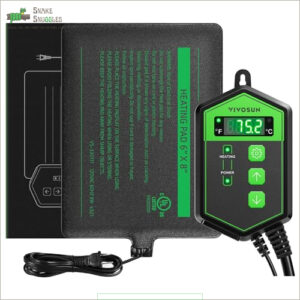
The Vivosun Reptile Heating Pad Thermostat Combo is a solid starter pick for families new to snake keeping. The 6×8 inch pad fits snugly under 20–30 gallon tanks, and the built-in digital thermostat keeps temps between 40–108°F — so you’re not guessing.
Far-infrared heating spreads warmth evenly, which cuts down on hot spots. Setup is straightforward: peel, stick, plug in. The IP67-rated surface also wipes clean easily, which any parent will appreciate on a busy weekend.
| Best For | Families just getting into reptile keeping who want a simple, no-fuss way to keep their snake or lizard warm without constantly babysitting the temperature. |
|---|---|
| Dimensions | 6 x 8 inches |
| Power | Not specified |
| Adhesive Mounting | 3M adhesive |
| Tank Compatibility | Small terrariums |
| Thermostat Included | Yes, digital |
| Reptile Compatible | Yes |
| Additional Features |
|
- The digital thermostat takes the guesswork out of temperature control — set it and forget it, within a solid 40–108°F range
- Far-infrared heating spreads warmth evenly, so no sketchy hot spots that could stress or burn your pet
- Super easy setup — peel, stick, plug in — and the IP67-rated surface wipes down clean without any hassle
- Not a great fit for larger enclosures or aquariums, so if your reptile needs more space, you’ll need something bigger
- The 3M adhesive can be hit or miss depending on the tank surface, so don’t count on it holding forever
- Some users have found the temps aren’t always spot-on, so a backup thermometer isn’t a bad idea just to double-check
2. Zilla Terrarium Heat Mat
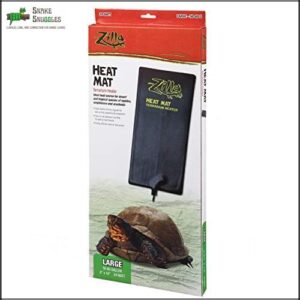
If you want something even simpler to set up, the Zilla Terrarium Heat Mat is worth a look. It uses carbon fiber heating — no wires inside that can break or kink — and spreads warmth evenly across the floor of the tank.
The 24-watt model covers tanks up to 60 gallons, but smaller options start at just 4 watts for tiny setups. Since it sits outside the glass, your kid can’t accidentally touch a hot element while handling their snake.
| Best For | Reptile owners who want a simple, safe, and energy-efficient way to keep their snake, lizard, or turtle warm without fussing with complicated setups. |
|---|---|
| Dimensions | 8.5 x 20 inches |
| Power | 24 watts |
| Adhesive Mounting | Adhesive mounting |
| Tank Compatibility | Various enclosures |
| Thermostat Included | No |
| Reptile Compatible | Yes |
| Additional Features |
|
- Carbon fiber heating spreads warmth evenly — no hot spots that could stress or burn your reptile
- Mounts outside the enclosure, so curious hands (and curious reptiles) stay safe
- Energy-efficient at just 24 watts, so it won’t spike your electric bill
- The adhesive can lose its grip over time, especially on certain surfaces
- You’ll need a separate temperature regulator to keep things from overheating
- Won’t work on UK or 240V power without a transformer
3. Fluker’s Reptile Heat Mat
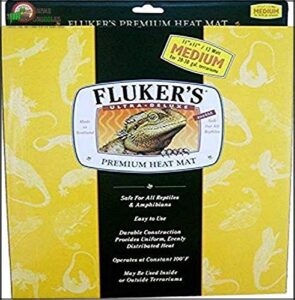
Fluker’s takes a no-frills approach — and that’s actually a good thing. This mat runs at a steady 100°F surface temperature, so there are no confusing settings to fiddle with.
It’s made in the U.S. from chloroprene, fits under or on the side of the tank, and works for snakes, lizards, even hermit crabs. One thing to know: it doesn’t come with a thermostat. You’ll need to add one separately to keep temps safe for your snake.
| Best For | Reptile owners who want a simple, no-fuss heat mat for snakes, lizards, or hermit crabs and don’t mind pairing it with a separate thermostat. |
|---|---|
| Dimensions | 11 x 11 inches |
| Power | Not specified |
| Adhesive Mounting | No adhesive |
| Tank Compatibility | Various enclosures |
| Thermostat Included | No |
| Reptile Compatible | Yes |
| Additional Features |
|
- Made in the U.S. from durable chloroprene — built to last
- Flexible mounting options: goes under or on the side of the tank
- No adhesive means you can reuse it or reposition it whenever you need
- Doesn’t include a thermostat, so you’ll need to buy one separately
- May not cut it for larger enclosures or thick substrates
- Warranty info is unclear, which might give some buyers pause
4. iPower Reptile Heat Mat
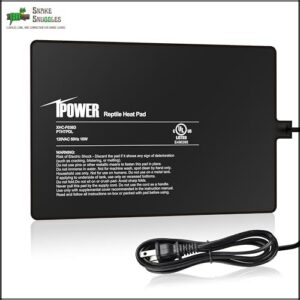
If you want something flexible and budget-friendly, the iPower Reptile Heat Mat is worth a look. It comes in four sizes — from a tiny 4×7 inch pad up to an 8×18 inch version — so you can match it to your kid’s tank without guessing.
If you’re still on the fence about whether a heat pad is the right call, this breakdown of whether ball pythons actually need heating pads does a solid job of explaining what your snake really needs to stay healthy.
The 8×12 inch, 16-watt model fits 30 to 40 gallon setups nicely. It uses PTC heating film, which spreads warmth evenly and won’t spike wildly. Just add a thermostat. It doesn’t include one.
| Best For | Budget-conscious reptile or amphibian owners with 30–40 gallon tanks who just need reliable, even heat without the fancy extras. |
|---|---|
| Dimensions | 8 x 12 inches |
| Power | 16 watts |
| Adhesive Mounting | 3M adhesive |
| Tank Compatibility | 30-40 gallon |
| Thermostat Included | No |
| Reptile Compatible | Yes |
| Additional Features |
|
- PTC heating film spreads warmth evenly across the mat — no hot spots
- Comes in multiple sizes, so you can find one that actually fits your tank
- Waterproof, UL listed, and built with 3M adhesive — solid basics covered
- No thermostat included, so you’ll need to buy one separately
- The adhesive is pretty permanent once it’s on — think carefully before sticking it down
- Not a great fit for larger tanks or species that need higher temps
5. iPower Reptile Heating Pad Mat
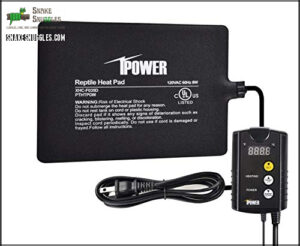
The iPower Reptile Heating Pad Mat is basically the same line, just with a digital thermostat built into the package. That’s a big deal. You get temperature control right out of the box, ranging from 40 to 108°F.
The PTC heating film spreads warmth evenly, so there aren’t hot spots under your snake. It sticks to the tank with 3M adhesive and runs quietly in the background. Great starter setup for kids — fewer separate parts to manage.
| Best For | Beginners setting up a reptile or small animal tank who want simple, built-in temperature control without buying separate gear. |
|---|---|
| Dimensions | 6.1 x 11.4 inches |
| Power | Not specified |
| Adhesive Mounting | 3M adhesive |
| Tank Compatibility | 10-20 gallon |
| Thermostat Included | Yes, digital |
| Reptile Compatible | Yes |
| Additional Features |
|
- Digital thermostat (40–108°F) is included right out of the box — no extra purchases needed
- PTC heating film spreads heat evenly, so no hot spots under your pet
- Energy efficient and quiet, making it easy to just set it and forget it
- The 3M adhesive can weaken over time and the mat may unstick from the tank
- Temperature can fluctuate after the first few uses, which isn’t great for sensitive animals
- Struggles to heat larger tanks or rooms that run cold
6. Zacro Reptile Heating Pad
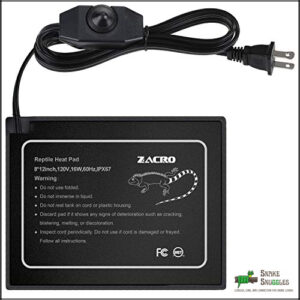
The Zacro Reptile Heating Pad is a solid pick for a first snake setup. It fits 30 to 40-gallon tanks and uses a low 8-watt design, so it won’t spike your energy bill.
The flexible PVC body lies flat against glass, and the 3M adhesive keeps it locked in place — which matters when curious kids are nearby. Just pair it with a separate thermostat. Without one, temperatures can drift, and your snake deserves better than guesswork.
| Best For | Beginner reptile owners setting up their first 30–40 gallon snake or lizard tank. |
|---|---|
| Dimensions | 12 x 8 inches |
| Power | Not specified |
| Adhesive Mounting | Adhesive tape |
| Tank Compatibility | 30-40 gallon |
| Thermostat Included | Yes, adjustable knob |
| Reptile Compatible | Yes |
| Additional Features |
|
- Easy to set up — just peel, stick, and plug in
- Fits 30–40 gallon tanks and stays flat against the glass
- Works for reptiles, amphibians, and even plants
- Temperature isn’t super precise, so a separate thermometer is a must
- The adhesive can lose its grip over time
- Not a great fit for aquariums due to insulation and air gap issues
7. Vivosun Reptile Heat Pad
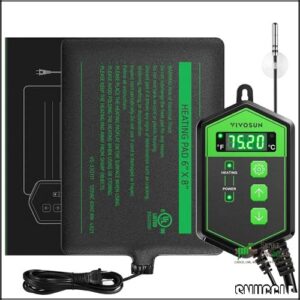
The Vivosun Reptile Heat Pad is a reliable workhorse for beginner snake setups. The 6 x 8 inch size works well for 20 to 30-gallon tanks, and the far-infrared heating spreads warmth evenly — no hot spots sneaking up on your snake.
It’s UL certified, IP67 water-resistant, and pairs with a simple digital thermostat that kids can actually read. Setup is straightforward: stick it under the tank, plug in the thermostat, and you’re done.
| Best For | Beginner reptile owners setting up a 20–30 gallon tank for snakes, lizards, or similar cold-blooded pets. |
|---|---|
| Dimensions | 6 x 8 inches |
| Power | Not specified |
| Adhesive Mounting | 3M adhesive |
| Tank Compatibility | Small terrariums |
| Thermostat Included | Yes, digital |
| Reptile Compatible | Yes |
| Additional Features |
|
- UL certified and IP67 water-resistant, so it’s built to last and safe around moisture
- Far-infrared heating spreads warmth evenly — no hot spots, just consistent temperature across the floor
- Easy to set up with 3M adhesive and a readable digital thermostat anyone can figure out
- Some users have had durability issues within the first year, which is frustrating at any price point
- Temperature precision can be hit or miss — half-degree increments don’t always behave the way you’d expect
- The adhesive can struggle in aquarium or fully enclosed enclosures, so it’s not the best fit for every setup
8. Aiicioo Reptile Terrarium Heating Pad
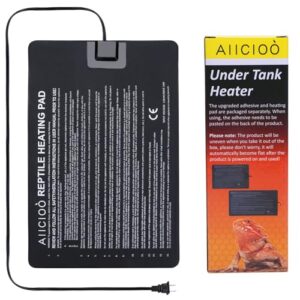
The Aiicioo Reptile Terrarium Heating Pad is a solid pick for medium tanks in the 30 to 40-gallon range. At 16 watts, it delivers steady warmth without going overboard. It mounts on the outside of the glass — never inside — so your snake stays safe.
One thing to know: it doesn’t have a built-in thermostat, so you’ll want to grab one separately. Pair it right, and it’s a dependable, no-fuss option for beginner setups.
| Best For | Beginner reptile owners with medium 30–40 gallon glass tanks who want a simple, affordable heating solution for snakes, lizards, turtles, or hermit crabs. |
|---|---|
| Dimensions | 14 x 8 inches |
| Power | 16 watts |
| Adhesive Mounting | Adhesive material |
| Tank Compatibility | 30-40 gallon |
| Thermostat Included | No |
| Reptile Compatible | Yes |
| Additional Features |
|
- Mounts cleanly on the outside of the tank, so there’s no risk of your reptile coming into direct contact with it.
- Delivers steady, even heat between 104°F and 122°F without hot spots — gentle enough for sensitive animals.
- Lightweight and easy to maintain, making it a solid no-fuss option for beginner setups.
- No built-in thermostat, so you’ll need to buy one separately to avoid overheating your enclosure.
- Adhesive can wear out if you remove and reattach it, so placement needs to be right the first time.
- Not a fit for large tanks, plastic or acrylic enclosures, or setups that need higher heat output.
Key Features to Look for in Heat Mats
Not every heat mat is worth your money — or your snake’s comfort. Before you buy, there are a few things that really matter. Here’s what to look for.
Adjustable Thermostats and Temperature Control
A good thermostat is basically the brain of your heat mat setup. Without precision control, you’re just guessing — and snakes don’t forgive guessing.
Here’s what solid thermostat settings actually give you:
- Temperature ranges from 68°F to 108°F for accurate thermal gradient management
- One-degree increment adjustments for heat mat calibration
- Real-time thermal monitoring via a probe sensor
- Reliable temperature regulation for warm hides around 85–90°F
For best results, it’s essential to properly position your thermostat probe based on.
Overheat Protection and Automatic Shutoff
Think of built-in thermal fuses as a silent backstop. If your thermostat misses something, these overheat sensors cut power automatically — usually before temperatures hit dangerous levels.
Many certified reptile heating pads carry safety certifications confirming they’ve passed real heat limits testing. Automatic cutoff features protect both your snake’s thermal gradient and curious hands. That’s a feature worth prioritizing.
When choosing a mat, consider products that offer uniform heat distribution technology for added safety and reliability.
Waterproof and Moisture-Resistant Design
Snakes love humidity, and water bowls get knocked over — that’s just reality. That’s why sealed layers and moisture protection matter so much in reptile heat mats.
Look for waterproof or moisture-resistant reptile heating pads with sealed cord connections. Good cord safety keeps live wiring away from splashes. IP-rated thermal management means humidity control won’t compromise your mat’s reliability or your child’s safety.
Appropriate Sizing and Wattage for Enclosures
Size and wattage go hand in hand. A 10-gallon tank usually needs an 8 to 16 watt mat — enough for solid heat distribution without turning the whole enclosure into a sauna.
Bigger tanks need more wattage to maintain a proper thermal gradient. Cover only about one-third of the floor with your mat placement so your snake can actually choose where it wants to be.
Safe Installation and Placement Tips
Getting the heat mat installed correctly makes a bigger difference than most people expect.
A few simple placement choices can mean the difference between a thriving snake and a stressed one.
Here’s what to get right before your snake ever sets foot in the tank.
Positioning for Proper Thermal Gradient

Place your heat mat under one-third of the tank floor — always on one end, never the middle. This single move creates two clear temperature zones: a warm side and a cool side. Your snake needs both for proper reptile heating and snake temperature control.
Here’s how smart heat mat placement and gradient control work together:
- Position the mat at one end for clean thermal gradient separation
- Keep the warm side between 85–92°F depending on your species
- Let the cool side drop naturally to the low-to-mid 70s
- Place warm and cool hides on opposite ends to guide movement
- Use a thermostat probe directly above the mat for accurate tank layout readings
Preventing Direct Contact to Avoid Burns

Your snake’s belly scales are surprisingly sensitive — and bare glass above a heat mat gets hot fast. That’s where barrier materials come in. A flat ceramic tile placed over the mat spreads heat evenly, making burn prevention simple and reliable.
A ceramic tile over your heat mat spreads warmth evenly, protecting your snake’s sensitive belly scales from dangerous burns
| What to Use | Why It Helps |
|---|---|
| Ceramic tile barrier | Spreads heat evenly |
| Safe substrate (1–2 inches) | Buffers direct surface heat |
| Heat guards over cords | Blocks snake contact |
| Thermal monitoring probe | Catches dangerous spikes early |
Ensuring Electrical Safety and Regular Checks
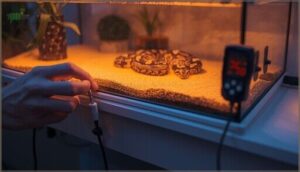
Behind every safe setup is a quick monthly routine. Check cords for fraying, feel outlets for warmth, and look for brown spots or bubbling on your heating pads — those are red flags.
Route cord protection along the wall, away from curious hands. Good electrical inspection habits keep reptile heat sources running safely. Thermal monitoring isn’t optional; it’s what keeps heating pad safety real.
Using Surge Protectors and Thermostats

Think of your thermostat and surge protector as a team — one regulates temperature control, the other guards against power spikes. Plug your heat mat into the thermostat first, then into a surge-protected strip rated above your total wattage.
This setup covers electrical overload prevention without extra fuss. Mount both out of reach, and your reptile heat sources stay reliably safe.
Maintaining Heat Mats for Snake Health

A heat mat that’s poorly maintained won’t keep your snake healthy for long. Dirt, temperature drift, and worn-out mats can quietly cause problems before you notice anything’s wrong.
Here’s what to stay on top of so your setup keeps working the way it should.
Routine Cleaning and Inspection
Clean heat mats last longer and keep your snake safer — it’s that simple. For mat maintenance, always unplug first and let it cool completely before wiping anything down.
Move your snake to a temporary tub, then use a soft cloth with mild soap. Check the cord for cracks during every inspection. Stick to monthly deep cleaning schedules for real equipment longevity.
Monitoring Temperatures Regularly
Your reptile heat mat only works as well as the temperatures you’re actually tracking. Use digital probes for accurate daily checks — one on the warm hide, one on the cool side.
Temp guns let you scan surfaces fast without disturbing your snake. Watch for behavior changes too. A snake hugging the cool glass? Check that thermostat. A solid thermal gradient means temperature control you can actually trust.
Replacing Heat Mats as Needed
Even a solid reptile heat mat won’t last forever — most need replacing every three to five years.
For snake wellness and heat safety, watch for these red flags:
- Mat feels barely warm despite thermostat settings
- Burning smell or discoloration under the tank
- Frayed cords or cracked casing
- Hot spots disrupting the thermal gradient
When in doubt, replace it. Your snake’s health isn’t worth the gamble.
Avoiding Excessive Substrate Depth
Thick bedding is sneaky. Reptile heat mat safety and snake comfort depend on it. Keep substrate depth over the warm side of your reptile heat mat to about half an inch — one finger-width is a good rule of thumb.
Too much insulation traps heat at the bottom, pushing temperatures into burn territory while the surface feels fine. For snake comfort and heat mat safety, thin and even bedding on the warm side beats a fluffy pile every time.
Teaching Kids Heat Mat Safety

Getting kids involved in heat mat safety doesn’t have to feel like a lecture. A few simple habits go a long way toward keeping both the snake and your child comfortable.
Here’s what to teach and model at home.
Supervising Snake Handling and Enclosure Checks
Always stay within arm’s reach when your child interacts with the snake — that’s non-negotiable for child supervision and reptile wellness. Keep sessions to 10–15 minutes max. Before opening snake enclosures, check the snake’s position yourself.
Let kids observe thermal monitoring by watching the thermostat display, not touching the mat. These simple snake handling tips protect both your child and your pet snake’s health.
Helping Kids Recognize Warm and Cool Zones
Once your child knows what to watch on the thermostat, zone recognition is the next skill. Try red tape on the warm side, blue on the cool side — instant heat mapping they’ll actually remember.
Teach them that the warm zone hovers near 88–92°F, while the cool side stays around 75–80°F. That gradient understanding fosters real temperature awareness and better snake care overall.
Establishing Safe Habits for Snake and Child
Zone recognition is a great start, but Habits are what keep kids and pet snakes safe long-term. Consistent Supervision Routines matter here — no solo snake time, ever.
Clear Handling Rules like sitting low, using two fingers, and staying calm go a long way. Hygiene Habits After Handling mean soap and water every time.
Safe Enclosure Interaction and Emergency Response Steps round out solid snake care.
Adult Responsibilities in Heat Mat Use
Kids can build great snake habits, but reptile heat mat safety still falls squarely on adults. Reptile care doesn’t run on autopilot.
- Lock thermostat settings so kids can’t crank the heat
- Check cords weekly for fraying or damage
- Use a digital thermometer daily for accurate temperature control
- Supervise any plug-in or adjustment — no exceptions
Adult supervision is the backbone of pet snake health.
Frequently Asked Questions (FAQs)
Are heat mats safe for snakes?
Heat mats are hiss-torically safe devices — but only with proper temperature control.
Pair yours with a thermostat, and snake burn risks drop substantially.
Without one, surfaces can dangerously overheat within minutes.
What temperature should a heat mat be for a snake?
Aim for a warm-side surface of 88 to 92°F for most snakes. Use a thermostat for precise heat mat settings, and keep the cool side around 75 to 80°F.
How to keep a snake enclosure warm in winter?
Winter turns your snake’s enclosure into an icebox fast.
Boost warmth by adding a small room heater nearby, sealing drafts, and pairing your heat mat with a thermostat for steady, safe thermal gradient control.
Can you leave the heating pad on all night for a snake?
Yes, you can leave a heating pad on all night — but only with a thermostat controlling it. Without one, overnight heating becomes a real snake burn risk fast.
Can heat mats work for lizards and turtles?
Lizards love belly warmth, but turtles? Not so much.
For lizard heating, mats help — but turtle safety demands overhead basking alternatives. Always pair any reptile heat mat with a thermostat for safe reptile thermoregulation.
How often should heat mats be replaced?
Plan to replace your reptile heat mat every two to three years.
Replacement Schedules matter — don’t wait for failure. If you notice uneven Heat Mat Lifespan signs like cold spots or scorch marks, replace it sooner.
What substrate works best over heat mats?
Thin, flat substrates work best. Paper towels or reptile carpet keep heat transfer efficient without blocking warmth.
Limit substrate depth to one inch for mat safety, snake comfort, and a reliable thermal gradient.
Can heat mats cause fires if left unattended?
Heat mats can cause fires if left unattended without a thermostat. Overheating Prevention starts with proper temperature control.
Without one, heating pads can reach dangerous levels within 20 minutes, creating serious Electrical Hazards and Fire Risk Factors.
Conclusion
Back in the day, snake keepers guessed at temperatures and hoped for the best. You don’t have to.
The right reptile heat mats for kids with pet snakes take the guesswork out completely—giving your child’s snake a warm side, a cool side, and a healthy life in between. Pick a mat with a thermostat, check it weekly, and teach your kid the basics. A happy snake really is that straightforward.
- https://winchestervetclinic.com/2025/03/01/reptile-care-health-tips/
- https://www.nps.gov/subjects/biodiversity/reptiles.htm
- https://nationalzoo.si.edu/animals/reptiles-and-amphibians
- https://reptile-database.reptarium.cz/
- https://trimleaf.com/products/vivosun-6-x-8-reptile-heat-mat-digital-thermostat-combo