This site is supported by our readers. We may earn a commission, at no cost to you, if you purchase through links.
Few snakes have earned their reputation for being as clean as Pantherophis guttatus. Farmers across the American Southeast once welcomed them into granaries not as pets, but as working animals—silent, efficient hunters keeping rodent populations in check while the rest of the farm slept.
That practical relationship, stretching back centuries, gave us the common name we still use today.
The corn snake’s biology rewards this kind of close attention: precise coloration, methodical hunting behavior, and a life history shaped by the ecotones where forest meets open land.
Every detail of this species tells you something worth knowing.
Table Of Contents
- Key Takeaways
- What is a Corn Snake?
- Corn Snake Classification and Name Origin
- Corn Snake Size and Appearance
- Corn Snake Range and Habitat
- Corn Snake Behavior and Temperament
- Corn Snake Diet and Hunting
- Corn Snake Reproduction and Growth
- Corn Snake Lifespan and Development
- Corn Snake Look-Alikes and Identification
- Corn Snake Conservation and Human Use
- Frequently Asked Questions (FAQs)
- Which snake has the highest IQ?
- What are some cool facts about corn snakes?
- How old is a 20 inch corn snake?
- How many species of corn snakes are there?
- What are some facts about corn snakes?
- Which corn snake is venomous?
- How big is a corn snake?
- Are corn snakes venomous?
- How do corn snakes hunt?
- Are corn snakes aggressive?
- Conclusion
Key Takeaways
- Corn snakes (Pantherophis guttatus) are nonvenomous colubrids whose name traces to both checkered belly pattern resembling corn kernels and their historical role as rodent hunters in grain storage facilities.
- Their coloration — reddish‑orange dorsal blotches edged in black over a checkerboard belly — combined with round pupils and a tapered head reliably distinguishes them from venomous look‑alikes like copperheads, which show triangular heads and vertical pupils.
- As opportunistic constrictors targeting mice, voles, and amphibians across forest edges and agricultural structures, they function as a cost‑free pest management system with measurable impact on rodent‑borne disease transmission.
- Captive corn snakes routinely live 15–20 years — roughly double their wild lifespan — because controlled temperature, consistent feeding, and veterinary care eliminate predation, parasites, and climate stress that cut wild individuals short.
What is a Corn Snake?
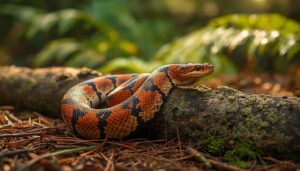
The corn snake (Pantherophis guttatus) is a non-venomous colubrid native to the southeastern United States, widely regarded as one of the most manageable and well‑studied snake species in both field and captive settings.
Their range stretches from New Jersey to Florida’s coastal plains, and this corn snake habitat and range guide breaks down exactly where these adaptable constrictors thrive in the wild.
It’s docile, appropriately sized, and comes in a striking range of color morphs — which is exactly why it’s a staple in the reptile hobby.
Here’s what you need to know about what makes this species tick.
From its needle-like teeth to its secretive burrowing habits, this fangtooth snake eel facts and bite guide unpacks why it’s so often mistaken for something far more dangerous.
Common Name and Scientific Name
The corn snake — scientifically known as Pantherophis guttatus — is a nonvenomous snake belonging to the family Colubridae, widely distributed across eastern and central North America.
Its common name evolution reflects regional vernacular differences, while historical synonym usage of Elaphe guttata still appears in older texts.
Scientific naming conventions and taxonomic authority citations standardized its current binomial, ensuring consistent species distribution tracking across research and education.
Latin provides stability for scientific names, preventing meaning shifts over time.
Non-venomous Snake Classification
Sitting firmly within family Colubridae — the largest nonvenomous snake family on the planet — Pantherophis guttatus exemplifies Colubrid Diversity at its finest. Unlike Constriction Families such as boas and pythons, or Rear-fanged Species with mild venom, this colubrid species poses zero threat to humans.
Molecular Phylogeny and Morphological Keys confirm it as a textbook nonvenomous species.
Why Corn Snakes Are Popular
That zero-threat profile makes Pantherophis guttatus one of the most sought-after reptiles in the pet trade today — and it’s easy to see why. Three qualities consistently drive that demand:
- Beginner Friendly docility and low‑maintenance care requirements suit first-time keepers.
- Affordable Pricing — basic morphs start around $30–$50.
- Color Morph Variety from captive breeding and genetic morphs rewards every aesthetic preference.
Small Space Suitability seals the deal for apartment dwellers ready to embrace pet ownership responsibilities with a nonvenomous species.
Corn Snake Classification and Name Origin
Before you can truly understand the corn snake, it helps to know where its name actually comes from — both the common one and the scientific one.
The taxonomy tells a more layered story than most people expect.
Here’s what you need to know about how this species is classified and named.
Pantherophis Guttatus Taxonomy
Pantherophis guttatus sits firmly within Family Colubridae — one of the largest snake families — and belongs to the tribe Lampropeltini. Its taxonomic classification reflects molecular phylogeny research that reorganized North American rat snakes under Genus Pantherophis. Phylogenetic placement here separates it cleanly from venomous lineages.
Family Colubridae traits include smooth scales and no venom apparatus, making Genus Pantherophis overview straightforward: entirely non-venomous, slender-bodied North American constrictors.
Former Scientific Name Elaphe Guttata
Before the genus reallocation that gave you Pantherophis guttatus, the corn snake carried a different name: Elaphe guttata, first described by Linnaeus in 1766. historical synonym stuck in literature for over two centuries.
molecular phylogenetics followed, reassigning North American colubrids away from the Eurasian genus Elaphe.
You’ll still find Elaphe guttata on older museum labels and vintage field guides today.
Meaning of “guttatus”
That species epithet, guttatus, carries its meaning right in the Latin droplet origin of the word — gutta, meaning "drop."
It’s a taxonomic adjective usage describing a spotted pattern, meaning exactly what you see: those large red blotches, the red-orange background with black-bordered blotches defining Pantherophis guttatus.
This morphological descriptor history connects it to dozens of comparative guttatus species across plants, fungi, and animals, sharing similarly spotted appearances.
How The “corn” Name Began
The "corn" in corn snake doesn’t trace back to the vegetable you’re picturing. In Old English, the Germanic root kurnam simply meant any small seed or grain — wheat, rye, barley. Colonial maize naming shifted that meaning as settlers adopted Indian corn terminology for the dominant New World crop.
Three things explain the corn snake’s name:
- Belly checkering resembles corn kernels
- Frequent shelter in corn granaries
- Early corn rat snake crosses documented in agricultural records
Maize etymology, then, only partially explains it.
Corn Snake Size and Appearance
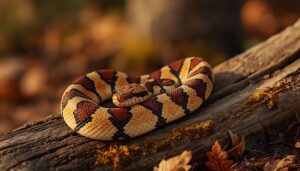
Corn snakes are a study in elegant proportions — not too bulky, not too slender, built just right for the life they lead. Their coloring alone is enough to stop you mid‑trail if you spot one in the wild.
Here’s what you can expect regarding size, build, and markings.
Adult Length and Weight
Adult corn snakes usually reach 4 to 6 feet in length, with sexual dimorphism playing a real role — females commonly measure 4.5 to 5.5 feet, while males plateau around 3.5 to 4.5 feet.
If you’re curious about the timeline behind those size differences, this corn snake growth rate guide breaks down how quickly males and females pack on length at each life stage.
Weight-length ratio varies by condition, with well-fed adults weighing 1 to 2.5 pounds.
Captive growth potential often exceeds wild norms, and seasonal weight changes — especially in breeding females — can temporarily shift that baseline.
Body Shape and Scale Texture
Run your hand along a corn snake’s back and you’ll notice something immediately — there’s no roughness, no ridge, just smooth dorsal scales with a glossy sheen effect that reflects light cleanly.
That’s snake morphology doing real work: scale overlap mechanics minimize friction-reduction design against substrate, while enlarged ventral scale grip provides traction.
This thermoregulatory texture also allows even heat absorption across the physical description’s full profile.
Typical Color and Blotch Pattern
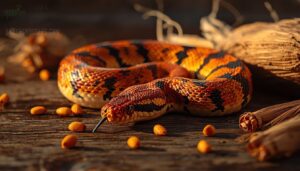
What makes a corn snake instantly recognizable is its ground color variation — a warm canvas of light tan, peach, or deep amber that sets the stage for bold reddish‑orange blotches edged in sharp black outlines.
Blotch shape follows a saddle pattern along the dorsal midline, with camouflage effectiveness peaking in dappled leaf litter.
Pattern contrast and regional color shifts vary subtly between populations.
Belly Checkered Markings
Flip the snake over and you’ll find an entirely different story. The ventral surface displays a bold checkerboard pattern — alternating black and cream rectangles running in precise horizontal bands from chin to tail.
This isn’t decorative coincidence; the high-contrast black outlines serve real predator distraction tactics, breaking up the silhouette effectively.
Morph-specific contrast varies, with some lineages producing starkly crisp squares, others softer tones.
Juvenile Versus Adult Appearance
Hatchlings emerge looking noticeably duller — brownish where adults run orange‑red, with faint keels and blotchy contrast that hasn’t quite settled yet.
Each shed triggers a shedding color enhancement, gradually sharpening the Color Richness Progression toward that bold adult palette.
The spear marking on the neck sharpens too, a reliable Spear Marking Emergence that, combined with Body Proportion Growth, confirms maturity far better than size alone.
Corn Snake Range and Habitat
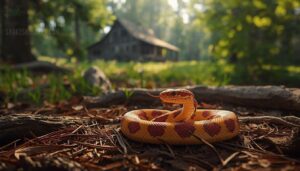
Corn snakes are remarkably adaptable, turning up everywhere from dense forest edges to old farmhouses across much of the eastern United States.
Their range is broader than most people expect, stretching well beyond their southeastern stronghold and even reaching a few island chains far from the mainland.
Here’s a closer look at exactly where they live and what draws them to certain spots.
Native Geographic Distribution
Across the Southeastern Core Range, corn snakes (Pantherophis guttatus) extend from southern New Jersey through Florida—where populations peak—northward into the Mississippi River Corridor and westward across the Gulf Coastal Plain into Louisiana and Oklahoma.
Elevational limits top roughly 1,800 meters in the Appalachians, though habitat and distribution of corn snakes remain densest at lower elevations, where habitat connectivity maintains strong, genetically linked populations throughout the southeastern and central United States.
Introduced Populations on Islands
Beyond the mainland, Pantherophis guttatus has established introduced populations on Grand Bahama, Grand Cayman, St. Thomas in the U.S. Virgin Islands, and several Lesser Antilles islands—mostly traced to pet releases. These founder populations face genetic drift and founder effects, yet thrive where predator absence removes key pressures.
Eradication strategies on these islands remain complex, as geographic range and introduced populations continue expanding across Caribbean habitats.
Forest Edges and Grasslands
Where forest meets open meadow, Pantherophis guttatus finds its ideal operating zone. Forest edges deliver edge microclimate advantages—warmer daytime temperatures, varied shelter, and rich edge biodiversity that concentrates prey.
Edge seed dispersal patterns shape the herbaceous understory corn snakes exploit as cover. Edge fire regimes maintain open grasslands and meadowlands where rodent populations peak, making these transitional zones central to the species’ ecological role in rodent control.
Barns and Abandoned Structures
Old barns and abandoned buildings aren’t just picturesque relics—for Pantherophis guttatus, they’re prime real estate. Timber joints, loft access points, and ventilation systems create a labyrinth of shelter preferences perfectly suited to a reclusive colubrid.
Foundation settling opens ground-level gaps; roof decay exposes warm cavities above.
In human-modified landscapes, these structures function as surrogate nesting sites, concentrating rodent prey and offering reliable thermal refuge year-round.
Shelter and Cover Preferences
Regarding ground cover types, Pantherophis guttatus is remarkably selective—favoring leaf litter, rotting logs, and rocky hillsides where burrow selection aligns with both microhabitat moisture levels and thermal refuge needs.
Wooded groves, tropical hammocks, and abandoned buildings each serve distinct seasonal shelter shifts, offering concealment from predators while maintaining the stable microclimatic conditions this species consistently exploits throughout its native range.
Corn Snake Behavior and Temperament
Corn snakes have a reputation that holds up in the wild just as well as in captivity — calm, curious, and rarely looking for trouble. Understanding how they actually behave helps you appreciate what makes this species stand out from other North American colubrids.
Here’s a closer look at the key behavioral traits that define them.
Daily Activity Patterns
Corn snakes follow a crepuscular timing that surprises many keepers — dawn and dusk are their prime hours, not midday. Temperature movement drives everything: your snake’s activity rhythms shift directly with ambient heat, with ideal foraging rhythm occurring between 28–32°C.
Morning basking behavior usually runs 20–60 minutes before hunting begins.
Expect pronounced seasonal activity shifts, with spring surges giving way to winter brumation.
Secretive and Reclusive Habits
Think of your corn snake as a creature that treats concealment as survival strategy, not shyness. In the wild, Pantherophis guttatus relies on crevice utilization — wedging into rock fissures, root masses, and debris — for microhabitat thermoregulation.
Scent trail navigation guides it back reliably after foraging.
Cryptic and solitary by nature, it favors overgrown fields and shadowed edges, executing seasonal hide shifts as temperatures dictate.
Defensive Behavior and Bluffing
When cornered, Pantherophis guttatus deploys a layered bluff sequence rather than immediate retreat.
Neck flattening widens its apparent silhouette; head flicking signals readiness; coil defense tucks essential organs inward.
Tail vibration in leaf litter — pure Batesian mimicry of vipers — combined with camouflage and faint hissing, completes the performance.
Thermal threat assessment determines whether it bluffs or vanishes head‑first into cover.
Docility Around Humans
captive-born Pantherophis guttatus generally settles into human interactions with impressive composure.
Consistent socialization strategies — short daily sessions, full-body support, calm movements — shorten the acclimation period considerably.
stress indicators like rapid tongue-flicking or tight coiling; these signal you to back off.
Sound handling techniques, mirroring human care practices at the Smithsonian National Zoo, make all the difference.
Climbing and Hiding Behavior
Beyond docility, Pantherophis guttatus reveals a surprisingly active behavioral repertoire through its climbing and hiding tendencies.
Your enclosure should reflect this: vertical substrate preference is genuine — in the wild, these snakes ascend rough bark and vine stems via arboreal prey strategies, pursuing lizards and birds through shrubs.
Temperature-driven climbing peaks during crepuscular hours.
Juvenile climbing risks are real; younger individuals navigate tight spaces less reliably.
Secretive habits anchor everything — rotten stumps, decaying vegetation, and leaf litter aren’t optional enrichment, they’re biological necessities, shaping your snake’s escape route selection and daily comfort.
Corn Snake Diet and Hunting
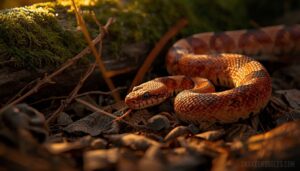
Corn snakes are efficient, methodical hunters — built for tracking down prey in tight spaces and subduing it quickly.
In the wild, their diet shifts as they grow, and in captivity, what and how often you feed them matters more than most keepers realize.
Here’s what you need to know about how corn snakes hunt, what they eat, and how to feed them safely.
Wild Prey Species
Corn snakes display impressive Rodent Diversity in the wild, with mice and voles forming the backbone of their mammal prey.
Seasonal shifts matter too — Amphibian Seasonal Peaks bring frogs and salamanders into the menu, while Bird Nestling Capture occurs opportunistically near ground nests.
Invertebrate Supplementation rounds things out for juveniles.
Here’s what they usually target:
- Rodent prey — mice and voles from rodent burrows
- Amphibian prey — frogs and salamanders during wet seasons
- Nestlings — fledglings and eggs near low vegetation
- Invertebrates — larvae and earthworms for smaller snakes
Prey Size Variation tracks closely with the snake’s own growth stage.
Hunting and Constriction Method
Once a strike lands, the real work begins.
Through Rhythmic Tightening and Coil Pressure Mechanics, corn snakes wrap their muscular torsos around prey, applying Blood Flow Restriction to major vessels with each exhale. Prey Struggle Response subtly cues tighter spirals — classic Ambush Positioning combined with precise constriction technique that makes their predatory behavior remarkably efficient for rodent population control.
Juvenile Diet Differences
Hatchlings don’t eat like adults — their higher metabolic rate demands more frequent meals and careful Prey Size Scaling, keeping items within 20–30% of body girth to prevent regurgitation. Digestive Speed Differences and Thermal Digestion Needs mean juveniles rely on ideal enclosure warmth to absorb nutrients efficiently.
Their dietary habits shift from lizards and tree frogs toward rodents within weeks, reflecting natural Feeding Schedule Variability as they grow.
Feeding Frequency in Captivity
Most captive corn snakes thrive on a consistent feeding schedule — adults every 7 days, juveniles every 5 to 7 days with a tighter juvenile cadence supporting rapid development. Enclosure temperature directly influences feeding behavior and digestion, so don’t let your hot spot drop.
Watch health indicators like muscle tone and activity; seasonal reduction in winter is normal and won’t compromise dietary habits long-term.
Safe Prey Size Guidelines
Matching prey to your snake’s body isn’t guesswork — it’s biology. Prey width should approximate the snake’s widest girth point, and prey weight ratio should stay near 10% of body weight for juveniles, scaling to 5–10% for adults.
Follow these Prey Width Guidelines:
- Juveniles — pinky to fuzzy mice (2–8g)
- Sub-adults — hoppers to weaners (10–40g)
- Adults — appropriately sized rodents matching girth
Always enforce Post-Feeding Rest (24–48 hours) and practice Body Condition Monitoring regularly.
Corn Snake Reproduction and Growth
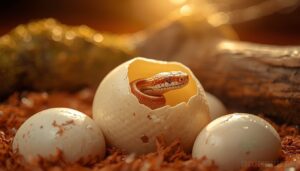
Corn snake reproduction follows a fairly predictable cycle once you understand the key stages. From the first courtship behaviors in early spring through hatching in late summer, each phase has its own timing and conditions worth knowing.
Here’s a closer look at how that whole process unfolds.
Breeding Season Timing
Breeding season in Pantherophis guttatus runs from March to May, triggered by a precise convergence of photoperiod cues and temperature thresholds. As days lengthen, GnRH release drives gonadal activity, while daytime temperatures consistently above 20–25°C signal reproductive readiness. Geographic variation matters considerably — southern populations initiate courtship weeks earlier than northern counterparts.
| Factor | Effect on Breeding Timing |
|---|---|
| Photoperiod cues | Stimulates hormonal cascade initiating courtship |
| Temperature thresholds | Accelerates or delays mating onset |
| Rainfall influence | Synchronizes female receptivity and digestion |
| Habitat microclimate | Rocky or agricultural sites warm earlier, advancing seasonal breeding |
Females ultimately deposit a clutch of 10 to 30 eggs, with egg incubation dependent on consistent warmth throughout development.
Courtship and Male Combat
Once temperatures climb in spring, P. guttatus males don’t waste time — courtship rhythms ignite almost immediately. Male display posture becomes assertive: head elevated, body widened, tongue flicking to assess female receptivity. Rival males settle disputes through the iconic combat dance, involving pushing, pinning, and brief combat lunges — rarely injurious but decisive.
Three key drivers shaping mating season outcomes:
- Temperature influence — warmer microhabitats accelerate courtship initiation
- Shelter proximity — males near cover gain repeated female access
- Display dominance — dominant posture directly influences female choice
Egg Laying Locations
Female P. guttatus don’t just drop eggs anywhere — site selection is deliberate, shaped by moisture, concealment, and thermal stability.
Tree Hollow Nests, Rotting Log Cavities, and Leaf Litter Pockets dominate natural choices, while agricultural zones introduce Stored Grain Bins and Warm Soil Microhabitat beneath debris.
Rotten stumps and rocky hillsides also serve reliably.
| Nest Site | Key Advantage |
|---|---|
| Tree Hollow Nests | Stable humidity, predator concealment |
| Rotting Log Cavities | Insulating moisture, structural protection |
| Leaf Litter Pockets | Camouflage, temperature buffering |
| Stored Grain Bins | Consistent warmth, accessibility |
| Warm Soil Microhabitat | Passive thermal regulation during egg incubation |
Incubation Temperature and Duration
Once eggs are nestled in their chosen site, the clock starts.
Your ideal temp range sits between 80 and 85°F — hold it steady, because temperature dependence is real here. Cooler conditions stretch the incubation period toward 75 days; warmer accelerates it closer to 60 days.
Humidity balance around 75–90% prevents dehydration, while a consistent turning schedule and stage timing reduce mortality risks substantially.
Hatchling Size and Independence
When those eggs finally open, what emerges is already self-sufficient. Hatchlings measuring 10–15 inches hit the ground running — literally. Within hours, Microhabitat Selection kicks in instinctively, each juvenile traversing cover without any parental guidance.
- Early Foraging Success depends on strike accuracy from day one
- Nest Moisture Influence shapes initial body mass across the clutch of 3 to 24 eggs
- Sibling Competition Dynamics are avoided entirely — independence is immediate
- Rapid Growth Benefits compound quickly, reducing predation vulnerability within weeks
Corn Snake Lifespan and Development
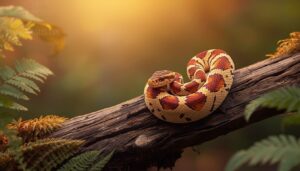
Corn snakes aren’t in a rush — they grow steadily over several years before reaching full maturity, and once they do, they can stick around for a surprisingly long time.
Whether you’re tracking a wild individual or caring for one at home, lifespan looks quite different depending on the environment. Here’s what how corn snakes develop and how long they live.
Growth Rate by Age
Growth rate in corn snakes follows a predictable arc across age classes. The juvenile growth surge is dramatic — hatchlings can gain 3–6 inches within the first six weeks, reaching 30–60 inches by year two.
Midlife weight gain then takes over, with length stabilizing while girth increases.
Seasonal growth fluctuations, temperature dependent growth conditions, and diet influence how quickly each individual progresses toward maturity.
Time to Sexual Maturity
Sexual maturity in corn snakes generally arrives between 18 and 36 months, though several variables shape that window considerably. Growth Rate Influence is real — faster-growing individuals hit reproductive thresholds earlier across age classes.
Temperature Effects and Photoperiod Cues trigger hormonal cascades, while a Body Condition Threshold must be met before females ovulate. Genetic Variation means no two snakes follow identical timelines.
- Consistent feeding accelerates growth to maturity
- Stable warm temperatures cue reproductive biology
- Lighter day cycles stimulate hormonal readiness
- Healthier body condition allows earlier egg production
Wild Lifespan Expectations
Wild corn snakes don’t get the same comfortable ride as their captive counterparts. Juvenile mortality hits hard — many hatchlings don’t survive their first year, caught between predation pressure from raptors and larger snakes, and the unforgiving reality of climate variability.
| Factor | Impact | Typical Lifespan Effect |
|---|---|---|
| Seasonal Survival | Food scarcity weakens growth rate | Reduces years substantially |
| Disease Impact | Parasites and infection | Shortens age classes unpredictably |
| Predation Pressure | Hawks, kingsnakes, mammals | Cuts wild lifespan to 6–8 years |
Rare individuals reach 10–12 years — but that’s the exception, not the rule.
Captive Lifespan Expectations
Captive corn snakes live dramatically longer than their wild counterparts — generally 15 to 20 years, with well-managed individuals occasionally reaching lifespan 23 years.
That gap reflects what thoughtful captivity care actually delivers: consistent Temperature Management, Dietary Quality, Veterinary Care, and Stress Reduction through stable routines.
Strong Genetic Selection in captive-bred lines further bolsters longevity.
Quality reptile husbandry and attentive human care genuinely transform their developmental trajectory.
Factors Affecting Longevity
Genetic health lays the foundation, but how long a corn snake actually lives depends on several interacting pressures.
In the wild, habitat quality, parasite load, and unpredictable prey availability cut lifespans short.
In captivity, precise thermal regulation, consistent nutrient intake, and controlled feeding behavior and prey types remove most of those variables.
Habitat loss increasingly compounds wild mortality.
Get these factors right, and you’re actively extending their lifespan.
Corn Snake Look-Alikes and Identification
Corn snakes get mistaken for dangerous species more often than you’d think, and that confusion can cost them their lives.
Knowing how to tell them apart — from venomous look-alikes to similar harmless species nearby — is one of the most useful skills you can develop.
Here’s what to look for.
Distinguishing From Venomous Snakes
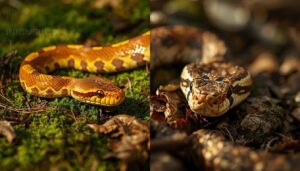
Telling a corn snake apart from a venomous species comes down to few reliable anatomical markers. Venomous snakes usually display a triangular head broader than the neck, a pronounced neck constriction, vertical pupils, heat-sensing pits between the eye and nostril, and a raised scale ridge above the eye.
Knowing these physical traits is the first step, but proper snake handling gear and clothing adds an essential layer of protection whether you’re sure of the species or not.
Corn snakes are entirely harmless and shouldn’t be handled with folk deterrents either, since how salt affects a snake’s body over time shows why such methods cause needless harm without actually keeping snakes away.
Corn snakes — nonvenomous, round-pupiled, smooth-scaled — share none of these features.
Color Pattern Clues
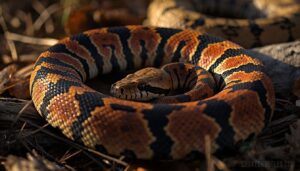
Once you know what to look for, the pattern tells the whole story. Corn snakes display four reliable color clues:
- Dorsal blotch alignment — reddish‑orange blotches run in a uniform midline sequence, sharply edged in black
- Lateral saddle markings — mirror the dorsal blotches symmetrically on both flanks
- Ventral pattern contrast — a crisp black‑and‑white checkerboard runs the full belly length
- Regional color variation — populations shift from orange‑red in Georgia to golden‑tan farther west; molt‑induced fading can temporarily dull these contrasts, but the essential blotch arrangement stays intact
Head and Eye Features
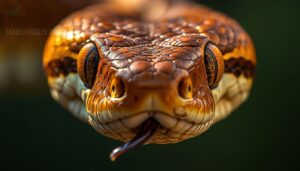
The head gives it away just as fast as the belly does. Corn snakes display a gently triangular Head Shape Morphology — especially narrower than a pit viper’s broad, arrow-shaped skull. Large round eyes with round pupils are your clearest tell: venomous copperheads carry elliptical, cat-slit pupils. Iris Pattern Variation produces warm amber-to-orange tones, while Pupil Dilation Dynamics shift noticeably with light intensity.
| Feature | Corn Snake | Venomous Look-Alike |
|---|---|---|
| Head shape | Narrow, tapered triangle | Broad, distinct arrow |
| Pupil shape | Round | Vertical ellipse |
| Eye size | Large round eyes, prominent | Smaller, recessed |
| Iris coloration | Amber-orange (Iris Pattern Variation) | Dull gold or yellow |
| Eye Scale Arrangement | Smooth, uniform scales surrounding orbit | Irregular, rougher bordering scales |
No Sensory Pit Distribution appears between eye and nostril — that heat-sensing pit is exclusive to vipers. Corn snakes rely instead on a flickering tongue feeding the Jacobson’s organ, processing chemical cues rather than infrared signals — a fundamental part of the Physical description and identification of corn snakes that separates them cleanly from dangerous species.
Body Shape and Scale Details
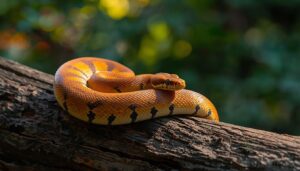
Beyond the head, body shape seals the ID. Corn snake physical description and morphology follow a slim, continuous line — the Head-Neck Junction flows without abrupt widening, and the Tail Taper Gradient narrows gradually rather than dropping off sharply.
Dorsal Scale Rows run 19–23 at midbody, smooth glossy scales catching light cleanly. The Ventral Checkerboard Pattern and consistent Scale Arrangement won’t appear on any venomous look-alike.
Regional Confusion With Similar Species
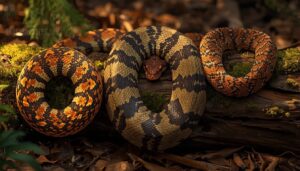
Even with body shape and scales locked down, regional field guide discrepancies still trip people up. In range overlap zones — where Pantherophis guttatus shares habitat with Red rat snakes, the Great Plains rat snake, and other nonvenomous constrictors — plastron pattern overlap and diagnostic trait variability blur the lines.
Seasonal migration mixing only compounds the problem, temporarily crowding similar-looking species into the same microhabitat.
Corn Snake Conservation and Human Use

Corn snakes occupy a unique space where wildlife conservation and human interest genuinely overlap. Their story isn’t just about survival in the wild — it’s also about how people interact with, benefit from, and sometimes threaten this species.
Here’s what you should know across the key areas that shape their relationship with us.
IUCN Conservation Status
The corn snake holds a "Least Concern" designation on the IUCN Red List — a reassuring position reflecting stable population trends across its native range. That said, the Red List Category isn’t a permanent badge of safety.
Threat Assessment Criteria and Recovery Monitoring Metrics guide ongoing evaluations, and Conservation Funding Implications shift when new data emerge. Your awareness of its conservation status genuinely matters.
Habitat Loss and Threats
That "Least Concern" status doesn’t mean threats aren’t real. Habitat loss has claimed roughly 30% of suitable range since 2000, driven by compounding pressures:
- Urban expansion converts forest edges and grasslands into concrete.
- Agricultural pesticides cause secondary poisoning through contaminated prey.
- Road mortality disrupts migration and fragments populations.
- Climate range shift pushes suitable habitat upslope, shrinking refuges.
Invasive species and habitat fragmentation compound every one of these.
Importance in Rodent Control
Think of corn snakes as nature’s pest management crew. Their diet and hunting behavior—targeting mice, rats, and voles with lethal efficiency—delivers real crop damage reduction and disease transmission prevention without a single dollar spent on chemicals.
That consistent predator-prey relationship reinforces integrated pest management strategies, contributing to pesticide use decline and measurable economic savings. Their ecological role and rodent control by corn snakes remain quietly indispensable to agricultural health.
Pet Trade and Captive Breeding
Captive breeding has transformed corn snakes into one of the reptile hobby’s most accessible entry points. Breeders leverage online sales platforms and morph market trends to showcase genetic morphs—albino, snow, charcoal—products of deliberate genetic diversity management spanning decades.
Breeder regulation and supply chain ethics vary considerably by jurisdiction, so verifying captive-bred documentation before purchasing protects both you and wild populations.
Public Safety and Education
Misidentification kills more corn snakes than habitat loss ever will — that’s where public education becomes a conservation tool.
Misidentification kills more corn snakes than habitat loss — education is the most powerful conservation tool we have
Teaching communities to recognize the identification features distinguishing corn snakes from venomous species, including their round eyes and smooth scalation, reduces unnecessary killings.
Public outreach programs, school emergency drills, and community safety partnerships increasingly incorporate nonvenomous snake awareness, helping residents make informed, confident decisions rather than fearful ones.
Frequently Asked Questions (FAQs)
Which snake has the highest IQ?
King cobras reign as the sharp minds of the serpent world, demonstrating problem-solving, spatial learning, and memory retention that set them apart in every intelligence comparison and behavioral ecology study conducted.
What are some cool facts about corn snakes?
Corn snakes pack surprising depth into a slender frame — their color morph diversity, thermal regulation instincts, and subtle predator mimicry make them genuinely fascinating, whether you’re a first-time keeper or a seasoned herpetologist.
How old is a 20 inch corn snake?
As the saying goes, "size tells the story."
A 20-inch corn snake is generally six to twelve months old, though the feeding schedule impact and temperature growth effect can push some individuals there by four months.
How many species of corn snakes are there?
Technically, there’s one widely recognized species — Pantherophis guttatus — though ongoing taxonomic controversy, driven by molecular phylogeny and genetic divergence studies, suggests two or three distinct geographic lineages may warrant separate species delimitation.
What are some facts about corn snakes?
From its bold predator mimicry to impressive color morph diversity, the corn snake captivates — diurnal, secretive, and built for thermal regulation; it’s a species where genetic research keeps rewriting what we thought we knew.
Which corn snake is venomous?
None of them are. Every corn snake (Pantherophis guttatus) is completely nonvenomous — no venom glands, no toxins, no exceptions.
A bite may sting briefly, but infection risk, not venom, is your only real concern.
How big is a corn snake?
Adult corn snakes generally reach four to six feet, with hatchlings measuring just 10–15 inches at birth. Genetic potential, dietary influence, and temperature impact all shape how quickly they hit maturity.
Are corn snakes venomous?
No, corn snakes aren’t venomous. They lack venom glands entirely and rely on constriction to subdue prey. Bites cause only minor irritation — no systemic effects, no real danger.
How do corn snakes hunt?
Using scent tracking via the Jacobson’s organ and thermal detection, corn snakes employ ambush positioning near burrows, strike with precise timing, then subdue prey through constriction — making them remarkably effective rodent control agents.
Are corn snakes aggressive?
No, corn snakes aren’t aggressive by nature.
They’re docile, calm snakes that tolerate gentle handling well — defensive reactions usually stem from feeding time reactivity, shedding stress, or feeling cornered, not true aggression.
Conclusion
Picture a barn cat and a corn snake sharing the same granary—one chasing mice by day, the other by night, neither aware of their unlikely partnership. That’s how seamlessly Pantherophis guttatus fits into its world.
Digging into corn snake species information reveals a species shaped by purpose: precise, adaptable, and quietly essential.
Once you understand what drives this snake’s biology and behavior, you don’t just recognize it—you respect it.