This site is supported by our readers. We may earn a commission, at no cost to you, if you purchase through links.

Somewhere in the Iranian highlands, a viper flicks its tail to mimic a crawling spider—and a bird dives for what it thinks is an easy meal. That tail belongs to the spider-tailed horned viper, one of the most astonishing examples of evolutionary deception on Earth.
Snakes have been quietly developing strange bodies, vivid colors, and structural tricks for millions of years, and most people never see beyond the fear. From iridescent scales that split light like a prism to leaf-shaped noses built for disappearing in plain sight, this unique looking snake species guide reveals just how remarkable these animals truly are.
Table Of Contents
- Key Takeaways
- Most Unique-Looking Snake Species
- Bold Colors and Patterned Markings
- Strange Body Shapes and Adaptations
- Habitats That Shape Their Look
- Rare Species and Conservation Issues
- Frequently Asked Questions (FAQs)
- What is the most unique snake?
- Can I upload a picture to identify a snake?
- What is the coolest looking snake in the world?
- What is the rarest snake to see?
- What snakes have best camouflage abilities?
- How often do pet snakes shed skin?
- Can snakes see in complete darkness?
- What snakes are most active at night?
- Do snakes have a good memory?
- How do unique snakes behave during mating season?
- Conclusion
Key Takeaways
- The spider-tailed horned viper’s tail physically mimics a living spider to lure birds, making it one of the most specialized predatory adaptations found in any snake species.
- Snake coloration isn’t decoration—patterns like coral snake banding and milk snake mimicry are active survival strategies shaped by predator behavior and habitat pressure.
- Unusual body structures like tentacles, flattened gliding forms, and leaf-shaped snouts show how deeply environment shapes a snake’s anatomy over evolutionary time.
- Many of the world’s most visually striking snakes face serious threats from habitat loss, illegal collection, and tiny geographic ranges that leave them with almost no margin for survival.
Most Unique-Looking Snake Species
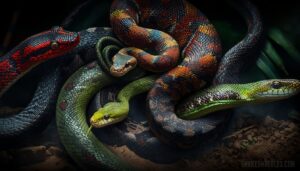
Snakes have been perfecting the art of looking impressive for millions of years. From vivid warning colors to body parts that seem borrowed from other animals entirely, some species have taken evolution in directions you wouldn’t expect.
Some of these adaptations are genuinely jaw-dropping, as you’ll see browsing this gallery of the world’s most visually stunning snake species.
Here are seven of the most visually striking snakes you’ll find anywhere on Earth.
Green Tree Python
The Green Tree Python is a masterclass in arboreal lifestyle excellence. Its vivid green coloration isn’t just beautiful — it’s functional camouflage built for rainforest canopies. The species is native to New Guinea and nearby islands.
- Uses prehenile tail use to anchor on branches
- Thermoregulation strategies involve canopy positioning
- Dietary preferences include birds, lizards, small mammals
- Reproductive behaviors involve egg-coiling incubation
- Captive breeding challenges stem from humidity sensitivity
Brazilian Rainbow Boa
If the Green Tree Python wins on camouflage, the Brazilian Rainbow Boa wins on sheer spectacle.
Native to Central and South American rainforests, this non-venomous constrictor carries dazzling iridescent scales that shift through the full color spectrum in bright light.
Its microhabitat selection spans the forest floor to low branches, and live-bearing reproduction, dietary flexibility, thermal gradient preference, and captive longevity exceeding 20 years make it endlessly fascinating.
Coral Snake
Few snakes stop you cold quite like the Coral Snake. Those vivid bands of red, yellow, and black aren’t decoration — that’s aposematism at work, warning coloration that signals genuine danger.
Fixed front fangs deliver neurotoxic venom affecting the nervous system directly. Fossorial behavior and nocturnal activity keep them hidden, emerging quietly to lay a small egg clutch beneath forest debris.
Spider-Tailed Horned Viper
If the Coral Snake wins with color, the SpiderTailed Horned Viper wins with shape.
Found in Iran’s rocky deserts, this snake’s tail tip carries scale filaments that mimic a living spider — genuine Morphological Specializations in Snakes you won’t find anywhere else.
It wiggles to lure birds close, then strikes.
Horned Scale Evolution and Unique snake adaptations worldwide rarely get stranger than this.
Tentacled Snake
Meet the Tentacled Snake — one of the strangest hunters in the water. It uses fleshy sensory tentacles to detect fish through Muddy Water Camouflage, where vision fails completely. Its J-shaped Strike Posture launches a Rapid Strike Timing attack faster than you can blink.
- Viviparous Live Birth means young arrive ready to hunt
- Seasonal Breeding Cycle ties reproduction to warm, stable water
- Tentacles scan independently, showcasing Unique snake adaptations worldwide
Malagasy Leaf-Nosed Snake
If you’ve ever mistaken a stick for something alive, the Malagasy Leaf-Nosed Snake takes that trick to another level.
This evolutionary oddity from Madagascar shows striking sexual dimorphism — males carry spear-like nasal appendages while females sport a convincing leaf-shaped one.
Its microhabitat preference keeps it perched 1.5 to 2 meters up, relying on camouflage in rainforest habitats during nocturnal hunting.
Barbados Threadsnake
What fits in your palm and lives its entire life underground? The Barbados Threadsnake barely reaches 10 centimeters, making it one of the tiniest reptiles on Earth. Its burrowing lifestyle in the sandy soils of Barbados suits its miniature size perfectly, and its Island Endemism and Snake Evolution story is genuinely fascinating.
- Termite Diet: It feeds almost entirely on termite larvae
- Single Egg Reproduction: Females lay just one egg per cycle
- Sandy Soil Habitat: Loose soils host the termite colonies it depends on
- Camouflage and Venom in Uncommon Snakes: It relies on concealment, not venom, for survival
Bold Colors and Patterned Markings
Snake coloration isn’t just about looking striking — it’s a survival language written in scales. Every pattern, from vivid warning bands to ghostly camouflage, tells you something real about how that snake lives and stays alive.
Here’s a closer look at the color strategies that make these species some of the most visually impressive on the planet.
Aposematic Warning Colors
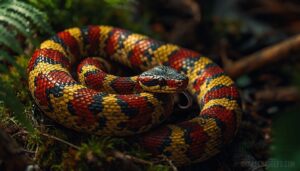
Some snakes wear danger openly. Aposematic signaling works because bold coloration warning signals — like the coral snake’s red, yellow, and black bands — trigger predator learning fast.
High contrast efficacy matters here: predators associate those hues with pain and retreat. Hue effectiveness, especially red and yellow, speeds up avoidance.
Multimodal warning adds hissing or striking behavior, reinforcing the visual threat.
Batesian Mimicry in Milk Snakes
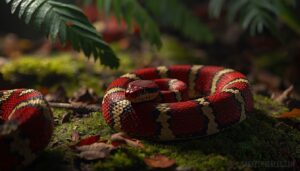
Milk snakes pull off one of nature’s cleverest tricks — they look dangerously like coral snakes without actually being venomous. That’s Batesian mimicry at work. Here’s what makes it so effective:
- Snake coloration matches the aposematic signaling of true coral snakes
- Predator learning drives avoidance without a single bite
- Mimicry accuracy tightens where model abundance is high
- Habitat mosaic creates pockets of strong and weak mimics
- Human misidentification puts harmless milk snakes at unnecessary risk
Iridescent Rainbow Sheen
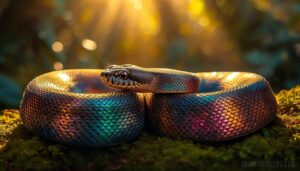
Brazilian Rainbow Boa doesn’t use pigment to produce its stunning color — it uses physics. Its iridescent scales create color through thin film interference, a structural color mechanism where nano-texture effects bend light into angle-dependent hues.
As you shift your viewing angle, the sheen glides through the spectrum.
Among coolest looking snake species worldwide, this color morph stands apart.
Leaf-like Camouflage Patterns
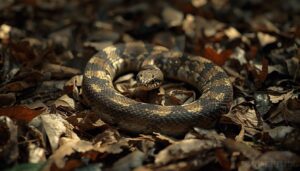
Where iridescent sheen dazzles through physics, leaf-like cryptic coloration works through deception. Species like the Gaboon viper achieve camouflage efficiency through a pattern that mimics fallen leaves on the forest floor, making them nearly invisible.
Vein Pattern Evolution, Micro Surface Roughness, and Adaptive Leaf Shading all contribute:
- Seasonal Color Matching keeps disguise effective year-round
- Vein-like markings break up the snake’s outline
- Subtle texture mimics aged, dried leaf surfaces
- Camouflage Efficiency Metrics show cryptic coloration outperforms visual signaling in predator-prey interactions
Banding, Blotches, and Stripes
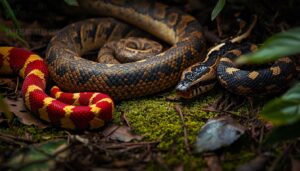
Patterns don’t stop at leaf mimicry — banding, blotches, and stripes each tell their own survival story. Disruptive Camouflage Bands break a snake’s outline against dappled forest light, while Vertebral Stripe Alignment draws the eye along the spine, creating motion illusions. Geographic Pattern Variation means island populations often show Island Stripe Divergence from mainland relatives. Seasonal Molt Effects can shift red, yellow, and black bands from vivid to muted.
| Pattern Type | Primary Function | Example Species |
|---|---|---|
| Red, yellow, black bands | Warning signal (aposematic) | Coral Snake |
| Diamond-shaped markings | Cryptic camouflage | Diamondback Rattlesnake |
| Vivid blue and red stripes | Batesian mimicry | Milk Snake morph |
Snake coloration and morph variations reflect predation pressure, habitat, and evolutionary history — making every pattern a window into how a species survives.
Every snake pattern is a window into predation pressure, habitat, and survival history written in scales
Strange Body Shapes and Adaptations
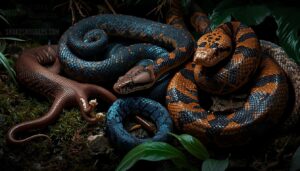
Snakes don’t just look unusual — some are built in ways that seem almost impossible. Evolution has handed certain species tools so strange you’d think they came from a different planet.
Here are some of the most jaw-dropping body adaptations you’ll find anywhere in the reptile world.
Elongated Snouts for Stealth
An elongated snout isn’t just a quirky feature — it’s a precision hunting tool.
Species like the Long-nosed Vine Snake (Ahaetulla prasina) and Malagasy Leaf-Nosed Snake use rostral scale texturing and camouflage shadow reduction to stay invisible during a stealthy approach.
Snout sensory pits detect subtle air shifts, while low-noise probing lets them test distance before striking — no wasted movement, no second chances.
Tentacles for Sensing Prey
If elongated snouts show how far evolution can push a hunting tool, tentacles take that idea even further.
The Tentacled Snake (Erpeton tentaculatum) carries mechanosensory tentacles on its snout — a highly specialized snake morphology built for aquatic ambush.
These mechanoreceptor arrays detect water disturbances instantly, feeding neural signal integration that sharpens strike timing precision.
Infrared sensitivity adds another layer, making this energy efficient hunting system remarkably effective.
Spider-like Tail Lures
When a snake turns its own tail into a fishing lure, you’re witnessing one of evolution’s most inventive tricks. Pseudocerastes urarachnoides, the spider-tailed horned viper, does exactly that. Its tail kinematics study-worthy movements mimic a live spider with shocking accuracy through spider mimicry details built into its anatomy.
Here’s what makes this predatory ambush tactic impressive:
- Tail Vibration Patterns — rapid trembling mimics a struggling spider, drawing birds close
- Prey Lure Dynamics — the bulbous, fringed tip repositions prey toward the strike zone
- Evolutionary Lure Adaptations — camouflage and mimicry combine, making the lure nearly indistinguishable from real arachnids
Loose Skin for Fish Capture
The elephant’s trunk snake pulls off something impressive with loose, baggy skin that acts like a soft net.
Skin elasticity mechanics let it flex around slippery fish without losing grip.
A thin layer of mucus friction along the surface keeps prey from slipping free.
Viscoelastic damping absorbs sudden thrashing, while microcurrent sensing helps it detect movement.
This prey grip adaptation is unusual reptile morphology at its finest.
Flattened Bodies for Gliding
When a flying snake — genus Chrysopelea — launches from a branch, its body transforms instantly. Rib expansion widens the midsection, wing-like skin unfolds, and lift morphology kicks in. The result is gliding locomotion in flying snakes that covers up to 100 meters per launch.
Here’s what makes gliding snake biomechanics so impressive:
- Flattened posture controls glide angle for a smooth descent
- Scale texture stabilizes airflow and reduces turbulence
- Rib expansion creates a lift-generating surface mid-flight
- Sinuous body movements adjust pitch and direction
- Adaptations for aerial descent allow precise landings on new perches
Habitats That Shape Their Look
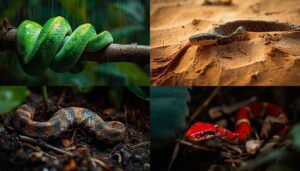
Where a snake lives shapes almost everything about how it looks. From rain-soaked canopies to bone-dry desert sands, each environment pushes these animals toward solutions you’d never expect.
Here’s a closer look at the habitats behind some of the most striking appearances in the snake world.
Rainforest Canopy Specialists
Rainforest canopies aren’t just treetops — they’re a layered world where arboreal snakes have evolved for vertical territory use across distinct light gradients.
In the rainforests of Southeast Asia, species like the Green Tree Python exploit light gradient adaptation and microclimate thermoregulation, moving between warm sun-exposed branches and cooler shaded zones. Banded Flying Snake takes this further, using gliding locomotion to cross canopy gaps efficiently.
Desert-dwelling Vipers
Desert horned vipers have mastered survival in the arid deserts of North Africa through impressive Horn Scale Morphology — those distinctive raised scales above each eye break up the outline against sand and rock. Nocturnal Activity keeps them safe from scorching heat, while Heat Detection pits locate prey in darkness.
Burrow Behavior shelters their Egg Clutch Size during reproduction.
Few venomous viper species in deserts match their desert survival strategies.
Island-endemic Snakes
Island endemics like the Barbados Threadsnake and Golden Lancehead show what happens when a species evolves in isolation. Genetic bottlenecks shrink diversity, microhabitat specialization tightens, and island dwarfism or reduced venom potency can follow.
Malagasy Leaf-Nosed Snake and Santa Catalina Island rattlesnake tell similar stories.
Conservation genetics now helps researchers understand how island endemism shapes — and threatens — these impressive animals.
Arboreal Vine and Tree Snakes
Tree snakes take island isolation a step further — spreading across entire rainforest canopies instead. The Long-nosed Vine Snake uses rectilinear locomotion to bridge gaps between stems, while its prehensile tail anchors it securely mid-reach.
Camouflage color variability shifts from shadowed understory greens to sunlit yellows.
Most are diurnal, depositing eggs in canopy crevices — a strategy that keeps clutches hidden and protected.
Aquatic Ambush Hunters
Some snakes traded the canopy for still water — and their bodies changed accordingly. Aquatic ambush hunters like the Tentacled Snake rely on water camouflage techniques and lateral body compression to minimize drag during strikes.
Thermal detection underwater guides them toward prey, while suction feeding mechanics seal the catch in milliseconds. Vegetation ambush strategies keep them hidden until the moment counts.
Forest-floor Camouflage Species
From still water to solid ground, the forest floor presents its own camouflage challenge.
Species with cryptic morphology rely on Microhabitat Texture Matching, aligning their scale patterns with decomposing leaves and bark.
Ground Shadow Alignment and Scale Gloss Wetness mimic damp soil textures, while Tail Posture Camouflage keeps them motionless.
Against Predator Motion Detection, stillness becomes their best defense in dense rainforests.
Rare Species and Conservation Issues
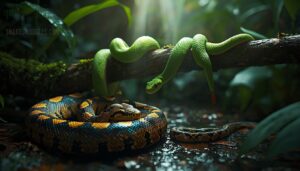
Some of the world’s most visually striking snakes are also the most vulnerable. Their unusual features often come paired with tiny ranges, specific habitats, and a long list of pressures working against them.
Here’s what you should know about the conservation challenges facing these rare species.
Endemic Snakes With Tiny Ranges
Some snakes don’t just live in small areas — they’re locked into them. The Barbados Threadsnake exists only on one Caribbean island, while the Malagasy Leaf-Nosed Snake clings to Madagascar’s dry forests. The Golden Lancehead never leaves Snake Island, Brazil.
Microhabitat Specialization, Island Population Isolation, and Limited Dispersal define these species:
- Altitudinal Segregation splits populations across elevation bands
- Conservation Genetics reveals dangerously low diversity
- Santa Catalina Island Rattlesnake occupies a single Mexican island
- Sri Lankan Pit Viper is confined to highland refuges
- Small range size amplifies every environmental threat
Habitat Loss and Fragmentation
When forests shrink, snakes suffer most. Edge Effects push heat and dryness deep into once-stable patches, disrupting the microclimate shifts that habitat specialists can’t tolerate.
Fragmentation Metrics reveal how quickly Genetic Isolation sets in, cutting off movement between populations.
Without thoughtful Corridor Design, rare snakes with unusual physical traits lose the connectivity they need to survive long-term.
Conservation Status of Unusual Snakes
Many unusual snakes face a tough reality: their conservation status reflects years of human impact on snake populations. Genetic Bottlenecks and Inbreeding Depression quietly erode resilience in already small groups, while Climate Change Impacts shift habitats faster than populations can adapt.
Protected Area Gaps leave critical microhabitats unguarded. Effective Population Monitoring remains essential for the conservation of unusual reptiles and tracking endangered species before losses become irreversible.
Threats From Collection and Trade
Every visually striking snake you’ve read about here faces pressure from illicit trade networks targeting rare morphs and endemic species. CITES loopholes let traffickers exploit permit forgery and mislabeling, while border inspection gaps miss shipments moving through online sales platforms.
Pet market profitability consistently outpaces conservation budgets, making human impact on snake populations a genuine crisis for reptile conservation worldwide.
Why Rare Snakes Matter for Biodiversity
Rare snakes aren’t just fascinating to look at — they’re doing quiet, essential work beneath the surface. Each species contributes to Ecosystem Regulation and Trophic Balance in ways you might not expect:
- They control rodent and insect populations
- They function as Bioindicator Species, signaling habitat health
- Their unique venom lineages serve as Genetic Reservoirs
- They support Habitat Engineering through burrows and foraging patterns
Losing them unravels more than you’d think.
Frequently Asked Questions (FAQs)
What is the most unique snake?
No single snake claims the title outright, but the spider-tailed horned viper comes remarkably close — its bizarre snake adaptation, a spider-like tail lure, ranks among the coolest looking snake species worldwide.
Can I upload a picture to identify a snake?
Yes, you can upload a picture for snake identification.
Use a clear, well-lit photo with good resolution, include your location, and always verify results with a herpetologist or local wildlife authority before acting.
What is the coolest looking snake in the world?
If looks could kill — some snakes nearly can. The Green Tree Python wins for sheer Evolutionary Aesthetics: vivid emerald scales, jewel-like posture, and a gaze that stops you cold.
What is the rarest snake to see?
The St. Lucia racer tops the list — fewer than 20 individuals survive today.
Population surveys using sophisticated detection techniques confirm it’s indeed the hardest snake on Earth to ever spot in the wild.
What snakes have best camouflage abilities?
Some of the best camouflage artists include the Gaboon viper, Green Tree Python, and Malagasy Leaf-Nosed Snake — each using background matching strategies and disruptive coloration techniques to vanish completely into their forest habitat.
How often do pet snakes shed skin?
Ever wonder why your snake seems to disappear into its own skin?
Most pet snakes shed every four to six weeks, though Growth Phase Timing, Humidity Management, and species all influence the cycle.
Can snakes see in complete darkness?
Snakes don’t truly see in complete darkness through their eyes alone.
Instead, pit organs detect infrared thermal sensing from warm prey, enabling multi-sensory hunting even when dark adaptation limits normal vision entirely.
What snakes are most active at night?
Have you ever wondered snakes truly own the night?
The Green Tree Python, Brazilian Rainbow Boa, Coral Snake, Spider‑Tailed Horned Viper, and Tentacled Snake all peak in nocturnal activity, relying on Thermal Sensing and Nighttime Stealth for Nocturnal Hunting.
Do snakes have a good memory?
Yes, snakes have surprisingly capable memories.
Through associative learning and spatial navigation, they recall prey locations and shelter routes for weeks. Sensory memory tied to scent drives much of their long-term recall.
How do unique snakes behave during mating season?
During mating season, unique snakes rely on Pheromone Signaling, Courtship Displays, and Mating Balls to find partners. Seasonal Triggers like warmth cue activity, while Sperm Storage allows flexible fertilization timing.
Conclusion
Since time immemorial, snakes have worn their evolution openly—etched into every scale pattern, tail lure, and leaf-shaped snout.
This unique-looking snake species guide has only scratched the surface of what millions of years can build.
Each species you’ve discovered here represents a living argument for why biodiversity deserves protection.
When you look at a viper differently now—not with fear, but with genuine curiosity—that shift in perspective is exactly where conservation begins.