This site is supported by our readers. We may earn a commission, at no cost to you, if you purchase through links.
Your ball python spends its days curled in a dark hide, and wild ones rarely see direct sun. So why do keepers argue so fiercely over reptile UV lamps for ball python enclosures?
Because the answer isn’t a simple yes or no. Many snakes get enough vitamin D3 from whole prey, yet UVB adds a safety margin against metabolic bone disease. The catch is that a bad lamp, a wrong distance, or a fixture that burns out in two months can cause more trouble than it solves.
Four popular options compete for your cart. Here’s how they perform, and how to use them safely.
Table Of Contents
- Key Takeaways
- Do Ball Pythons Need UVB Lamps?
- Top 4 UV Lamp Products Compared
- Choosing a Safe Ball Python UVB Lamp
- Setting Up Ball Python UVB Safely
- Measuring and Maintaining Ball Python UVB
- Frequently Asked Questions (FAQs)
- Do ball pythons need UVB lamps?
- Is 70 degrees too cold for a ball python at night?
- Are snakes attracted to UV light?
- What type of lamp does a ball python need?
- Do ball pythons need UVB?
- How do you light a ball python?
- Do ball pythons need light?
- Can ball pythons see ultraviolet light?
- How much UV does a ball python need?
- Can snakes get too much UVB?
- Conclusion
Key Takeaways
- You don’t strictly need UVB for a ball python, since whole prey usually covers its vitamin D3 needs, but a low-output lamp is cheap insurance against painful metabolic bone disease.
- Keep the basking spot at a modest UV index of about 0.5 to 1.0, confirm it with a UV meter, and always give your snake a shaded hide so it can choose how much light it gets.
- Don’t trust your eyes or the product reviews, because bulbs fade silently and all four lamps compared here have reports of early failure, so log your readings and replace bulbs every 6 to 12 months.
- Mount the fixture overhead and well out of reach, start with about four hours of UVB a day, and cut the output or raise the lamp if your snake hides more than usual.
Do Ball Pythons Need UVB Lamps?
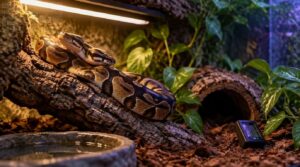
Why does the ball python UVB requirement spark so much debate? Because these snakes survive without it, and plenty of keepers prove that daily.
Even without UVB, keepers can support healthy ball pythons through thoughtful humidity, temperature gradients, and hiding spots, which these python terrarium design ideas cover well.
Ball pythons are crepuscular, hiding for most of the day, so they’re classed as Ferguson Zone 1: minimal natural UVB exposure. Many get enough vitamin D3 from whole prey. Still, UVB helps with vitamin D3 synthesis, and that gives you a safety margin.
Here’s the catch. Poor calcium metabolism can lead to metabolic bone disease, and it’s painful and hard to reverse. UVB isn’t mandatory, but it’s cheap insurance.
If you add it, follow UVB exposure guidelines for low-output Zone 1 setups, and always give your snake shade to retreat into. Don’t guess. Measure with a meter.
Top 4 UV Lamp Products Compared
Picking the right UVB lamp matters, because a bad one can leave your ball python with too little output or too much. Below, you’ll find four popular options, each with its own strengths and trade-offs. Read through them with your enclosure size, basking UVI target, and budget in mind.
1. REPTI ZOO T5 HO UVB Kit
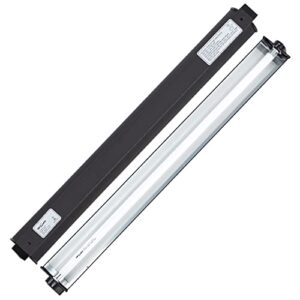
The REPTI ZOO T5 HO UVB Kit is a low-profile fixture built around a high-output tube and a highly polished curved reflector. It comes in 24W for 24" cabinets and 39W for 36" cabinets, and it includes the Rainforest 5.0 UVB T5 lamp.
You can mount it inside the vivarium or over mesh. The removable cord has an on/off switch.
Here’s the catch: bulb lifespan is often reported at two months or less, and some units simply won’t turn on.
| Best For | Reptile keepers with a 24" or 36" cabinet who want a low-profile UVB fixture they can mount inside the vivarium or over mesh, and who don’t mind replacing bulbs often. |
|---|---|
| Lamp Type | T5 linear fixture |
| UVB Output | Rainforest 5.0 UVB |
| Power Rating | 24W or 39W |
| Mounting Options | Inside vivarium or over mesh |
| Power Control | On/off switch on cord |
| Reliability | Short bulb life, mixed reliability |
| Additional Features |
|
- Low-profile design with a highly polished curved reflector for higher efficiency
- Includes the Rainforest 5.0 UVB T5 lamp, which supports calcium metabolism and uses UVA to stimulate appetite, activity, and reproductive behavior
- Mounts inside the vivarium or over mesh, and has a removable power cord with an on/off switch
- Bulb lifespan is often reported at two months or less
- Some units fail to turn on, so reliability is mixed
- Customer feedback on overall quality and durability is inconsistent
2. Hygger Zoo 5.0 13W UVB Bulb
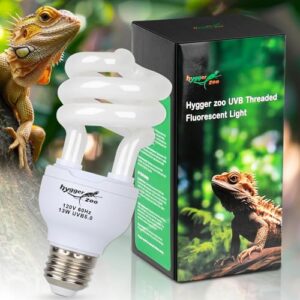
If a T5 fixture sounds like overkill, the Hygger Zoo 5.0 13W UVB Bulb offers a smaller option. It’s a compact screw-in UVB bulb with an E26 base, measuring 2.3" x 5.3", so it fits a shallow dome.
If your boa needs more coverage than a compact bulb offers, this guide to choosing the best UVB lights for boa constrictors explains which fixture sizes and strengths suit larger enclosures.
The specs list 5% UVB and 30% UVA, and the quartz glass promises stable output. Always verify your basking distance, since compact bulbs are low intensity.
Reliability is the weak spot. Owners report burnout after about a year, and some arrive dead.
| Best For | Reptile and amphibian owners with a shallow dome fixture who want a compact, budget-friendly screw-in UVB bulb for small rainforest species like chameleons, tree frogs, and iguanas. |
|---|---|
| Lamp Type | Compact dome bulb |
| UVB Output | 5% UVB |
| Power Rating | 13W |
| Mounting Options | Shallow dome fixture |
| Power Control | N/A |
| Reliability | Burns out around one year |
| Additional Features |
|
- Compact 2.3" x 5.3" size fits shallow domes where longer bulbs won’t
- Screw-in E26 base works with standard dome fixtures, so no special T5 setup is needed
- Quartz glass design and 5% UVB with 30% UVA output support vitamin D3 synthesis and calcium absorption
- Many owners report the bulb burns out after about a year
- Some units arrive dead and don’t work out of the box
- Compact bulbs are low intensity, so basking distance needs careful checking
3. Zoo Med Desert UVB Heat Kit
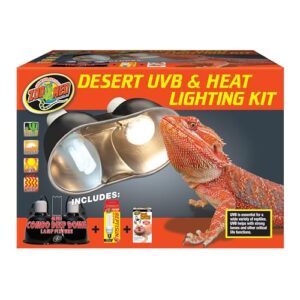
Want heat and UVB in one box? The Zoo Med Desert UVB Heat Kit bundles both into one dual-socket fixture.
It includes a 75w Repti Basking Spot Lamp, a 13w ReptiSun 10.0 Mini Compact Fluorescent UVB Lamp, and a metal Mini Combo Deep Dome. Each socket has its own switch, and grips up to 160 watts.
Here’s the catch. Some owners report UVB lamp failure within days, and the heat may fall short in larger enclosures. Stick to small setups.
| Best For | Owners of small terrariums with diurnal desert reptiles who want heat and UVB lighting in one ready-to-use kit. |
|---|---|
| Lamp Type | Compact fluorescent combo |
| UVB Output | ReptiSun 10.0 UVB |
| Power Rating | 13W UVB, 75W basking |
| Mounting Options | Deep dome fixture |
| Power Control | Dual on/off switches |
| Reliability | UVB failure in days or weeks |
| Additional Features |
|
- Comes with everything needed: a 75w basking spot lamp, a 13w ReptiSun 10.0 UVB lamp, and a dual-socket dome fixture.
- Separate on/off switches let you control each lamp on its own.
- Durable metal housing with ceramic sockets that support up to 160 watts each.
- Some users report the UVB lamp failing within days or weeks.
- Heat output may not be enough for larger enclosures.
- The fixture may be too small for certain bulb installations.
4. Reptispa T5 UVB Reptile Light Fixture
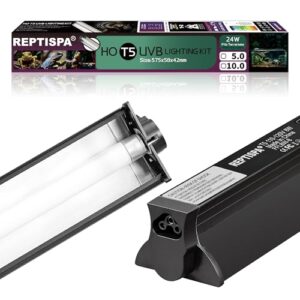
Although the Reptispa T5 fixture packs an integrated T5 HO ballast and a tube emitting 5% UVB and 30% UVA, it isn’t perfect. The alloy reflector pushes UVB downward, and the detachable cable with its on/off switch makes installation easy on a mesh top, tank lid, or wooden enclosure.
Watch the heat, though. Surfaces get hot, so keep your python at least 12 inches away and offer shaded retreats. Reviews also report bulbs failing within days or weeks. Monitor closely.
| Best For | Keepers of tropical reptiles and amphibians, such as chameleons, frogs, and aquatic turtles, who want an all-in-one UVB fixture with a built-in ballast and flexible mounting options. |
|---|---|
| Lamp Type | T5 HO integrated fixture |
| UVB Output | 5% UVB |
| Power Rating | N/A |
| Mounting Options | Mesh, tank lid, or wooden mount |
| Power Control | On/off switch on cable |
| Reliability | Failure in days or weeks reported |
| Additional Features |
|
- Integrated T5 HO ballast and a tube emitting 5% UVB and 30% UVA give steady, flicker-free light that supports vitamin D3 synthesis and calcium absorption
- Alloy reflector directs UVB downward and resists UV degradation
- Detachable cable with an on/off switch makes installation easy on a mesh top, tank lid, or wooden enclosure
- Surfaces get hot during use, so pets need to stay at least 12 inches away
- Bulbs may fail within days or weeks, according to some reviews
- Customer feedback is mixed on reliability and value for the price
Choosing a Safe Ball Python UVB Lamp
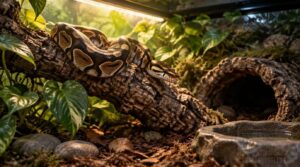
Picking a safe UVB lamp isn’t just about grabbing the brightest bulb on the shelf. Five steps below walk you through lamp type, basking UVI, placement, shaded retreats, and bulb replacement. Work through them in order, and you’ll build a setup your ball python can regulate on its own.
Compare UVB Lamp Types
Not every UVB lamp earns its place.
T5 HO linear bulbs deliver the strongest output per length, so they suit most setups. Compact 5.0 bulbs fit tight enclosures but push less UVB. Mercury vapor adds heat. LED stays cool but reaches short distances.
Expect UVB degradation, so use a UVB meter for UVB intensity measurement. Follow UVB exposure guidelines.
Check Basking UVI
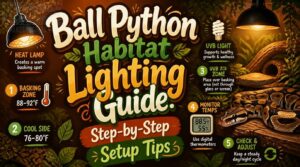
Think of UVI as a thermostat for sunlight: set it wrong and everything feels off. Your UVI target for a ball python’s basking spot sits between 0.5 and 1.0.
UVB intensity measurement needs a UV index meter.
- Take three meter readings and average them.
- Record distance and bulb age.
- Try UVB gradient mapping across the enclosure.
- Recheck after décor changes.
Plan Safe Placement
Picture a sunbeam slanting through a forest canopy, bright above and fading below. Copy that.
Good UVB fixture placement mounts the lamp overhead, away from substrate moisture, at the manufacturer’s distance. Check the UVB dropoff curve so UVB exposure levels stay safe where your python rests.
Let UVB intensity gradient design lead, and follow UVB safety guidelines. Measure twice, mount once.
Provide Shaded Retreats
Your ball python hates being watched under a spotlight.
Place a shaded retreat right beside the basking spot, so it can duck out of Ferguson Zone 1 without crossing the whole reptile enclosure.
Choose a washable hide with two entrances, and keep it on the cool end of the UVB gradient. Follow UVB safety guidelines: leave airflow around the walls.
Monitor And Replace Bulbs
Your lamp is fading, and you can’t see it. UVB degradation is silent, so trust a meter, not your eyes.
Your UVB lamp fades silently while still looking bright, so trust a meter, not your eyes
Plan UVB replacement around UVB bulb lifespan: 6-12 months for compact fluorescents, 9-12 for T5 HO.
- Check basking UVI weekly
- Log replacement dates and readings
- Keep spare bulbs on hand
Keep your UVB timer settings steady for UVB output consistency.
Setting Up Ball Python UVB Safely
Once you’ve picked your gear, the real work starts with the build. A smart UVB setup puts the light where your snake can choose it, not where it can’t escape it.
Mount the UVB fixture on the enclosure’s ceiling or inside the screen top, directly over the basking zone. Keep it clear of the heat source and out of reach, so your snake can’t touch the tube. Aim for a short, low-intensity window, then give the other half of the enclosure deep shade. A T5 HO screen-top UVB mount holds the tube at a steady height and angle, so the light stays focused over the basking spot.
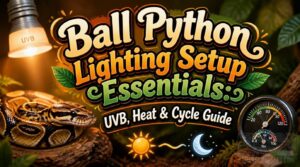
For UVB timer settings, start with four hours on, the rest off, and nudge toward six if your snake stays relaxed. UVB safety means watching behavior: if it hides, cut the UVB output or raise the fixture.
Measuring and Maintaining Ball Python UVB
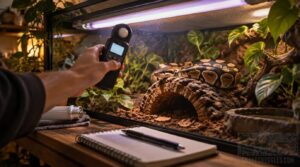
Your setup is built, but guessing won’t keep it safe. Grab a UVB meter and read the irradiance at basking height, through the same screen and with the bulb warmed up. Log the number the day you install it.
UVB intensity drops fast with distance, so even a small fixture shift changes your readings. Retest after any change to the cover, the mount, or the bulb.
Bulbs fade long before they go dark. Track UVB degradation hours and re-measure every few months, because UVB output can sag while the light still looks bright. Wipe dust off the lamp and screen.
Keep a simple log: bulb type, install date, readings, and your UVB exposure time. Trends tell you when to replace.
Frequently Asked Questions (FAQs)
Do ball pythons need UVB lamps?
Not strictly. The ball python UVB requirement is modest; diet can cover vitamin D3 synthesis gaps and prevent Metabolic Bone Disease (MBD).
Still, UVB for albino morphs helps. Plan UVB bulb replacement every 10-12 months.
Is 70 degrees too cold for a ball python at night?
Relax, 70°F won’t doom your snake. It’s the safe nighttime floor, and your reptile temperature gradient should cool while the UVB lamp stays off.
Below 70°F, add a ceramic heat emitter. Ceramic heat emitters are lightless, which makes them ideal for nighttime heating equipment that keeps your ball python warm without disrupting its day-night cycle. Basking spot stays warm.
Are snakes attracted to UV light?
Picture your ball python curled beside a glowing UVB lamp. It’s there for warmth, not light.
Snakes follow heat, so your basking spot draws them, not UVB exposure. That’s reptile behavior, regardless of reptile lighting.
What type of lamp does a ball python need?
Your ball python needs a heat lamp first. Aim it at one basking spot in your reptile terrarium, near 90°F. A low-intensity UVB lamp is optional, and any UVB fixture should keep UVB intensity gentle.
Do ball pythons need UVB?
Not always. These nocturnal snakes can get enough vitamin D3 from a solid diet, so a UVB lamp isn’t mandatory.
But shaky nutrition makes UVB exposure valuable for reptile health.
How do you light a ball python?
Your enclosure is a tiny sun.
Mount a UVB fixture with a low-output UVB bulb over one basking spot at 88 to 92°F. Keep UVB intensity gentle, add shade, and run a 12-hour UVB photoperiod.
Do ball pythons need light?
Yes, a 12:12 light cycle matters. Do ball pythons need light all night? No.
UVB lighting stays optional, though Ferguson Zone 2 output suits a ball python enclosure. Plan UVB bulb replacement every 10-12 months.
Can ball pythons see ultraviolet light?
Your python sees UV through frosted glass. Reptile vision here is weak, and the snake vision spectrum barely reaches UVB spectrum light.
Follow UVB safety tips and check the UV index before adding any lamp.
How much UV does a ball python need?
Very little. Keep the basking spot at 5 UVI or lower, confirmed with a UVB meter. Stay well below Ferguson Zone 2, and build a UVB gradient with shade. Vitamin D3 synthesis still happens safely.
Can snakes get too much UVB?
Too much UVB exposure burns your snake’s eyes and skin, and it can trigger vitamin D toxicity. Stay within UVB safe limits, watch for swollen eyes, and remember UVB output degradation changes your UVB lighting.
Conclusion
One keeper I know ran a cheap bulb for eight months before testing it with a meter. The reading? Nearly zero.
That’s the lesson. The best reptile uv lamps for ball python owners aren’t the priciest ones, they’re the ones you place correctly, measure honestly, and replace on schedule. Keep shaded retreats available, aim for a modest basking UVI, and let your snake choose. Treat the lamp as insurance, not a substitute for good husbandry.