This site is supported by our readers. We may earn a commission, at no cost to you, if you purchase through links.

Most people assume a snake either tolerates you or it doesn’t—that personality is fixed, binary, almost reptilian in the coldest sense of the word. Ball pythons prove that wrong within the first few weeks of ownership.
A young ball python’s personality sits somewhere on a spectrum, shaped by genetics, handling history, and the environment you build around it.
Some juveniles emerge bold and curious, exploring your hands within minutes. Others need weeks of patient, consistent interaction before they stop treating you like a threat.
Understanding where your snake falls on that spectrum, and what drives its behavior, changes everything about how you care for it.
Table Of Contents
Key Takeaways
- ball python’s personality isn’t fixed—genetics, handling history, and enclosure conditions all shape whether your snake leans bold or shy.
- Learning to read body language, like tight coiling, hissing, or relaxed exploration, tells you exactly how your snake feels before stress becomes a problem.
- Short, consistent handling sessions two to three times a week build trust gradually, and rushing that process is one of the fastest ways to set it back.
- well-designed enclosure with stable temperatures, proper humidity, multiple hides, and enrichment does as much for your snake’s confidence as any amount of hands-on time.
What is The Personality of a Young Ball Python?
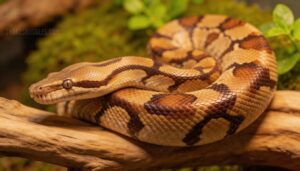
Young ball pythons have a lot more going on beneath the surface than most first-time owners expect.
Their calm temperament and manageable size make them one of the easiest snake species to raise and breed, even if their care needs can surprise new owners at first.
Their personalities aren’t one-size-fits-all — some are bold and curious right away, while others take weeks to warm up.
Here’s a closer look at the key traits that define a juvenile ball python‘s character.
Naturally Docile and Non-Aggressive Temperament
Ball pythons are almost always the gentlest snake you’ll find in captivity. Their instinct, when startled, isn’t to strike — it’s to curl up and wait it out. That docile and calm nature is what makes them so approachable.
Support their ball python temperament with:
- Gentle voice tones near the enclosure
- Sudden movements during interaction
- Predictable daily routine they can rely on
Solitary and Independent Nature
Unlike some pets, your ball python genuinely prefers its own company. Its solitary nature isn’t shyness — it’s simply how they’re wired.
In the wild, microhabitat selection means finding one secure spot and staying put.
Captive juveniles mirror this, establishing territory boundaries within a small zone, relying on stress-free hiding and independent feeding preferences to self-soothe without any social interaction needed.
| Behavior | What It Signals | Your Response |
|---|---|---|
| Retreating to hide | Stress-free hiding instinct | Leave undisturbed |
| Single-zone activity | Microhabitat selection | Maintain consistent layout |
| Feeding alone quietly | Independent feeding preferences | Minimize nearby movement |
Individual Personality Ranges From Shy to Curious
Every juvenile has its own ball python temperament, and you’ll notice it quickly. One snake may show bold Feeding Boldness, tracking prey across the enclosure with steady Tongue Flick Frequency.
Another stays tucked away, relying heavily on Hide Utilization. Exploration Preference and Acclimation Speed vary too — some juveniles map their space within days, while shyer ones need weeks to show their true personality differences among individual ball pythons.
Maintaining a proper temperature gradient helps reduce stress and promotes consistent behavior.
Nocturnal Activity Patterns in Juveniles
juvenile’s personality doesn’t clock out when you do. Nocturnal activity peaks after midnight, driven by Thermal Gradient Shifts and Nighttime Foraging Bursts that reveal real behavioral cues you won’t catch at noon.
Watch for:
- Crepuscular Exploration just after dusk
- Midnight Movement Peaks near cooler hides
- Brief pauses from Noise Disruption Effects
Temperature gradient stability keeps this natural ball python temperament rhythm consistent.
How Genetics and Morphs Influence Temperament
Genetics quietly runs the show before you even pick up your snake. Cortisol gene variants and heritable aggression levels shape whether your hatchling leans calm or reactive from day one.
Those inherited temperament traits also influence how much your python explores vertically, as explained in this guide to ball python climbing behavior and enrichment.
Morph visual sensitivity and pattern-driven activity also play real roles — selective breeding temperament outcomes vary by lineage.
That’s why morph genetics and ball python morph selection and breeding matter more than most new keepers expect.
Common Behavioral Signs in Baby Ball Pythons
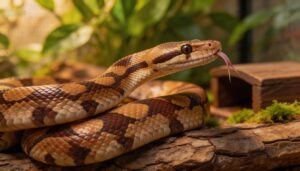
Baby ball pythons communicate a lot through their body language, and learning to read those signals makes a real difference in how you care for them. Some behaviors are easy to misread, especially if you’re new to keeping snakes.
Here are the most common behavioral signs you’ll notice in a young ball python and what they’re actually telling you.
Defensive Ball Coiling and What It Means
When a young ball python curls into a tight sphere, that’s not attitude — it’s a distress signal.
The coil tightness scale matters here: a fully locked ball with the head buried at the center means high stress, while a looser curl with the head partly visible suggests lower anxiety.
Head position significance can’t be overstated.
Balling triggers include sudden movement, overhead grabs, or unfamiliar surroundings.
Hissing, S-Posturing, and Other Stress Signals
When your ball python hisses, that’s one of the clearest vocalization triggers you’ll encounter — a sharp, rasping exhale that says "back off."
Watch for neck posture indicators too: that S-shaped curve, head raised, signal defensive posture and real discomfort.
These body language cues, paired with environmental stressors like bright lights or rough handling, tell you everything.
Recognizing snake stress signals early makes handling response strategies far more effective.
Signs of a Calm and Content Juvenile
A calm juvenile doesn’t need to announce itself — it simply moves through its enclosure like it belongs there.
Look for these reassuring signs:
- Relaxed coil in a hide, with steady breathing and flat, smooth scales
- Curious tongue flick when exploring, not a defensive strike
- Calm exploration of enrichment items at an easy, unhurried pace
- Consistent feeding with confident, precise strikes and quiet post-meal rest
How Shedding and Feeding Cycles Affect Behavior
Two natural cycles quietly shape how your juvenile acts day to day: shedding and feeding. Pre-shed appetite drops are normal — cloudy eyes signal the body is focused elsewhere. Post-feeding calm follows a good meal, with your snake retreating contentedly.
Molting humidity effects are real too; low humidity worsens shedding stress signals.
Once both cycles settle, your ball python’s true temperament returns.
Differences Between Fear Response and True Aggression
Fear and aggression aren’t the same thing, even when they look similar. Knowing the difference helps you respond correctly instead of pulling back at the wrong moment.
- Body Posture Cues: Fear tucks the head inward; aggression keeps the body open and ready
- Vocalization Patterns: Hissing signals stress, not a desire to attack
- Threat Proximity: Defensive posture fades once distance increases; true aggression holds ground
- Recovery Behavior: A snake that calms after retreat shows stress indicators, not sustained aggression
Recognizing these indicators of stress and aggression in ball pythons lowers your escalation threshold and builds real confidence.
What Shapes a Young Ball Python’s Temperament?

A young ball python’s personality isn’t random—it’s shaped by several real, identifiable factors you can actually influence. Some of these go back to genetics and early life history, while others come down to the daily conditions you provide.
Here’s what plays the biggest role in shaping how your juvenile ball python turns out.
Role of Genetics and Captive-Bred Vs. Wild-Caught
Where ball python comes from shapes more than just its looks — it shapes how it acts around you. Captive-bred juveniles tend to be noticeably calmer, largely because breeders have been selecting for docility across generations. That intentional breeding for docility and temperament traits shifts allele frequencies toward more tractable behavior, though it can also reduce genetic diversity over time.
Captive-bred ball pythons are calmer by design — generations of selective breeding have made docility part of their DNA
Wild-caught individuals carry broader genetic variation, but they arrive with stronger defensive instincts built from surviving real predators. wariness doesn’t disappear overnight.
| Factor | Captive-Bred | Wild-Caught |
|---|---|---|
| Baseline temperament | Calmer, more handleable | More reactive, defensive |
| Genetic diversity | Lower; allele frequency shifts common | Higher heterozygosity |
| Inbreeding risk | Higher without managed founder line representation | Minimal |
| Settling period | 1–2 weeks usually | Several weeks or longer |
| Long-term docility | More predictable | Improves slowly with consistency |
Ball python morph selection and breeding also matter more than many owners realize. genetic lines carry temperament tendencies alongside their color traits. Wild gene introgression — introducing wild-origin genetics into captive programs — can restore both fitness and behavioral range. founder line representation accelerates inbreeding depression, affecting not just health but personality differences among individual ball pythons too.
Early Socialization and Handling History
Genetics sets the starting point, but how you handle your juvenile from day one shapes where it ends up.
The Initial Handling Window matters — wait until your snake is eating and shedding consistently before you start.
From there, a Gradual Touch Increase builds confidence without overwhelming.
Stress Signal Monitoring keeps sessions productive, and a Consistent Routine creates Positive Human Association that quietly rewires your ball python’s response to you over time.
How Enclosure Conditions Impact Personality
Your setup does more for your ball python’s personality than you might expect.
Microclimate variation, ventilation quality, and noise levels all quietly shape how your juvenile feels day to day. Poor enclosure design creates a low-trust habitat fast.
Three enclosure factors that shift behavior:
- Temperature and humidity management for reptiles stabilizes mood
- Visual barriers reduce stress
- Enclosure size facilitates confident exploration
A low-stress habitat builds a calmer snake.
Health Status and Its Effect on Behavior
Your python’s mood often mirrors its health. Respiratory distress, parasite irritation, or poor body condition can flip a calm juvenile into a defensive, hissing ball overnight.
Dehydration impacts feeding behavior and appetite, while shedding difficulties and respiratory infections quietly raise stress indicators in snakes.
Health monitoring and disease prevention aren’t optional — they’re how you protect the personality you’ve been building.
Temperament Changes as Juveniles Mature Into Adults
Most juveniles start out jumpy, but behavioral maturation usually smooths those rough edges over time.
Regular, calm handling drives confidence development, and stress reduction follows naturally as your snake learns the routine isn’t a threat.
Activity shifts toward steadier exploration, feeding response evolution becomes more predictable, and those wild defensive bursts grow slower and more measured.
Ball python temperament really does improve with consistent, patient care.
How to Build Trust With Your Ball Python
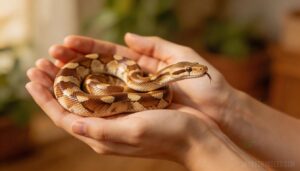
Building trust with a young ball python isn’t complicated, but it does take patience and consistency. Every snake is different, so knowing the right approach makes all the difference.
Here’s what actually works for handling your juvenile safely and building real confidence over time.
Approaching and Picking Up a Juvenile Safely
The way you approach your juvenile matters more than most keepers realize. Slow Approach Timing is everything — move deliberately, dim the lights slightly, and let the snake register your presence before contact.
Use Gentle Hand Placement under the mid-body, never grabbing near the head.
A Towel Barrier Technique adds security for defensive individuals.
Practice Escape Prevention by staying low, and always watch for Stress Signal Monitoring cues like tight coiling or hissing.
Ideal Handling Session Length and Frequency
Keep short handling sessions under 10 minutes, especially as a beginner. Handling frequency works best at two to three times per week, giving your juvenile a solid recovery period between sessions.
Temperature stability matters here — prolonged exposure to cool room air can trigger stress indicators fast. Consistent, brief contact builds a gentle temperament over time, making trust building feels natural rather than forced.
Progressive Desensitization for Shy Snakes
juvenile ball pythons need a slower road to trust — and that’s completely fine. Threshold Training and the Approach Retreat Cycle let you work at your snake’s pace, moving close, watching for stress, then backing off before fear sets in.
Choice-Based Touch and Least Intrusive Care keep interactions voluntary. Gradual Intrusion Practice builds comfort with necessary handling over time, turning a low-stress habitat into a genuine foundation for confidence.
Common Handling Mistakes That Set Back Trust
Even small mistakes can unravel weeks of progress. Sudden grabs and chasing around the enclosure trigger instant fear responses that undo patience you’ve built carefully.
Post-feeding handling risks regurgitation and refusal at the next meal. Temperature swings, strong odors, and overhandling compound stress quietly.
Learn the proper handling techniques for ball pythons, watch for stress indicators in snakes, and respect the boundaries your snake clearly signals.
Setting Up an Enclosure That Supports Healthy Personality
Your ball python’s personality doesn’t develop in a vacuum — the enclosure you build plays a bigger role than most new keepers expect. Getting the setup right means addressing a few key factors that directly shape how comfortable and confident your snake feels day-to-day.
Here’s what to focus on.
Temperature Gradient and Humidity Requirements
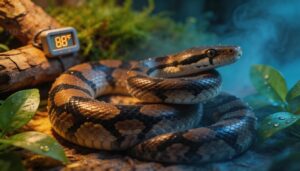
Temperature is the backbone of a low-stress habitat. Get it wrong, and your snake’s Ball Python temperament and personality traits shift fast—eating stops, hiding increases, and trust erodes.
- Warm Side Range: Keep it 31–33°C for digestion and activity
- Cool Side Range: Maintain 25–27°C so your snake can self-regulate
- Nighttime Temperature Drop: A gentle 1–3°C dip is fine with a thermostat
Humidity Stability matters just as much. Aim for 55–70% daily, bumping Shedding Humidity to 65–80% when a shed cycle begins. Temperature gradients and humidity control working together create the calm, predictable environment your juvenile needs to thrive.
Importance of Multiple Secure Hides

Beyond temperature and humidity, hides quietly do the heavy lifting for stress reduction strategies for pet snakes.
Two secure hides—one warm, one cool—give your juvenile real Temperature Flexibility and Microclimate Choice without forced exposure.
That is Feeding Privacy, Pathogen Control through rotation cleaning, and genuine Stress Mitigation rolled into one simple upgrade.
Multiple hiding places are a cornerstone of any low-stress habitat built around solitary housing requirements for ball pythons.
Substrate Choices for Comfort and Exploration
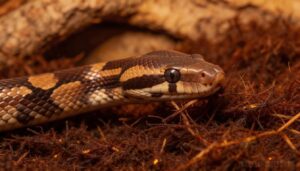
What’s underfoot matters more than you’d think. Substrate selection directly affects how comfortable and curious your juvenile feels day-to-day.
- Moisture Retaining Substrates like cypress mulch or coconut fiber keep humidity stable between 50–60%
- Texture Variety facilitates exploring and curiosity through natural tactile engagement
- Burrow Depth of 2–3 inches mimics wild hiding places without trapping hatchlings
- Cleanliness Maintenance through regular spot-cleaning protects substrate hygiene and calm behavior
- Enrichment Compatibility pairs loose substrate with cork hides for real behavioral enrichment
Enrichment Items That Encourage Natural Behavior
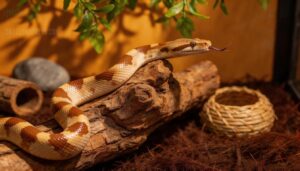
Good substrate gives your juvenile a foundation, but enrichment is what keeps that curious mind engaged.
Puzzle feeders, scent enrichment, and tactile objects add meaningful variety without overwhelming a shy snake.
| Enrichment Type | Natural Behavior Triggered |
|---|---|
| Puzzle Feeders | Foraging and strike response |
| Scent Enrichment | Exploration and tongue-flicking |
| Tactile Objects | Climbing and body investigation |
| Rotating Challenges | Sustained curiosity over time |
Difficulty scaling keeps things fresh.
How Lighting Cycles Influence Activity and Mood

Lighting does more for your juvenile than you might expect. A steady circadian rhythm, built around roughly 12 hours of daylight duration and 12 hours of nighttime darkness, keeps your snake’s internal clock grounded. Consistent light cycles directly support calmer behavior and more predictable evening activity.
Keep these in mind:
- True darkness matters — skip the colored night bulbs
- Light intensity should stay moderate, never harsh
- Seasonal light shifts can mirror natural conditions gently
Frequently Asked Questions (FAQs)
What is the temperament of a baby ball python?
Baby ball pythons carry a naturally docile, calm temperament beneath their cautious exterior. They’re shy first, curious later, and rarely aggressive unless mishandled or stressed.
What is the friendliest snake for beginners?
Ball pythons top the list for beginners. They’re docile, calm, and show low aggression even when nervous.
Their temperament consistency, easy feeding habits, and gentle bite make them a naturally beginner-friendly, low maintenance pet snake.
Can two young ball pythons share an enclosure?
No, two young ball pythons shouldn’t share an enclosure. Resource competition, illness transmission, and aggression risk make cohabitation stressful for both animals. Separate setups are always the safer, healthier choice.
How long do juvenile ball pythons typically live?
With proper care, juvenile ball pythons usually live 15 to 30 years in captivity. Lifespan Expectations depend heavily on Environmental Stability, Feeding Frequency, and consistent Health Maintenance from the very start.
When should a juvenile see a reptile vet?
An ounce of prevention is worth a pound of cure.
Schedule vet visits within two weeks of bringing your juvenile home, then maintain routine annual exams to catch feeding refusal, weight loss alerts, shedding complications, or respiratory distress early.
How do ball pythons communicate with their owners?
They don’t use words, but they say plenty.
Through tongue-flicking, body posture, and Jacobson Organ Sensing, your ball python tells you exactly how it feels — if you know what to look for.
Conclusion
Regarding young ball python personality, patience and understanding go a long way. As the saying goes, you can’t rush a good thing.
By recognizing your snake’s unique traits and responding with gentle, consistent care, you’ll build a strong bond.
A well-adjusted young ball python’s personality will shine through, revealing a curious and affectionate companion.
Trust, after all, is a two-way street—yours and your snake’s—nurtured daily through positive interactions and a supportive environment, always.