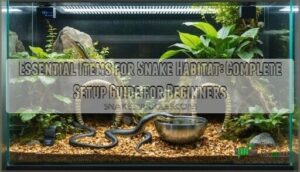
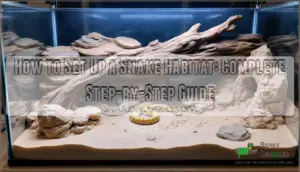
This site is supported by our readers. We may earn a commission, at no cost to you, if you purchase through links.

A snake that escapes isn’t being sneaky—it’s telling you something about its home. Most new keepers focus on finding the right snake but underestimate how much the enclosure shapes the animal’s health, behavior, and lifespan. Get the setup wrong, and you’ll deal with stress, illness, and escape attempts before the first month ends.
The good news: building a proper habitat isn’t complicated once you know what actually matters. This checklist breaks down everything your snake needs, from enclosure size and heat gradients to substrate, hides, and lighting.
Table Of Contents
- Key Takeaways
- Snakes Need a Secure, Sized Enclosure
- Choose an Enclosure at Least as Long as The Snake’s Adult Length
- Provide Extra Floor Space for Active or Larger Species
- Use Lockable Lids, Clips, or Bolts to Prevent Escapes
- Check for Gaps Around Lids, Vents, Wires, and Decorations
- Select Glass, PVC, Plastic, or Screen Cages Based on Heat and Humidity Needs
- Ensure Proper Ventilation With Vents or Mesh Panels
- Snakes Need Proper Heat Gradients
- Snakes Need Humidity and Clean Water
- Match Humidity Levels to Desert, Arid, or Tropical Species
- Use a Hygrometer to Monitor Enclosure Humidity
- Provide a Heavy Water Bowl Large Enough for Soaking
- Change Water Daily and Clean Bowls Regularly
- Add Misting, Damp Moss, or Humid Hides for Shedding Support
- Reduce Excess Moisture With Ventilation or Drier Substrate
- Snakes Need Safe Substrate
- Snakes Need Hides, Enrichment, and Lighting
- Frequently Asked Questions (FAQs)
- Conclusion
Key Takeaways
- Enclosure size, security, and material type directly shape your snake’s health, so match the length to your snake’s adult size and lock every lid before bringing one home.
- Snakes can’t regulate their own body temperature, so you need a warm side (28–32°C) and cool side (22–26°C), each monitored by its own digital thermometer and controlled by a thermostat.
- Humidity is a tightrope — too dry causes bad sheds, too wet causes rot — so match levels to your snake’s native climate and provide a damp moss hide for shedding support.
- Cedar and pine shavings are toxic to snakes; stick to aspen, coconut fiber, or cypress mulch, and replace substrate regularly to prevent bacteria and mold.
Snakes Need a Secure, Sized Enclosure
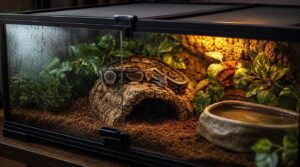
Getting the enclosure right is the first thing you need to nail before bringing a snake home. Size, security, and materials all matter more than most people expect.
If you’re starting with a Children’s Python, this beginner’s guide to Children’s Python care walks you through exactly what a proper setup looks like.
Here’s what to look for when choosing the right setup.
Choose an Enclosure at Least as Long as The Snake’s Adult Length
Size matters more than you think. Regarding enclosure size and selection, the minimum stretch guideline is simple: match the enclosure length to your snake’s adult length measurement — nose to tail tip, fully stretched.
- Linear space planning starts with adult size, not current size
- Future growth allowance prevents costly upgrades later
- A 4-foot snake needs a 4-foot minimum enclosure length
- Length width ratio improves thermoregulation and comfort
Ensuring a secure latch mechanism prevents escapes and keeps the enclosure safe.
Provide Extra Floor Space for Active or Larger Species
Floor area matters just as much as length. Active species like Burmese pythons require wide corridors and multiple pathways to move naturally. Prioritizing spacious enclosures supports their natural behaviors and overall well-being.
A key guideline for adequate space is to allow 1.5 times the snake’s length in floor space. Modular panels help as your snake grows, enabling easy adjustments to accommodate increasing size requirements.
| Snake Size | Minimum Floor Area |
|---|---|
| Small | 2 × 1 ft |
| Medium | 4 × 2 ft |
| Large | 6 × 3 ft |
Use Lockable Lids, Clips, or Bolts to Prevent Escapes
Once your enclosure size is sorted, locking it down is next. A secure lid isn’t optional — snakes are escape artists. Use UV-resistant clips spaced evenly around the rim, or bolt systems with adjustable bolt tension for a snug, warp-free seal.
Gasket sealing adds an extra layer. Always perform a pre-handling inspection, and listen for the satisfying click of latch redundancy confirming everything is locked tight.
Check for Gaps Around Lids, Vents, Wires, and Decorations
Even with a secure lid locked tight, tiny gaps can undo all that work. Think of gap inspection as your weekly safety sweep.
Check lid seal integrity around the full perimeter—nothing larger than 2 millimeters. Confirm vent alignment checks are done, ensure wire routing safety is solid with grommets, and verify décor attachment security holds firm.
This gap inspection routine keeps your escape-proof setup truly escape-proof.
Select Glass, PVC, Plastic, or Screen Cages Based on Heat and Humidity Needs
Your enclosure type shapes everything about heat and humidity control. Hybrid material combos let you customize both.
- Glass humidity retention in glass terrariums holds moisture well — ideal for tropical species
- PVC heat insulation cuts heating costs by up to 40 percent
- Plastic airtight design in plastic vivariums stabilizes nighttime humidity
- Screen airflow balance suits desert snakes needing dry conditions
Ensure Proper Ventilation With Vents or Mesh Panels
Good ventilation is essential for keeping your snake healthy and stress-free. Implement Cross Vent Placement by positioning mesh panels on opposite walls, ensuring even airflow. This setup actively pushes fresh air through the enclosure.
Aim for a Vent Surface Ratio of 4 to 10 percent of the total enclosure surface area. Use Stainless Steel Mesh to resist rust in humid environments, maintaining durability and safety.
Install Adjustable Vent Latches for convenient access during maintenance. Prioritize Smart Humidity Vent Balance to ensure your snake breathes comfortably without excessive dryness.
Snakes Need Proper Heat Gradients
Snakes can’t regulate their own body temperature — they rely entirely on you to set things up right. Getting the heat gradient wrong is one of the most common mistakes new keepers make.
A proper heat gradient depends on more than just your thermostat — ball python ventilation and airflow setup explains how vent placement keeps temperatures stable across the whole enclosure.
Here’s exactly what you need to have in place: proper heating equipment and a well-designed enclosure to maintain the necessary temperature variations.
Create a Warm Side and a Cool Side
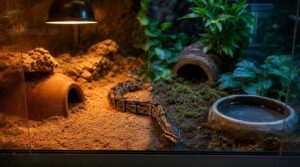
Think of your enclosure like a tiny climate map. Your snake needs a warm side reaching 28–32°C and a cool side maintained at 22–26°C. This temperature gradient allows your snake to regulate its own temperature, moving between zones as needed.
Maintain a zone size ratio of roughly 20% warm to 80% cool, and ensure non-slip flooring throughout for safe movement.
Use Heat Mats, Basking Bulbs, or Ceramic Heat Emitters
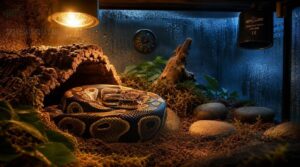
You’ve got three solid options for heating your snake’s home. Heat mats warm the belly from below—match size to your enclosure for proper Mat Wattage Selection. Basking bulbs should follow Bulb Positioning Guidelines: mount them above the warm side, not the center. For nighttime, CHE Night Heating maintains warmth without disrupting sleep.
Always prioritize safety with Guarded Fixtures to prevent accidents. Consider implementing Power Backup Systems to ensure continuous heating during outages.
Connect Every Heat Source to a Thermostat
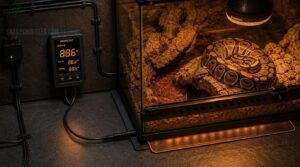
A thermostat is your snake’s safety net — without one, heat sources can spike to dangerous levels fast. Wire your under tank heaters and ceramic heat emitters in parallel so each runs independently. This ensures stable temperature control and prevents overheating risks.
Always check Thermostat Compatibility before buying. Run a quick Load Calculation to avoid Overload Protection trips, ensuring your electrical system handles the demand safely.
Safety Grounding keeps the whole setup shock-free and reliable, protecting both your reptile and equipment from electrical hazards.
Place Digital Thermometers on Both Enclosure Ends
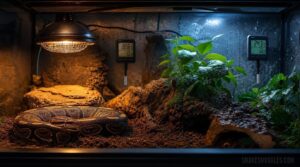
One thermometer isn’t enough — you need two. Place one probe on the warm end and one on the cool end to confirm your temperature gradient is real.
Smart probe positioning means mounting both at your snake’s typical hang-out height, away from direct heat sources. Good cable management prevents crushing.
Stick to consistent placement for reliable temperature monitoring — your calibration routine depends on it.
Adjust Temperatures for Species-specific Needs

Every snake has its own thermal sweet spot. Corn snakes require a basking spot around 86°F, while desert species reach up to 93°F. Knowing your species’ thermal windows helps you dial in the right thermostat set points.
A ball python and a sand boa aren’t roommates for a reason — their temperature gradients are genuinely different worlds.
Allow Safe Nighttime Temperature Drops When Appropriate
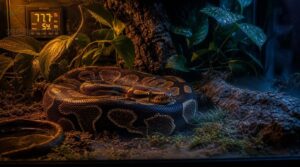
Just like daytime, nighttime calls for a plan. A gradual cooling schedule — dropping 2 to 4 degrees Celsius over several hours — keeps stress low. Thermostat programming manages this automatically, eliminating guesswork.
Maintain your temperature gradient intact and closely monitor the cool side. Watch for behavioral cues like reduced activity, which indicate proper acclimation.
Always have a backup heat source ready for emergencies.
Do not forget nighttime humidity balance, as cooler air dries out quickly.
Snakes Need Humidity and Clean Water

Getting humidity right is one of those things that really separates a thriving snake from a stressed one. Too dry, and your snake struggles to shed; too wet, and you’re looking at scale rot and respiratory issues.
Humidity is a fine line: too dry and your snake can’t shed, too wet and it rots
Here’s what you need to keep moisture levels and water access dialed in.
Match Humidity Levels to Desert, Arid, or Tropical Species
Getting humidity right comes down to knowing your snake’s origins. Desert species like sand boas thrive with relative humidity around 20–40%, while tropical snakes need 60–80%.
Think of it as Microclimate Zones — dry basking spots, slightly damper hides.
Seasonal Humidity Adjustments also shift seasonally, so factor in these changes during winter when indoor heating dries everything out.
Use a Hygrometer to Monitor Enclosure Humidity
Once you’ve nailed your target humidity range, you need to actually measure it. That’s where a hygrometer comes in — think of it as your snake’s personal weather station.
- Probe Placement: Mount the sensor mid-wall, away from heat sources
- Digital vs Analog: Digital wins for real-time accuracy
- Calibration Routine: Check monthly against a salt solution
- Data Logging: Some models track humidity trends over time
- Ventilation Integration: High readings? Open vents gradually
Reliable humidity monitoring keeps guesswork out of your care routine.
Provide a Heavy Water Bowl Large Enough for Soaking
Your snake’s water bowl does more than quench thirst — it facilitates soaking, shedding, and humidity.
For capacity requirements, choose a bowl holding 1.5 to 2.5 liters, roughly 8 to 12 inches wide.
Material safety matters too: ceramic or stainless steel won’t leach chemicals.
An anti-tip design prevents spills.
For ideal placement, set it on the warm side where water provision and sanitation remain consistent.
Change Water Daily and Clean Bowls Regularly
Fresh water every day is the simplest rule for keeping your snake healthy. Daily water rotation prevents bacteria from turning the bowl into a Petri dish, and choosing ceramic or steel bowls simplifies sanitization.
- Swap in dechlorinated water daily for clean water your snake will actually drink.
- Spot-cleaning debris keeps waterborne pathogen detection simple — cloudiness or slime means it’s time to change it now.
- Follow disinfection protocols weekly using a pet-safe cleaner, rinse thoroughly, then dry completely.
Water sanitation isn’t optional — water quality directly affects your snake’s health.
Add Misting, Damp Moss, or Humid Hides for Shedding Support
Shedding is stressful for your snake when the air’s too dry. A humid hide — packed with damp sphagnum moss — gives them a moisture retreat they can choose on their own terms.
Place it on the warm side for best results.
Watch for Shedding Support Indicators like dull eyes or stuck skin.
Refresh your Moss Replacement Schedule every few weeks to prevent mold.
Reduce Excess Moisture With Ventilation or Drier Substrate
Too much moisture is just as harmful as too little.
Improve cross vent placement by positioning intake vents low and exhaust vents high — that steady upward airflow manages humidity control naturally.
For substrate thickness control, go thinner with paper substrate choice; paper dries fast and won’t trap dampness.
Heat assisted drying from your warm side pulls moisture up and out, keeping your enclosure fresh.
Snakes Need Safe Substrate
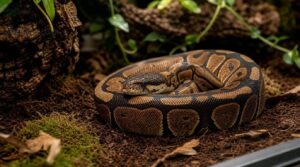
The substrate you pick matters more than most people think. It affects your snake’s health, moisture levels, and even stress.
Here’s what’s safe to use — and what to watch out for.
Choose Aspen, Coconut Fiber, Cypress Mulch, Paper Towels, or Newspaper
Aspen shavings offer solid moisture retention and great substrate lifespan — easy spot-cleaning makes them ideal for cleaning convenience.
Coconut fiber excels at burrowing support for diggers.
Cypress mulch resists mold naturally.
Paper towels win on cost efficiency and cleaning convenience, especially for quarantine setups.
Newspaper works short-term too, though it should be swapped out frequently.
Avoid Cedar and Pine Shavings
Cedar shavings and pine shavings are not suitable for snake enclosures. Both release VOC emissions that cause respiratory irritation and can even trigger liver enzyme impact over time.
These bedding materials essentially poison the air your snake breathes, posing serious long-term health risks. Bedding sourcing standards matter to avoid such hazards.
Stick to safer alternatives like aspen shavings or cypress mulch for a healthy substrate choice and proper enclosure maintenance.
Use Deeper Substrate for Burrowing Snake Species
Burrowing snakes need more than just a safe substrate choice and maintenance routine — they need depth. Imagine building tunnel architecture underground: smaller burrowers require 4–6 inches, while larger species need up to 12.
Cypress mulch and coconut fiber excel at substrate stability and moisture retention, creating a natural burrow microclimate. Match depth to your snake’s species-specific habitat requirements.
Spot-clean Waste Every Few Days
Once your burrowing depth is sorted, keeping that substrate fresh is next. Spot-cleaning waste every few days is your first line of defense for odor management and substrate hygiene.
Here’s a simple cleaning protocol that works:
- Put on disposable gloves before handling anything
- Use tongs or a small scoop as your main cleaning tools
- Remove waste plus any visibly soiled substrate around it
- Seal everything in a dedicated trash bag for proper waste disposal
- Mist stubborn spots lightly to lift stuck residue
Stick to a "check daily, clean as needed" spot-check timing routine.
Replace Substrate Regularly to Prevent Bacteria and Odor
Spot-cleaning buys you time, but it can’t do everything. A full substrate replacement is what truly resets your enclosure’s bacterial prevention and odor control game.
| Substrate Type | Replacement Schedule |
|---|---|
| Paper towels | Every 1–2 weeks |
| Aspen shavings | Every 2 months |
| Coconut fiber | Every 1–2 months |
| Cypress mulch | Every 2–3 months |
| Bioactive mix | Every 3–4 months |
During each swap, wipe down cleaning tools and dry the enclosure floor before adding fresh bedding. That’s your waste management reset — done right.
Watch for Mold in Damp Substrates
Fresh substrate won’t stay clean if moisture creeps in unchecked. Mold can start forming in as little as 24–48 hours after a wet spot forms — and it spreads fast.
Watch for these mold warning signs:
- White or fuzzy gray patches on substrate surfaces
- A musty odor near corners or under hides
- Condensation on enclosure walls despite ventilation strategies
- Damp zones that your humidity gauge keeps flagging as too high
- Spore control problems recurring after cleaning without fixing airflow
Snakes Need Hides, Enrichment, and Lighting
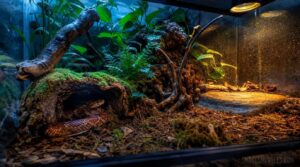
Your snake needs more than just heat and water — it needs a space that actually feels like home. That means hides, things to explore, and the right lighting on a steady schedule.
Here’s what to add to your enclosure.
Provide One Hide on The Warm Side
Your snake’s warm hide is its comfort zone — place it directly over the heat source, but keep the entrance facing away from open space.
Proper Sizing matters: snug, not squishing.
Check Substrate Stability so it won’t tip when your snake enters.
Secure Construction means no collapsing parts.
These hiding spots along the warm side of the temperature gradient make thermoregulation feel safe and natural.
Provide One Hide on The Cool Side
The cool side hide is just as important as the warm one. Place it in a low-traffic spot, away from vents for smart ventilation integration.
Choose a hide with proper entrance sizing — snug, not trapping. Material insulation keeps the interior stable.
Easy sanitization means quick cleaning wins. These hiding spots complete your snake enclosure, giving your snake real hiding place benefits all day.
Add a Humid Hide for Shedding
Shedding goes smoothly when your snake has a humid hide to retreat to. Prepare a small plastic container, cut a smooth entry-hole design that fits your snake snugly, and add an inch of damp sphagnum moss.
Place the hide on the warm side of the enclosure to speed evaporation. Establish a re-dampening schedule every two to three days. Check for mold weekly—replace moss that smells off.
This targeted humidity control and monitoring keeps the rest of the enclosure dry.
Use Branches, Cork Bark, Rocks, and Plants for Enrichment
Think of enrichment as building a mini-world your snake actually wants to explore. Climbing routes using branches and vines, textured surfaces from cork bark, and flat rocks as territorial landmarks all encourage natural movement and muscle use.
Live plants create microhabitat zones with humidity pockets that snakes genuinely use.
- Cork bark doubles as a hide and shed aid
- Branches and vines support full-body exercise
- Rocks and logs anchor enrichment rotation every few weeks
Secure Heavy Decor to Prevent Crushing Injuries
A toppled rock cave can seriously injure or kill your snake. Always use anchor brackets rated for the item’s weight, and never skip weight ratings — they exist for a reason.
Follow clearance guidelines by keeping large pieces at least 5 cm from walls. Choose commercial snake decorations with rounded or smooth rocks and edge protection.
Run quick safety audits after every rearrangement.
Provide a Regular Day-night Lighting Cycle
Your snake’s body clock runs on light cues, just like yours. Aim for 12 hours on, 12 hours off using full spectrum lighting during the day. Timer automation ensures consistent lighting schedules without guesswork.
Use a gradual shift from bright to dim, then switch to red night lighting. This mimics a natural day-night cycle and maintains a proper lux ratio, keeping stress low and rhythms steady.
Consider UVB Lighting for Species That Benefit From It
Not every snake needs UVB lighting, but many benefit from it. Desert and tropical species especially use UVB exposure to produce vitamin D3, which promotes bone health.
When setting up UVB lighting, fixture placement matters — position the bulb 6–12 inches above the basking spot. Follow species dosage guidelines, adhere to your lighting schedule, and use a meter to monitor UVB intensity.
Replace bulbs every 9–12 months, as bulb lifespan affects output even when they still glow.
Frequently Asked Questions (FAQs)
What is needed in a snake enclosure?
Your setup is the whole world for your snake.
Nail the essentials: secure enclosure, hiding spots, temperature and heat source management, ventilation, lighting timer, and seasonal adjustments.
Master these, and you’re already ahead.
Can a snake go 2 weeks without food?
Most healthy adult snakes can easily go two weeks without food. Their low metabolic rate and ectothermic metabolism make fasting normal.
Keep your temperature gradient stable, maintain hydration, and watch body condition closely.
What do snakes like in their tank?
Turns out, your snake’s a bit of a homebody — give it hiding spots, climbing structures, and natural scents.
With the right background color, low noise levels, and visual stimulation, it’ll genuinely thrive.
How often should I feed my pet snake?
Feeding frequency depends on age, species, and body condition. Hatchlings eat every 5–7 days. Adults need meals every 10–14 days. Match prey size to your snake’s widest point.
How do I handle a snake safely?
Move slowly, support the body, and keep the head pointed away from your face. Wash your hands after every session. Simple calm approach habits make handling feel natural fast.
What signs indicate my snake is sick?
Watch for appetite loss, weight loss, shedding problems, or discolored skin.
Respiratory distress, labored breathing, eye abnormalities, and dehydration signs like sunken eyes are serious symptoms requiring a reptile vet visit fast.
Can multiple snakes share the same enclosure?
Most snakes do best alone. Species compatibility, disease transmission risks, and stress reduction all argue against cohabitation.
If you must house two together, strict quarantine protocols, proper enclosure size guidelines, and resource partitioning are non-negotiable.
How do I help my snake during shedding?
Most snakes shed every four to six weeks. To assist the process, boost humidity to 70%, offer a warm soak at 88°F for 15 minutes, and add damp moss to the enclosure.
Never peel stuck shed — instead, let moisture do the work to prevent injury.
Conclusion
Your snake doesn’t ask for much—just a little world that makes sense to it. When you nail what snakes need in their enclosure, you’re not just checking boxes. You’re building trust, one warm hide and clean water bowl at a time.
A settled snake barely moves the lid. It explores, eats well, and sheds clean. Get the setup right, and your snake won’t be looking for the exit—it’ll already be home.
- https://www.zenhabitats.com/blogs/reptile-care-sheets-resources/ball-python-complete-lighting-and-heating-guide?srsltid=AfmBOoo3QbZ_h-hLpFgQm--RFoPuFhjG2QMOqiNXq7C3ZAvDpiCodfIa
- https://tempcube.io/blogs/temperature-humidity/providing-the-perfect-reptile-habitat-temperature-humidity-and-lighting-requirements?srsltid=AfmBOooSBmfKZkBokWgRrkkuKqSC6j4TQnwjQI2FHu0ZhFqfePve27no
- https://www.inkbird.com/blogs/aquarium-terrarium/ball-python-enclosure-ideas-size-humidity-temperature
- https://reptifiles.com/heterodon-hognose-snake-care/hognose-temperatures-humidity-lighting/
- https://vcahospitals.com/know-your-pet/snakes---housing