This site is supported by our readers. We may earn a commission, at no cost to you, if you purchase through links.
A bearded dragon basking under the wrong bulb doesn’t collapse overnight. It suffers slowly, bones softening over months as calcium leaches from its skeleton, until a keeper notices a jaw that won’t close right or hind limbs that tremble under weight. Metabolic Bone Disease remains the top killer in captive reptiles, and it’s almost always a UV failure, not a diet one.
Choosing among reptile UVB lights for naturalistic vivariums means matching Ferguson zones, bulb chemistry, and fixture design to the exact species basking beneath your canopy. Get the output wrong, and even lush, photo-worthy setups turn hazardous. Here’s what separates a display tank from a habitat that actually keeps its inhabitants thriving.
Table Of Contents
- Key Takeaways
- Top 10 Reptile UVB Lights
- 1. Arcadia T5 UVB Desert Reptile Kit
- 2. Reptizo Dual Reptile Light Fixture
- 3. Lucky Herp Desert Reptile UVB Bulb
- 4. Repti Zoo T5 HO UVB Kit
- 5. Zoo Med T5 HO UVB Hood
- 6. Dual Reptile Light Fixture
- 7. T5 UVB Reptile Light Fixture
- 8. T5 UVB Reptile Light Fixture Combo Kit
- 9. Zoo Med ReptiSun 10.0 UVB Lamp
- 10. Reptitrip LED UVB Reptile Light
- Why Naturalistic Vivariums Need UVB
- Match UVB to Reptile Species
- Compare UVB Bulb Types
- Choose Fixtures and Placement
- Build Safe UVB Gradients
- Maintain Long-Term UVB Performance
- Frequently Asked Questions (FAQs)
- What is the best UVB light for reptiles?
- Is 0 or 0 UVB better for bearded dragons?
- Can a reptile get too much UVB?
- Do LED UVB lights work for reptiles?
- Can nocturnal reptiles be harmed by UVB exposure?
- How does humidity affect UVB bulb performance over time?
- Should UVB lighting be turned off at night?
- Can multiple reptile species share the same UVB setup?
- Does substrate choice interfere with UVB light penetration?
- Conclusion
Key Takeaways
- Metabolic Bone Disease, the top killer of captive reptiles, stems almost always from inadequate UVB exposure rather than diet, since Vitamin D3 synthesis from UVB is required for calcium absorption.
- Matching UVB output to a species’ Ferguson zone (from Zone 1 shade-dwellers to Zone 4 desert baskers) is essential, since bulb type, intensity, and distance must reflect what that species evolved under.
- UVB output degrades well before visible light dims, so bulbs need regular replacement (T5: 9–12 months, T8: 6–8 months) and verification with a Solarmeter rather than relying on brightness alone.
- Proper fixture design—including reflector quality, basking zone size, heat/UVB alignment, and zero-UV retreat zones—determines whether a bulb’s rated output actually reaches the reptile as a usable gradient.
Top 10 Reptile UVB Lights
Choosing the right UVB fixture means weighing bulb type, zone requirements, and fixture design against your specific species’ needs.
If your setup houses multiple enclosures, check out this guide on designing a multi-tier snake rack system to see how UVB fixtures fit into the layout.
The ten options below span T5 HO kits, LED systems, and mercury vapor lamps, covering everything from desert baskers to shade-dwelling tropicals. Here’s what stands out about each one.
1. Arcadia T5 UVB Desert Reptile Kit
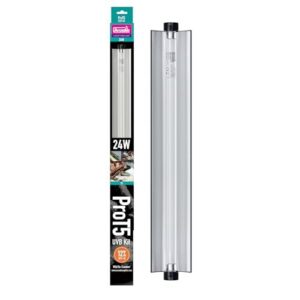
For keepers building Zone 3-4 desert setups, this kit delivers 12% UVB and 30% UVA through a T5 HO bulb paired with a curved reflector that concentrates output onto the basking zone. The reflector boosts efficiency while minimizing spill.
At 24 watts and 22.5 inches, it suits bearded dragons and uromastyx in 24-39 inch enclosures. Expect a higher price point, but the linkable design (up to 10 units) makes multi-enclosure setups genuinely practical.
| Best For | Keepers of desert species like bearded dragons, uromastyx, snakes, and turtles who need strong UVB output for enclosures in the 24-39 inch range, especially larger or multi-pet setups. |
|---|---|
| UVB Output | 12% |
| Wattage | 24W |
| Material | Aluminum |
| Target Species | Desert species |
| Mounting Type | Linkable/mesh |
| Heat Emission | No |
| Additional Features |
|
- Delivers high-output 12% UVB and 30% UVA, ideal for desert species with intense lighting needs
- Curved reflector focuses light onto the basking zone, boosting efficiency and reducing wasted spill
- Linkable design (up to 10 units) makes it easy to scale across large or multi-enclosure setups
- Higher price point compared to budget UVB alternatives
- Requires a specific T5 fitting kit, adding an extra installation requirement
- Designed specifically for desert species, so it’s not suitable for tropical or low-UV reptiles
2. Reptizo Dual Reptile Light Fixture
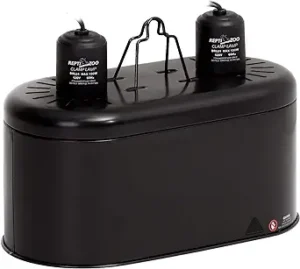
If a single-bulb rig won’t cut it, this dual fixture solves the problem outright: independent switch control lets you run a UVB tube and a ceramic heat emitter on separate schedules, up to 150W per socket. Ceramic lamp caps handle sustained heat without degrading, and top vents help dissipate it.
It suits mixed collections, bearded dragons, snakes, chameleons, alike, since you’re not locked into one bulb type. Loose sockets after months of use are a reported gripe, so check connections periodically.
| Best For | Keepers with mixed reptile collections or animals needing both UVB and heat sources, like bearded dragons, snakes, and chameleons, who want independent control over each bulb. |
|---|---|
| UVB Output | N/A |
| Wattage | 150W |
| Material | Metal/Ceramic |
| Target Species | Multiple reptiles |
| Mounting Type | Hanging hook |
| Heat Emission | Yes (with bulb) |
| Additional Features |
|
- Independent switch power lines allow separate scheduling and control for each bulb
- Heat-resistant ceramic lamp caps and top ventilation holes support sustained high-wattage use up to 150W per socket
- Versatile mounting options with a hanging hook make it easy to fit into different enclosure setups
- Some users report electrical buzzing noises during operation
- Sockets can become loose after extended use, requiring periodic checks
- Risk of shipping damage if the unit isn’t packaged in a rigid box
3. Lucky Herp Desert Reptile UVB Bulb
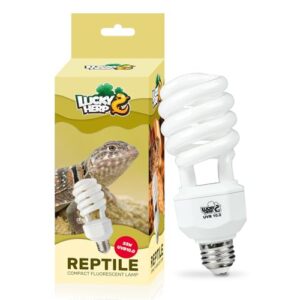
Simplicity wins here: a 23W CFL screwing into any standard E26 dome, delivering 10% UVB and 30% UVA at a 90 CRI for accurate color rendering. Bearded dragons, tortoises, and uromastyx benefit from the calcium-metabolism support without added heat output, so pair it with a separate basking bulb.
Expect 6-12 months of usable UVB before phosphor degradation sets in, and never wipe the bulb surface directly.
| Best For | This bulb is best for owners of desert-dwelling reptiles like bearded dragons, tortoises, and uromastyx who want reliable UVB support without a fuss. |
|---|---|
| UVB Output | 10% |
| Wattage | 23W |
| Material | N/A |
| Target Species | Desert species |
| Mounting Type | Standard E26 |
| Heat Emission | No |
| Additional Features |
|
- Delivers strong 10% UVB and 30% UVA output for natural vitamin D3 synthesis and calcium absorption
- High 90 CRI ensures colors look accurate, making it easier to monitor your reptile’s health and appearance
- Simple CFL design fits standard E26 fixtures, making setup quick and hassle-free
- Produces no heat, so a separate basking bulb is required to meet full temperature needs
- UVB output degrades over time, requiring replacement every 6 to 12 months for continued effectiveness
- May be too large for some standard lamp fixtures and isn’t compatible with 110V systems outside North America
4. Repti Zoo T5 HO UVB Kit
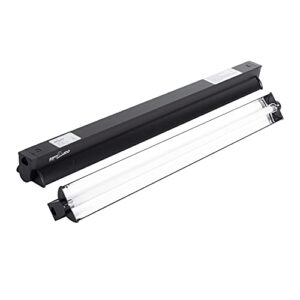
Where the Lucky Herp bulb keeps things simple, this kit steps up for keepers running rainforest-style setups needing broader coverage. The detachable curved reflector concentrates output from the 5.0 UVB T5 HO lamp, creating a defined basking gradient suited to 24–36 inch enclosures.
ETL certification confirms electrical safety, and the slim profile fits under mesh tops without crowding canopy space. Quick-plug wiring and swappable bulbs mean you’re not replacing the whole fixture come maintenance time.
| Best For | Reptile keepers with rainforest-style or humid terrarium setups housing 24–36 inch enclosures who need broader UVB coverage and a defined basking gradient. |
|---|---|
| UVB Output | 10.0 |
| Wattage | 24W |
| Material | Aluminum/Plastic |
| Target Species | Desert species |
| Mounting Type | Mesh top |
| Heat Emission | No |
| Additional Features |
|
- Detachable curved reflector concentrates UVB output for a clear basking gradient
- ETL certification ensures verified electrical safety
- Slim profile and quick-plug wiring make bulb swaps and mesh-top mounting easy
- Designed for 24–36 inch enclosures, so it may not suit smaller or larger setups
- Requires proper mesh or canopy mounting to achieve optimal UVB output
- Detachable reflector adds a component that could be lost or damaged during maintenance
5. Zoo Med T5 HO UVB Hood
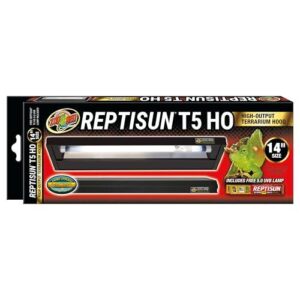
Fourteen inches of low-profile housing hides real output: this hood pairs a polished curved reflector with a ReptiSun 5.0 T5 HO lamp, pushing UVB deeper into tall or heavily planted enclosures than flat-backed fixtures manage.
At 0.65 kilograms, it mounts easily on standard rails without sagging mesh tops. No hanging hardware ships included, and prong handling during bulb swaps demands care—minor tradeoffs for a fixture built specifically to combat Metabolic Bone Disease through consistent D3 synthesis.
| Best For | reptile, bird, and paludarium keepers with tall or heavily planted enclosures who need strong UVB penetration in a compact, space-saving fixture. |
|---|---|
| UVB Output | 5.0 |
| Wattage | T5 HO |
| Material | Plastic |
| Target Species | Reptiles/birds |
| Mounting Type | No hardware |
| Heat Emission | No |
| Additional Features |
|
- Polished curved reflector delivers effective UVB penetration even in large or tall setups
- Energy-efficient T5 HO ballast provides full-spectrum UVA, UVB, and visible light
- Low-profile, lightweight design (0.65 kg) makes it easy to mount and transport
- Doesn’t emit heat, so a separate heat source is still needed
- No hanging hardware included for suspension mounting
- Bulb changes require careful prong handling, and some units may experience ballast flickering
6. Dual Reptile Light Fixture
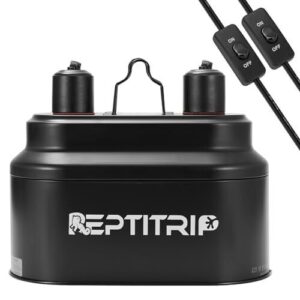
Two independent E26 sockets, one polished metal dome: this fixture pairs a UVB tube with a ceramic heat emitter, each running off its own switch for full thermal and photoperiod control.
Since desert reptiles like these often rely on prey moisture and low-loss scales rather than frequent drinking, understanding how often snakes actually need water helps you set up hydration alongside this dual-socket heating and lighting fixture.
Rated to 160W per socket, it suits bearded dragons and turtles needing distinct basking and UV zones. Top vents dissipate heat, extending bulb life, while adjustable contact prongs prevent flicker.
Bulbs aren’t included, and disconnecting power before adjusting contacts isn’t optional—it’s a safety requirement worth respecting.
| Best For | Owners of bearded dragons and turtles who need independent control over heat and UVB lighting to create distinct basking and light zones. |
|---|---|
| UVB Output | N/A |
| Wattage | 160W |
| Material | Metal |
| Target Species | Bearded dragons/turtles |
| Mounting Type | Screen mount |
| Heat Emission | Yes (with bulb) |
| Additional Features |
|
- Dual switches allow separate control of heat and UVB for a customized enclosure setup
- Polished interior boosts light and UVB reflection while top vents help bulbs last longer
- Built-in warning label and adjustable contacts make it easy to monitor performance and fix flicker issues
- Bulbs are sold separately, so you’ll need to budget for them
- Fixing contact issues means manually adjusting metal prongs inside the fixture
- Any maintenance requires unplugging the unit first, adding an extra step
7. T5 UVB Reptile Light Fixture
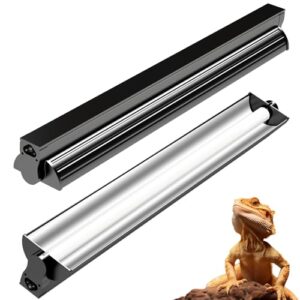
Slim enough to tuck into tight canopy gaps, this fixture houses a single T5 HO tube and relies on an aluminum reflector to push UVB output up to 70% higher than a bare bulb would deliver.
Its narrow 5/8-inch tube diameter, versus the bulkier T8 standard, means you get comparable intensity without sacrificing vivarium real estate.
Pair it with a 5.0 or 10.0 tube depending on species, and mount it 8 to 18 inches above the basking site for accurate UVI delivery.
| Best For | desert-dwelling reptile species like bearded dragons and tortoises kept in small to 12-inch enclosures that need strong, stable UVB output for bone health and appetite stimulation. |
|---|---|
| UVB Output | 10% |
| Wattage | 8W |
| Material | N/A |
| Target Species | Desert species |
| Mounting Type | Mesh/tank lid |
| Heat Emission | No |
| Additional Features |
|
- Alloy reflective layer boosts UVB output for more effective lighting
- T5 HO electronic ballast delivers flicker-free, stable illumination
- Slim, space-saving design fits easily into tight enclosure setups
- UVB bulb needs replacing roughly every six months to stay effective
- Reflective coating may peel with extended use
- Not suitable for tropical species that require UVB 5.0 spectrum
8. T5 UVB Reptile Light Fixture Combo Kit
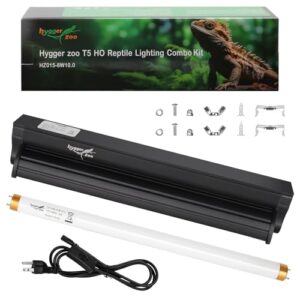
Bundled for convenience, this combo kit pairs a T5 HO tube with a matched fixture and reflector, eliminating the guesswork of sourcing compatible parts separately.
The included aluminum reflector boosts UVB reach toward that 70% efficiency ceiling, while quick-plug wiring skips extra ballast installation entirely.
Available in 10.0 or 5.0 output depending on your species’ Ferguson Zone, it suits keepers building a first vivarium who want basking-ready coverage without piecing together mismatched hardware.
| Best For | This combo kit is best for first-time reptile keepers who want a complete, ready-to-install UVB setup for bearded dragons, turtles, chameleons, or tortoises without having to match separate parts. |
|---|---|
| UVB Output | 10.0 |
| Wattage | 8W |
| Material | Aluminum |
| Target Species | Multiple reptiles |
| Mounting Type | Mesh/tank/vivarium |
| Heat Emission | No |
| Additional Features |
|
- Combines tube, fixture, and reflector in one bundle, taking the guesswork out of sourcing compatible parts
- Polished aluminum reflector boosts UVB intensity and helps with heat dissipation
- Quick-plug wiring means no extra ballast installation is needed
- Available output choices (10.0 or 5.0) require knowing your species’ Ferguson Zone beforehand
- Requires a specific socket type, so cable compatibility should be checked first
- Protective film on the reflector must stay intact, adding a bit of care during setup
9. Zoo Med ReptiSun 10.0 UVB Lamp
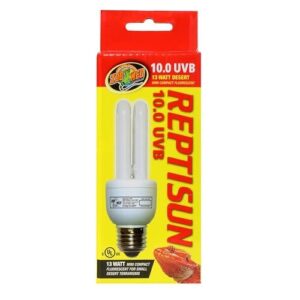
Few UVB lamps have logged as many keeper-hours as this one, and that track record matters when metabolic bone disease is the alternative.
Built as a T8 fluorescent tube, it delivers 10% UVB output designed for desert and high-basking species, with UVA rounding out a spectrum meant to mimic outdoor sun exposure.
Run it across standard T8 housings in longer vivariums, replacing annually since output degrades well before visible light dims. It’s a dependable baseline, not a specialty tool.
| Best For | desert and basking reptile species that need strong, reliable UVB exposure to support healthy bone growth and calcium metabolism. |
|---|---|
| UVB Output | 10% |
| Wattage | 13W |
| Material | N/A |
| Target Species | Desert species |
| Mounting Type | Vertical/horizontal |
| Heat Emission | No |
| Additional Features |
|
- 10% UVB and 30% UVA output through UVB-transmitting quartz glass for maximum penetration
- Dual orientation lets you mount it vertically or horizontally depending on your setup
- Fits neatly into Mini Deep Dome Lamps or Naturalistic Terrarium Hoods
- UV output fades over time, so it needs replacing every 12 months even if it still looks fine
- Won’t necessarily provide enough heat on its own for every species
- Costs more upfront than some all-in-one spectrum lamps
10. Reptitrip LED UVB Reptile Light
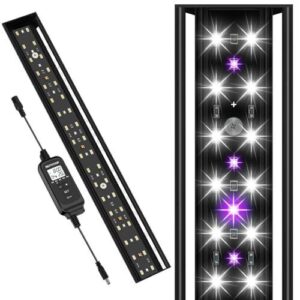
Mercury-free and built for longevity, this fixture rates over 10,000 hours of service, sidestepping the fluorescent degradation curve entirely. The aluminum housing dissipates heat while resisting the humidity that corrodes lesser units in tropical setups.
Available in 8-inch and 16-inch lengths, it suits bearded dragons and iguanas alike. Consistent UVB output across its lifespan beats fluorescent drop-off, though you’ll still want a Solarmeter to confirm actual basking-zone intensity rather than trusting the spec sheet.
| Best For | Reptile owners with bearded dragons, turtles, snakes, or geckos who need a reliable, energy-efficient UVB source for calcium absorption and healthy bone development. |
|---|---|
| UVB Output | UVI zones 1-4 |
| Wattage | 14W |
| Material | Aluminum Alloy |
| Target Species | Multiple reptiles |
| Mounting Type | Mesh/bracket/board |
| Heat Emission | No |
| Additional Features |
|
- Four preset UVI modes (M1-M4) plus a manual mode make it easy to match Ferguson zone requirements for different species
- Aluminum alloy construction dissipates heat efficiently and supports a service life of over 7,000 hours
- Flexible mounting options (mesh, internal brackets, or wooden board suspension) fit a wide variety of enclosure setups
- Doesn’t produce heat, so you’ll need a separate heating element for your reptile’s enclosure
- Built-in UVB card readings aren’t reliable—professional testing equipment is needed for accurate measurements
- Requires precise distance placement to correctly match the intended Ferguson zone output
Why Naturalistic Vivariums Need UVB
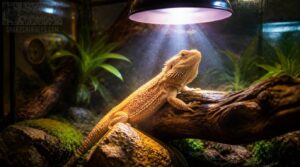
UVB isn’t a nice-to-have in a naturalistic vivarium; it’s a physiological requirement built into how your reptile’s body actually functions. Understanding why makes every fixture choice in this guide easier to justify, not just easier to make. Here’s what’s really happening under that light, and why it matters so much for the animal basking beneath it.
Vitamin D3 Synthesis
Photons striking 7-dehydrocholesterol in the epidermis drive the photochemical conversion process, splitting its B ring into previtamin D3. Body heat then triggers thermal isomerization, folding that molecule into vitamin D3 itself. Push exposure too far and photoproduct reversal kicks in, shunting output toward lumisterol instead.
This process is essential for the active hormone form to eventually regulate calcium levels. That’s the biochemical engine your UVB lighting setup exists to power—no bulb, no synthesis, no wellness.
Calcium Absorption Support
Vitamin D3 doesn’t stop at synthesis—it drives intestinal absorption pathways, upregulating transport proteins in the duodenum so dietary calcium actually crosses into your reptile’s bloodstream. Without it, calcium sits unused regardless of diet quality.
Dietary oxalate impact matters here too: oxalate-rich greens bind calcium, blocking uptake. Magnesium mineral balance and gut microbiome health further shape absorption efficiency, making UVB lighting the foundation supporting everything downstream.
Natural Basking Behavior
Getting calcium moving is only half the equation—your reptile still has to want to bask. Watch a bearded dragon choose an elevated basking substrate over shade, and you’re seeing thermoregulation impacts digestion in real time.
Basking peaks midday, shifts seasonally, and signals overall health. Disrupted circadian rhythm alignment or avoidance often means your UVB lighting or UV Index needs adjustment.
Metabolic Bone Disease Prevention
Every basking choice you just watched acts one endgame: preventing Metabolic Bone Disease. Without adequate UVB output driving Vitamin D3 synthesis, dietary calcium sits unabsorbed, regardless of Gut Loading Insects or supplement quality.
- Correct Calcium Phosphorus Ratios
- Matched Vitamin D3 Dosing
- Thermal Digestion Support
- Dietary Mineral Balance
- Consistent reptile UVB lights exposure
Skip any piece, and bowed limbs follow fast.
UVA Color Vision Benefits
UVA does more than fill the spectrum gap beside UVB—it drives chromatic range expansion, letting your reptile perceive UV reflective markings invisible to us.
| UVA Benefit | Mechanism | Wellness Payoff |
|---|---|---|
| Foraging efficiency boost | Cone stimulation (320-400nm) | Faster prey detection |
| Social cues | Pattern discrimination | Territory recognition |
| Prey visibility enhancement | UV-reflective contrast | Accurate strikes |
That’s reptile wellness, built into your spectrum lighting choice.
Match UVB to Reptile Species
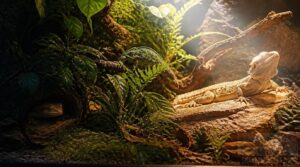
Not every reptile wants the same slice of sky, and treating them like they do is where husbandry goes wrong.
The Ferguson Zone system gives you a framework for matching UVB output to what a species actually evolved under, from shade-dwellers to full-sun baskers. Here’s how that breaks down across the animals you’re most likely to keep.
Ferguson Zone Basics
Think of the reptile world as having its own thermostat map, one that Gary Ferguson charted by measuring actual basking behavior in the field rather than guesswork.
- Zone 1: UVI 0.4–0.7, shade dwellers
- Zone 2: UVI 0.7–1.0, occasional baskers
- Zone 3: UVI 1.0–2.6, open-habitat baskers
- Zone 4: UVI 2.6–3.5+, midday desert species
Matching UVB output to these microhabitats prevents both deficiency and overexposure.
Shade-dwelling Reptiles
Shade-dwelling species like leaf litter geckos and skinks don’t shun UVB—they just need it dialed down. Ferguson Zone 1 covers these animals, whose crevice-and-litter lifestyle relies on microhabitat thermal heterogeneity rather than open basking.
Low-level UVB output (UVI 0.4–0.7) still helps with D3 synthesis without disrupting their shade-driven thermoregulation, predator avoidance, or morning-dusk activity patterns tied to cover and moisture retention.
Crepuscular Snake Needs
Crepuscular snakes don’t bask under the blazing midday sun; their D3 needs are met through low-intensity UVB exposure timed to dawn and dusk activity. Pair modest UVB output with gradual dimming to support circadian rhythm stability.
Feeding during twilight, when crepuscular hunting cues peak, alongside stable thermal gradient management, keeps digestion and activity aligned with their natural rhythm.
Tropical Vivarium Species
Dense canopy species live in filtered light, not open sun, so moderate UVB output paired with high humidity (70–90%) matters more than intensity. Epiphytic plants and bromeliads offer dart frogs and leaf frogs microhabitats for egg-laying and moisture retention.
Arboreal snakes need secure perches within mid-level humidity zones, positioned near, not directly beneath, the UVB spectrum for balanced exposure.
Desert Basking Reptiles
Bearded dragons and uromastyx evolved under brutal sun, so their vivariums demand high-intensity UVB—UVI 2.6 to 3.5 in the basking area, delivered via T5HO tubes.
Beyond lighting, replicate thermal heterogeneity: hot basking rock, cool retreat. Watch for postural heat distribution and vasodilation heat shedding as cooling cues.
Support hydration through metabolic water intake and smart microhabitat selection strategies, since desert species rarely drink standing water.
Compare UVB Bulb Types
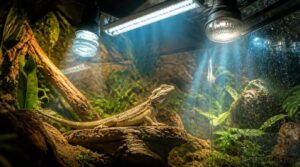
Once you know your species’ Ferguson zone, the next decision is which bulb technology actually gets you there. Not every UVB source behaves the same way, and output, spread, and longevity vary considerably between designs. Here’s how the major bulb types stack up against each other.
T5 HO Tubes
Sixteen millimeters in diameter, T5 HO fixtures outperform T8s in lumens per watt while demanding dedicated ballasts—no cross-compatibility exists. Phosphor coating quality dictates UVB longevity and color temperature range (3000K–6500K).
- Match ballast type exactly
- Mount 12–24 inches above basking sites
- Prioritize UVB-specific phosphors
- Verify CRI above 80
Skimping on ballast compatibility wastes your investment entirely.
T8 Fluorescent Tubes
Drop down to a full inch in diameter, and you’re in T8 territory: these linear UVB fluorescent tubes use standard G13 bi-pin bases, so swapping fixtures is simple.
Mercury vapor gas excites the phosphor coating, generating usable UVB, but output degrades faster here—expect replacement every 6 to 8 months. Electronic ballasts still cut flicker nicely, with color temperatures spanning 3000K to 6500K.
Compact UVB Bulbs
Compact fluorescent UVB bulbs solve fixture headaches T5 and T8 tubes can’t: standard E26/E27 screw bases fit almost any dome fixture already sold for exotic pet lighting.
Quartz glass construction maximizes UV transmission, though output stays concentrated with a steep drop-off gradient. Match wattage (13W–26W) to enclosure size, verify placement with a UV meter, and expect 6-12 months before replacement.
Mercury Vapor Lamps
Mercury vapor lamps take an entirely different approach: electricity arcs between electrodes inside a pressurized quartz tube, exciting mercury vapor to emit UVA, UVB, and heat simultaneously. A self-ballasted mercury vapor lamp integrates ballast regulation directly into the bulb, with no separate hardware needed.
Exo Terra’s Solar-Glo exemplifies this High Intensity Discharge category—powerful, but arc tubes degrade unpredictably, demanding regular Solarmeter verification.
LED UVB Technology
Twelve years ago LED UVB barely existed; now it’s reshaping how keepers think about vivarium lighting. Narrowband spectral precision targets 305-315nm for accurate D3 synthesis targeting, avoiding UVA/UVC spill.
Thermal management challenges persist—heat shifts peak emission. Yet LED lifespan comparison favors LEDs: 20,000+ hours, gradual decline. Energy efficiency benefits are real, delivering consistent UVB output for reptile habitats without mercury’s unpredictability.
Choose Fixtures and Placement
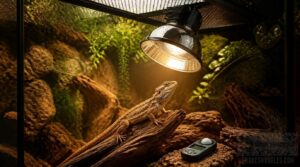
Picking the right bulb solves half the equation; the fixture and its placement solve the rest.
Reflector quality, canopy material, and basking zone geometry all determine whether your UVI readings match what the bulb’s spec sheet promises. Here’s what separates a properly engineered setup from one that leaves your reptile under-exposed.
Reflector Efficiency
A bare bulb wastes half its UVB output into the fixture’s interior; the reflector decides whether that light reaches your reptile or dies as heat. Polished aluminum delivers 85-95% reflectance; dielectric coatings push past 95%, minimizing wavelength shift. Cavity-closing geometry curbs scattering losses.
Since dust cuts efficiency measurably, wipe reflectors regularly, non-abrasively, restoring lost reflectance in any UVB lighting kit.
Mesh Versus Glass Tops
Which lid you choose shapes UVB output as much as bulb selection does. Match your terrarium’s lid to the species’ humidity and UVB lighting demands.
Screen cages improve ventilation efficiency and light diffusion but complicate humidity control and collect dust, raising cleaning difficulty. Glass tops filter some wavelengths, limiting UVB penetration, yet stabilize moisture and offer clearer aesthetic visibility into the vivarium.
Basking Zone Size
Size the basking area for full-body extension, roughly 1.5 times body length, so your reptile can stretch, rotate, and adjust posture without crowding the UVB source. Undersized platforms force repositioning and block dorsal UVB exposure.
Larger species benefit from multi-level basking spots at varied elevations, encouraging natural movement, retreat options, and stable surface temperatures across the terrarium setup.
Light and Shade Method
Your enclosure only has one sun—so light it that way. The light and shade method clusters your UVB and heat sources at one end, creating a true gradient rather than flat, shadowless glare.
This mimics naturalistic light patterns, supporting:
- Clear thermal gradient creation
- Genuine shade-dwelling refuges
- Believable shadow diffusion
- Sharper visual depth perception
Ferguson Zone accuracy depends on it—UVI readings mean little without directional logic.
Heat and UVB Alignment
Split heat and UVB across your enclosure and you’ve built two competing gradients instead of one coherent basking site. UVB heat overlap matters: your basking surface should hit 30-40°C while delivering UVI 2-4 at that exact spot.
Run both on matching 12-hour cycles for circadian rhythm alignment. Verify with a Solarmeter—thermal UVB balance only works when reflectors don’t shadow the UVB field.
Build Safe UVB Gradients
A single basking bulb doesn’t make a UVB gradient; you build one, zone by zone, until the whole enclosure offers your reptile a choice.
That means calculating maximum UVI at the basking spot, then engineering a clean drop-off to zero elsewhere. Here’s what goes into getting that gradient right, from distance and shade to the meter readings that confirm you’ve nailed it.
Maximum Basking UVI
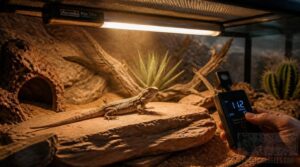
Maximum basking UVI is the ceiling reading at the hottest point in the enclosure, usually 4 to 8 for desert baskers under a T5HO bulb.
Distance drives everything: moving the animal one inch closer can spike UVI by 0.5 to 1.0 units. Verify actual output with a Solarmeter 6.5, not visible brightness, since aging bulbs deceive the eye long before they stop delivering usable UVB.
Zero-UV Retreat Zones
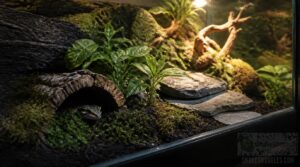
Every gradient needs an off-ramp, and that’s the zero-UV retreat zone—an area shielded to near-zero UVI using solid backing or dense hides. Placement matters: position it in the cool zone, away from basking spillover.
Shielding material selection determines success; verify attenuation with your Solarmeter, checking for leaks. This behavioral refuge lets reptiles self-regulate, retreating during peak UV hours whenever exposure needs drop.
Distance and Intensity
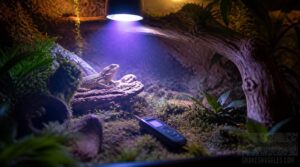
Distance governs everything here, thanks to the Inverse Square Law: double your basking surface proximity and UVI quadruples; halve it and irradiance drops to a quarter.
Halve the distance to your reptile’s basking spot and UVI quadruples; double it and irradiance drops to a quarter
Gradient mapping techniques—Solarmeter readings taken at multiple points—reveal actual UVI levels, not assumed ones. Managing light spread this way, rather than guessing, keeps your UVB lighting scheme honest and your reptile’s dosage accurate.
Plant Cover and Hides
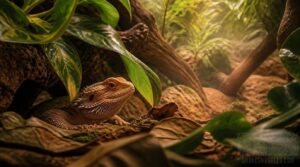
Numbers only tell half the story—foliage architecture shapes the rest. Vertical foliage layers cast dappled shade, letting shy species retreat without going full dark.
Naturalistic hide materials like cork bark and driftwood break UVB exposure into pockets, while leaf litter benefits extend to humidity and microhabitat creation for thermoregulation.
Tactile texture variety across your bioactive enclosure gives reptiles behavioral choice, not just a lit basking spot and darkness.
Solarmeter Readings
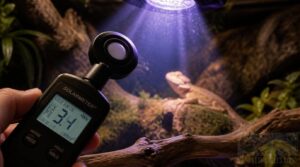
How do you know your bulb’s actually delivering, not just glowing? A UV Index meter with photodiode sensor technology gives you real irradiance data, not guesswork.
Angle and distance matter: the inverse square law means readings crash fast off-axis. Log UVI gradients at basking height, recalibrate periodically, and cross-check sensor accuracy—your gradient’s only as trustworthy as the tool measuring it.
Maintain Long-Term UVB Performance
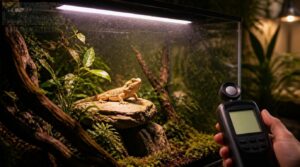
Buying the right bulb only solves half the equation, since UVB output quietly degrades long before visible light gives you any warning.
Your fixture’s lifespan, cleaning habits, and replacement timing all determine whether that gradient you built stays biologically meaningful. Here’s what actually keeps your setup performing the way it should, month after month.
T5 Replacement Schedule
T5 UVB bulbs lose photobiological potency long before visible light dims, which is why calendar-based swaps alone won’t cut it. Standard use calls for replacement every 9 to 12 months, though heat, enclosed fixtures, or extended photoperiods can shorten that to 6-9 months.
Track decline with a PAR or Solarmeter reading weekly rather than guessing—your bearded dragon’s bones depend on it.
T8 Replacement Schedule
T8 lamps degrade faster than their T5 counterparts, demanding replacement every 6 to 8 months despite unchanged visible brightness. Larger diameter tubes shed UVB output disproportionately once past the halfway mark—bulb decay signs hide in wavelength, not lumens.
Track lifespan with install-date labels, and factor replacement cost analysis against declining D3 synthesis. Always follow mercury disposal safety protocols; these tubes count as hazardous waste in most jurisdictions.
Cleaning Fixtures Safely
Dust and mineral spray settle on fixtures fast in humid vivarium setups. Wipe reflectors and housings with a microfiber cloth and non-abrasive cleaner—never ammonia or bleach near sockets. Dry thoroughly to prevent mineral buildup on aluminum reflectors, which degrades reflectivity.
While cleaning, inspect seal integrity around waterproof fixtures and switches; compromised gaskets invite moisture, corrosion, and eventual electrical failure in your UVB setup.
Tracking Bulb Age
A quartz tube glowing bright tells you nothing about actual UVB output, which is why bulb life logging matters more than eyeballing brightness. Track purchase date, hours run, and species requirements together.
Set replacement safety margins before rated life expires—don’t wait for failure. Pair calendar reminders with periodic dosimeter accuracy testing, since heat and humidity accelerate decay beyond stock ratings.
Frequently Asked Questions (FAQs)
What is the best UVB light for reptiles?
No single bulb basks in glory alone—the "best" one depends on your species’ Ferguson zone. T5 HO bulbs with accurate UVI verification, matched to specific needs and paired with proper fixture safety, consistently outperform generic options.
Is 0 or 0 UVB better for bearded dragons?
For Zone 3-4 desert dwellers, 0 UVB outperforms 0 every time—it delivers adequate UVI at practical basking distances, supporting Vitamin D3 synthesis and calcium metabolism, whereas 0 forces closer placement, raising eye irritation risks unnecessarily.
Can a reptile get too much UVB?
Yes. Excessive UVB output pushes the UV index beyond species tolerance, causing photokeratoconjunctivitis, skin burns, oxidative stress, and shedding abnormalities.
Watch for eye irritation, lethargy, or basking avoidance—these behavioral indicators signal you’ve overshot safe supplementation levels and need adjustment immediately.
Do LED UVB lights work for reptiles?
Picture a Reptizo LED setup lighting a chuckwalla’s basking patch: LED spectrum precision delivers real UVB, but weaker output than mercury vapor means targeting exposure carefully and supplementing heat separately.
Trust LED lifespan advantages over years of consistent, reliable performance.
Can nocturnal reptiles be harmed by UVB exposure?
Absolutely, if intensity exceeds their nocturnal skin adaptations. Prolonged exposure risks ocular damage and skin irritation symptoms. Keep pulses short—30 to 120 minutes—with protective shading, respecting circadian rhythms while still supporting vitamin D3 synthesis and overall reptile welfare.
How does humidity affect UVB bulb performance over time?
Damp air is no laughing matter for your UVB bulbs—it’s downright humidifying their downfall. Moisture scattering effects, reflector oxidation, and seal degradation compound over time, causing condensation transmission loss that quietly saps UVB output your reptile depends on.
Should UVB lighting be turned off at night?
Switch UVB off nightly on a timer: darkness helps melatonin production, stabilizes circadian rhythm regulation, and prevents nocturnal sleep disruption.
Consistent photoperiod matters more than round-the-clock exposure—your reptile’s biological rhythms depend on genuine nightfall, not ambient light interference mimicking daytime.
Can multiple reptile species share the same UVB setup?
Like sharing one sun across different climates, yes—but only with careful gradient microhabitat design.
Species mismatch risks arise when UVI tolerance doesn’t overlap, so give each reptile its own basking zone matching species-specific UVB requirements within the shared enclosure.
Does substrate choice interfere with UVB light penetration?
Yes: dark, dense substrates absorb more UVB, while light-colored sand transmits it deeper. Moisture increases surface scattering but dampens penetration below. Depth matters too—thick beds block more energy than shallow layers reaching your reptile’s microhabitat.
Conclusion
The sun never enters your terrarium, but its ghost must, filtered through glass and mesh into a UVI gradient your dragon can trust. That’s the real function of reptile UVB lights for naturalistic vivariums: recreating a signal reptiles evolved to depend on, not decorating a canopy.
Match zone to species, replace tubes on schedule, verify output with a meter. Do that, and the bones stay dense, the behavior stays wild, and the display finally earns the word habitat.
- https://www.neherpetoculture.com/vivariumlighting101
- https://exo-terra.com/explore/academy/lighting/understanding-ferguson-zones
- https://britexotics.co.uk/blog/best-uvb-bulb-bearded-dragon-uk
- http://www.lllreptile.com/products/40252-exo-terra-reptile-uvb100-vho-t5-bulb-12
- https://www.reptilecentre.com/blogs/reptile-blog/which-ferguson-zone-is-my-reptile-in