This site is supported by our readers. We may earn a commission, at no cost to you, if you purchase through links.

Rush the hook and your snake learns one lesson fast: it’s a threat, not a tool. That first defensive strike doesn’t just hurt, it sets the tone for every handling session that follows. Most keepers skip straight to lifting when they should be building trust first.
Learning how to introduce a new snake to a hook starts long before the hook ever touches scales. It’s about timing, body language, and reading your snake’s signals before you make a move. Get the sequence right, and you’ll turn a stressed, defensive animal into one that settles calmly under gentle pressure, session after session.
Table Of Contents
- Key Takeaways
- Introduce Your Snake Using Gentle Hook Cues
- Choose and Prepare The Right Hook
- Lift and Guide Your Snake Safely
- Read Stress and Feeding Responses
- Build Trust With Consistent Practice
- Frequently Asked Questions (FAQs)
- How long should you wait to hold a new snake?
- How long should I wait to feed a new snake?
- Can you introduce snakes to each other?
- How often should I practice hook handling weekly?
- Can I use a hook on aquatic snake species?
- What age should hatchlings begin hook introduction training?
- Should I use the same hook for multiple snakes?
- How do I replace a damaged or worn-out hook?
- Conclusion
Key Takeaways
- Let your new snake settle for 7 to 14 days and stick to short, five-minute sessions before ever bringing the hook near it, since rushing this stage teaches fear instead of trust.
- Approach from the side and always support the middle third of the body, never the head or tail, using light pressure under 2 newtons to guide your snake without triggering a defensive reaction.
- Learn to read your snake’s signals, like slow tongue flicks and loose body movement for calm, or a raised head and hissing for stress, so you know exactly when to continue and when to back off immediately.
- Build trust through repetition by using the same hook cue every session, waiting 24 to 48 hours after feeding, and adding just five minutes per week only after three calm sessions in a row.
Introduce Your Snake Using Gentle Hook Cues

First contact with a hook sets the tone for every session after it. Rush this part, and you’ll teach your snake to see the hook as a threat instead of a cue. Here’s how to introduce it the right way, step by step.
Picking the right tool matters just as much as timing, so take a look at this guide on choosing and using a snake handling hook before you begin.
Let Your New Snake Settle
Before that hook ever touches your snake, give it room to breathe. Keep enclosure placement quiet, away from foot traffic, with a steady temperature gradient, hiding spots, and fresh water access. Wait 7 to 14 days. This acclimation period allows a new snake time to settle in, as most guidance recommends leaving snakes undisturbed following guidelines on new snake acclimation for one to two weeks after acquisition. Then start with five-minute sessions, always the same routine, so trust builds before the hook comes anywhere near.
Approach From The Side
Once settled, position yourself beside the enclosure, never head-on. Straight-on approach reads as threat.
Use side entry technique with a calm, quiet posture. Keep the hook angle low, tip clearing substrate, moving toward the snake’s midbody first. This gentle hook contact restricts forward motion without alarming it, setting up calm approach reinforcement for every session after.
Open The Enclosure Slowly
With side positioning locked in, lift the lid over 2 to 3 seconds, no faster. Sudden motion undoes your calm approach fast.
Pause briefly mid-lift. Watch for tension before continuing.
This stress-free opening builds predictable handling cues your snake learns to trust, session after session, laying real groundwork for routine consistency training.
Touch The Middle Body
Once the lid’s open, slide the hook tip under the snake’s middle third, never the head or tail. This midbody support technique prevents thrashed movement and keeps body alignment steady.
Use the lightest pressure that still makes contact. That calm touch reassurance tells your snake this cue means safety, not danger.
Pause Before Lifting
Don’t lift yet. Hold for one to two seconds after hook contact and run a quick breathing and coil check, watching for taut muscle or corkscrewing.
Confirm your own calm, scan for hazards, verify the hook’s clean and enclosure stable. Relaxed coils mean go. Lift slowly and confidently, same routine every time.
Choose and Prepare The Right Hook

The right hook makes handling smoother, and the wrong one makes it harder than it needs to be. Size, shape, and material all matter more than most new owners think. Here’s what to check before you pick one up.
Match Hook to Snake Size
A mismatched hook is a fast track to a stressed snake. Match hook length to snake length, roughly one-third of body length for control.
Hatchlings do fine with 12 inches. Adults need 14 to 18 or longer.
As enclosure size grows, so does the value of training your snake to move confidently between handling sessions and enclosures using a hook.
Tip width should track body girth, and balance point matters too: a balanced hook keeps weight near your hand, not the tip.
Check Tip Width and Shape
Once length is sorted, tip width decides whether your snake glides calm or twists in protest.
- 1.5–3mm for small to mid sized snakes
- Rounded, burr free edges prevent microtears
- Width matched to girth, never guessed
A smoothly rounded, blunt tip spreads pressure evenly for gentle hook placement and proper snake gripping technique.
Choose Lightweight, Durable Materials
Weight decides how long your arm lasts during a session. Aluminum alloys stay light but resist corrosion. Titanium controls fatigue and heat. Carbon fiber molds precisely at minimal weight.
| Material | Best Trait |
|---|---|
| Aluminum | Corrosion resistant |
| Titanium | Fatigue resistant |
| Stainless steel | Durable for heavy use |
Choose based on your snake’s size and your grip endurance.
Inspect and Clean Equipment
A dirty hook spreads bacteria. Wipe it down after every session with an antiseptic wipe or enzyme-based cleaner, then rinse and dry fully before storage.
Check the shaft for cracks, the tip for burrs, and edges for smooth rounded contact. Log wear. Store dry and ventilated. Clean tools build trust and protect your snake’s skin.
Reserve Hooks for Handling
Keep one hook for daily handling, one in reserve. That separation stops cross-contamination and gives you a backup for longer moves, like enclosure-to-carrier transfers.
Reserve hooks need the same care: clean after each use, dry fully, store in a dedicated pouch. Choose polished stainless steel for corrosion resistance. Grip tape helps when hands turn oily mid-session.
Lift and Guide Your Snake Safely
Once your snake accepts the hook’s presence, the real work begins: the lift itself. This is where technique matters most, since a shaky grip or sudden move can undo weeks of trust-building in seconds. Here’s exactly how to support, guide, and move your snake with confidence.
Support The Middle Third

Balance is everything here. Slide the hook under the mid body, roughly one to two thirds down from the head, and lift with midbody support instead of the neck.
- Keeps spine safe
- Stops thrashing before it starts
- Builds smooth lifting motions
Loose body movement means you’re doing it right. Anywhere else risks a bite.
Use Minimal Contact Pressure

Once the hook sits under the mid body, don’t press. Under 2 newtons is the target, basically a gentle resting touch, nothing more.
Use a shallow angle approach with broad surface support, spreading contact instead of digging in. Pause after hook contact for a beat.
Loose body movement means pressure’s right. Ease into smooth lifting motions from there.
Guide The Head Away

Once pressure feels right, arc the hook gently so the head rotates away from your body. This gentle head redirection relies on a slow, steady curve, never a jerk.
Position yourself slightly off to the side during this move. As the head clears, pause a beat. That short pause after hook contact lets the snake resettle before you continue guiding.
Support The Body Securely

After that gentle head redirection, shift focus to the body itself.
Cradle the mid body with a curved contact, keeping the line straight along your forearm. Secure body support means distributing weight across your palm, not squeezing.
- Keep contact above ventral scales
- Follow the snake’s natural curve
- Watch for calm tongue flicks
Stay within your temporary restraint limit, 30 to 60 seconds tops.
Keep Initial Sessions Brief
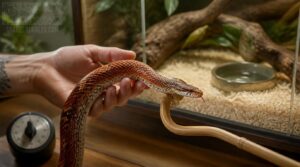
Once support feels steady, cut the session short. Start with five-minute sessions, max, no matter how calm your snake seems.
One snake, one clear cue set, nothing else running. Pause after lifting to read tongue flicks and muscle tone.
Add 30 seconds only after three calm sessions in a row. Rushing this stress monitoring step costs you weeks of trust later.
Read Stress and Feeding Responses

Your snake talks to you before it ever bites you. The trick is learning to read the signals fast, so you know when to keep going and when to back off. Here’s what to watch for during every session.
Your snake talks to you before it ever bites you, so learn to read the signals fast
Recognize Calm Tongue Flicks
That flicking tongue isn’t a warning, it’s a conversation. Calm tongue flicks move slow and steady, jaw loose, mouth relaxed, no hissing. Watch flick rhythm: even spacing means low stress. Shallow, unhurried extension signals curiosity, not threat. Consistent, predictable flicking builds trust with snakes fast, proof your reptile body language interpretation skills are on point.
Look for Loose Movement
Watch the whole body, not just the head. Loose movement means slow tail twitches, gentle undulation, and even weight shifts side to side.
- Tail twitch signals: relaxed, exploring
- Body undulation cues: unhurried, curious
- Weight shift patterns: balanced, no rearing
Uniform muscle contractions confirm calm control. This behavioral observation window builds real handling trust signals.
Identify Defensive Warning Signs
A raised head with forward tilt means back off, now. Add hissing or tail vibration and you’ve got clear defensive warning signs, not a mood swing.
Mouth gaping, body tension, rapid escape attempts. Any one of these breaks the session immediately. Ignoring stress signals here undoes weeks of handling trust signals and resets your reptile behavior conditioning to square one.
Distinguish Feeding Posture
Feeding posture fools new handlers fast. Jaw opening, gaze fixation on the hook, and a straight body alignment mean your snake thinks lunch, not threat. Tongue flicks stay calm and slow during genuine feeding cue recognition.
That’s why you wait 48 hours after feeding before any session. Confusing this with strike posture assessment risks a bite you triggered yourself.
Stop After Hissing or Striking
A hiss or strike means one thing: stop immediately. Don’t lift, don’t reposition, just retreat.
Let your snake settle into its coils before trying again. Check enclosure noise, temperature, and feeding timing, one of these triggered that defensive strike. Resume later with shorter sessions and gentler cues. Rushing back in teaches distrust, not safety.
Build Trust With Consistent Practice

Trust isn’t built in one session, it’s built in dozens of identical ones. Your snake learns the hook means calm handling only if every cue looks and feels the same, every time. Here’s how to turn repetition into real reliability.
Repeat The Same Hook Cue
Boil it down to muscle memory: same hand position, same angle, same distance from the enclosure, every single time. That repetition is what builds snake behavior conditioning, teaching your snake to expect calm handling instead of a threat.
Keep tempo steady and pressure light. Skip the cue variety. Predictability, not novelty, is what earns trust here.
Wait After Feeding
Consistency stalls if you rush a full belly. Give a post-feeding rest period of 24 hours minimum, 48 for hatchlings with large meals.
Watch for:
- Slow, relaxed tongue flicks
- Steady breathing, no gasping
- Loose, settled posture
- Renewed interest in prey
- Calm response near the enclosure
That quiet post-meal window protects digestion and builds real trust.
Extend Sessions Gradually
Once feeding rest passes, start with five-minute sessions and repeat the same routine each time. Add five minutes weekly, only if calm cues hold.
| Week | Duration |
|---|---|
| 1 | 5 min |
| 2 | 10 min |
| 3 | 15 min |
| 4 | 20 min |
Build in cool down periods between sessions. Track behavior weekly, stress monitoring protocols decide the next increment.
Track Calm Handling Responses
Numbers don’t lie, so write them down. After each session, log calm tongue flicks, body posture, and breathing rate with timestamps.
- Note tongue flick speed versus baseline
- Record time spent calm post-lift
- Log any stress interruptions
- Track color or pattern shifts
- Compare session data weekly
Patterns emerge fast. This log guides your next duration jump and flags stress reduction progress before problems build.
Adjust for Species Temperament
No two snakes read the same playbook. A ball python might tolerate handling within weeks, while a skittish species needs months of gradual duration increase before it trusts your hook.
Watch each snake’s own stress response, not a textbook average. Slow lighting, side approaches, or shorter sessions all count as valid temperament assessment tools when your usual cues fall flat.
Frequently Asked Questions (FAQs)
How long should you wait to hold a new snake?
Patience isn’t weakness, it’s strategy. Give your snake a full settling period of at least seven days before handling. Confirm feeding reliability first, then respect the post-feeding waiting period of 48 hours before that first gentle session.
How long should I wait to feed a new snake?
Give your snake 48 hours minimum to settle before that first meal, 72 for larger species or bigger prey. Confirm normal activity first. Thaw prey to room temperature and offer with tongs, minimizing direct handling.
Can you introduce snakes to each other?
Tread carefully here. Most snakes are solitary by nature, so cohabitation risks stress and aggression. Watch for territorial behavior, use larger enclosures with visual barriers, keep separate feeding zones, and monitor health closely, since species differences matter greatly.
If you’re newer to keeping snakes, starting with a naturally calm and beginner-friendly snake breed makes cohabitation attempts far safer and less stressful for everyone involved.
How often should I practice hook handling weekly?
Aim for two sessions weekly at first, starting with five-minute handling and the same routine each time. After two calm weeks, bump it to three. Adjust frequency based on comfort, running a weekly safety check too.
Can I use a hook on aquatic snake species?
Water babies need special care. I can’t verify aquatic-specific hook data from reliable sources here, so I won’t guess on species-specific hook use or water-resistant materials. Want me to pull verified guidance on that instead?
What age should hatchlings begin hook introduction training?
Most hatchlings show readiness at 4 to 6 weeks, once body control and cooperation appear. Don’t rush it before 4 weeks, early handling raises stress. Start with five-minute sessions, repeat the same routine, and let temperament guide your timeline.
Should I use the same hook for multiple snakes?
One tool doesn’t fit all: match hooks by temperament-based selection and size. Enforce cross-contamination prevention with a hook cleaning routine, wear inspection, and dry storage, or better yet, keep enclosure-specific dedicated kits.
How do I replace a damaged or worn-out hook?
Retire any hook with cracks, corrosion, or bends. Support the load, loosen bolts slowly, then install a matched replacement at the correct torque. Confirm free rotation, reconnect latches, and test lift before trusting it fully.
Conclusion
A hook is just steel and vinyl, but to your snake, it becomes a promise: calm hands, no threats. That’s the quiet truth behind how to introduce a new snake to a hook, patience rewrites fear into familiarity.
Watch the tongue flicks, respect the warnings, keep sessions short. Trust builds slowly, one deliberate cue at a time.
Master that rhythm, and your snake won’t just tolerate the hook. It’ll expect it.