This site is supported by our readers. We may earn a commission, at no cost to you, if you purchase through links.

That $445 starter kit staring at you from the pet store shelf? Your snake doesn’t care about it one bit. Ball pythons and corn snakes have lived happily in setups costing a fraction of that for decades — you just need to know where the real value hides.
Here’s the truth: enclosure prices swing wildly based on material, size, and features that barely matter for your snake’s comfort. A PVC build holds humidity 20-30% better than glass, while a secondhand tank from a local marketplace can run you $70 instead of hundreds.
Consider this your guide to affordable snake enclosure options that keep your slithery roommate safe, warm, and humidity-happy — without draining your wallet.
Table Of Contents
- Key Takeaways
- Affordable Snake Enclosure Options: What You Need to Know
- How to Choose a Budget Snake Enclosure
- Top 8 Affordable Snake Enclosures Reviewed
- Setting Up Your Budget Snake Enclosure
- Money-Saving Tips for Snake Enclosures
- Frequently Asked Questions (FAQs)
- How to make a cheap snake enclosure?
- How much do snake enclosures cost?
- Is it cheaper to build or buy a reptile enclosure?
- What can I use as a snake enclosure?
- Should you buy a snake enclosure for your new best friend?
- What makes a good snake enclosure?
- Do you need a snake enclosure?
- Are snake enclosures waterproof?
- What is a 20 gallon snake enclosure?
- What materials do snake cages & enclosures come in?
- Conclusion
Key Takeaways
- PVC enclosures hold humidity 20-30% better and weigh half as much as glass, while cheap PVC can degrade within 2-3 years and release toxic compounds above 85°F, so quality HDPE builds often save $600-800 over a decade despite higher upfront cost.
- Enclosure prices range from $20 basic tubs to $500+ PVC cabinets, with cost driven by material, size, hardware, and features rather than actual snake comfort needs.
- Sizing should be based on your snake’s adult length, not its current size, with species-specific minimums like 120-150 gallons for ball pythons and 6x2x2 feet for boas.
- You can cut costs significantly through DIY builds (40-60% savings on larger enclosures), secondhand marketplace finds around $70, and sourcing materials like PVC sheets from hardware stores, as long as you inspect used tanks and quarantine snakes for 30 days before moving them in.
Affordable Snake Enclosure Options: What You Need to Know
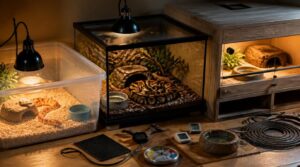
Snake enclosures can run anywhere from a $20 plastic tub to a $500 PVC cabinet, and the price tag alone won’t tell you what’s actually right for your snake. You’ll want to know what drives that cost before you start shopping, so you’re not paying for features you don’t need.
If you’d rather build than buy, this guide to budget-friendly ball python enclosure setups breaks down how a DIY tub or PVC rig gets you the same results for a fraction of the cost.
With that groundwork laid, let’s get into eight budget-friendly picks worth your money.
Why Enclosure Cost Varies So Much
Ever wonder why one snake tank runs $70 and another hits $500? It comes down to material quality, hardware inclusion, and whether it’s mass-manufactured or custom-built.
Glass panels, PVC thickness, locking hardware, even ventilation cuts all add cost. DIY builds skip labor markups entirely—a 4x2x2 setup runs $150-$200 versus $445+ for kits—while customization and long-term durability push prices higher still.
Choosing the right material for reptile cages is essential to balance humidity needs and cost.
Cheap Vs. Quality: Key Tradeoffs
Saving money upfront can cost you later. Cheap PVC breaks down within 2-3 years and can release toxic compounds once temps climb past 85°F—not exactly escape-proof or safe.
Cheap PVC breaks down in just 2-3 years and can release toxic compounds above 85°F
Quality HDPE builds last 10+ years, hold heat better, and actually save you $600-800 over a decade. That "bargain" tank isn’t always the bargain—weigh durability vs price before you buy.
Average Price Ranges by Enclosure Type
Once you know the durability tradeoffs, pricing makes more sense. Glass vs PVC matters most: glass runs $6-800+, while PVC costs 40-60% less.
- Under 20 gal: $6-100
- 20-50 gal: $100-250
- 50-100 gal: $250-350
- 100+ gal: $350-800+
Capacity cost scaling is real, and front-opening doors add 25-35% more.
How to Choose a Budget Snake Enclosure
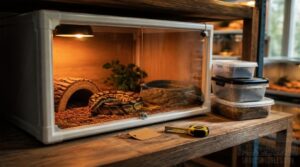
Before you grab the cheapest bin on the shelf, you’ll want a game plan. A good enclosure balances your snake’s size, your budget, and how long it’ll actually hold up. Here’s what to weigh before you start comparing specific picks.
Measuring Your Snake’s Space Needs
Grab a tape measure before you grab your wallet — sizing mistakes cost more than the enclosure itself.
Use your snake’s adult length, not current size, for width, height, and floor space math.
| Body Type | Length Formula | Width Needed |
|---|---|---|
| Terrestrial | Full length | 3/4 body length |
| Arboreal | Full length | Half length |
| Active | Full length | 1–1.5x length |
Adequate floor space beats cramped "cozy" setups every time.
Species-Specific Housing Requirements
Not every snake wants the same real estate. Hatchling growth space starts small — a 20-40 gallon tub works for corn snake babies — but adults need serious floor room.
Adult corn snakes want 40+ gallons; ball pythons need 120-150 gallons with steady python humidity zones near 70-75% during shedding. Boa size requirements hit 6x2x2 feet minimum. Arboreal species? Prioritize arboreal verticality needs over floor space.
Enclosure Materials Compared
Glass, plastic, or PVC — the material you pick shapes everything from your heating bill to moving day.
Glass terrariums win on optical clarity but leak heat fast, swinging 8-10°F versus PVC’s steady 2°F range. Plastic tubs stay cheap and lightweight. PVC reptile enclosures trap humidity 20-30% better and weigh half as much as glass — one person, zero back strain, easy budget reptile enclosure choice.
Balancing Price and Long-Term Durability
Since your snake isn’t upgrading enclosures every year, think lifetime cost, not just sticker price.
- PVC vs HDPE: PVC lasts 5-10 years; HDPE costs more upfront but outlasts it entirely
- Melamine/MDF: cheaper now, replaced every 3-5 years in humid setups
- Hidden maintenance costs: sealant, hardware, replacement parts add up
Weigh initial vs lifetime spending before choosing your budget reptile enclosure — durability tradeoffs matter more than day-one savings.
Top 8 Affordable Snake Enclosures Reviewed
You’ve got the basics down, so now it’s time to see what actually fits the bill. We rounded up eight enclosures that balance price, safety, and space without making your wallet cry. Here’s the lineup, starting with a solid all-in-one kit for beginners.
1. Zoo Med Reptihabitat 20 Long Snake Kit
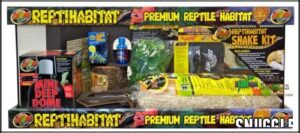
Everything-in-one-box setups don’t get much friendlier than this. The Zoo Med Reptihabitat 20 Long Kit hands you a glass tank, under-tank heater, 100-watt daylight bulb, aspen bedding, hide, water dish, and even a beginner’s guide — all for $147.99. That price alone makes it one of the most complete starter bundles you’ll find.
At 30" x 12" x 12", it holds a true 20 gallons, enough room for corn snakes, king snakes, or a juvenile ball python still finding its feet. The sliding screen top keeps things secure without blocking airflow, and the included analog thermometer gets you monitoring temps from day one, even if you’ll likely swap it for a digital gauge down the road.
Here’s the catch: glass ships rough. Cracked arrivals aren’t rare, so inspect it immediately on delivery.
| Best For | beginner reptile keepers looking for a simple, low-maintenance indoor habitat for pet snakes. |
|---|---|
| Material | Glass |
| Door Type | Sliding screen top |
| Ventilation | Screen top |
| Price | $147.99 |
| Substrate Heater Support | Not specified |
| Indoor Use | Yes |
| Additional Features |
|
- Spacious 20-gallon glass tank gives snakes plenty of room to move
- Easy, quick assembly makes it beginner-friendly
- Low-maintenance design keeps cleaning simple
- Doesn’t include heating or lighting components, which snakes need separately
- Glass construction can crack or break if dropped or bumped
- Built for indoor use only, so it won’t work for outdoor setups
2. Exo Terra Terrarium Cabinet Medium
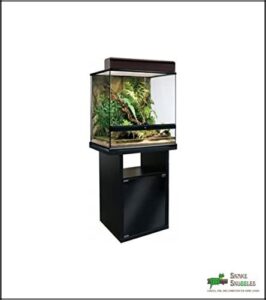
Ever wanted your snake setup to double as actual furniture? The Exo Terra Terrarium Cabinet Medium pulls it off, hiding your terrarium behind smoked tempered glass doors with soft-touch magnetic latches and slick metal hinges.
You get an integrated storage cabinet underneath — perfect for stashing cricket tubs and feeding supplies guests don’t need to see — plus an external shelf for books or décor. Built from FSC certified materials in the UK, it measures 24.25" W x 18.25" D x 27.75" H and weighs 51 pounds, sized specifically for medium Exo Terra terrariums.
Here’s the tradeoff: it ships flat-packed, so you’re assembling it yourself, and standalone shipping runs $49.95. Worth it if looks matter as much as function.
| Best For | Reptile owners with a medium Exo Terra terrarium who want their setup to look like a stylish piece of furniture while keeping supplies out of sight. |
|---|---|
| Material | Glass/FSC Wood |
| Door Type | Magnetic cabinet doors |
| Ventilation | Glass doors |
| Price | $49.95 shipping |
| Substrate Heater Support | Not specified |
| Indoor Use | Yes |
| Additional Features |
|
- Smoked tempered glass doors with soft-touch magnetic latches give it a sleek, modern look
- Integrated storage cabinet and external shelf keep feeding supplies hidden and display items handy
- Built from FSC certified sustainable materials for an eco-conscious choice
- Ships flat-packed, so assembly is required before use
- Only fits medium-sized terrariums, limiting compatibility
- At 51 pounds, it’s fairly heavy to move once assembled
3. Exo Terra Reptile Terrarium Large
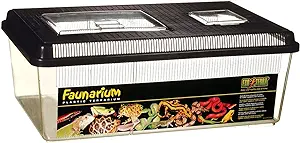
At 36x18x18 inches, the Exo Terra Reptile Terrarium Large gives adult colubrids and smaller boas real room to stretch out, and the price stays reasonable for what you get.
Dual front doors open independently, so you’re not wrestling with one giant panel just to swap a water dish. The full screen top allows UVB and infrared penetration nicely, plus you get five closable inlets for running heat cables or misting lines without leaving gaps for your snake to exploit.
The raised bottom frame accommodates substrate heaters, and that waterproof base means humid setups won’t warp anything underneath. Built from glass with a locking door system, it’s sturdy enough for daily handling routines without constant worry.
Since the enclosure is only part of the cost, our milk snake care and setup guide shows what a full habitat really involves.
If you’re budgeting for a quality enclosure like this, it helps to understand the full lifetime cost of owning a pet snake before committing to your setup.
| Best For | Owners of adult colubrids and smaller boas who want a spacious, secure, glass enclosure for everyday care and handling. |
|---|---|
| Material | Glass |
| Door Type | Dual independent doors |
| Ventilation | Full screen top |
| Price | Moderate |
| Substrate Heater Support | Raised bottom frame |
| Indoor Use | Yes |
| Additional Features |
|
- Dual independent front doors make feeding and maintenance easy without fully opening the enclosure
- Full screen top plus five closable inlets support proper UVB/infrared exposure and simple equipment setup
- Waterproof base and raised bottom frame make it easy to run substrate heaters and humid setups without damage
- Glass construction adds weight and makes it more fragile than plastic alternatives
- Large 36x18x18 inch footprint requires significant dedicated space
- Not designed for smaller species or temporary/quarantine use
4. Exo Terra Mini Wide Glass Terrarium
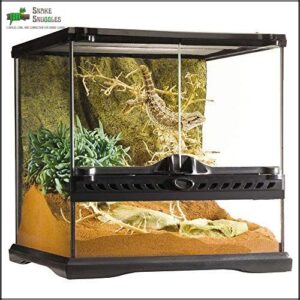
Think of this one as the studio apartment of snake enclosures — small footprint, big function. At 12x12x12 inches, it’s built for hatchlings or petite species, not your growing ball python. Priced at $92.99, it comes with a decorative rock background included, so you’re not shopping for extras right out of the box.
The dual doors with independent locks make feeding time simple, and the raised bottom frame holds a substrate heater for burrowing species who like to dig in deep. That removable screen top lets UVB and infrared light in without a fuss, while the front window ventilation keeps air moving without drying things out completely. Small size, smart design.
| Best For | hatchling snakes, geckos, frogs, and other small or burrowing reptile species that need a compact, deep-substrate setup rather than a large enclosure. |
|---|---|
| Material | Glass |
| Door Type | Dual independent doors |
| Ventilation | Removable screen top |
| Price | $92.99 |
| Substrate Heater Support | Raised bottom frame |
| Indoor Use | Yes |
| Additional Features |
|
- Dual doors with independent locks make feeding and maintenance quick and escape-proof
- Raised bottom frame supports a substrate heater, great for burrowing species that like to dig deep
- Removable full screen top allows UVB and infrared light to pass through freely
- Small 12x12x12 inch footprint isn’t suitable for larger or fast-growing reptiles
- Indoor use only, so it won’t work for any outdoor housing needs
- Getting full habitat functionality may require additional Exo Terra accessories
5. Exo Terra Glass Terrarium 18x18x12
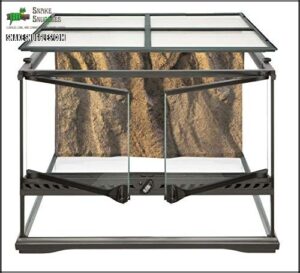
Sizing up from that mini terrarium, the 18x18x12 gives you a little more elbow room without going overboard. At 12 inches high with 324 square inches of floor space, it suits juvenile ball pythons or corn snakes that need room to stretch out.
You get front-opening doors with click-lock security, full screen ventilation for UVB light, and a raised bottom for heat mats. Six wire inlets in back keep cables tidy. Solid pick for snakes outgrowing hatchling tubs but not ready for the big leagues.
| Best For | juvenile ball pythons, corn snakes, or other growing snake species that have outgrown hatchling tubs but still need a mid-sized enclosure. |
|---|---|
| Material | Glass |
| Door Type | Front click-lock doors |
| Ventilation | Full screen top |
| Price | Moderate |
| Substrate Heater Support | Raised bottom |
| Indoor Use | Yes |
| Additional Features |
|
- Front-opening doors with click-lock security make access safe and simple
- Full screen top ventilation supports proper UVB light penetration
- Raised bottom accommodates heat mats for temperature gradients
- Glass construction is fragile and needs careful handling
- Indoor use only, so it’s not suited for outdoor or unregulated climates
- Heating, lighting, and substrate must be purchased separately
6. Exo Terra Glass Reptile Terrarium Kit
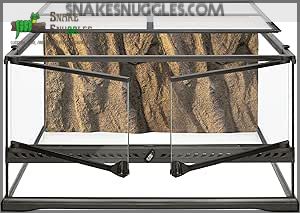
Same footprint as before, but this kit skips the guesswork by bundling everything you’d otherwise buy piecemeal. You get a thermometer, hygrometer, water dish, and substrate right in the box, plus a Repti-Glo 10.0 UVB bulb and a Night-Glo moonlight for that day-night cycle your snake actually needs.
Heating’s covered too, with a 150-watt ceramic heat emitter and a raised bottom plate built for substrate heaters — no cutting or drilling required.
The front doors use Exo Terra’s patented lock, so your snake can’t pull a great escape while you’re refilling water. Five closable inlets per side let you run cables for heaters or sensors without leaving gaps predators (or curious cats) could exploit.
Toss in the fake plants and vines for a jungle look, and you’ve basically got a starter kit that saves you a shopping trip.
| Best For | Snake owners who want an all-in-one starter setup without hunting down separate lighting, heating, and monitoring gear. |
|---|---|
| Material | Glass |
| Door Type | Patented lock doors |
| Ventilation | Screen top + inlets |
| Price | Bundled kit price |
| Substrate Heater Support | Raised bottom plate |
| Indoor Use | Yes |
| Additional Features |
|
- Comes bundled with a thermometer, hygrometer, water dish, substrate, UVB bulb, and moonlight bulb, so there’s no piecemeal shopping
- Front doors use a patented lock system, keeping escape-prone snakes secure during feeding or cleaning
- Raised bottom plate and cable inlets make adding a heat emitter or sensors simple, with no cutting or drilling needed
- At just over 30 pounds, it needs a sturdy surface to sit on
- Indoor use only, so it won’t work as an outdoor enclosure
- Still requires decor like the included fake plants and vines to be arranged before the habitat feels complete
7. 50 Gallon Reptile Terrarium Tank
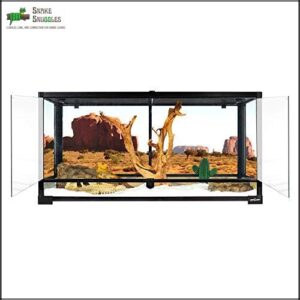
Maybe you don’t want a kit, and maybe you just want a tank that does its job without fuss. That’s where the REPTI ZOO 50 Gallon comes in — a straightforward glass terrarium measuring 36" x 18" x 18", with plenty of floor space for adult corn snakes or ball pythons to actually stretch out.
The dual front doors open independently, so you’re not wrestling a whole panel open just to swap a water dish (your snake will thank you for the reduced startle factor). Mesh ventilation keeps air moving, and the waterproof bottom works for both dry desert setups and humid rainforest ones.
That raised frame underneath? Built specifically for substrate heaters, no jerry-rigging required. Assembly takes about five minutes, and at roughly $150 to $200, you’re getting tempered glass durability that outlasts cheaper plastic bins by years, not months.
| Best For | Reptile keepers who want a no-frills, durable glass tank for adult snakes or lizards without paying extra for a full starter kit. |
|---|---|
| Material | Glass |
| Door Type | Dual independent doors |
| Ventilation | Mesh sides |
| Price | $150-$200 |
| Substrate Heater Support | Raised frame |
| Indoor Use | Yes |
| Additional Features |
|
- Dual independent front doors make feeding and maintenance easy without fully opening the enclosure
- Waterproof bottom and raised frame support both arid and humid setups, plus easy substrate heater installation
- Quick, tool-included assembly with sturdy tempered glass built to last
- Top frame can feel less sturdy when heavier lighting equipment is added
- Mesh side panels may make it harder to maintain high humidity levels
- Some buyers have reported glass fractures or door misalignment during shipping
8. Extra Long Deep Terrarium
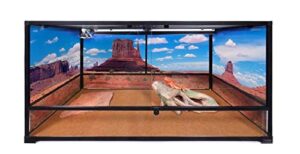
Here’s a size that solves a real problem: snakes long enough to need floor space but not so bulky they need a wall unit. The Carolina Custom Cages Extra-Long Deep Terrarium runs 48"L x 24"W x 18"H, giving you 4 feet of unbroken swimming — er, slithering — room, which covers adult corn snakes up to 5 feet with room to spare.
That’s roughly 135 gallons of usable volume, and the 18-inch depth means you can layer substrate deep enough for burrowing species to actually dig in and disappear for a while (very on-brand for snakes).
You get sliding doors with key-lock security, a full steel screen top for airflow, and a full-length top vent that pulls warm air out naturally while a front vent lets cooler air in — no fancy gadgets required. Tempered glass and self-closing hinges keep even the escape-artist types locked down tight. At 73 pounds, grab a buddy for setup, but the payoff is durable, budget-friendly housing your snake can grow into.
| Best For | Reptile and amphibian keepers who need a spacious, secure, easy-to-monitor glass enclosure for larger or floor-dwelling species. |
|---|---|
| Material | Glass |
| Door Type | Sliding key-lock doors |
| Ventilation | Steel screen mesh top |
| Price | Premium |
| Substrate Heater Support | Not specified |
| Indoor Use | Yes |
| Additional Features |
|
- Sliding doors with integrated key-lock security keep pets safely contained
- Full steel screen mesh top ensures strong ventilation and airflow
- Deep 6.3-inch waterproof base tray keeps substrate and debris out of the door tracks
- At 73 pounds, the unit is heavy and requires careful handling or a second person during setup
- Glass construction may need specific cleaning protocols to keep it looking clear
- Large 48L x 24W x 24H footprint requires significant dedicated space
Setting Up Your Budget Snake Enclosure
So you snagged an enclosure without breaking the bank—now comes the part that actually keeps your snake alive and happy. A budget setup only works if you get the essentials right, from heat to hides to a lock that actually locks. Let’s walk through exactly what you need inside that new home.
Heating and Lighting Essentials
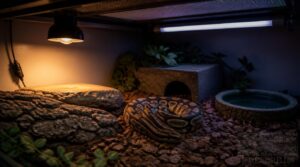
Think of your snake’s tank like a house with a furnace and a porch—one warm side, one cool side. Set up a thermal gradient using ceramic heat emitters paired with a thermostat (probe on the cool side) for real temperature control.
Add low-output UVB and a timer for consistent day-night cycles. Keep heat sources away from PVC walls—melting isn’t a good look.
Choosing Substrate and Hides
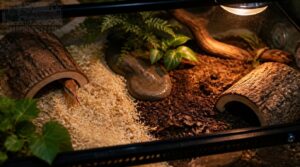
Here’s the quick version: match substrate depth to species. Ball pythons want 2-4 inches, corn snakes need 3 inches for burrowing.
Aspen shavings work great and are safe if swallowed. Bioactive soil makes natural foraging easy.
For hides, size them at 75% of body length—snug, not roomy. Place one on each side of your thermal gradient, so your snake always has a cozy retreat.
Maintaining Temperature and Humidity
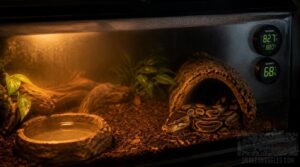
Get the climate right, and your snake basically thrives on autopilot.
Build a heat gradient with an under-tank mat covering a third of the floor, controlled by a proportional thermostat—non-proportional ones like Inkbird work fine for basic setups, but panels need dimming control.
For humidity, skip constant misting:
- Pour one cup of water into substrate corners for 60-70% humidity
- Add a warm-side water bowl to boost evaporation
- Use cypress mulch for moisture retention
- Tape screen tops with HVAC tape to stop moisture loss
- Check readings weekly with a digital hygrometer, not analog dials
Solid tops beat screens for holding warmth and moisture together.
Escape-Proofing and Lock Safety
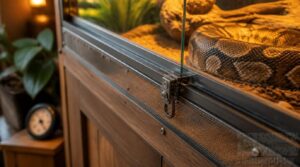
Snakes are Houdini with scales, so lock it down tight.
| Feature | Budget Fix | Cost |
|---|---|---|
| Sliding door locks | Exo Terra Lock | ~$10 |
| Gap sealing | Weather stripping | ~$5 |
| Vent mesh | Fine screen + screws | ~$8 |
Seal 1/4-inch gaps, secure ventilation mesh, and add escape prevention hardware. Lock your snake room too—it’s cheap insurance against a slithery breakout.
Money-Saving Tips for Snake Enclosures

You don’t need a big budget to give your snake a great home, just a little know-how. From building your own setup to snagging a solid deal secondhand, there are plenty of ways to save without cutting corners. Here’s what you should know before your snake outgrows its first enclosure.
DIY Enclosure Building Basics
Building your own enclosure costs a fraction of retail price, and it’s more doable than it sounds.
- 2×2 lumber frames run about $3 per stud, built in 30 minutes
- Silicone corner seals outperform interior-only application
- Melamine needs sealed edges to block moisture
- Skip pine or cedar—they release harmful hydrocarbons
Add ventilation holes up top, install glass with siliconed trim, and test heat for 24 hours before move-in day.
Sourcing Affordable Materials
Home Depot sells 4’x8′ PVC sheets for about $100 — enough for a full 4x2x2 build, and cheaper in-store than online once you factor shipping.
Pair that with glass door alternatives from old cabinets or sliding closet doors, and you’ve dodged another $40-$60.
Reclaimed wood repurposing works too: pallets, scrap MDF, whatever’s gathering dust in the garage. Facebook Marketplace and Craigslist often have people practically giving materials away.
Buy hardware in bulk when you can — screws, hinges, silicone tubes stretch further and save real money across multiple builds.
Buying Secondhand Enclosures Safely
Facebook Marketplace listings starting around $70 often beat DIY costs, but inspect before you buy. Check for leak repairs, ask about prior marine use (residue risk), and test heaters or filters on-site.
Negotiate down if equipment’s missing or the tank’s older. Transport it upright, padded, covered.
Then quarantine 30 days with paper towel substrate before your snake moves in.
When to Upgrade as Your Snake Grows
Once quarantine ends, watch your snake, not the calendar. Glass surfing or constant door-pressing means the current tub’s too tight. Upgrade at 75% of adult length—for corn snakes, that’s around 3 feet by year two.
Ball pythons need bumps at 2 and 4 feet. Boas need 50% more floor space past 3 feet. When in doubt, size up.
Frequently Asked Questions (FAQs)
How to make a cheap snake enclosure?
You don’t need power tools to pull this off. Modified storage bins, repurposed furniture, or DIY PVC construction all work great — just add proper ventilation holes, secure locking lids, and low-cost sealant to keep humidity in check. Budget doesn’t mean unsafe.
How much do snake enclosures cost?
Prices swing wildly: $20 basic tubs to $1,200+ luxury PVC builds. Size drives cost most — 20-gallon setups run $50-$100, while premium 5’x2’x2′ models hit $837-$
Budget-friendly picks, secondhand deals, and DIY builds keep costs manageable long-term.
Is it cheaper to build or buy a reptile enclosure?
Funny how "saving money" often means buying tools, hardware, and materials anyway — DIY isn’t free. For small tanks, costs are similar either way. Larger builds, though, can mean 40-60% savings, plus bulk material discounts if you’re patient.
What can I use as a snake enclosure?
Plastic bin setups work great for hatchlings, while repurposed furniture builds add style. Choose PVC for humidity and heat retention, glass for visibility, acrylic if you don’t mind scratches, or HDPE for tough, odor-resistant snake housing options.
Should you buy a snake enclosure for your new best friend?
A glass box won’t cut it forever — think of a proper enclosure as your snake’s forever home, not a shoebox. Yes, buy one: secure, right-sized housing protects against escapes and keeps temperature and humidity stable, safeguarding long-term health.
What makes a good snake enclosure?
Good housing comes down to airflow patterns that prevent stale air, secure latching mechanisms strong snakes can’t outsmart, and species-appropriate space. Materials matter too: glass shows off your pet, while PVC holds a thermal gradient better and costs less over time.
Do you need a snake enclosure?
Picture a loose snake sliding behind your fridge for three days—that’s the reality without one. Enclosures aren’t optional: they prevent escapes, protect health, and keep you legally compliant. Skipping proper snake housing risks stress, injury, and even confiscation.
Are snake enclosures waterproof?
Here’s the truth: no enclosure is fully waterproof out of the box.
PVC offers strong moisture resistance thanks to sealed seams, glass relies on silicone joints, and wood needs extra sealing—proper humidity control methods and drainage design keep any setup dry long-term.
What is a 20 gallon snake enclosure?
A 20 gallon snake enclosure holds 7 liters, usually 30"×12"×12", or a 20 gallon long version at 30"×13"×13" for extra floor space. It suits juvenile housing—corn snakes, hognose males, young ball pythons—in glass or PVC reptile tanks.
What materials do snake cages & enclosures come in?
Think of enclosure materials like shoes—each built for a different job.
Glass terrariums offer clarity but lose heat fast. PVC panels stay light and insulated. Plastic tubs save cash, while melamine wood resists water, balancing style with lasting material durability.
Conclusion
Your snake would honestly be thrilled living happily in a shoebox with a heat lamp duct-taped to its side — that’s genuinely how low the bar sits. The real secret behind affordable snake enclosure options isn’t cutting corners, it’s knowing which corners don’t matter.
Spend your money on secure locks and steady heat, skip the fancy extras, and your slithery roommate will thrive without your bank account taking the hit. Simple choices. One happy, well-hidden snake.