This site is supported by our readers. We may earn a commission, at no cost to you, if you purchase through links.
Most reptile keepers focus on misters, foggers, and expensive humidity systems before trying the simplest fix sitting right in front of them. A properly set up water bowl does more than hydrate your animal. It actively humidifies the enclosure through evaporation, and with the right bowl, placement, and routine, it can handle humidity needs for many species on its own.
Surface area drives evaporation. A wide, shallow bowl exposes more water to the air than a tall, narrow one, which means more moisture releases into the enclosure passively throughout the day. Position that bowl near the warm side of your setup, and thermal lift accelerates the process even further.
Getting this right takes a little more intention than just filling a dish and walking away.
Table Of Contents
Key Takeaways
- A wide, shallow bowl outperforms any expensive misting system for many species, because greater water surface area means steady, passive evaporation all day long.
- Placement is everything — setting your bowl 5–15 cm from the warm side lets rising heat pull moisture upward, turning a simple dish into a natural humidity engine.
- Daily water swaps and weekly scrubbing aren’t optional extras; biofilm and bacteria can take hold within 24 hours and quietly undermine both your reptile’s health and your humidity readings.
- When the bowl still can’t hit your target range, check for over-ventilation first, then layer in moisture-retaining substrate or active humidification rather than jumping straight to gadgets.
Raise Humidity With a Wider Water Bowl
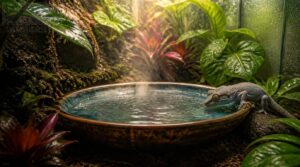
The bowl you choose matters more than most keepers realize. A wider surface area means more water exposed to the air, which translates directly into better evaporation and a steadier humidity level inside the enclosure. Here’s what to look for when picking the right one.
Once you’ve settled on the right size, keeping it clean is simple — just follow the basics of caring for terrarium water bowls for ball pythons to maintain a healthy setup.
For a deeper look at how bowl size and evaporation work together during the shed cycle, raising humidity effectively before your snake sheds is worth reading before you size up your setup.
Choose a Wide, Shallow Bowl
Shape matters more than most keepers realize. A wide shallow bowl exposes more water to the surrounding air, raising your water evaporation rate a lot.
Think of a puddle versus a cup. The puddle dries out faster because of its greater surface area.
For steady room humidification, choose a bowl of water around 25 centimeters wide, with a stable, weighted base. Just as students improved outcomes by focusing on data-centered figure examination, keepers benefit from paying close attention to surface area details when optimizing evaporation.
Use Glass or Ceramic
Once you’ve settled on size, material matters too. Glass and glazed ceramic are your best options, since neither absorbs minerals or degrades from moisture.
Glass lets you monitor water levels easily, while ceramic’s weight keeps the bowl steady if your reptile climbs in.
Both have smooth surfaces that won’t trap bacteria, and both wipe clean with a weekly scrub.
Fill With Fresh Water
Material sorted. Your water source matters just as much as the bowl itself.
Swap fresh water daily to prevent algae and keep evaporation steady across the bowl’s surface area.
- Use dechlorinated or filtered tap water
- Do daily water changes, no exceptions
- Scrub the water bowl weekly with a nonabrasive tool
- Keep water near room temperature to support consistent evaporation
Select a Tip-resistant Design
A spilled bowl of water wastes humidity and soaks substrate fast. Look for a tip-resistant design with a weighted rim and low profile to maintain surface area and water surface exposure when your reptile nudges it.
Non-slip feet grip tile and wood, and base stability matters on uneven floors. A spill guard catches splashes before they hit your heatsafe surface.
Match Bowl Size to Enclosure
Getting the bowl-to-enclosure match right is simpler than it sounds. For small tanks under 20 gallons, a 6 to 8-inch diameter bowl covers enough water surface exposure without crowding the space. Medium enclosures of 20 to 40 gallons do better with 8 to 12 inches, and large setups over 40 gallons need at least 12 inches across.
Place The Bowl for Better Evaporation
Where you place the water bowl matters just as much as which bowl you choose. The right spot encourages steady evaporation and keeps moisture moving through the enclosure instead of pooling in one corner. Here’s how to position it so it actually works.
If your snake constantly flips or moves the bowl, keeping a snake’s water bowl from tipping comes down to placement, weight, and how the dish is anchored to the enclosure floor.
Start Near The Warm Side
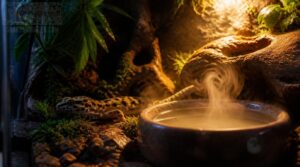
The warm side of your enclosure is a natural engine for evaporation. Placing your water bowl 5 to 15 centimeters from the warm zone gives rising warm air direct contact with the water surface, pulling moisture upward and into the ambient air. That gentle thermal lift works far better than leaving the bowl in a cool corner where evaporation stalls.
For arboreal setups especially, that warm-side placement strategy pairs well with water bowls designed for arboreal snake enclosures, where height and evaporation work together.
Position your water bowl near the warm zone so rising heat pulls moisture upward, not stalls it
Avoid Direct Heater Contact
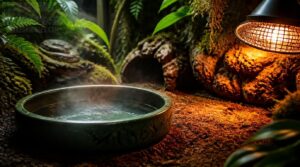
Proximity has limits. Direct heater contact drains your water bowl quickly and turns metal bowls dangerously hot.
For heater safety distance, keep at least 10 to 15 centimeters between the bowl and any heating element. Position it where pets and your reptile won’t tip it, and make sure electrical clearance around nearby outlets stays clear.
Maintain Gentle Enclosure Airflow
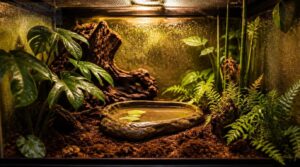
Airflow vent placement makes or breaks your humidification strategy. A fan on low, paired with mesh barriers, spreads moisture from the water bowl without drafting over your reptile.
- Position vents at multiple heights for draft-free air
- Run fans at low velocity to prevent hotspots
- Use mesh to soften direct airflow
- Support natural humidification with steady circulation
Protect Substrate From Spills
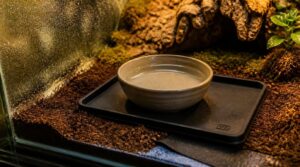
A spilled water bowl can waterlog substrate in minutes. Place your bowl on a spill containment tray with a raised lip and non-skid base to stop overflow from spreading.
Layering a waterproof underlayment beneath your substrate adds real backup, blocking moisture from soaking through.
Without these barriers, waterlogged substrate becomes a mold risk within 24 hours.
Keep Water Easily Accessible
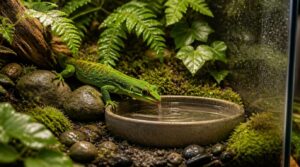
A reptile that can’t reach the water bowl won’t use it. Without easy access, even a well-placed bowl of water falls short.
- Place at ground level for full animal reach
- Use shallow depth so small species can drink
- Make sure stable placement to prevent tipping
- Refill daily for water freshness and clean water
- Check that air circulation suits your room size
Monitor Enclosure Humidity Accurately
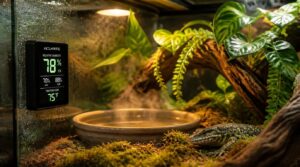
Getting the humidity right means nothing if you can’t actually measure it with confidence. A few simple habits will keep your readings honest and your reptile’s environment dialed in. Here’s what to pay attention to when monitoring your enclosure:
Use a Digital Hygrometer
Knowing what’s happening in your reptile enclosure requires a reliable digital hygrometer placed at mid-height, away from direct drafts and the water bowl.
| Feature | Why It Matters |
|---|---|
| Dual display | Shows relative humidity and temperature |
| Min/max memory | Captures overnight fluctuations |
| Data logging | Tracks trends across days |
Calibrate using a salt solution periodically to preserve sensor accuracy, especially after any battery change.
Measure Away From The Bowl
That hygrometer won’t give you accurate humidity readings if it sits too close to your water bowl. Local moisture skews results.
- Place it 6 inches from the bowl center
- Keep the sensor horizontally aligned to prevent tilt errors
- Position away from direct airflow paths
- Use a stand or shelf for proper elevation
- Measure from the same exact spot each session
Check Warm and Cool Zones
Once you’ve locked in a consistent sensor position, check humidity in both the warm and cool zones, not just one spot. Temperature affects how air holds moisture, so readings vary across the gradient. The warm side usually runs 75-85°F, and that heat drives faster evaporation and higher local humidity than the cooler retreat end.
Your animal’s behavior tells part of the story too.
Follow Species-specific Humidity Targets
What those readings actually mean depends entirely on your animal. Desert species like bearded dragons thrive between 30 and 40 percent RH, while tropical species and many amphibians need 60 to 80 percent. A ball python sits somewhere in between, around 55 to 60 percent.
Your bowl of water and evaporation rates matter less if you don’t know your target.
Track Changes After Repositioning
After repositioning your water bowl, give your hygrometer at least an hour before drawing any conclusions. Think of this like reviewing your edit history: one reading isn’t a trend.
Note the humidity before and after each move, and watch how enclosure airflow and room size shift the result together. Small, steady changes often reveal more than dramatic ones do.
Keep The Water Bowl Clean
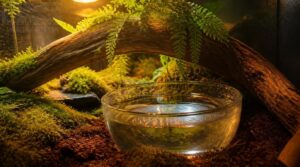
A clean water bowl does more than keep your reptile healthy — it keeps your humidity efforts from working against you. Stagnant water, waste, and buildup can quickly turn a helpful setup into a source of bacteria and odor. Here’s what to stay on top of to keep things running smoothly.
Replace Drinking Water Daily
Stale water is a silent problem. Biofilm and bacteria can take hold within 24 hours, so replace water daily without exception.
Fresh water also keeps the bowl clear, letting you spot any debris, shed skin, or waste that contaminated the supply. It protects your reptile’s hydration and helps you catch health changes early.
Scrub The Bowl Weekly
Even fresh water leaves residue behind. Scrub the bowl weekly with a soft-bristle brush, targeting the rim and corners where biofilm formation develops from standing water.
- Use a mild, reptile-safe cleaner
- Rinse thoroughly to remove all soap traces
- Dry completely before refilling
- Check for algae or water cloudiness
Consistent cleaning frequency protects water quality and keeps microbial buildup in check.
Remove Waste Immediately
A single dropping near the water bowl can contaminate the whole surface within hours. Ammonia from feces builds quickly in small rooms, disrupting airflow and skewing humidity monitoring results. Keep waste removal frequency high, at least twice daily, to prevent odor buildup, reduce ammonia levels, and maintain enclosure hygiene.
| Action | Benefit |
|---|---|
| Remove waste immediately | Prevents odor buildup |
| Spot clean twice daily | Reduces ammonia levels |
| Clear the bowl area | Minimizes substrate contamination |
| Seal and bin waste | Maintains enclosure hygiene |
Dry Soaked Substrate Promptly
When water spills from the bowl, soaked substrate becomes a humidity trap. Damp conditions slow evaporation and skew your relative humidity readings.
Pull the wet section out, spread it on a breathable surface, and let it air-dry at room temperature. Substrate drying time usually falls between 6 and 12 hours, keeping moisture content balanced and preventing mold growth before it starts.
Watch for Mold and Odors
A musty smell in your reptile enclosure is rarely random. It almost always points to hidden mold growth near or under the bowl.
Watch for these warning signs:
- Fuzzy or discolored patches on the bowl, substrate, or walls
- Persistent odor even after water replacement
- Slimy residue forming inside the bowl
- Warping or staining on nearby surfaces
- Unexplained spikes in relative humidity
Know When The Bowl Isn’t Enough
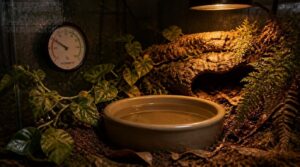
Sometimes a water bowl does its job well, but the enclosure still won’t hold humidity the way your reptile needs it to. That’s a sign it’s time to look beyond the bowl and address what’s actually working against you. A few targeted adjustments can make a real difference, and here’s where to start.
Increase Exposed Water Surface
If your bowl isn’t cutting it, exposed water surface is the lever. A wide, shallow bowl of water evaporates faster in small rooms with airflow.
| Bowl Type | Surface Area | Evaporation |
|---|---|---|
| Tall/narrow | Low | Slow |
| Saucer | Medium | Moderate |
| Wide/shallow | High | Fast |
Surface area optimization matters: a good shallow bowl design in glass or ceramic boosts the evaporation rate through material heat transfer.
Refill Before Water Runs Low
Exposed surface area gets you started, but evaporation only works if there’s water left to evaporate. Once your bowl drops below halfway, the effective surface area shrinks and humidity control suffers fast. Get into the habit of a daily water level check before it becomes a problem rather than after.
Assess Excessive Enclosure Ventilation
Even consistent refills won’t help much if your air exchange rate is too high. Over-ventilated enclosures push ambient moisture out faster than evaporation can replace it.
Run through these three checks:
- Hold your hand near vents to gauge airflow intensity
- Compare humidity readings from warm and cool zones
- Seal minor gaps to improve enclosure tightness and reduce moisture escape
Add Moisture-retaining Substrate
Sealing gaps is one step, but moisture-retaining substrate like coir or sphagnum peat adds a quiet buffer, holding water and releasing it slowly to support indoor RH as enclosure conditions shift.
Aim for a 2 to 4 mm particle size to balance moisture absorption and airflow. Keep it loose and refresh organic components every few months to preserve steady moisture control.
Consider Active Humidification Safely
When a water bowl can’t maintain indoor RH within a comfortable range, active humidification fills the gap:
- Use a misting system for timed moisture
- Install a fogger or waterfall feature
- Try an ultrasonic humidifier for steady output
- Add a drip system for controlled delivery
Keep devices stable and clean for reliable humidity control and respiratory comfort.
Frequently Asked Questions (FAQs)
Can tap water harm animals through mineral exposure?
Yes, tap water can harm reptiles. It contains dissolved minerals, trace metals, and added chemicals like chlorine. Over time, mineral deposits can become airborne irritants, especially in humid enclosures where evaporation concentrates residues.
How does room temperature affect bowl evaporation speed?
Strike while the iron is hot. Warmer room temperatures increase the water’s surface energy and deepen the vapor pressure gradient, letting moisture escape the bowl faster and spread through your enclosure air more readily.
Is distilled water safer than filtered water for bowls?
Both are safe for reptile bowls, but distilled water is the smarter pick. With zero dissolved solids, there’s no mineral buildup or white residue, and the risk of bacterial contamination stays lower between cleanings.
How many bowls work best in larger enclosures?
One bowl won’t cut it in large enclosures. Two to three bowls, spaced at least 5 times the widest dimension apart and varied in height, create multiple evaporation zones and more steady passive humidification throughout.
Does bowl color or material affect evaporation rate?
Color and material both play a role. Dark-colored bowls absorb ambient heat and warm the water faster, speeding evaporation. Metal conducts heat faster than ceramic. Lighter or glossy surfaces reflect heat, slowing moisture output.
Conclusion
Who thought learning how to raise humidity with a water bowl could simplify your entire care routine this much? Wide surface, warm placement controls more than most keepers ever expect.
Refill daily, scrub weekly, and watch your hygrometer. Your reptile won’t wait for perfect conditions, but it will thrive when things stay consistent. Trust the basics.
A dish of fresh water, set up with real intention, is often the only upgrade your enclosure actually needs.