This site is supported by our readers. We may earn a commission, at no cost to you, if you purchase through links.
Most stuck sheds and skipped meals don’t start in the terrarium—they start on the dinner plate. A snake fed the wrong prey size, missing calcium, or inconsistent protein won’t show trouble for weeks, sometimes months. Then the signs surface all at once: dull skin, thinning muscle along the spine, a shed that peels in fragments instead of one clean sleeve.
Reptile health and nutrition work as a single system, not separate boxes to check. Get the protein source right, match UVB exposure to species needs, and calcium metabolism follows. Miss one piece, and the rest destabilizes fast—here’s what actually keeps that system running.
Table Of Contents
- Key Takeaways
- Snake Diet Types and Nutrient Requirements
- Safe Prey Selection and Feeding Prep
- Calcium, UVB, and Bone Health in Snakes
- Feeding Schedules by Snake Life Stage
- Hydration, Habitat, and Health Monitoring
- Frequently Asked Questions (FAQs)
- What does God say about reptiles?
- What foods can reptiles not eat?
- What is the best diet for reptiles?
- What diseases do reptiles carry?
- Can lizards hear your voice?
- Can reptiles get giardia?
- What are reptile nutrition requirements?
- What nutrients do Reptiles need?
- What should a pet reptile eat?
- Do Reptiles need supplements?
- Conclusion
Key Takeaways
- Whole vertebrate prey delivers complete amino acid profiles that no commercial or single-source formula can fully replicate, making species-appropriate feeding the foundation of snake health. Breeders looking to optimize reproductive outcomes will find that essential nutrients for breeding snakes go far beyond protein alone, encompassing minerals and fatty acids working in precise biological concert.
- Maintaining a 2:1 calcium-to-phosphorus ratio alongside proper UVB exposure (30–120 minutes daily at UV Index 3.0–5.0) is essential to prevent metabolic bone disease.
- Frozen-thawed prey reduces injury and pathogen risks compared to live feeding, while proper sizing (matched to the snake’s widest point) and rotation across rodent species improve nutritional completeness.
- Feeding frequency, portion size, and calcium needs should shift with life stage and season, guided by body condition scoring and weight trends rather than fixed schedules.
Snake Diet Types and Nutrient Requirements
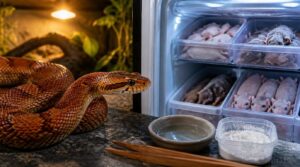
Think of your snake’s diet as the foundation everything else builds on: get it wrong, and no amount of UVB or humidity control will fix the damage.
A poor diet can also mask itself as sluggish digestion, so if your snake seems unusually sluggish, it’s worth ruling out common causes of lethargy in pet snakes before assuming it’s just a lazy day.
Every species comes with its own protein needs, prey preferences, and nutrient quirks—there’s no one-size-fits-all feeding plan.
Here’s what you need to know before you open that freezer.
Carnivore Protein Needs
Think of a snake’s protein needs as non-negotiable—there’s no substitute for vertebrate prey. Whole animals deliver complete amino acid profiles across muscle and organ tissue, supporting growth versus maintenance depending on life stage.
Understanding essential amino acids is key because these specific nutrients cannot be produced by the body.
Skip protein blood tests. Instead, track tissue mass assessment through body condition and shedding quality. Poor protein energy balance shows up as slowed growth in juveniles, reduced condition in adults.
Species-Specific Diet Planning
A ball python isn’t a bearded dragon, and your feeding plan shouldn’t pretend otherwise. Natural Prey Matching starts here—rodents for one, insects for another.
Build each plan around three pillars:
- Species-specific prey type and size
- Seasonal Feeding Shifts and portion changes
- Body Condition Targets, not just appetite
Skip generic prey swaps. Nutritional Mismatch Risks follow careless substitutions—stick to prey rotation within proper categories for real dietary diversity.
Macronutrients and Micronutrients
Prey matching gets the species right—now the biochemistry has to back it up. Protein completeness is non-negotiable: amino acid roles include tissue repair and enzyme production, and only animal-based prey delivers the full set.
Fat isn’t filler either. Essential fatty acids maintain cell membranes, while fat-soluble vitamins depend on adequate dietary fat for absorption.
Carbs matter less here—snakes handle glucose metabolism inefficiently, so calories come from protein and fat instead.
On the mineral side, calcium-to-phosphorus balance and zinc or magnesium as enzyme co-factors round out true balanced nutrition and nutrient bioavailability.
Gut-Loading Insect Prey
Feeder insects arrive nutritionally hollow—gut-loading fixes that. Feed insects a calcium-and-carotenoid-rich diet for 24–48 hours before offering them, raising prey item nutritional value substantially.
Skip spinach; its oxalate content blocks calcium absorption. Use hydration gel, not water bowls—drowning risk is real.
Stable, uncrowded housing keeps insects alive long enough for gutload quality to matter, feeding into your broader species-specific diet planning.
Commercial Diet Limitations
Complete nutrition" on a label doesn’t guarantee it for your snake. Nutrient ratio imbalances slip through—calcium-to-phosphorus ratios shift batch to batch, and prey profile replication falls short since muscle-only formulas skip organs whole prey provides.
Protein source variety also suffers with single-source formulas. Add feeding acceptance challenges and commercial supply constraints, and species-appropriate diets built solely on commercial diets risk real nutritional deficiencies. Captive diet optimization demands you verify, not assume, adequacy.
Safe Prey Selection and Feeding Prep
Feeding time carries more risk than most owners realize—one wrong choice and you’re looking at an injured snake or a serious health setback. Prey selection isn’t just about size; it’s about sourcing, storage, and safety working together. Here’s what you need to get right before that rodent ever reaches the enclosure.
Frozen-Thawed Prey Benefits
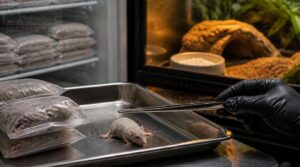
Think of frozen-thawed rodents as insurance for your feeding program. Freezing halts pathogen activity, so parasite reduction happens before the prey ever reaches the enclosure.
- Rigid, unmoving bodies—no scratching or biting
- Uniform batches—predictable nutrition every meal
- Freezer stacks—ready stock without live colonies
You get injury prevention, nutritional consistency, easier storage management, and genuine feeding convenience—supporting truly species-appropriate diets through smart prey rotation and steady dietary supplementation.
Live Prey Safety Risks

Why risk a bite when the cage is already stocked with a safer option? Live rodents fight back—biting, scratching, sometimes infecting wounds that need veterinary care. Pathogen transfer risks run both directions, threatening you during cleanup too.
Add invertebrate parasite exposure and feeding stress impacts, and the math favors frozen-thawed prey. Rotate feeder prey wisely; cross-contamination prevention starts with what you never bring in alive.
Prey Size Guidelines

Too big, too small, or just right—prey sizing is where feeding mistakes happen most.
A good rule of thumb is to match each meal to the widest part of your snake’s body, and our boa constrictor feeding guide covers sizing, temperature, and schedules.
Start with the widest-point rule: match feeder prey width to your snake’s thickest midsection. Confirm with a weight-percentage check, favoring the smaller option if the two disagree.
If your snake regurgitates, wheezes, or shows an odd bulge after eating, check these warning signs that a feeder is too big right away.
- Gauge post-feeding bulge
- Avoid undersized prey
- Respect gape limitation
- Reassess via body condition scoring
Digestive health depends on getting this right, every time.
Proper Rodent Storage
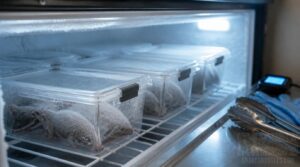
Your freezer is a biosecurity checkpoint, not just cold storage.
Airtight container selection matters most—hard plastic bins with intact seals block odor and gnawing better than bags. Store elevated, away from walls, as part of sound pest proofing strategies. Keep frozen-thawed prey at –20°C or below; never refreeze. Good moisture control techniques and handling hygiene protocols prevent spoilage that draws pests into your reptile husbandry space.
Rotating Prey for Variety

A single feeder species can’t deliver every nutrient your snake needs. Mice, rats, and chicks differ in amino acid profiles and nutrient density, so rotating rodent species diversifies calcium, phosphorus, and fat intake naturally.
Make any switch in prey gradual—one variable at a time—to preserve feeding response and avoid managing feeding refusals. Always offer frozen-thawed prey, matching your species-specific diet plan for truly balanced nutrition and sound exotic pet nutrition practice.
Calcium, UVB, and Bone Health in Snakes

Think of your snake’s skeleton as a bank account—withdrawals happen fast, but deposits take real work. Calcium and UVB exposure form the backbone of that deposit system, and getting either wrong invites trouble.
A snake’s skeleton is a bank account: calcium and UVB make the deposits, but withdrawals happen fast when you get them wrong
Here’s what you need to know to keep bones strong and deficiencies off your radar.
Calcium-to-Phosphorus Ratio
Why does one number decide whether your snake’s skeleton stays sound? The calcium-to-phosphorus ratio governs mineral absorption efficiency, and a 2:1 balance keeps calcium metabolism working in your reptile’s favor. Skew it, and skeletal mineralization outcomes suffer fast.
For selective feeders, reptile vitamins for picky eaters can help support balanced mineral intake without triggering food refusal.
Phosphorus density risks come standard with whole prey — every rodent delivers phosphorus you can’t skip. Supplement dosing accuracy matters just as much: calcium carbonate and other calcium solubility types absorb differently, so consistency beats guesswork.
- Calibrate supplement dosing every feeding, not sporadically
- Rotate prey to offset phosphorus density risks
- Watch for soft bones or spinal kinks
- Reassess mineral balance whenever protein sources change
UVB and Vitamin D3 Synthesis
Getting that ratio right means nothing without the mechanism that builds calcium into bone. UVB radiation photolyzes 7-dehydrocholesterol in the skin, forming pre-vitamin D3, which then undergoes thermal isomerization into usable vitamin D3. Solar altitude dictates wavelength penetration, while photoproduct feedback loops prevent toxic overproduction. Without adequate UVB lighting, calcium and vitamin D3 metabolism collapses regardless of diet.
Daily UVB Exposure Needs
Daily UVB exposure needs hinge on time, not just intensity. Most snakes need 30–120 minutes under a UV Index of 3.0–5.0 daily.
Species basking behavior varies wildly—arboreal versus fossorial snakes won’t bask equally. Lamp distance, enclosure barriers, and photoperiod timing all shift actual dose.
Verify with a UVB meter, not guesswork, since incorrect placement silently starves vitamin D3 synthesis regardless of bulb wattage.
UVB Bulb Replacement Schedule
A meter tells you when output has faded—but a calendar keeps you from forgetting to check. Mark install dates and swap compact/T8 bulbs at 6–8 months, T5 HO or mercury vapor near 10–12 months.
| Bulb Type | Replace By |
|---|---|
| Compact/T8 | 6–8 months |
| T5 HO/Mercury Vapor | 10–12 months |
Longer photoperiods accelerate degradation regardless of visible light output.
Spotting Metabolic Bone Disease
How do you know your snake is already in trouble? Look for bowed limbs, a curved spine, or a jaw that won’t close right—classic metabolic bone disease.
Watch gait: limping, tremors, or reluctance to move signals muscle weakness. Check joints for swelling, palpate for rubbery ribs.
These stem from a broken calcium and vitamin D3 cycle, skewing your calcium-phosphorus ratio and halting proper skeletal development—early rickets or osteomalacia.
Feeding Schedules by Snake Life Stage

Think of feeding schedules as a moving target, not a fixed rule—your snake’s age dictates the pace. A hatchling’s metabolism runs a different race than a full-grown adult’s, and treating them the same invites trouble. Here’s how to match the schedule to the life stage in front of you.
Juvenile Feeding Frequency
Think of a juvenile snake as a construction project running on a deadline: skeletal development won’t wait. That’s why feeding frequency stays tight—every 4 to 7 days—driven by digestion cycle timing, not the calendar.
- Match prey size to growth
- Skip meals during shedding appetite changes
- Slow feeding as temperature metabolism shifts
- Prevent regurgitation by spacing meals correctly
Adult Feeding Frequency
Growth slows once your snake reaches adulthood, and adult feeding frequency reflects that shift: weekly meals work for most, though some species stretch comfortably to 10–14 days.
Let weight trend monitoring drive adjustments, not the calendar. Gaining weight or refusing prey? Lengthen the interval. Losing condition? Shorten it.
Digestion temperature alignment matters too—cooler enclosures slow metabolic rate, demanding longer gaps between meals. Layer in seasonal appetite shifts, since cooler months or shedding cycles often blunt appetite naturally. Respond to these cues, not rigid schedules.
Body Condition Scoring
Your hands tell you more than a scale ever will—body condition scoring turns touch into diagnosis. Run fingers along the spine, ribs, and midbody, comparing contour to your snake’s own baseline.
- Sharp, visible spine: underconditioned
- Ribs faintly palpable under light fat: normal
- Smooth midbody, ribs hidden: overconditioned
- Angular taper: lean
- Broad, rounded girth: excess fat
Score consistently, same spot, same pressure. Weight fluctuates with meals; condition doesn’t lie.
Seasonal Diet Adjustments
Winter doesn’t dull your snake’s appetite by accident—it’s metabolic rate slowing in response to temperature. Digestion depends on heat, so cooler ambient ranges mean slower processing and reduced hunger.
- Scale back portions as temperatures drop
- Match calcium to actual intake, not habit
- Watch for lethargy signaling reduced needs
- Reintroduce full feeding gradually each spring
- Track weight trends through the change
Species-specific diet planning matters here: tropical snakes tolerate less seasonal swing than temperate species. Stable gradients prevent feeding "crashes.
Preventing Snake Obesity
A fat snake isn’t a healthy snake—it’s a metabolic disorder waiting to surface. Weight Trend Tracking and Body Girth Assessment catch gains early, before appearance lies to you.
Manage caloric intake through feeding frequency and prey size, not instinct. Add enrichment driven locomotion—branches, tunnels, supervised exploration.
Persistent bulk despite correct husbandry warrants veterinary health screening. Preventative veterinary care, paired with consistent reptile health monitoring, keeps species-appropriate diets working as intended.
Hydration, Habitat, and Health Monitoring

Diet alone won’t keep a snake healthy — the enclosure has to do its part too. Water, humidity, and temperature all work together behind the scenes, quietly shaping shed cycles, digestion, and hydration status. Here’s what you need to watch for, and how to catch trouble before it shows up in the animal itself.
Fresh Water Access
Where you put the water bowl matters as much as the water itself. Best bowl placement means positioning it away from basking lights—this controls evaporation and keeps hydration status stable.
Python species habitat needs can help you match bowl size and placement to your snake’s natural climate.
Choose shallow, wide, nonporous bowls to minimize submergence safety risks. Clean daily using proper biofilm removal techniques; scrub, rinse, refill.
These contamination prevention methods sustain real hydration management, not just clear water.
Humidity for Healthy Shedding
Water bowl placement affects hydration status—but shedding hinges on air moisture, not standing water.
Watch for cloudy, blue-gray eyes: that’s your shedding humidity window, signaling a bump from baseline toward 70–90%. A humidity hide with damp substrate creates a microclimate without soaking the whole enclosure. Measure relative humidity via digital hygrometer, positioned near the hide, to catch swings and prevent stuck shed on eyes or tail tip.
Temperature Gradients and Basking
Think of your enclosure as a stovetop with dials, not a single burner. Thermal gradient setup means one hot end, one cool retreat, gradient between.
- Basking spot precision: 28–32°C daytime
- Nocturnal cooling cycles: drop 5–10°C after dark
- Species temperature variation: desert snakes run hotter
Reptile thermoregulation drives digestion and shedding—microclimate management via thermostat keeps that gradient honest, not guessed.
Tracking Feeding and Health Logs
Every gradient dial you set means nothing without a paper trail behind it.
Log feeding entry timing immediately—start, end, prey type, full or partial intake. Track stool pattern monitoring and shedding status alongside weight trends to catch digestive health issues early. Note medication outcome tracking for any treatment.
Run routine review processes weekly; feeding frequency deviations against species-specific diet schedules reveal problems before reptile wellness declines.
Recognizing Dehydration Signs
How do you know when your reptile is running on empty? Check skin elasticity changes first: gently tent the skin—dehydrated snakes lose that snap-back. Watch for sunken eye indicators, dull skin, and shedding difficulty patterns—retained caps signal trouble. Monitor urate consistency monitoring too.
Lethargy and movement slow noticeably. Correct proper humidity fast; untreated dehydration threatens overall amphibian and reptile wellness.
Frequently Asked Questions (FAQs)
What does God say about reptiles?
Curious what Scripture actually says about your scaly patient? Genesis calls creeping things part of intentional creation, worthy of praise per Psalm Genesis 1:26 grants human dominion, while Leviticus 11 marks dietary purity—yet serpents symbolize deception in Genesis
What foods can reptiles not eat?
Avoid persin-laden avocado, rhubarb, onion, alcohol, caffeine, chocolate, fruit pits, and peanuts (aflatoxin risk). Skip moldy or spoiled items, greasy human snacks, and high-oxalate foods—these disrupt species-appropriate diets, block calcium absorption, and trigger micronutrient deficiency.
What is the best diet for reptiles?
There’s no single "best" diet — that’s like asking the best shoe size for everyone. It’s species-specific, built on whole-body nutrition, correct calcium to phosphorus ratio, vitamin D3 support, and nutrient-rich gut-loading to prevent micronutrient gaps.
What diseases do reptiles carry?
Salmonella transmission, Mycobacterium infections, and intestinal parasites top the list. Reptiles also harbor tick-borne pathogens and arthropod reservoirs. Watch for lethargy, dull skin, or respiratory infections—these signal zoonotic risk even in outwardly healthy animals.
Can lizards hear your voice?
Silence speaks louder than words to a lizard’s ears. Yes — 100–4,000 Hz range catches your voice, but recognition stays vibrational, not linguistic. Calm, steady tones reduce auditory stress better than any words themselves ever could.
Can reptiles get giardia?
Yes. Fecal-oral spread transmits Giardia between reptiles, sometimes producing diarrhea. Fecal testing confirms protozoan infection.
Zoonotic transmission risks stay low but real—strict sanitation, prompt waste removal, and veterinary follow-up protect both digestive health and keeper safety.
What are reptile nutrition requirements?
Coincidentally, an engine and an ectotherm run on the same logic: wrong fuel, everything stalls.
Nutrition in Reptiles hinges on species feeding categories, protein-fat balance, correct calcium and vitamin D3, and nutrient completeness — mismatches invite metabolic bone disease and lasting deficiency risks.
What nutrients do Reptiles need?
Your reptile needs protein for essential amino acids, fats for energy, and calcium plus vitamin D3 for skeletal strength.
Balance drives mineral absorption—skewed calcium-to-phosphorus ratios trigger fast deficiencies, so species-specific diet planning and calcium supplementation matter more than you’d think.
What should a pet reptile eat?
You crawl before you walk, you walk before you run — and you feed species-specific diets before anything else.
Herbivores need leafy greens; carnivores need whole prey or frozen-thawed rodents; omnivores need variety. Match protein sources, calcium supplementation, and nutrient ratios to your species.
Do Reptiles need supplements?
Most captive reptiles need calcium-rich supplements, dietary vitamin D3, and mineral rotation to prevent metabolic bone disease. Whole-prey feeders often skip this—insect-eaters can’t. Both over-supplementing and deficiency threaten long-term bone health and calcium absorption.
Conclusion
A single missed calcium dose won’t kill your snake in a day—but a thousand oversights will, one shed at a time. Reptile health and nutrition isn’t a checklist you finish; it’s a cycle you maintain.
Match protein to species, calcium to phosphorus, UVB to biology, and your snake’s body takes care of the rest. Skip one link, and the whole chain fails silently—until it doesn’t. Master the system.
Your snake’s spine, skin, and shed will prove it.