This site is supported by our readers. We may earn a commission, at no cost to you, if you purchase through links.

Walk into any classroom bearded dragon habitat on a Monday morning after a dry weekend, and you’ll spot the trouble fast: flaky skin, a stuck shed clinging to the toes, maybe a little wheeze when your class pet breathes. Reptiles don’t forgive humidity swings the way a wilting plant does—you can’t just water them and move on. Get it wrong, and you’re looking at respiratory infections or worse, all from an enclosure nobody thought to check over a long weekend.
That’s where reptile humidifiers for classrooms earn their keep. The right unit runs quiet enough not to spook a chameleon mid-lesson, refills without a struggle, and keeps humidity steady even when you’re not around to babysit it.
Ahead, you’ll find ten models worth your classroom budget, plus the safety features and species-specific ranges that turn a "just okay" setup into one your students—and your reptiles—actually thrive under.
Table Of Contents
- Key Takeaways
- Top 10 Classroom Reptile Humidifiers
- 1. Reptile Terrarium Ultrasonic Fogger Humidifier
- 2. Reptizoo tree trunk reptile humidifier
- 3. Blerema Reptile Fogger Humidifier
- 4. Top Fill Reptile Fogger Humidifier
- 5. Hoqqf reptile humidifier fogger
- 6. Wacool Reptile Fogger Humidity Controller
- 7. Moistenland automatic reptile misting system
- 8. Coospider Reptile Fogger Mister Humidifier
- 9. Repti Zoo Digital Reptile Fogger
- 10. Evergreen Pet Supplies Reptile Fogger
- Classroom Humidity Needs by Species
- Choosing Classroom-Safe Humidifiers
- Foggers Versus Misting Systems
- Maintenance for Healthy Classrooms
- Frequently Asked Questions (FAQs)
- Can you have a humidifier in a classroom?
- Are humidifiers good for reptiles?
- What humidifier is best for eczema?
- Are automatic reptile misters worth it?
- How much does a reptile humidifier typically cost?
- Can students help operate the humidifier safely?
- Where should the humidifier be placed in enclosures?
- How long does installation and setup usually take?
- What warranty coverage do reptile humidifiers usually offer?
- Conclusion
Key Takeaways
- Match humidifier type to species needs: tropical reptiles need 70-90% humidity via fine ultrasonic mist, while desert species like bearded dragons and leopard geckos thrive at just 20-30% and can be harmed by excess moisture.
- Prioritize classroom-safe features like quiet operation under 35dB, automatic dry-run shutoff, and large tanks (4L+) to reduce refills and avoid disrupting lessons.
- Use only distilled or reverse-osmosis water and stick to a weekly cleaning routine to prevent mineral buildup, mold, and bacterial growth in humidifiers and hoses.
- Watch for warning signs like stuck sheds, wheezing, or flaky skin, since these often signal humidity imbalances that can lead to respiratory infections or dehydration if left unchecked.
Top 10 Classroom Reptile Humidifiers
Every classroom terrarium has its own quirks, so the right humidifier really depends on your setup, your species, and how much hands-on time you’ve got between bells.
If you’re weighing durability alongside moisture control, this guide to choosing classroom-safe snake terrariums breaks down setups built to handle little hands and heavy humidity alike.
Some units favor quiet, hands-off automation, while others give you more manual control over misting bursts.
Here are ten models worth considering, each with strengths that fit different classroom situations.
1. Reptile Terrarium Ultrasonic Fogger Humidifier
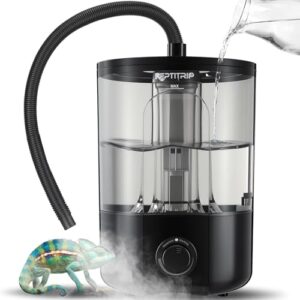
Picture a rainforest tank fogged up like a morning trail — that’s this unit’s whole job. Its ultrasonic transducer shreds water into 5–10μm particles, pumping out 50ml to 400ml per hour depending on your dial setting.
The 4-liter reservoir means fewer weekend refills, and dry-burn protection kicks in automatically if water runs low. At 35dB, it won’t drown out your lesson, and the anti-tip base keeps curious hands from knocking it over mid-class.
| Best For | Reptile and amphibian keepers who need reliable, high humidity for tropical species like red-eye tree frogs while also being able to dial back moisture for arid-adapted animals like leopard geckos. |
|---|---|
| Tank Capacity | 1 gallon (4L) |
| Dry-Run Protection | Yes |
| Mist Technology | Ultrasonic |
| Adjustable Output | Yes, rotary dial |
| Hose Included | Yes |
| Target Species | Frogs, geckos, tortoises, snakes |
| Additional Features |
|
- Ultrasonic technology produces ultra-fine 5–10μm mist for even, gentle humidity coverage
- Large 4-liter reservoir cuts down on refill frequency, and dry-burn protection adds peace of mind
- Whisper-quiet 35dB operation and a tip-proof rubberized base keep the tank calm and stable
- Best performance requires distilled water, adding an extra supply to keep on hand
- Mist hose needs careful, kink-free installation to work properly
- Still requires manual water level checks despite the larger tank size
2. Reptizoo tree trunk reptile humidifier
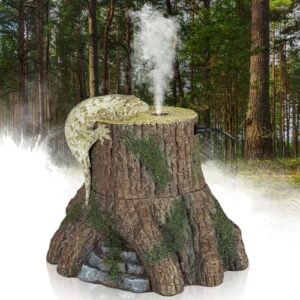
If your fogger is more workhorse than décor, this one splits the difference. The tf16’s resin trunk doubles as a climbing structure, so students see enrichment happening, not just a humidity gadget humming in the corner.
Water sits in the base — 1000ml worth — and the unit cycles 10 minutes on, 50 minutes off automatically, sipping power while keeping levels steady over a long weekend.
Bottom-fill design means no fumbling with hoses at 7am. Quick, quiet, done.
| Best For | classrooms or reptile keepers who want a low-maintenance humidifier that doubles as a naturalistic climbing feature for the terrarium. |
|---|---|
| Tank Capacity | 1000ml |
| Dry-Run Protection | No |
| Mist Technology | Ultrasonic |
| Adjustable Output | No |
| Hose Included | No |
| Target Species | General reptiles |
| Additional Features |
|
- Automated 10-on/50-off misting cycle keeps humidity steady with minimal power use
- Bottom-fill reservoir makes refills fast and mess-free
- Detachable resin trunk design adds enrichment value while staying easy to clean
- Requires cleaning 1–2 times per week to keep water quality in check
- Filter head needs periodic rinsing to keep misting performance consistent
- May arrive with residual water from factory testing
3. Blerema Reptile Fogger Humidifier
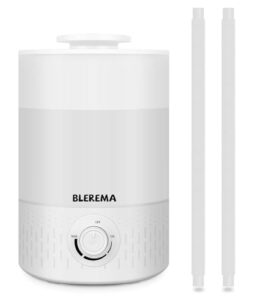
Not every classroom needs bells and whistles, and that’s exactly where the Blerema earns its spot. It runs a 2.5 to 3 liter tank, pushing out 250–320ml of fog per hour, with dry-run protection kicking in the second water runs low.
Top-fill access means quick refills between periods, and the adjustable output lets you dial fog down for smaller tanks. No chemicals, no fuss, just steady ultrasonic mist through distilled water and a design that forgives a busy teacher’s schedule.
| Best For | teachers and classroom terrarium keepers who want steady, low-maintenance humidity for reptiles and amphibians without babysitting the equipment. |
|---|---|
| Tank Capacity | 3 liters |
| Dry-Run Protection | Yes |
| Mist Technology | Ultrasonic |
| Adjustable Output | No |
| Hose Included | Yes, dual |
| Target Species | Snakes, tortoises, chameleons |
| Additional Features |
|
- Top-fill design makes refills fast and easy between class periods
- Dry-run protection automatically shuts off the unit when water gets low
- Adjustable, dual-hose output lets you fine-tune fog levels for different tank sizes
- 3-liter tank requires manual refilling once it runs dry
- Works best paired with a separate humidity controller or timer for hands-off operation
- Functions as a fogger only, not a direct water sprayer, so it won’t wet surfaces or plants directly
4. Top Fill Reptile Fogger Humidifier
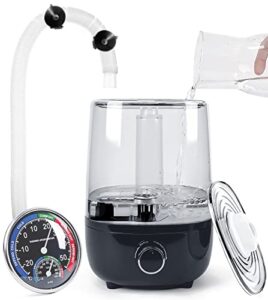
Simplicity wins again here. This one skips the digital screen entirely, using a wide-mouth top opening and mechanical knob instead, so refills happen mid-lesson without unplugging anything.
The 4L tank runs 20 to 40 hours depending on your mist setting, and hoses stretch 25.6 to 76 inches for flexible placement.
Dry-run protection flips on an indicator light when water’s low, which means no guessing games during a busy teaching day.
| Best For | Reptile, amphibian, and plant keepers who want a low-maintenance humidifier for vivariums, terrariums, or grow tents without fussing over digital controls. |
|---|---|
| Tank Capacity | 4L |
| Dry-Run Protection | Yes |
| Mist Technology | Cold fog |
| Adjustable Output | Yes, knob |
| Hose Included | Yes, extension |
| Target Species | Frogs, geckos, snakes |
| Additional Features |
|
- Top-fill design with a removable lid makes refills and cleaning quick and easy
- Automatic dry-out protection with an indicator light takes the guesswork out of monitoring water levels
- Flexible 25.6 to 76 inch extension hose allows versatile placement around enclosures
- Only functions as a cold fog machine, with no warm mist option
- Requires monthly cleaning to keep it hygienic
- Water levels still need regular manual checking despite the indicator light
5. Hoqqf reptile humidifier fogger
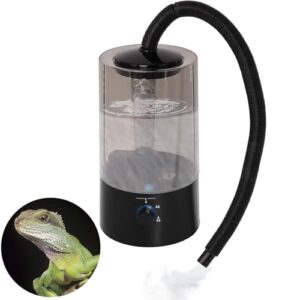
Ever had a fogger die mid-semester right when you need it most? The Hoqqf earns its spot with a straightforward 4L tank and ultrasonic misting built for shared classroom setups, not just single tanks.
That fine mist can push humidity up dramatically, so it helps to check ideal reptile humidity levels before dialing in your Hoqqf’s output.
Top-fill access means no disassembly during passing periods, and auto shut-off kicks in the moment water runs low, so you won’t fry the transducer during a hectic Monday.
Its flexible hose targets specific hides, while quiet operation keeps students focused instead of distracted by mechanical hums.
| Best For | Reptile and amphibian keepers—like chameleon, gecko, or bearded dragon owners—who need reliable humidity control for naturalistic, rainforest-style enclosures. |
|---|---|
| Tank Capacity | 4 liters |
| Dry-Run Protection | Yes |
| Mist Technology | Ultrasonic |
| Adjustable Output | Yes |
| Hose Included | Yes, extension |
| Target Species | Chameleons, dragons, geckos |
| Additional Features |
|
- Ultrasonic misting with adjustable fog levels creates consistent, natural humidity for tropical pets and plants
- Automatic shut-off protects the unit when water runs low, and the transparent tank makes checking levels simple
- Quiet operation and a flexible 24–80 inch hose let you direct mist precisely without disturbing animals
- Water must be added from the bottom of the tank, which can be less convenient than a top-fill design
- The 4-liter tank requires manual refilling once depleted, with no continuous water line option
- The fog hose can’t be bent during use, limiting some placement flexibility
6. Wacool Reptile Fogger Humidity Controller
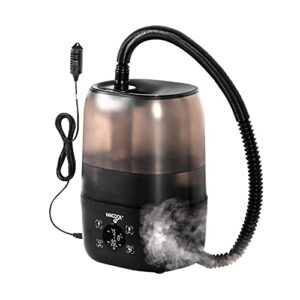
Twenty-five percent to ninety percent — that’s the humidity window this unit covers, thanks to a built-in controller reading real-time conditions off its LED display.
You set your target range, it cycles the fogger automatically, no guesswork required.
Dual-tube output waters two tanks from one 4L reservoir, running under 35 decibels so lessons stay uninterrupted.
Auto shut-off prevents dry burns, and that ±5% sensor accuracy means your bearded dragons and corn snakes each get exactly what they need.
| Best For | This fogger is best for reptile, amphibian, and tortoise owners who want automated, precise humidity control across one or two enclosures. |
|---|---|
| Tank Capacity | 4 Liters |
| Dry-Run Protection | Yes |
| Mist Technology | Ultrasonic |
| Adjustable Output | Yes, levels |
| Hose Included | Yes, extendable |
| Target Species | Reptiles, amphibians, tortoises |
| Additional Features |
|
- Automatic humidity controller with LED display keeps conditions steady without manual checks
- Dry-out protection and quiet pump operation make it safe and low-disturbance for pets
- Dual-tube design and adjustable misting levels (100ml, 200ml, or 300ml/hr) offer flexible setup for multiple tanks
- Humidity probe must be kept away from fog and water, adding placement constraints
- Requires monthly cleaning to avoid leakage issues
- Needs a stable surface, limiting placement options to prevent spills
7. Moistenland automatic reptile misting system
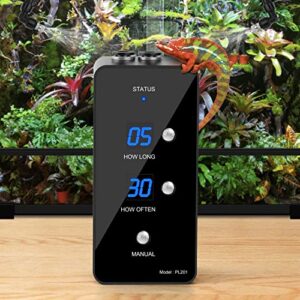
Sixteen feet of hose, one bucket, zero built-in tank to babysit — that’s the Moistenland’s whole pitch.
It skips the reservoir entirely, pulling from any external water source so you’re not refilling a tiny tank every other day. Dual 360-degree nozzles handle full coverage, and the LCD controller lets you program cycles from quick daily bursts to multi-hour intervals.
Priming the pump takes ten seconds if it’s sat idle. Tighten those nozzles, though, or you’ll get drips instead of mist.
| Best For | reptile, amphibian, and vivarium/paludarium owners who want automated, hands-off misting for long stretches away from home. |
|---|---|
| Tank Capacity | External bucket |
| Dry-Run Protection | No |
| Mist Technology | Pump spray |
| Adjustable Output | Yes, timer |
| Hose Included | Yes, 16ft |
| Target Species | Reptiles, amphibians, paludariums |
| Additional Features |
|
- Adjustable misting frequency from 1 hour to 30 days makes it easy to fit any care schedule
- External bucket reservoir means fewer refills than a small built-in tank
- Dual 360-degree nozzles give full enclosure coverage with a simple 10-minute setup
- Pump needs manual priming for at least 10 seconds if it’s been sitting idle
- Loose tubing or nozzles can lead to water leaks
- You have to supply and maintain your own external water reservoir
8. Coospider Reptile Fogger Mister Humidifier
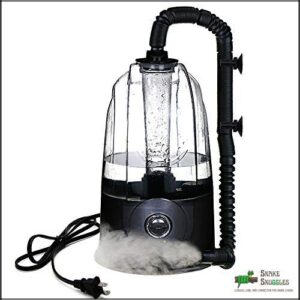
One knob, one job — that’s the Coospider’s whole appeal for a busy classroom.
Its 3.8L tank runs up to 26 hours on medium, so you’re not refilling between periods. Dry-off protection kicks in automatically, and hoses stretch 1.5 to 6.3 feet for flexible placement.
No timer, no hygrometer built in — you’ll add those separately. But under 35dB, it won’t compete with your lesson, humidifying quietly while students work.
| Best For | Classrooms or homes with a single 10-40 gallon terrarium that need quiet, hands-off humidification for reptiles, amphibians, or other herps. |
|---|---|
| Tank Capacity | 3.8L |
| Dry-Run Protection | Yes |
| Mist Technology | Ultrasonic |
| Adjustable Output | Yes, knob |
| Hose Included | Yes, extended |
| Target Species | Reptiles, amphibians, herps |
| Additional Features |
|
- Runs up to 26 hours on medium, so refills aren’t needed between periods
- Operates under 35dB, quiet enough to run during lessons or overnight
- Automatic dry-off protection with clear green and red indicator lights
- No built-in timer or humidity monitoring, so those must be added separately
- Water can’t be added and the unit can’t be moved while it’s running
- Requires manually flipping a power switch on the back to turn on
9. Repti Zoo Digital Reptile Fogger
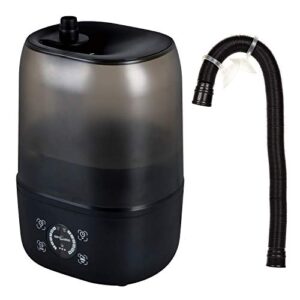
Want humidity control that basically babysits itself? The Repti Zoo Digital Fogger comes closest to it on this list.
Its built-in humidity controller reads real-time RH off a probe, then throttles output automatically, no guesswork needed. A digital display shows current and target humidity side by side, plus temp.
You get two modes: timer-based misting or full humidity control. Dual hoses handle multi-point coverage in one enclosure. Auto shut-off protects the pump when water runs low, and the 4L tank suits small-to-medium setups nicely.
| Best For | Reptile and amphibian keepers—like those with geckos, snakes, turtles, or frogs—who want a flexible, easy-to-refill misting system for maintaining terrarium humidity. |
|---|---|
| Tank Capacity | 4 liters |
| Dry-Run Protection | No |
| Mist Technology | Ultrasonic |
| Adjustable Output | Yes, touch screen |
| Hose Included | Yes, flexible |
| Target Species | Geckos, snakes, turtles, frogs |
| Additional Features |
|
- Smart touch screen remembers your previous settings, so you don’t have to reprogram it every time
- Adjustable mist output (100ml, 200ml, or 300ml per hour) with customizable timing for species-specific humidity needs
- Top-fill design and flexible 15.6–63.6 inch extension tubing make water refills and placement simple
- Doesn’t include a built-in humidity controller, so you’ll need to buy one separately for fully automatic humidity regulation
- Requires periodic manual water refills, especially at higher misting intensities
- Maximum runtime is about 12 hours at full mist output before the 4-liter tank needs topping off
10. Evergreen Pet Supplies Reptile Fogger
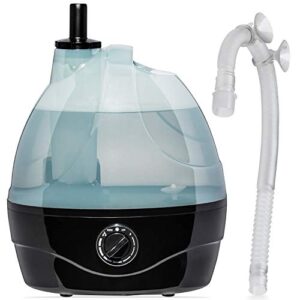
Big tank, minimal fuss — that’s the Evergreen’s whole pitch. Its 4-liter reservoir dwarfs most competitors, so classroom staff aren’t refilling between every period.
Ultrasonic transducers push out fine cool mist, and a flexible hose lets you aim coverage exactly where your enclosure needs it. The no-spill valve keeps refills tidy, no puddles on the cabinet.
Digital timer automation takes care of scheduling, while dry-run protection kills the motor before damage happens. Solid, low-drama choice for busy classrooms.
| Best For | Reptile and amphibian owners who want an easy, low-maintenance way to keep humidity steady in terrariums, frog tanks, or tortoise enclosures. |
|---|---|
| Tank Capacity | 2 Liters |
| Dry-Run Protection | Yes |
| Mist Technology | Ultrasonic |
| Adjustable Output | Yes |
| Hose Included | Yes, adjustable |
| Target Species | Reptiles, snakes, dragons |
| Additional Features |
|
- Adjustable fog output lets you customize misting levels for different pets
- No-spill valve makes refilling the tank quick and mess-free
- Automatic shut-off protects the unit from dry running
- 2-liter tank requires manual refilling more often than larger units
- Built specifically for terrarium/enclosure use, so it’s not versatile for other spaces
- Adjustable hose helps with placement, but setup still takes a bit of initial effort
Classroom Humidity Needs by Species
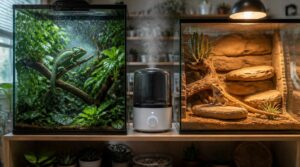
Not every reptile in your classroom wants the same kind of air, and that’s the part teachers often miss. A chameleon and a bearded dragon are practically living in opposite climates, even if their tanks sit two feet apart.
Here’s what each species actually needs to stay healthy, so you can match your humidifier settings to the animal, not just the room.
Tropical Reptile Humidity Ranges
Picture a rainforest floor at dawn, thick with mist clinging to leaves — that’s the humidity range your tropical reptiles expect, roughly 70-90%. Green tree pythons and chameleons need that arboreal hydration daily.
Mimic rainforest microclimates using a humidity gradient, wetter near hides, drier near basking spots. This helps with shedding cycle moisture and healthy skin, so watch dew point monitoring to avoid mold. Using digital tools helps maintain proper reptile humidity levels for your classroom animals.
Corn Snake Classroom Humidity
Corn snakes want a calmer world than their rainforest cousins, sitting comfortably between 40 and 60 percent humidity, with 50 percent as your sweet spot.
Watch for:
- Dull, stuck shedding cycle monitoring signs
- Dry, flaky scales near the tail
- Wheezing or thick nasal sounds
Calibrate your classroom hygrometer weekly, and let your reptile humidifier’s automatic shutoff protect substrate moisture management without soaking the terrarium setup.
Desert Species Moisture Limits
Bearded dragons and leopard geckos come from an arid climate playbook entirely, tolerating humidity levels down to 20-30%. They lean on prey water intake, substrate moisture refuges, and stored metabolic water for dehydration prevention.
Push humidity control past 40% and you’re inviting desiccation risk factors instead of comfort—these guys evolved for dry air, and humidity-temperature interactions matter more than raw numbers ever will.
Shedding and Dehydration Risks
Skipping a molt is never really "skipping" it — a snake stuck at low humidity just gets stuck skin, plain and simple. Retained shed traps old layers around eyes and tail tips, while dehydration adds wrinkled skin and sunken eyes to the mix.
A snake stuck at low humidity doesn’t skip its molt, it just gets stuck skin, trapped around the eyes and tail
Watch for:
- Patchy, incomplete sheds clinging to toes or tail
- Dull, tight-looking skin lacking normal elasticity
- Lethargy paired with reduced appetite
Consistent hydration and diet moisture keep molting on track.
Respiratory Health Warning Signs
How do you know when humidity trouble has crossed into respiratory territory? Watch for wheezing sounds, open-mouth breathing, or a cough sticking around past a few days. Add chest pain patterns, lethargy, or bluish skin (cyanosis) and that’s your cue for a vet, fast.
Consistent humidity control and clean water prevent most of this before it starts.
Choosing Classroom-Safe Humidifiers
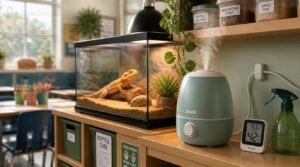
Not every humidifier belongs in a room full of kids and curious hands. Classroom setups need quiet motors, safe shut-offs, and hardware that won’t leak or malfunction mid-lesson. Here’s what actually matters when you’re picking one out.
Quiet Operation for Lessons
Ever try teaching a lesson while a fogger hisses like a leaky tire? Not fun.
Look for noise levels below 30 decibels, thanks to ultrasonic transducers instead of noisy fans. Vibration isolators keep units from buzzing against desks, and softened mist delivery avoids sudden pops.
Bonus: automatic shutoff with dry-run protection means silent, safe humidity control even when nobody’s watching the tank.
Tank Size and Refill Frequency
How big should your water reservoir be? Bigger tanks mean fewer trips across the room mid-lesson. Small units hold 0.5–2.5 liters; larger models offer 5–10 liter reservoirs, cutting refill frequency by roughly 10–15% per extra gallon.
Top-fill designs speed things up without disconnecting hoses. BPA-free polycarbonate resists cracking better than glass in busy classrooms—worth considering before it shatters mid-refill.
Auto Shut-off Safety
Picture a fogger running dry at 2am, motor grinding with nothing left to mist—that’s exactly what dry-run protection stops. Good units pair sensor-triggered shutdowns with temperature safety limits and electrical leak detection, cutting power before damage happens.
Look for:
- Fault code diagnostics for quick troubleshooting
- Automatic shutoff on low water
- Leak-detection circuitry
These features aren’t extras; they’re the backbone of safe humidity control in any classroom reptile humidifier.
Timer and Sensor Controls
Why babysit a humidifier when it can babysit itself? A humidity sensor paired with a controller reads real-time RH and triggers misting only when needed—true demand-based operation.
| Feature | Function | Classroom Benefit |
|---|---|---|
| Hysteresis | Prevents rapid cycling | Quiet lessons |
| Programmable timers | Sets schedules | Predictable routines |
| Manual override | Instant control | Controls emergencies |
Calibrate sensors monthly for accuracy you can trust.
Leak-resistant Hose Design
A drippy hose kills the whole misting system’s purpose. Look for braided steel reinforcement on your extension hose, plus crimped end fittings and tight compression seals—these resist swelling and pull-out.
- Check connections monthly for cracks
- Confirm the reservoir tank seats snugly
- Test for pressure surge dampening during startup
Leakproof design isn’t optional; it’s terrarium maintenance insurance.
Foggers Versus Misting Systems
Foggers and misters aren’t the same tool, even though students (and plenty of adults) mix them up constantly.
One fills the air with fine mist, the other soaks the substrate, and picking wrong means fighting your enclosure’s humidity all year.
Here’s how each type stacks up for classroom use, from single tanks to multi-enclosure setups that run themselves over the weekend.
Best for Ambient Humidity
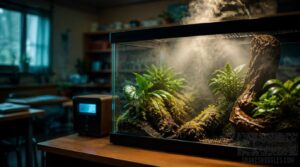
Ultrasonic foggers win for ambient humidity, hands down. That fine 5–10μm mist floats through classroom air instead of soaking surfaces, lifting RH into the 40–60% range tropical species need without drenching enclosure walls.
Place your hygrometer away from the direct mist stream for accurate readings, and coordinate with gentle airflow to prevent mold hotspots around terrariums.
Best for Substrate Moisture
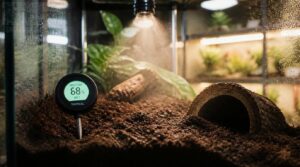
Misting systems earn their keep at the substrate level, delivering those 50–100 micron bursts that soak in rather than float away. That heavier droplet size helps maintain moisture retention between 40–60%, matching what coir and coconut fiber naturally hold.
Watch for:
- Substrate porosity preventing anaerobic zones
- Ideal depths of 3–5 inches
- Monthly moisture meter calibration
- Managing damp hides near young animals
Small Enclosure Compatibility
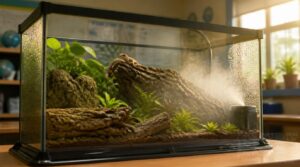
Ten-gallon tanks turn into humidity traps fast, since a fogger or mister sized for large vivariums overwhelms small enclosure compatibility. Look for units with adjustable mist output, tight seals, and hoses routed away from student traffic.
| Feature | Small Enclosure Need | Why It Matters |
|---|---|---|
| Vent placement | Opposite-side airflow | Prevents condensation |
| Sensor spot | Mid-height, away from spray | Accurate readings |
| Drip tray | Included | Catches overflow |
Multi-enclosure Classroom Setups
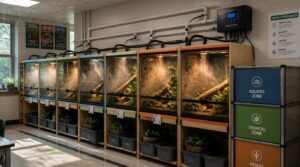
Once you’re running six or eight enclosures side by side, individual foggers become a nightmare to manage. Shared reservoir systems with a centralized control synchronization unit fix that, cycling humidity across every tank on one schedule.
Modular panel reconfiguration lets you resize zones as species change, while student zone identification borders keep kids at their own enclosure during group work.
Automation for Weekends
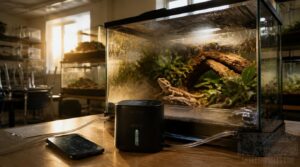
Nobody wants to drive to school Sunday morning just to mist a bearded dragon tank. That’s where weekend scheduling earns its keep, running Saturday 8:00 to Sunday 20:00 automatically.
- Sensors holding humidity within 5% of target
- Auto shutoff stopping misting if water runs low
- Remote dashboards showing logs from your phone
- Alerts flagging clogged nozzles before Monday’s lesson
Power outage protection keeps settings intact, no reprogramming needed.
Maintenance for Healthy Classrooms
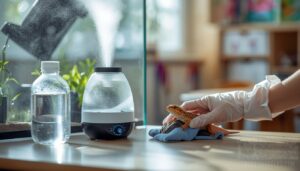
Buying the right humidifier is only half the job, keeping it running clean is what actually protects your class pet.
Skip a cleaning or use tap water once, and you’re looking at bacteria, scale, or a moldy corner nobody wants to explain to a principal.
Here’s exactly what that upkeep looks like, week by week.
Distilled Water Requirements
Ever wonder why your fogger clogs up after a month? Blame the water, not the machine.
Tap water carries dissolved minerals that cause mineral buildup, clogging nozzles and leaving white dust on glass. Stick with distilled or reverse-osmosis water—it’s got near-zero conductivity, so no scaling. Store it in sealed, opaque containers to curb pH drift from CO2 absorption. That’s real water purity maintenance, not busywork.
Weekly Cleaning Routines
Set a fixed day, say Sunday, for weekly maintenance—your reptiles won’t thank you, but their lungs will.
Empty collection trays and sanitize with diluted vinegar to dissolve scale. Disassemble nozzles, hoses, and reservoirs; scrub away biofilm and slime with warm soapy water. Dry every component fully before reassembly—trapped moisture invites microbial growth. Run a quick inspection checklist: cracks, leaks, clogs. Five minutes now prevents costly breakdowns later.
Mold Prevention Tips
Mold thrives on stagnant, damp air, so crack a window or run a classroom fan to keep air moving across walls and enclosure stands.
Wipe down nearby surfaces with EPA-registered disinfectant weekly. Check hoses and reservoirs for hidden leaks—damp corners breed spores fast.
Monthly deep cleans with distilled vinegar curb microbial growth and mineral buildup, keeping both your fogger and classroom air genuinely healthy.
Hygrometer Placement Checks
Placement makes or breaks accuracy. Mount your hygrometer at breathing height, away from sunlight, vents, and direct fogger spray to dodge localized peaks. Stay 10-20cm from corners to prevent boundary effects.
Got multiple enclosures? Try microclimate mapping—stagger sensors to catch true relative humidity, not skewed readings near doors, aquariums, or drafty exterior walls.
Safe Student Handling Rules
A well-run terrarium teaches responsibility, but only if handling stays gentle and structured.
- Support the chest and tail with both hands, never grab a limb or tail
- Wash hands before and after every session
- Watch for handling stress signs and stop immediately if they appear
- Rotate students every five minutes, logging duration and mood
Report bites or scratches right away. Your humidity control routine means little without safe, supervised hands.
Frequently Asked Questions (FAQs)
Can you have a humidifier in a classroom?
Think of your classroom as a tiny world, balancing warmth and moisture like a greenhouse. Yes, you can—with proper safety measures: stable placement, secured cords, auto shut-off features, and consistent humidity monitoring keeping both students and your reptile enclosure protected.
Are humidifiers good for reptiles?
Yes, when matched to species-specific moisture needs. A reptile humidifier helps with microclimate stability, hydration, respiratory health, and shedding assistance—key pillars of good reptile husbandry.
Get humidity levels wrong, though, and you’re trading one terrarium problem for another.
What humidifier is best for eczema?
For eczema, cool mist ultrasonic humidifiers win out—they add moisture without heat, easing skin hydration balance. Skip warm mist, which can worsen dryness. Use distilled water to dodge mineral dust irritation and keep respiratory health protected.
Are automatic reptile misters worth it?
For busy classrooms, automated misting beats manual spraying hands down. It cuts human error, ensures weekend care reliability, and saves time long-term. The upfront cost pays off through consistent humidity control—worth every penny for healthy reptiles.
How much does a reptile humidifier typically cost?
Don’t expect a bargain-bin price tag to cut it. Budget foggers start around $15–30, while full-featured units with hygrostats and automation run $50–100, and multi-nozzle misting systems for larger classroom setups can climb past $150.
Can students help operate the humidifier safely?
With dry hands and adult supervision, one assigned student can safely check the humidity sensor, report readings above 60%, and observe cleaning. They never refill units, touch cords carelessly, or override auto shutoff features designed to prevent overheating.
Where should the humidifier be placed in enclosures?
Mount at mid-height, 6–12 inches from walls, away from heat sources. Aim mist toward open air, not glass, to prevent wall saturation. Skip direct substrate placement — pooling and mold follow fast, disrupting your habitat’s humidity gradient.
How long does installation and setup usually take?
Picture a bell ringing while you’re still fumbling with hoses — that’s avoidable. A single reptile humidifier setup runs 15–30 minutes; add 5–15 minutes for digital pairing, and 3–6 minutes per extra unit for multi-enclosure classroom automation and misting systems.
What warranty coverage do reptile humidifiers usually offer?
Most brands offer 6 to 12 months covering manufacturing defects—motors, pumps, timers—not wear or misuse. Register within 30 days with proof of purchase to activate coverage. Skipping registration often shrinks protection to 90 days, so don’t lose that receipt.
Conclusion
Picture that same Monday morning months from now: clear eyes, smooth sheds curling off like paper, steady breathing instead of that telltale wheeze.
That’s the payoff of getting reptile humidifiers for classrooms right—no more Friday-afternoon guessing games about weekend humidity.
Your bearded dragon isn’t just surviving your teaching schedule; it’s thriving alongside it.
Pick the unit that matches your species and your classroom rhythm, then let consistency do the quiet work you can’t always be there for.