This site is supported by our readers. We may earn a commission, at no cost to you, if you purchase through links.

That tight coil around your wrist feels harmless enough, until you notice the head tucked deep inside it and the breathing rate climbing past 30 per minute. Snakes can’t whimper or pull away in any dramatic sense, so their stress hides in details most handlers miss entirely: a held S-curve, a flattened body, a jaw locked open a beat too long.
Reading the signs of discomfort during snake handling isn’t optional if you want a snake that tolerates you long-term. Miss the early cues, and you risk a defensive strike, a stress-related illness, or a snake that refuses food for two weeks straight.
Your snake is talking. You just need to know its language, from the subtle tremor in its muscles to the moment it’s finally telling you: enough.
Table Of Contents
- Key Takeaways
- What Are The Physical Signs of Discomfort During Snake Handling?
- What Snake Body Language Signals Handling Stress?
- What Changes After Handling Suggest Ongoing Stress?
- What Should You Do When Your Snake Seems Uncomfortable?
- When Do Discomfort Signs Require a Reptile Veterinarian?
- Frequently Asked Questions (FAQs)
- How to get a snake comfortable with handling?
- How to tell if a snake likes being held?
- How can you tell if a snake is in pain?
- Do snakes enjoy being handled?
- How often should I handle my snake weekly?
- Can snakes recognize their owners scent or voice?
- What time of day is best for handling?
- Do different snake species have different stress triggers?
- How long does it take stressed snakes to recover?
- How often is it safe to handle a snake?
- Conclusion
Key Takeaways
- Your snake’s body warns you long before it strikes—watch for a held S-curve, flattened posture, or a jaw locked open, since these subtle cues signal real distress.
- Open-mouth breathing, wheezing, stargazing, or persistent tremors aren’t just stress—they’re emergency signs that call for a reptile vet right away.
- Stress doesn’t always end when handling does, so watch for after-effects like hiding over 7 days, refusing food for 7-14 days, or repeated escape attempts against enclosure walls.
- When your snake tenses up, end the session calmly, support its full body, keep sessions to 10-15 minutes, and give it 24-72 hours to fully recover before handling again.
What Are The Physical Signs of Discomfort During Snake Handling?
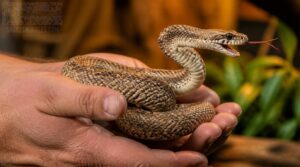
Your snake’s body talks long before it strikes or coils away. Some of what it’s saying shows up in the way it breathes, moves, or holds itself in your hands. Here’s what to watch for, sign by sign.
Learning to read these subtle cues—like tensed muscles, tongue-flicking patterns, or defensive posturing—starts with this guide to interpreting common snake body language.
Rapid or Labored Breathing
Watch the mouth, not just the coiling. Open mouth breathing past a minute or two signals real respiratory distress, not simple stress. Baseline runs 10-15 breaths per minute; handling can push it to 25-35. Listen for wheezing, check nasal flare, and confirm breathing rate recovery within 10-15 minutes once your snake’s back home. Since snakes lack a diaphragm and can’t cough, they’re especially vulnerable to airway mucus clearance issues, making prompt recovery after handling even more important to confirm.
Muscle Tension, Rigidity, and Tremors
Beyond breathing, put your hand along the body. Stress-induced rigidity feels like constant resistance through the whole range of motion, unlike normal muscle tone.
Tremors differ: rhythmic, involuntary shaking distinct from deliberate defensive posturing. Either sign, held past a few minutes, points toward genuine handling stress or possible neuromuscular trouble, not just an anxious wiggle.
Abnormal Head or Body Positioning
Position matters as much as tension. A head locked upward near 45 degrees, held for minutes without repositioning, signals stargazing, often linked to neurological disease. Watch too for corkscrewing, aimless spiraling with no forward progress.
- Head fixed rigidly skyward, unmoving
- Body spiraling with no direction
- Loss of coordinated movement
- Inability to right itself
- Disorientation during simple repositioning
Unexpected Eye Changes or Discharge
Eyes tell you more than most handlers realize. Clear discharge often means nothing, just lubrication. Thick white or yellow discharge signals infection.
Watch spectacle blood flow, too: those crisscrossed vessels engorge under stress, briefly sharpening vision for perceived threats.
Retained eye caps, from humidity below 40%, risk permanent damage within 24-48 hours if ignored.
Skin Discoloration, Lesions, or Swelling
Run your fingers gently along the body during handling, you’re checking skin integrity, not just watching for strikes. New red, purple, or dark patches often signal irritation or early scale rot. Raised bumps, crusty sores, or swelling with an ulcerated, necrotic texture aren’t cosmetic quirks, they’re red flags. Anything oozing or failing to heal needs a vet’s eyes, fast.
What Snake Body Language Signals Handling Stress?
Your snake’s body has its own vocabulary, and it’s talking to you long before it ever thinks about biting. Some of these signals look dramatic, others are easy to miss if you’re not paying attention. Here’s what to watch for, and what each posture is really telling you.
S-Shaped Neck Before Striking

That tight letter-S curve isn’t decoration, it’s a loaded spring. Neck curvature analysis shows the bend sits mid-neck, head retracted low, held just 0.2 to 0.8 seconds before a defensive strike.
If you spot that brief window, backing away calmly beats testing it — here’s a closer look at what actually triggers a defensive snake strike.
Watch for:
- Rapid tongue flicking
- Head tilted slightly
- Forebody lifted off substrate
- Narrowed eye focus
That’s your snake’s clearest body language signal: back off, now.
Hissing and Open-Mouth Warnings

When your snake hisses, it’s forcing air through its glottis, a sharp burst lasting one to three seconds, sometimes escalating into continuous warning.
Watch the sequence: hiss first, then a wide open-mouth display baring fangs, paired with a raised head and forward tension. Escalating hisses signal imminent strike risk. Nonvenomous species hiss too, so never assume safety.
Body Flattening or Sudden Freezing

A puffed-up snake isn’t bluffing for fun, it’s terrified. Defensive flattening can widen the body by 50%, mimicking venomous species like rattlesnakes or cobras. Puff adders inflate entirely; garter snakes flatten just the head.
Then there’s the opposite: sudden freezing. Rigid, tongue stops flicking, waiting you out. Poor hides or wrong temps trigger both. Either way, back off.
Tail Rattling or Rapid Vibration
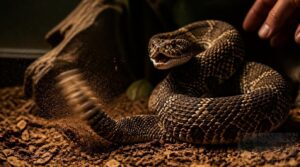
Hear that buzzing against the substrate? That’s not decoration, it’s a warning shot.
Vibration frequency spikes with fear: faster taps signal higher defensive strike risk, paired with hissing, rapid breathing, and body tension.
Common triggers:
- Sudden movement near the head
- Cornering against enclosure walls
- Prolonged, unwanted restraint
- Perceived predator shadows
- Repeated handling attempts
Respect the signal.
Tight Coiling or Balling Up
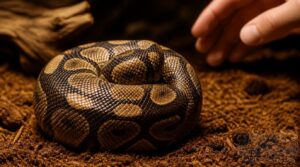
Ball pythons earned their name honestly: when overwhelmed, they collapse into a defensive posture, head tucked deep inside the coil.
This isn’t stubbornness, it’s a stress response mechanism. Tight coiling signals extreme discomfort, a clear space requirement signal. Continued handling now risks real harm.
Set the snake down. Walk away. Let it unwind on its own terms.
When your snake is overwhelmed, set it down, step back, and let it unwind on its own terms
What Changes After Handling Suggest Ongoing Stress?

Not every stress signal shows up mid-handling — some only surface once your snake is back in its enclosure. A calm session can still leave lingering effects, and those effects tell you just as much as the coiling or hissing did. Here’s what to watch for in the hours and days after you set your snake down.
Repeated Escape Attempts
Pressing repeatedly against glass walls for hours, not casual exploring, signals real trouble. Escape behavior intensifies with wrong temps (over 90°F), poor humidity, or recent enclosure changes.
Handling during these episodes backfires: rough sessions raise future attempts 25%, while gentle handling cuts them 40%.
Left unresolved past 30 days, chronic attempts alter stress responses permanently and shorten lifespan by 2-3 years.
Excessive Hiding After Handling
Escape attempts fade, but hiding takes over, and that’s not automatically good news.
Vanishing for more than 7 days signals excessive hiding, not shyness. Culprits: handling too soon after feeding, temps off by 2-3°F, humidity below 40%, or shedding cycles. Watch for sluggish tongue flicks and motionless hours.
Fix it: weekly handling, a second hide, stable temps. Visibility often returns within 10-14 days.
Refusing Food After Handling
A snake that skips a meal after handling isn’t being dramatic, it’s stressed. Handling too soon after feeding, wrong temps, or rushed acclimation trigger loss of appetite lasting 7-14 days.
Fix it:
- Wait 48+ hours post-feeding before handling
- Adjust feeding schedule around sessions
- Use secure prey presentation methods
- Respect species-specific tolerance
- Allow full handling recovery time
Sudden Lethargy or Restlessness
Appetite loss isn’t the only red flag. Watch what happens in the hours after handling: does your snake go still, or does it pace restlessly? Sessions over 10 minutes often trigger noticeable lethargy, while poor body support can cause sudden restlessness. Both suggest temperature disruption and stress.
Give at least 30 minutes of undisturbed rest in a proper thermal gradient.
What Should You Do When Your Snake Seems Uncomfortable?

Spotting the warning signs is only half the job — what you do next matters just as much. A stressed snake needs a clear, calm response, not guesswork or panic. Here’s exactly how to handle those first critical minutes.
For step-by-step guidance, proven techniques for calming a stressed snake can help you respond with the quiet confidence your reptile needs.
End The Session Calmly
Timing is everything here. Watch for relaxed, rhythmic tongue flicks, steady breathing, and loose muscles, not rapid probing or tension. If your snake starts exploring enclosure edges or drifts toward its hide, that’s your cue.
- Slow, deliberate tongue flicks
- Calm, even breathing rate
- Muscles hanging loose, tension-free
- Body drifting naturally toward the hide
End there. Don’t push for "just a few more minutes.
Support The Entire Body
Because unsupported weight causes real spinal strain, Proper Midsection Support matters most. Distribute weight across both hands, never grip head or tail.
| Body Length | Handlers Needed | Support Method |
|---|---|---|
| Under 4 ft | 1 | Midsection support |
| 4-6 ft | 1-2 | Hand over hand |
| Over 8 ft | 2+ | Multi handler coordination |
Safe lifting techniques and steady hand placement prevent regurgitation and defensive strikes.
Return Snake to Its Hide
Ending the session right starts with putting the snake back correctly. Approach the hide calmly, tilt it diagonally, and let gravity help. Tickle the belly scutes gently, never force. Familiar scent substrate and a one-way entrance ease the move. Let it slither off freely before closing up, then wash your hands.
Check Temperature and Humidity
A stressed snake often means a stressed enclosure. Grab your hygrometer and thermometer before assuming behavioral issues:
- Basking zone: 28-32°C
- Cool end: 24-26°C
- Humidity: 40-60% RH
- Sensor placement: eye level, 10cm from water
Calibrate monthly. Drifting readings, not defiance, may explain that irritable coil.
Adjust Timing and Session Length
Ever noticed your snake tense up at 2pm but flick its tongue calmly by dusk? Timing matters. Cap sessions at 15 minutes, less for new snakes, and skip handling within 48 hours of feeding or during shed.
| Factor | Guideline |
|---|---|
| Frequency | 1-2x weekly |
| Duration | 5-15 min |
| Post-feed wait | 48 hrs |
Adjust gradually, always watching body language.
When Do Discomfort Signs Require a Reptile Veterinarian?
Some warning signs fade once you set your snake down and let it settle. Others don’t—and pushing through them can turn a manageable problem into an emergency. Here’s when it’s time to stop guessing and call a reptile vet instead.
Open-Mouth Breathing or Wheezing
A snake gasping for air isn’t dramatic, it’s an emergency. Open-mouth breathing or wheezing (that whistle or coarse rattle on exhale) signals real airway obstruction, not stress alone.
Watch for rapid breathing, visible chest effort, or gaping during handling. These respiratory distress indicators mean stop immediately and call a reptile vet. Breathing effort like this doesn’t resolve on its own.
Stargazing or Lost Coordination
Picture a snake tilting its head skyward, twisting in corkscrew loops it can’t control: that’s stargazing, and it’s neurological, not behavioral.
Often linked to Inclusion Body Disease, a fatal bornavirus, it starts with abnormal positioning and progresses toward paralysis.
Vestibular failure, disrupted proprioception, even overheating can trigger it. This demands immediate veterinary evaluation and isolation from other reptiles.
Persistent Tremors or Muscle Rigidity
A brief quiver during handling might mean nothing, but a persistent tremor signals real trouble. Watch for rhythmic shaking at rest, not just during movement. Muscle rigidity assessment matters here: is your snake’s body abnormally stiff?
Get veterinary help if you notice:
- Resting tremor evaluation shows constant shaking
- Tremor frequency stays regular, not random
- Muscle tension persists after release
- Postural changes trigger tremor
- Neurological tremor causes seem likely
Eye, Skin, or Scale Abnormalities
Cloudy eyes past a normal shed cycle, spots on the cornea, or scales that won’t separate all point to trouble. Retained eye caps signal humidity below 50%. Yellow-green discharge means infection. Check ventral scales for stress lesions or discoloration too.
| Sign | Likely Cause | Action |
|---|---|---|
| Cloudy eye caps | Low humidity | Vet-guided soak |
| Discharge | Infection | Antibiotics |
| Retained scales | Dehydration | Veterinary removal |
Repeated Regurgitation or Feeding Refusal
A snake that vomits its meal isn’t being dramatic, it’s telling you something failed: wrong prey size, poor temps, or handling too soon after eating. Wait 8 days before refeeding, then offer prey half the previous size.
Refusing food past 14 days despite good husbandry? That’s your vet visit trigger, not a wait-and-see situation.
Frequently Asked Questions (FAQs)
How to get a snake comfortable with handling?
Trust builds like a bridge, one plank at a time. Follow a gradual acclimation process: wait a week, use short handling sessions, gentle handling techniques, full body support, and a calm pre-handling environment with hiding spots available.
How to tell if a snake likes being held?
A content snake moves with relaxed body posture, flicks its tongue out of curiosity rather than alarm, holds steady eye contact, and tolerates extended handling calmly, showing smooth curves instead of rigid, defensive coiling.
How can you tell if a snake is in pain?
Watch for rapid breathing, muscle tension, and hissing. Abnormal positioning, defensive posturing, and shifts in eye appearance or skin color often signal pain too, your snake’s body rarely lies about what it’s feeling.
Do snakes enjoy being handled?
Not exactly enjoy, but many tolerate it well when supported properly. Species and individual temperament vary widely. Building trust gradually, using safe handling techniques, and reading comfort signals turns tolerance into calm familiarity over time.
How often should I handle my snake weekly?
More isn’t better, less isn’t lazy: it’s calibration. Colubrids tolerate roughly three sessions weekly; ball pythons prefer two to three. Defensive or unknown-history snakes need just one to two, with gradual increases based on observed comfort.
Can snakes recognize their owners scent or voice?
Yes, through scent recognition, not voice. Your snake’s forked tongue samples your chemical signature via the Jacobson’s organ, building familiarity over repeated handling. Voice barely registers, low vibrations only complement scent cues, never replace them.
What time of day is best for handling?
Groggy at noon, alert by dusk: your snake’s clock rules the encounter. Match crepuscular handling windows or diurnal basking periods, keep sessions to ten to fifteen minutes, and stick to a consistent daily routine for calmer results.
Do different snake species have different stress triggers?
Absolutely, species-specific triggers shape everything. A ball python tolerates handling far better than an arboreal species denied climbing space, or a burrowing animal without deep substrate, since enclosure sensitivity, climate reactivity, and social isolation stress vary by evolutionary background.
How long does it take stressed snakes to recover?
Give it 24 to 72 hours under calm, stable conditions. Breathing and heart rate normalize within a day; appetite usually returns in 1 to 3 days. Skip repeat handling until then, rushing it only resets the clock.
How often is it safe to handle a snake?
Like a tide, handling should ebb and flow, not crash daily. Wait 48 to 72 hours after feeding, keep sessions to 10-15 minutes, and always let stress signals, not the calendar, set your schedule.
Conclusion
One day, the snake that always tolerated handling coils tighter, breathes faster, and refuses to soften. That moment matters.
Recognizing signs of discomfort during snake handling means catching the flattened body, the frozen stare, the S-curve, before it becomes a strike. Your snake can’t say stop, so its body does. Listen early, act calmly, and you’ll build trust that lasts years instead of a bond broken by one missed warning.