This site is supported by our readers. We may earn a commission, at no cost to you, if you purchase through links.

Most people picture a high-maintenance pet and immediately think fur, noise, and a daily walk in the rain—but snakes operate on an entirely different logic.
A ball python, for instance, eats once every two weeks, occupies a 40-gallon enclosure, and produces no sound whatsoever.
That’s not a compromise; that’s an architecture for low-stress ownership that suits apartments, busy schedules, and anyone who’d rather observe than constantly entertain.
Snake ownership for beginners carries an undeserved reputation for difficulty, but the fundamentals—stable heat gradients, appropriately sized prey, and a secure enclosure—are measurable, controllable, and learnable.
Get those variables right, and you’re most of the way there.
Table Of Contents
- Key Takeaways
- Why Snakes Suit Beginners
- Best Beginner Snake Species
- Before You Bring One Home
- Choosing a Safe Enclosure
- Heating and Humidity Basics
- Substrate, Hides, and Decor
- Feeding Your First Snake
- Safe Handling and Stress Reduction
- Cleaning and Health Checks
- Long-Term Care and Costs
- Frequently Asked Questions (FAQs)
- Are pet snakes a good choice for a beginner?
- Should you own a pet snake?
- How do I choose a pet snake?
- What is a good beginner snake?
- What is the best snake for a beginner owner?
- Where do snakes go in October?
- What do I need to know as a first time snake owner?
- How often do snakes shed their skin?
- Can snakes recognize their owners over time?
- What costs should I budget for annually?
- Conclusion
Key Takeaways
- Ball pythons and corn snakes top the beginner list because they eat every 10–14 days, stay under 5 feet, and tolerate new keepers without much fuss—making the husbandry curve genuinely manageable.
- Your enclosure needs a warm-to-cool thermal gradient (88–92°F down to 70–75°F), a thermostat on every heat source, and a secure escape-proof lid before your snake ever arrives home.
- Always buy captive-bred only—lower parasite loads, documented lineage, and cleaner health records make a real difference, especially when you’re still learning to spot early signs of illness.
- A ball python can live 25–30 years, so before you commit, line up a reptile-experienced vet, set a realistic budget covering food, heating, and emergency vet costs, and check your local laws for species permits or HOA restrictions.
Why Snakes Suit Beginners

Snakes fit surprisingly well into everyday life, especially if you’re short on space or time. They don’t bark, don’t need walks, and a well-kept enclosure takes up less room than most people expect.
If you’re still not sure it’s the right fit, convincing your parents to get a snake is easier than you’d think once they see how low-maintenance the setup really is.
Here’s what makes them genuinely manageable for first-time keepers.
Quiet, Space-saving Pet Benefits
Unlike dogs or cats, a pet snake won’t wake your neighbors — or you. Snakes produce virtually no vocalization, making them an ideal apartment-friendly pet where noise complaints are a real concern.
A beginner snake care setup fits comfortably on a shelf, with enclosure size generally ranging from 20 to 40 gallons.
- Noise-Free Living: No barking, meowing, or chirping — ever.
- Compact Habitat Design: Minimal footprint means more floor space for you.
- Low Energy Use: A single thermostat keeps the whole enclosure running efficiently.
Low Daily Attention Compared With Mammals
Beyond noise levels, snakes are genuinely low maintenance in day-to-day terms. A beginner snake care guide will tell you that reptile husbandry centers on enclosure self-sufficiency — passive temperature control manages most of the work while you’re at the office.
Infrequent feeding schedules mean adults eat every 10–14 days. Minimal interaction needs and a low maintenance habitat make this a practical fit for busy lives.
Common Beginner Myths About Snakes
Before you even shop for a beginner-friendly snake species, it helps to clear up a few persistent misconceptions about snake ownership.
Many people assume snakes are aggressive by nature — they aren’t; defensive biting is self‑protection, not personality. Snakes aren’t slimy either; their keratin scales are dry to the touch.
And no, snakes don’t hypnotize prey or all constrict — hunting strategies vary considerably by species.
In fact, Snakes help control rods by reducing pest numbers in domestic homes.
What Snake Ownership Really Involves
Now that the myths are out of the way, here’s what responsible snake ownership actually looks like day-to-day.
Your enclosure needs a secure, escape-proof lid, a warm-to-cool heat gradient, and humidity levels matched to your species.
Owner education matters from day one — feeding frozen-thawed prey, monitoring health, and scheduling annual reptile vet visits are long-term commitments spanning 15 to 30 years.
Best Beginner Snake Species

Not every snake belongs in a beginner’s hands, and that’s actually good news—it narrows your choices down to a short, well‑studied list of species that genuinely tolerate new keepers. Each one on this list has earned its reputation through consistent temperament, forgiving husbandry requirements, and decades of captive‑bred availability.
Here’s what you need to know about each of them.
Ball Pythons for Calm Temperaments
Ball pythons earn their beginner reputation through genuinely calm body language and a quiet activity cycle that suits most households. Their gentle acclimation to handling — built through short, consistent sessions — makes routine care straightforward.
Watch for these behavioral comfort signs:
- Slow, relaxed movement across your hands
- Steady breathing without wheezing
- Curious tongue-flicking rather than striking
- Loose coiling instead of tight defensive balling
Low‑stress enrichment, like secure hides and stable temperature gradients, keeps their snake temperament and handling predictable long‑term.
Corn Snakes for Easy Care
Corn snakes stand out when choosing beginner-friendly snake species because their forgiving nature extends across every aspect of care.
Their steady growth rate and slender build make prey selection simple — juveniles eat pinky mice every 5–7 days, while adults shift to larger feeders every 10–14 days.
A predictable shedding cycle, moderate night temps around 70–75°F, and stunning color morphs make them genuinely rewarding to keep.
Kenyan Sand Boas for Smaller Setups
If space is your main constraint, Kenyan sand boas are worth serious consideration — adults rarely exceed 2–3 feet, and a 36-by-18-by-18-inch enclosure accommodates them comfortably.
Burrowing behavior drives substrate selection: 3–4 inches of dust‑free sandy material facilitates burrow depth optimization naturally.
Rosy Boas for Dry Habitats
Rosy boas are fundamentally desert specialists in a compact package — adults stay between 2–3 feet and thrive where other snakes would struggle.
They need a seasonal temperature gradient running from 88–92 °F at the basking end down to 65–70 °F during desert night cooling.
Low humidity management is critical: keep levels under 40%.
For substrate selection, aspen shavings support natural burrowing depth while rocky crevices décor completes the habitat.
Choosing Captive-bred Snakes Only
Every captive-bred specimen you buy represents a deliberate choice — one that upholds breeder ethics, protects wild populations, and puts a healthier animal in your hands.
Captive-bred snakes carry considerably lower parasite loads than wild-caught individuals, and reputable breeders provide lineage records that verify genetic health. That documentation matters for responsible pet ownership.
Always confirm legal certification before purchasing, and never compromise on ethical sourcing.
Before You Bring One Home

Getting a snake isn’t something you do on a whim — there’s real groundwork to lay before that first enclosure even enters your home. From local permits to vet contacts, each step matters more than most beginners expect.
Here’s what you need to sort out first.
Check Local Laws and Permits
Before you fall in love with a ball python at a breeder’s table, check your local zoning regulations and species bans first. HOA policies and municipal ordinances can quietly prohibit certain reptiles regardless of what state law allows.
Some jurisdictions require permit applications, impose inspection requirements, or mandate escape-proof housing documentation. Understanding these legal considerations and legal requirements for exotic pets protects both you and your snake.
Set a Realistic Budget
Once the legal paperwork clears, money becomes your next honest conversation with yourself.
Initial Setup Costs usually run 100 to 250 euros, covering enclosure, heating, substrate, and hides. Monthly Expense Tracking for feeding and utilities averages 30 to 70 euros.
Build an Emergency Vet Fund of 100 to 300 euros, plan for Growth Upgrades, and factor in Energy Usage Estimates across a 15- to 30-year commitment.
Find a Reptile-experienced Veterinarian
Budget sorted — now, finding a reptile-experienced veterinarian deserves the same level of intention.
Don’t assume your nearest general practice qualifies. Finding a Reptile Veterinarian means specifically seeking an exotic veterinarian comfortable with herpetological medicine — ideally a Board-certified specialist through the ABVP’s Reptile and Amphibian category. Use a local reptile directory like ARAV’s "Find a Vet" tool or ReptiFiles’ Reptile Vet Directory to locate qualified providers near you.
Here’s why it matters before day one:
- Veterinary care for reptiles starts with a baseline — an initial vet consultation documents your snake’s weight, condition, and parasite status so any future changes don’t go undetected.
- A preventive exam schedule protects against silent illness — snakes mask symptoms well, and twice-yearly reptile health monitoring can catch problems before they become emergencies.
- Low-stress handling during exams reduces cardiovascular risk — snakes are sensitive to stress-induced physiological responses, so ask whether the practice uses Fear Free or similar low-stress handling protocols.
Also worth asking: does the practice offer insurance coverage guidance for exotic patients? It’s a small question that can save you from a very large bill.
Buy Supplies Before Purchase
With your vet lined up, the next move is straightforward: buy everything before the snake arrives.
Run through an Essential Gear Checklist — thermostat, heat source, substrate, hides, and water bowl — and do a Supplier Reputation Review alongside a Return Policy Check before ordering.
Shipping Timing Coordination matters too; don’t let supplies arrive after your snake does.
Discount Bulk Savings on substrate or feeders can offset early costs noticeably.
Prepare for a 15- to 30-year Commitment
Buying your supplies is the easy part — committing to the next two or three decades is a different matter entirely. A rosy boa or ball python can live 25 to 30 years, and that snake lifespan consideration changes everything about this decision. Long‑term snake commitment means planning across life stages you haven’t reached yet.
A ball python can outlive a family dog — choose one only if you’re ready to plan across decades
- Build a Financial Reserve for food, heating, and unexpected vet bills
- Schedule Health Tracking logs covering feeding dates, shed cycles, and weight
- Budget for Equipment Upgrades as your snake outgrows its starter enclosure
- Draft an Emergency Plan with a backup caregiver and a travel-ready transport container
- Join a Community Network through a local reptile club for ongoing, real-world support
Long‑term pet commitment isn’t dramatic — it’s just consistent, informed care, year after year.
Choosing a Safe Enclosure
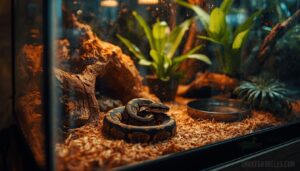
Getting the enclosure right is one of the most important decisions you’ll make as a new snake keeper.
A poorly designed setup can stress your snake, create escape risks, or make routine husbandry far harder than it needs to be. Here’s what to think about when choosing a safe, functional home for your snake.
Pick The Right Tank Size
Tank size isn’t just about comfort — it’s about survival. For most beginner species, your enclosure’s footprint calculation starts with a simple rule: the floor length should equal at least 1.5 times the snake’s total length.
Growth projection matters too, so plan for adult dimensions from day one. Factor in weight support and stand stability, since a filled 40-gallon setup is surprisingly heavy.
Use a Secure, Escape-proof Lid
Even a docile corn snake will exploit a loose lid given enough time — and they’re surprisingly methodical about it.
Escapeproof lids depend on several overlapping security features:
- Locking hinge design prevents lifting without deliberate disengagement
- Magnetic catch safety holds the lid flush until intentionally released
- Dual gasket redundancy seals gaps that compromise your temperature gradient and thermostat efficiency
Tamper-evidence seals and ventilation pressure balance complete a genuinely secure enclosure security system.
Add a Water Bowl and Hides
Your water bowl and hides do more work than they get credit for.
For bowl size selection, choose a vessel wide enough for occasional soaking but shallow enough to prevent spillage — glass or stainless steel simplifies water leak prevention and humidity control.
For thermoregulation positioning, place hides on both the warm and cool sides, using ceramic or smooth plastic for hide material safety.
Leave Room for Easy Cleaning
Cleaning becomes far easier when enclosure is designed with access in mind from the start.
Clear enclosure openings, smooth tank walls, and removable substrate trays cut maintenance time considerably:
- Leave 6 inches of clearance on all sides
- Use tool-free lid design for quick weekly spot cleaning
- Position accessible water bowls on removable bases
Good enclosure design makes cleaning and hygiene protocols sustainable long-term.
Plan for Adult Snake Size
Planning for your snake’s Adult Length Forecast from day one saves money and stress. A ball python reaches 3–5 feet within 2–4 years, so your Enclosure Expansion Plan should account for that Growth Timeline early.
Weight Tracking monthly helps you anticipate Future Habitat Needs before cramping occurs.
Following housing size recommendations of 40–60 gallons for adults ensures your Snake Enclosure Setup Beginner Basics — proper enclosure dimensions and habitat setup — scale correctly.
Heating and Humidity Basics
Getting the temperature and humidity right is honestly where most beginners either succeed or struggle. Your snake can’t regulate its own body heat, so the environment you build does that work for it.
Here’s what you need to set up and monitor.
Create a Warm-to-cool Gradient

Think of your enclosure like a color wheel made physical — warm reds on one end, cool blues on the other, with a smooth midtone shift between. Your snake’s thermal gradient should run from 88–92 °F on the warm side down to 70–75 °F on the cool end, giving it full temperature regulation control.
That gradient directly influences mood, activity, and digestion.
Use a Thermostat on All Heat Sources

That gradient only holds if your heat sources stay under real control — which is where a thermostat earns its place. Without one, a heat mat or ceramic emitter runs continuously, pushing temperatures well beyond your target range.
Follow probe placement guidelines carefully, positioning the sensor at resting height, not buried in substrate.
Match wattage to your thermostat’s load rating, and rely on built-in thermostat fail-safes as your last line of defense, not your first.
Measure Temperatures With Digital Thermometers

Your thermostat controls the heat, but your digital thermometer tells you what’s actually happening inside that enclosure. Thermistor vs RTD sensors both work well here — thermistors are affordable, while RTDs offer tighter accuracy for multi-point monitoring across your temperature gradient.
Key probe placement tips for reliable readings:
- Position probes at resting height, not buried in substrate
- Place one probe at each end of the enclosure
- Never rely on a single measurement point alone
- Follow a calibration schedule every few months to catch drift
Infrared contact comparison tools are handy for quick surface spot-checks, though a fixed probe gives you continuous data you can actually trust.
Track Humidity With a Hygrometer

Once your temperature probes are placed, humidity monitoring deserves equal attention.
A digital hygrometer with data logging capability captures overnight fluctuations you’d otherwise miss entirely.
| Hygrometer Feature | Why It Matters |
|---|---|
| Placement Tips | Keep sensors away from the water bowl |
| Calibration Schedule | Recalibrate every six months to prevent drift |
| Reading Interpretation | 40–60% suits most beginner species |
| Battery Management | Spare batteries prevent unexpected data gaps |
Adjust Levels During Shedding
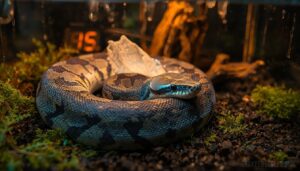
Humidity regulation techniques shift noticeably once your hygrometer signals the start of a shedding cycle. A Pre-shed Humidity Boost of 10–15% above your baseline helps the old skin loosen cleanly, but Ventilation Management still matters — stagnant air invites bacterial growth even while you’re raising moisture levels.
Watch for these Shed Progress Monitoring cues:
- Blue-tinted eyes indicate the molting process is actively underway
- Dull, patchy scales signal the temperature gradient needs checking alongside humidity
- Incomplete sheds in pieces mean parts stayed too dry
- Retained eye caps call for a consistently damp sphagnum moss hide
- Wrinkled skin after shedding suggests Damp Substrate Control wasn’t maintained long enough
Substrate, Hides, and Decor

What’s inside your snake’s enclosure matters more than most beginners expect. The substrate, hides, and any décor you add directly shape whether your snake feels secure, stays healthy, and behaves naturally.
Here’s what you need to get right before your snake ever moves in.
Choose Safe, Dust-free Substrate
Substrate choices matter more than most beginners expect.
Aspen shavings and coconut husk rank among the best low-dust options because their coarse texture stays firm under a burrowing snake without releasing airborne particles that irritate respiratory tissue. Paper towels and newspaper work well for moisture management and hygiene-friendly substrate maintenance, since both use non-toxic materials and let you spot waste immediately.
Avoid Loose Material That Risks Impaction
Sand, calcium sand, walnut shell, and loose gravel all carry real impaction risk — meaning an intestinal blockage that becomes a medical emergency if indigestible particles accumulate faster than your snake’s gut can clear them.
Stick with non-particulate flooring or established substrates like aspen shavings, cypress mulch, or coconut husk, and always feed on a dedicated feeding surface to keep loose bedding avoidance practical and consistent.
Place Hides on Both Enclosure Sides
Dual hide placement is one of those non-negotiable details that separates a functional proper enclosure from one that just looks the part. Position one hide within your warm thermal microclimate zone to support digestion and a second on the cool end for retreat.
appropriate hide size matters — your snake should fit entirely inside.
Easy-clean hide design and enrichment hide variety keep maintenance simple, as the temperature gradient does its job.
Add Simple Décor for Security
Décor does more than make your enclosure look good — it actively reduces stress.
Cork bark camouflage panels along the back wall, a frosted acrylic rear panel to minimize reflection, and a soft textured mat outside create layered enclosure security and escape prevention without cluttering the space.
Keep decorative items lightweight and movable, so routine substrate and enclosure decor checks stay quick and straightforward.
Match Substrate to The Species
Every species has different ground-level expectations, and getting this wrong affects everything downstream.
Ball pythons and corn snakes do well on aspen shavings — a natural, moisture retention substrate that facilitates habitat mimicry without encouraging bacterial growth. Rosy boas need temperature-compatible bedding like coconut husk to stay dry.
Match your substrate choices and impaction risk mitigation strategy to species-specific care requirements, and substrate turnover frequency practically regulates itself.
Feeding Your First Snake
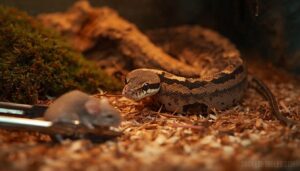
Feeding a snake is simpler than most beginners expect, but it does come with a few non-negotiable rules worth knowing upfront.
Get these right early, and you’ll sidestep most of the common feeding problems that trip up new keepers.
Here’s what you need to know before your snake’s first meal.
Offer Frozen-thawed Prey
Frozen-thawed rodents are the standard in responsible herpetological practice — safer for your snake, safer for you. Use controlled thawing by submerging sealed prey in warm water until it reaches the target temperature of roughly 37 °C.
Strict hygiene protocols apply throughout: wash hands, use tongs, and discard uneaten prey after the feeding window closes, usually 15–20 minutes.
Prey rotation keeps feeding responses consistent over time.
Match Prey Size to Snake Girth
Once you’ve nailed the thaw, sizing is your next checkpoint. Match prey diameter to your snake’s widest girth point — that midsection measurement is your practical prey size guideline.
A proper lump check during swallowing confirms you’ve got it right: a visible but manageable bulge, not strain.
Oversized prey risks regurgitation and stress. When uncertain, a weight ratio around 10% of body weight settles the call.
Set Juvenile and Adult Schedules
Once prey size is dialed in, feeding frequency becomes your next variable. Juvenile feeding frequency runs every 5–7 days, supporting rapid growth rate demands. Adult feeding interval stretches to 10–14 days, matching slower metabolism.
Apply schedule adjustment rules based on weight‑based timing — if midbody thickens, space meals further. Shedding impact matters too; delay feeding mid-cycle, since appetite naturally drops and digestion slows.
Use Feeding Tongs Safely
Tongs are your best defense against accidental strikes. Keep 15–25 cm stainless steel tongs between your hand and the snake’s strike zone, presenting frozen-thawed rodents slowly and level with the snake’s head.
Overextension prevention matters — don’t jab the prey forward.
Hold sessions under five minutes, then sanitize tong tips with reptile-safe disinfectant.
Simple grip posture safety habits like these prevent most feeding mistakes.
Handle Feeding Refusals Calmly
Even with perfect tong technique, refusals happen — and that’s completely normal. Your response matters more than the refusal itself. A quiet feeding environment, minimal interaction, and patience and timing do most of the heavy lifting here.
- Wait a few minutes, then withdraw the prey calmly
- Record refusal data: date, prey size, and enclosure temps
- Verify gradual prey size matches current girth
- Check for pre-shed cloudiness or behavioral changes
- Resume at the next scheduled feeding session without forcing
Safe Handling and Stress Reduction

Handling a snake well is less about bravado and more about reading the animal and moving with intention. Done right, it builds trust on both sides of the equation.
Here’s what to keep in mind before you pick your snake up.
Let The Snake Settle After Arrival
Think of your snake’s first two weeks like a job interview — it’s watching you just as much as you’re watching it. The acclimation period demands patience: complete your initial temperature check before the snake arrives, confirm hides are placed correctly per snake housing requirements, and minimize disturbance. Log observations daily.
| Day Range | Your Action | What You’re Watching For |
|---|---|---|
| Days 1–3 | Minimize disturbance entirely | Snake locating its hides |
| Days 4–7 | Daily observation logs only | Relaxed, unhurried movement |
| Days 8–10 | Initial temperature check review | No defensive posturing |
| Days 11–12 | Offer first meal | Calm feeding response |
| Days 13–14 | Assess readiness to handle | Settled, unstressed behavior |
Temperature and humidity management in reptile keeping must stay stable throughout this quarantine period — sudden shifts reset whatever comfort your snake has built.
Support The Whole Body Properly
snake’s weight across both hands is the single most important handling technique you’ll use. Slide your hand under the body rather than grabbing from above, and never grip the tail — unsupported segments cause stress and defensive responses.
Dual-hand support maintains stable body alignment, keeps snake temperament calm, and signals that handling is safe, not threatening.
Keep Handling Sessions Short at First
When you’re just starting out, shorter sessions do more for handling confidence than longer ones ever will.
Begin with calm transfer technique — a controlled, low-stress move from enclosure to hand — and stop at the first stress signal identification: stiffening, frantic wriggling, or repeated escape attempts.
Gradual time increase, paired with consistent observation before handling and limited session frequency, steadily improves your snake’s temperament and trust.
Avoid Handling After Feeding
After your snake swallows a meal, enforce a strict digestive rest period of 24 to 48 hours — no exceptions. Post-meal stress dramatically raises regurgitation risk, because lifting disrupts body alignment and interferes with normal digestion.
Feeding scent sensitivity also peaks during this window, heightening defensive responses. Limit yourself to enclosure monitoring only, checking temperatures and water without touching the snake.
Supervise Children and Other Pets
Even the calmest corn snake can react defensively when a curious toddler grabs its tail. Active supervision rules aren’t optional — designate barrier separation zones around the enclosure, teach safe touching boundaries consistently, and stay fully present. Reading stress signals early prevents most incidents.
Cross-species safety matters too; other pets can startle or corner a snake unexpectedly, so physical separation is your safest protocol.
Cleaning and Health Checks

A clean enclosure and a watchful eye are two of the most underrated skills in snake keeping. Your snake can’t tell you when something’s wrong, so you’ll need to catch problems early through routine observation and consistent maintenance.
Here’s what to stay on top of.
Spot-clean Waste Daily
Daily spot-cleaning is your first line of defense against odor buildup and bacterial accumulation. Focus your waste location identification on warm zones, hides, and water‑adjacent areas where feces and chalky urates tend to concentrate.
Use dedicated hygiene tools — a reptile‑safe scoop or disposable paper towels — and follow sound disposal methods by bagging waste immediately.
This substrate hygiene habit meaningfully reduces Salmonella transmission risks.
Replace Water Every Day
Fresh water beats spot-cleaning every time for one simple reason: a neglected bowl becomes a bacterial incubator quickly.
Replace yours daily to support:
- Water Temperature Consistency — room-temp water encourages normal drinking behavior
- Hydration Tracking — level drops reveal drinking patterns or enclosure leaks
- Bowl Leak Detection — daily refills expose tipping or seepage early
- Mold Prevention — stagnant water invites bacterial growth in warm enclosures
- Hygiene practices to prevent Salmonella transmission — fresh water removes post-drinking contaminants immediately
Deep-clean on a Regular Schedule
Beyond daily water changes, your enclosure needs a quarterly deep-clean to prevent pathogen buildup that routine spot‑cleaning simply can’t address.
Remove your snake, strip all substrate, then scrub surfaces using color‑coded supplies to avoid cross‑contamination.
Apply an EPA‑approved disinfectant and respect the labeled contact time fully.
A HEPA vacuum controls fine dust before post‑clean drying and resetting temperature and humidity management.
Watch for Wheezing or Discharge
Once your enclosure is clean and reset, shift your attention inward — to the snake itself.
Audible wheezing signs, like high-pitched whistling during exhalation or a wet, rattling breath, are never normal.
Nasal discharge types range from watery to pus-filled, and either warrants prompt veterinary attention.
Humidity irritation and feeding aspiration risks can both trigger respiratory infections, so treat any new breathing change as a vet emergency flag.
Check for Mites and Scale Issues
After checking for respiratory symptoms, turn your attention to the skin.
Mite spotting means scanning under the chin, around the vent, and along belly scales with a flashlight — mites appear as tiny moving dark specks. Scale rot detection involves looking for discolored or softened patches.
Check enclosure cracks for hidden mite colonies, and begin isolation treatment immediately if you find either problem.
Long-Term Care and Costs

Owning a snake isn’t just a hobby — it’s a decades-long commitment that comes with real, recurring costs. Before you get too comfortable with your setup, it’s worth understanding exactly what the long haul looks like financially and practically.
Here’s what you’ll want to plan for.
Plan for Heating and Food Expenses
Running costs surprise most first-time keepers, but they’re manageable once you map them out. A small enclosure usually draws 5–15 watts continuously, making Seasonal Heater Usage and Cost-Effective Enclosure Insulation genuine money-savers during colder months.
For feeding, Bulk Prey Savings of 5–15% come from ordering frozen rodents in quantity.
Key expenses to budget monthly:
- Heating – roughly €2–5 via Energy Consumption Estimates
- Prey – €10–25 depending on Feeding Frequency Optimization and snake size
- Substrate/supplies – €5–10 for routine maintenance
Keep Feeding, Shedding, and Weight Records
Tracking every feeding date, prey size, and shed outcome turns raw data into a diagnostic tool you’ll genuinely rely on. Log Entry Templates keep your records consistent, while Weight Trend Charts reveal gradual declines before they become emergencies.
Shed Quality Scoring flags shedding problems early, and Prey Size Tracking refines your feeding schedule over time. Together, these Health Correlation Metrics connect weight monitoring with feeding basics and safety protocols seamlessly.
Schedule Annual Reptile Vet Visits
Even if your snake looks perfectly healthy, scheduling at least one annual visit with a reptile veterinarian remains a cornerstone of responsible reptile health management.
Your preparation checklist should include feeding logs, weight records, and enclosure data. Consistent record keeping makes every visit more productive.
The vet will conduct diagnostic tests — fecal parasite screens, physical palpation, possibly X-rays — then outline clear follow-up plans.
Recognize When Care Needs Change
Your snake won’t tell you when something’s wrong — but it will show you.
Behavioral shifts like sudden inactivity, persistent hiding, or refusing food beyond the normal fasting window are stress signs in snakes worth investigating immediately.
Weight monitoring across successive weigh‑ins, shedding issues such as retained eye caps, respiratory signs like wheezing, and hydration cues including wrinkled skin all signal that temperature and humidity management needs reassessment.
Prepare for The Snake’s Full Lifespan
ball python can outlive a family dog — some reach 30 years, and corn snakes commonly hit 20.
That’s a genuine long-term commitment requiring lifespan monitoring, aging enclosure needs, and long-term nutrition adjustments as your snake matures.
Document genetic lineage when possible, maintain an emergency care fund for unexpected vet costs, and treat lifespan and commitment considerations as seriously as any other aspect of responsible herpetological husbandry.
Frequently Asked Questions (FAQs)
Are pet snakes a good choice for a beginner?
Well begun is half done" — and with beginner reptile care, choosing the right low-maintenance pet from the start makes all the difference. Yes, snakes are an excellent choice for beginners.
Should you own a pet snake?
If you’re drawn to a low-maintenance, quiet companion with real longevity, a captive-bred snake might suit you — provided you’re ready for the long‑term commitment, ethical sourcing, and beginner reptile care it genuinely demands.
How do I choose a pet snake?
temperament match, growth potential, and breeder credibility.
captive-bred corn snakes and ball pythons offer color morph variety, clean health records, and forgiving care needs — ideal when choosing beginner-friendly snake species.
What is a good beginner snake?
Corn snakes and ball pythons top the list for their docile temperament, small adult size, and low initial cost — genuinely the best snakes for beginners seeking minimal space needs and easy morph selection.
What is the best snake for a beginner owner?
For most beginners, corn snakes and ball pythons top the list — both species offer a gentle learning curve, manageable feeding size, wide pet store availability, and impressive lifespan expectancy that rewards long-term commitment.
Where do snakes go in October?
Like clockwork, snakes retreat to autumn denning sites as October’s cold-night cycles trigger brumation — burrowing into rock crevices, root systems, or burrows where temperature shelter stays stable throughout winter.
What do I need to know as a first time snake owner?
Start with species selection, enclosure setup, and feeding basics. Learn behavioral indicators early, handle gently, and keep an emergency kit ready. Choosing beginner-friendly snake species makes every step more manageable.
How often do snakes shed their skin?
Juvenile snakes shed every 2–4 weeks during growth spurts, while adults average every 4–8 weeks.
Age-related frequency, species shedding variation, and seasonal shedding patterns all influence your snake’s molting cycles throughout its life.
Can snakes recognize their owners over time?
Scent signals, not sight, drive snake recognition. Your snake’s Jacobson’s organ reads owner scent association repeatedly, building behavioral cues within weeks — a quiet, practical bond rooted in familiarity, not affection.
What costs should I budget for annually?
Annually, budget roughly $60–260 for prey costs, $20–60 for substrate replacement, $40–100 for veterinary expenses, $60–180 for electricity bills, and any applicable licensing fees depending on your local regulations.
Conclusion
The enclosure you build is a microcosm—every dial you set, every hide you position, every prey item you thaw reflects the exactness that defines responsible snake ownership for beginners.
There’s no guesswork once you understand the variables; there’s only steady, informed practice.
A ball python that eats reliably, sheds cleanly, and moves without hesitation is telling you something precise: the environment is correct. That’s not luck—that’s husbandry done right.