This site is supported by our readers. We may earn a commission, at no cost to you, if you purchase through links.

A ball python squeezed into a fist-sized coil isn’t hiding. It’s running a survival program written over millions of years of ectothermy, one that trades surface area for control. Tuck the head, layer the loops, drop the exposed skin by nearly 40%, and heat loss slows dramatically.
That instinct explains why snake coils tightly across nearly every context you’ll witness: warmth, threat, digestion, rest. The same posture that shields a heart from impact also stabilizes gut temperature after a meal. Read the coil right, and you’re reading your snake’s entire physiological state.
Table Of Contents
- Key Takeaways
- Snakes Coil Tightly for Warmth and Safety
- How Temperature Affects Tight Coiling
- When Tight Coiling Signals Stress
- Why Snakes Coil After Eating
- Coiling Differences Among Snake Species
- When Tight Coiling Needs Attention
- Frequently Asked Questions (FAQs)
- Can snakes bite if not coiled?
- Why is my snake all coiled up?
- What month do snakes go away?
- How can you tell a snake is happy?
- Does coil tightness vary between morning and night?
- Can two snakes coil together in one enclosure?
- Does substrate type influence how snakes coil?
- Why do snakes coil during shedding periods specifically?
- Do pregnant snakes coil differently than males do?
- Conclusion
Key Takeaways
- Coiling tightly is pure physics for your snake—it cuts exposed skin by nearly 40%, trapping warmth and slowing heat loss.
- The same posture doubles as armor, shielding your snake’s heart, lungs, and kidneys from impact.
- After a meal, tighter coils hold heat around the gut, keeping enzymes working efficiently and digestion on track.
- Rapid, repeated coiling paired with hissing or head-tucking is a stress signal, not curiosity, and it’s your cue to back off.
Snakes Coil Tightly for Warmth and Safety

A tight coil isn’t random—it’s a snake’s multi-purpose tool for survival. Warmth, safety, and even hunting success all tie back to this one posture. Here’s what that coil is actually doing for your snake.
Understanding the different meanings behind snake coiling behavior can help you tell a defensive posture apart from one that’s simply about staying warm.
Conserving Body Heat
Since snakes are ectotherms, coiling is pure physics: tighter loops mean less surface area, less convective heat loss, and a warmer thermal boundary layer. Ambient temperature buffering happens as body wraps trap insulating air pockets.
Heat conservation strategies include:
- Reducing exposed skin
- Trapping warm air
- Slowing radiative loss
- Retaining metabolic heat
Behavioral thermoregulation like this keeps center temperature stable overnight.
Snakes rely on behavioral adaptations to maintain center body temperature.
Protecting Vital Organs
Warmth isn’t the only payoff. A tight coil is a fortress: overlapping loops shield the heart and lungs, cushion the liver, and buffer the kidneys against impact. Essential organs sit centered, insulated by muscle and scale.
A tight coil is a fortress, shielding heart, lungs, and kidneys behind insulating loops of muscle and scale
Defensive coiling doubles as organ protection. Squeeze the loops tighter, and you’re guarding what actually keeps a snake alive.
Resting and Saving Energy
Guarding organs isn’t the only job a tight coil does. It’s also a budget move.
A resting coil cuts surface area, slashing conductive heat loss and letting your snake drop its metabolic rate without dropping internal temperature. That’s passive heat retention at work: stillness plus geometry, not extra calories, keeps the body warm.
Fewer muscle contractions, slower kidney and liver output. Pure energy conservation.
Preparing to Strike
That same stillness turns lethal in an instant. Your snake’s head tilts down, tongue flicking to confirm prey type, eyes locked for distance and timing.
The neck shortens, body tightening into an S-shaped strike coil. This posture anchors the tail while loading elastic energy, priming muscles for a lunge that can exceed 700 m/s².
Supporting Digestion
A full meal changes everything. Your snake curls tighter, using thermal regulation digestion to hold heat where enzyme activation happens fastest.
Coiling raises body temperature, supporting gut motility and nutrient absorption despite gut distension.
- Boosts enzyme concentration
- Speeds digestive efficiency
- Elevates metabolic rate post-feeding
- Aids postmeal coiling stability
- Protects the digestive process
How Temperature Affects Tight Coiling

Temperature isn’t just background noise for your snake—it’s the switch that controls how and why it coils. Ectothermy means your snake can’t generate its own heat, so every coil is a calculated response to what’s around it. Here’s what that looks like in different conditions.
A well-tuned enclosure lets your snake dial its body temperature in just right, which becomes crucial when it comes to managing shed cycles through proper thermal control.
Heat Retention
Big body, small surface, less heat lost. That’s ectothermic thermoregulation in action.
| Factor | Effect |
|---|---|
| Larger body | Slower heat loss |
| Smooth scales | More conduction |
| Rough scales | Less evaporation |
| Tight coil | Minimized surface area |
Coiling shrinks exposed surface, trapping warmth against muscle. Digestion adds metabolic heat too, extending heat retention naturally between basking sessions.
Basking While Coiled
A rock never argued with a sunbeam, and neither does a basking snake. It settles into a thermoregulatory coil, angling exposed loops toward direct light while the shaded middle stays insulated.
This positioning boosts sun exposure optimization:
- Dorsal scales catch maximum radiant heat
- Coiled sides shield the belly from wind
- Body shifts slowly toward thermal equilibrium
Cold Enclosure Temperatures
Ectothermy means your snake borrows warmth from its enclosure, so a cold enclosure forces tighter coiling every time. Keep temperatures between 70 and 85°F, checked with two independent sensors, not one guess-y dial.
Watch substrate heat absorption too: dark liners hold warmth, light ones reflect it. Get thermal gradient setup wrong, and coiling becomes constant, not occasional.
Warm and Cool Zones
A single hot spot won’t cut it. Your enclosure needs a real thermal gradient: warm zone 28-32°C, cool zone 20-26°C, verified by temperature monitoring.
Watch basking behavior patterns, a stretched basking coil versus a tucked shade coil tells you plenty.
- Wrong gradient stunts digestion
- Cool zone retreat prevents overheating
- Species-specific zones matter (pythons run hotter)
- Ectothermy demands your precision
When Tight Coiling Signals Stress
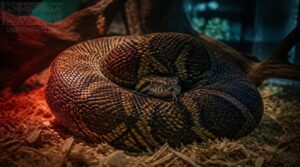
Not every coil means comfort. Sometimes that tight posture is your snake telling you something’s wrong. Here’s how to read the warning signs before they escalate.
Defensive Head Tucking
Watch the head first. A snake curling its skull beneath its own coils isn’t resting, it’s signaling threat perception.
This protective reflex fires within seconds. Eyes keep tracking you, mouth stays closed, body goes still. That’s a tight defensive coil doing its job, and your handling frequency shapes how often you’ll see it.
Sudden Repeated Coiling
Head tucking is one signal. Rapid, repeated coiling is another, and louder.
You’ll see multiple tight wraps forming within seconds, pausing, then tightening again. That’s a stress response pattern, not random movement. It escalates when handling feels sudden or escape routes vanish, and it’s a clear defensive threat display meant to bluff size before things turn physical.
Hissing and Striking
Repeated coiling can escalate fast. Hiss intensity climbs, air forced through the glottis in sharp bursts, a clear threat display paired with rising coil tension.
A raised, flattened neck signals strike readiness. That S-shaped posture stores elastic energy for genuine strike velocity, so treat it as a hard boundary, not a bluff to test.
Environmental Stressors
Before hissing even starts, something in the enclosure usually set it off. Humidity swings and poor airflow dry the skin, prompting defensive folds. Erratic light cycles and nearby noise or vibration spike stress hormones. Crowded tanks, murky water dishes, weak thermal gradients: each forces the same response. Coiling is just physiological stress management doing its job.
Safe Handling Responses
Once coil tightness spikes, your job is simple: stop. Pausing during tight coils beats pushing through them.
Offer a retreat option, let the snake reset, then resume only if it relaxes.
- Recognize stress signals early
- Use gentle handling techniques
- Observe without manipulation
- Prioritize safe handling responses
Patience prevents strikes.
Why Snakes Coil After Eating

A full meal changes everything about how your snake behaves next. That tight coil isn’t random—it’s doing real physiological work. Here’s what’s actually happening inside that curled-up body.
Maintaining Digestive Temperatures
Digestion runs on heat. Enzymatic activity spikes right after a meal, and tight coiling locks in that metabolic heat conservation, buffering against outside temperature swings. Coil tightness creates a stable microtemperature around the gut, a thermal buffering effect that keeps enzymes working efficiently.
Without it, digestive enzyme efficiency drops, slowing enzymatic breakdown until stable gut temperature returns.
Protecting a Full Body
A snake that just swallowed dinner is vulnerable, so full body shielding matters most now. Coiling gives structural stability while organ protection and injury prevention take priority.
- Shields important organs
- Prevents rough impacts
- Maintains defensive posture
- Preserves coil tightness
- Signals cautious body language
This defensive coiling keeps thermal regulation and energy conservation intact until digestion finishes safely.
Reducing Unnecessary Movement
Metabolic demands spike after a meal, so your snake’s body prioritizes stillness over exploration. Energy conservation and thermal regulation work together here.
Smart enclosure layout efficiency matters most now. Consistent resource placement strategy and stable routine path consistency mean your snake won’t wander for warmth or shelter, letting coil tightness hold steady while the digestive process runs uninterrupted.
Post-Feeding Handling Risks
That tight coil is a "do not touch" sign. Handling within two hours risks regurgitation, disrupted digestive efficiency, and postprandial quiescence collapse.
- Skip lifting the midsection
- Avoid loud noises or vibration
- Watch for stress signals like defensive coiling
- Respect species sensitivity, juveniles disturb easily
Injury prevention and thermal regulation matter more than curiosity right now. Let digestion finish undisturbed.
Coiling Differences Among Snake Species
Not every snake coils the same way, and that’s no accident. Species carry their own coiling signatures, shaped by body type, habitat, and instinct. Here’s how five common snakes put their own spin on the coil.
Ball Python Balling
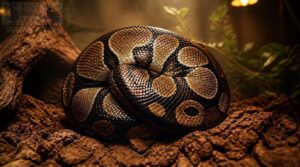
Few postures scream "leave me alone" like a defensive coiling sphere with the head buried dead center. That’s textbook Balling Behavior Triggers: fear, handling stress, unfamiliar enclosures.
Balling in Captivity looks identical whether it’s Balling Posture Meaning or thermal regulation at play. Balling Frequency Patterns shift too, tight and frequent when stressed, a loose resting coil when your ball python’s simply content.
Boa Constrictor Coils

Unlike the ball python’s sphere, a Boa Constrictor favors elongated, stacked loops for thermal regulation and ambush reach.
This tight spiral helps organ protection and digestive efficiency after large meals, while conserving energy between strikes. Gravid females hold broader, stable coils, balancing strike readiness with the demands of the digestive process and steady energy conservation.
Corn Snake Postures
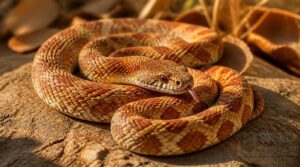
Where boas stack loops, the corn snake favors a classic S shaped coil on warm surfaces, aligning its body for thermal regulation near the center.
This posture doubles as prey strike positioning before ambush, and it shifts into a broad, motionless ring during the digestive process, holding a warm microclimate steady while gastric work proceeds undisturbed.
Juvenile Snake Reactions
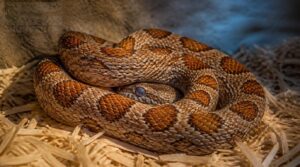
Young snakes react faster and tighter than adults, full stop. That corn snake’s calm S curve? A juvenile skips it for a reflexive defensive coil, head tucked, at the smallest disturbance.
Handling stress, cool enclosures, even a pending shed cycle all trigger this. Their heat conservation response runs hotter too, since smaller bodies lose warmth faster along any temperature gradient.
Arboreal Snake Coiling

Height changes everything. Green tree pythons wrap thick branches in tight circular coils, using ventral scale friction and load-bearing tail anchors for grip. Brown tree snakes rely on ventrolateral keels for rough bark.
Branch diameter dictates coil tightness. Perching within a sheltered thermal microclimate, they balance humidity, temperature gradients, and substrate contact. Juveniles perch looser, refining technique with age.
When Tight Coiling Needs Attention
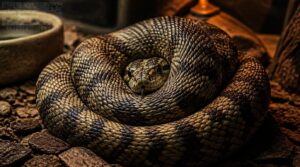
Most coiling is normal—but not all of it. Sometimes a tight coil is your snake’s way of telling you something’s wrong. Here’s what to watch for, and when it’s time to act.
Understanding how long snakes can hold their breath can also help you spot stress—a snake hiding underwater longer than usual may be signaling discomfort.
Persistent Abnormal Posture
A snake stuck mid-loop for days isn’t resting, it’s talking. Persistent abnormal posture signals real trouble, not quirky behavior.
Watch for:
- Rigid coiling beyond normal rest
- Head tucked with no trigger
- Coiling unrelated to feeding or temperature
- No shift after enclosure changes
These stress signals often reflect neurological stress or environmental strain, warranting veterinary assessment when postural communication doesn’t resolve.
Breathing or Balance Problems
Open-mouth gasping, shallow breaths, or wheezing during a coil signals respiratory distress, not calm rest.
Wobbling, tipping, or a delayed righting reflex points to balance issue causes like inner ear trauma or neurological symptoms.
Airway obstruction risks or poor enclosure temperatures worsen breathing compromise. Neither resolves alone.
Get veterinary care fast, respiratory compromise mitigation can’t wait once posture and breathing both falter.
Refusing Food
A coiled body that won’t eat tells its own story. Slow mouth movement and head-turning away from prey signal refusal, often paired with stress or poor prey size matching.
Feast-or-famine physiology means missed meals aren’t automatically alarming, but refusal past two weeks warrants veterinary consultation, especially with weight loss or lethargy alongside it.
Incorrect Enclosure Conditions
Persistent tight coiling often traces straight back to the enclosure itself. Check the temperature gradient first, then humidity, ventilation, substrate, water access, and lighting cycle.
- Uneven heat zones disrupt thermal exchange
- Humidity imbalance causes shedding stress
- Poor ventilation triggers sluggish, compact posture
Fix conditions before assuming illness.
When to Contact Veterinarians
Know when observation ends and intervention begins. Nasal discharge, mouth swelling, weight loss, skin discoloration, or persistent bleeding all warrant same-day veterinary care, not a wait-and-see approach.
Neurological stress signs, disrupted shedding cycles, or coiling despite correct humidity levels and enclosure size point toward Inclusion Body Disease. Don’t gamble on guesswork here. A reptile veterinarian can rule out what home observation simply cannot.
Frequently Asked Questions (FAQs)
Can snakes bite if not coiled?
Don’t be fooled: a snake needs no armor to swing its sword. Rattlesnakes and cobras deliver a defensive bite response at full non-coiled strike speed, hitting targets with sharp strike precision and efficient venom delivery.
Why is my snake all coiled up?
Context matters here. It’s likely thermoregulation or rest. But tight balling with head tucked signals stress. Watch for species-specific patterns, recent feeding, or handling disturbances before assuming trouble.
What month do snakes go away?
Most snakes retreat by October, as brumation season begins and temperature-driven inactivity sets in. Spring emergence timing varies by species and region, usually March or April, once thermal inertia and warming microhabitats signal it’s safe to resume normal seasonal behavior.
How can you tell a snake is happy?
Look for relaxed body language, clear bright eyes, and smooth scale texture. A content snake shows a consistent feeding response and calm exploratory behavior, gliding smoothly around its enclosure without hissing, striking, or repeated defensive coiling.
Does coil tightness vary between morning and night?
Coincidentally, your cold-blooded pet mirrors your own morning stiffness. Coil tightness follows a circadian rhythm, loosening at dawn for basking, then tightening by night as temperature-driven shifts and lower activity trigger heat conservation across the enclosure’s gradient.
Can two snakes coil together in one enclosure?
Rarely, and only with caution. Territorial coiling behavior, feeding zone competition, and stress-induced coiling make cohabitation risky even for siblings. A large enclosure with a solid temperature gradient and separate hiding space helps, but doesn’t guarantee peaceful coexistence.
Does substrate type influence how snakes coil?
Picture sand shifting underfoot versus rough bark grip: surface texture dictates coil tightness. Loose substrate prompts deeper coils for weight distribution; smooth, hard surfaces flatten coils.
Moisture boosts friction impact, while substrate depth shapes coil height and comfort.
Why do snakes coil during shedding periods specifically?
Compression traps a humidity pocket against the skin, aiding moisture retention and skin elasticity. The tight coil anchors your snake’s body, creating friction against substrate that loosens old skin from head to tail during shedding.
Do pregnant snakes coil differently than males do?
Yes. Gravid females shift to broader, stable coils, protecting eggs and conserving energy rather than mating readiness.
Males show no abdominal expansion or brooding posture.
Females also reduce movement, since energy conservation now outweighs typical exploratory body language.
Conclusion
A fortress doesn’t announce why it raises its walls. It just does, instinct built into every stone.
That’s why snake coils tightly, whether guarding warmth, a full belly, or a startled nerve. You now hold the translator’s key: loop tension, head position, and context tell you exactly what’s happening beneath the scales. Read that coil like a diagnosis, not a mystery. Your snake was never silent. You just weren’t listening yet.