This site is supported by our readers. We may earn a commission, at no cost to you, if you purchase through links.

A 100-pound Burmese python doesn’t telegraph its strike—one second it’s coiled, the next your hand is inside its mouth. Even experienced keepers get caught off guard, and bare skin against those recurved teeth means lacerations, punctures, and a serious cleanup job afterward.
The right pair of snake handling gloves for large constrictors won’t make you invincible, but they buy you the fraction of a second you need to react without flinching. Choosing well means understanding what the leather, stitching, and sleeve length actually do when pressure meets scale.
Table Of Contents
- Key Takeaways
- 10 Best Gloves for Large Constrictors
- 1. Steiner Y Series 23 Inch Welding Gloves
- 2. MarineStore Heavy Duty Leather Snake Gloves
- 3. Hand Max Kevlar Leather Gauntlet Gloves
- 4. Caiman Premium Split Deerskin Welding Gloves
- 5. TurtleSkin Bravo Police Duty Glove
- 6. XuYelora Animal Handling Bite Proof Gloves
- 7. WZQH Leather Animal Handling Gloves
- 8. RAPICCA Bite Proof Animal Gloves
- 9. RAPICCA Leather Animal Handling Gloves
- 10. Surfante Bite Proof Animal Gloves Snake Hook
- What Handling Gloves Actually Protect
- Bite Resistance Vs Real-World Safety
- Best Materials for Constrictor Gloves
- Glove Length for Large Constrictors
- Fit, Grip, and Dexterity
- Safe Handling With Protective Gloves
- Cleaning and Maintaining Snake Gloves
- How to Choose The Right Pair
- Frequently Asked Questions (FAQs)
- What gloves can snakes not bite through?
- Should you wear gloves when handling snakes?
- What gloves do they use on Deadliest Catch?
- Are snake handling gloves suitable for beginners with constrictors?
- Which safety certifications matter for large constrictor gloves?
- Can I use these gloves during feeding sessions?
- How well do gloves perform in hot, humid climates?
- What other protective gear pairs best with constrictor gloves?
- Can gloves protect against constrictor coiling pressure?
- Do gloves affect snake stress during handling?
- Conclusion
Key Takeaways
- No glove is truly bite-proof, so treat even the best leather-and-Kevlar pair as a risk reducer, not a guarantee, and always back it up with solid handling technique.
- Forearm coverage matters as much as hand protection, since large constrictors bite and rake the full length of your arm, making elbow-length or gauntlet-style gloves a smarter pick than short-cuff options.
- Fit directly affects control, because a loose glove slows your reaction time, dulls tactile feedback, and can shift at the worst possible moment during active restraint.
- Regular inspection of stitching, seams, and worn leather zones is non-negotiable, since material fatigue builds quietly with each use and a glove that looks fine can fail fast under real strike pressure.
10 Best Gloves for Large Constrictors
Finding the right gloves for large constrictors comes down to a few key factors — coverage, material strength, and how well you can still move your hands. Each option on this list brings something a little different to the table, whether that’s extra length, reinforced stitching, or a better grip.
If you’re still narrowing down which glove fits your specific snake and hand size, this guide to snake handling gloves for educators and reptile handlers breaks down how to match protection level to species and measure for a proper fit.
Here’s what made the cut.
1. Steiner Y Series 23 Inch Welding Gloves
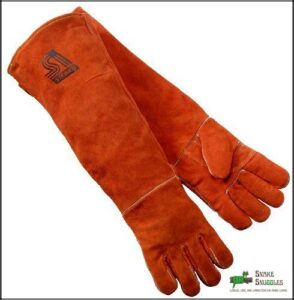
Originally built for welding, the Steiner Y Series pulls double duty, surprisingly well for large constrictor handling. The 23-inch shoulder-split cowhide reaches your mid-upper arm, giving you real coverage where most gloves quit.
Foam lining cushions pressure during prolonged holds, and the gauntlet cuff seals snugly around your forearm.
At $30, it’s hard to argue with the value. Just know the thick leather will slow your fine motor work, so keep your technique sharp.
| Best For | Welders, grillers, and anyone working around open flames or handling large animals who needs solid forearm coverage without spending a lot. |
|---|---|
| Material | Cowhide leather |
| Coverage Length | 23 inches |
| Bite Resistance | Yes |
| Heat Resistance | Yes |
| Unit Count | 1 pair |
| Price (USD) | $30.00 |
| Additional Features |
|
- 23-inch cowhide reaches mid-upper arm, so sparks and coals don’t sneak past the cuff
- Foam-insulated backing and cotton lining keep your hands comfortable during longer sessions
- At $30 a pair, replacing them when they wear out doesn’t hurt your wallet
- Thick construction makes fine motor tasks frustrating — don’t expect precision work
- Not waterproof, so prolonged wet conditions will break the leather down over time
- The snug cuff can feel tight over bulky sleeves, which might be a problem in colder weather
2. MarineStore Heavy Duty Leather Snake Gloves
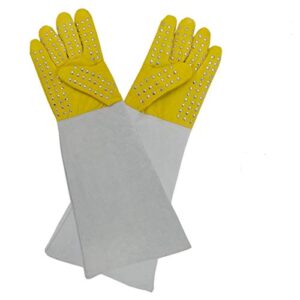
If you need something built more specifically for reptile work, the MarineStore Heavy Duty Leather Snake Gloves are worth a look.
Full-grain leather runs across the palm and back, and stainless-steel staples reinforce the seams where stress is most concentrated.
elbow-length coverage protects your forearm during holds, and the pre-curved fingers let you grip and reposition without fighting the glove.
It’s sold as a single right-hand glove only, so factor that in before you order.
| Best For | Field workers and reptile handlers who regularly work with non-venomous or mildly venomous snakes and need durable, reusable arm protection. |
|---|---|
| Material | Leather with steel staples |
| Coverage Length | Past elbows |
| Bite Resistance | Yes |
| Heat Resistance | Not specified |
| Unit Count | 1 glove (right only) |
| Price (USD) | Not listed |
| Additional Features |
|
- Heavy-duty leather with stainless-steel staple reinforcement holds up to repeated use without falling apart
- Elbow-length coverage keeps your forearm protected, not just your hand
- Pull-on design means you’re not fumbling with straps when you need it on fast
- Only comes as a single right-hand glove, so you’ll need to source a left separately
- Shipping runs around $70, which seriously bumps up the total cost
- Won’t give you full confidence against large, aggressive pit vipers or similarly powerful snakes
3. Hand Max Kevlar Leather Gauntlet Gloves
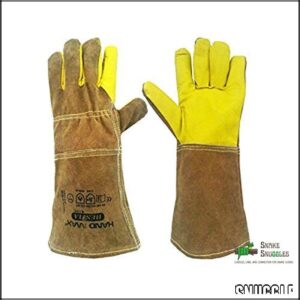
If you want both hands covered at a similar price point, the Hand Max Kevlar Leather Gauntlet Gloves are a solid step up.
Full-grain cowhide runs the outer shell, and Kevlar thread reinforces the seams where bites are most likely to land. The gauntlet cuff extends past the wrist, giving your forearm a reasonable buffer during restraint.
At roughly $19.87, it’s one-size, so try it on before committing — a loose glove on a large constrictor is a liability.
| Best For | Rescue workers, groomers, and handlers who regularly deal with feral or unpredictable animals and need full-hand and wrist coverage without spending a lot. |
|---|---|
| Material | Cowhide leather with Kevlar |
| Coverage Length | Gauntlet/wrist |
| Bite Resistance | Yes |
| Heat Resistance | Not specified |
| Unit Count | 1 pair |
| Price (USD) | $19.87 |
| Additional Features |
|
- Kevlar-reinforced stitching adds real bite resistance where it counts most
- The gauntlet cuff protects past the wrist, which most budget gloves skip entirely
- At under $20 for a pair, it’s an easy buy for anyone doing regular animal handling
- Minimal padding means a strong bite still hurts — you’ll feel the pressure even if the skin holds
- One-size fit can be hit or miss, especially if your hands are on the smaller or larger end
- No insulation at all, so cold-weather use is going to be uncomfortable pretty quickly
4. Caiman Premium Split Deerskin Welding Gloves
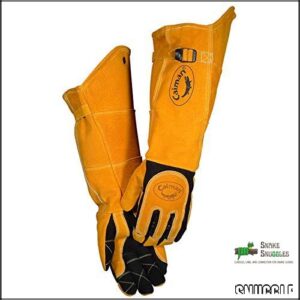
Stepping up in price and build, the Caiman Premium Split Deerskin Welding Gloves run $49.33 and bring genuine American deerskin with Kevlar-stitched seams and a cowhide heat-shield patch.
At 21 inches, they cover your forearm comfortably.
The 3D pre-curved fingers give you better grip than flat-cut gloves, so repositioning a large constrictor feels more controlled.
They’re welding gloves by design, but the heavy forearm padding and durable construction translate well to constrictor handling where arm pressure and abrasion are real concerns.
| Best For | Welders and handlers who need solid forearm protection and a better grip during long sessions in cold or high-heat environments. |
|---|---|
| Material | Deerskin leather |
| Coverage Length | 21 inches |
| Bite Resistance | Yes |
| Heat Resistance | Yes, up to ~600°F |
| Unit Count | 1 pair |
| Price (USD) | $49.33 |
| Additional Features |
|
- Kevlar stitching and the cowhide heat-shield patch hold up well through extended MIG or Stick welding
- 3D pre-curved fingers give you more control than a flat-cut glove, which matters when precision counts
- 21-inch length with heavy forearm padding means you can lean on hot surfaces without flinching
- The black leather sections can develop holes after repeated spatter hits, so longevity depends on how hard you push them
- They run warm inside during long sessions, so expect some sweating if you’re at it for hours
- The thick padding that protects your forearm is the same thing that makes fine motor work, like TIG filler-rod control, more frustrating
5. TurtleSkin Bravo Police Duty Glove
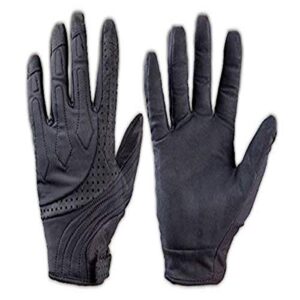
The TurtleSkin Bravo Police Duty Glove wasn’t built for snakes, but its aramid-fiber puncture-resistant lining and non-slip palm grip translate surprisingly well to large constrictor work.
At $81.99, it’s the priciest option here.
The lightweight mesh back keeps your hands cool, and the snug fit preserves enough tactile sensitivity to actually feel what the animal is doing.
Coverage stops at the wrist, though, so pair it with a long-sleeved layer if you’re working with anything over six feet.
| Best For | Handlers who work in warm climates and need a lightweight, dexterous glove for managing large constrictors during hands-on work. |
|---|---|
| Material | Polyethylene blend |
| Coverage Length | Palm to fingertips |
| Bite Resistance | Yes |
| Heat Resistance | Not specified |
| Unit Count | 1 glove |
| Price (USD) | $81.99 |
| Additional Features |
|
- Breathable mesh back keeps your hands cool during longer handling sessions
- Slim, snug fit gives you enough feel to sense the animal’s movement and tension
- Puncture-resistant lining adds a real layer of protection against unexpected bites or sharp edges
- At $81.99, you’re only getting one glove — pricey if you need a pair
- Protection stops at the wrist, leaving your forearms exposed when working with bigger snakes
- The lining runs stiff out of the box and some users have reported seam failures and liner issues after limited use
6. XuYelora Animal Handling Bite Proof Gloves
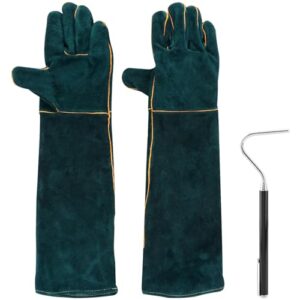
Full-grain cowhide with Kevlar-reinforced seams gives the XuYelora a solid baseline for moderate constrictor work.
Even so, all that tough material only does its job if the glove actually fits your hand — proper snake handling glove fit matters just as much as what the glove is made of.
The pre-curved fingers feel natural during restraint, and the adjustable wrist strap keeps the glove locked in place when a large animal starts pushing back.
It’s marketed as bite-proof, but keep expectations realistic — it manages moderate bites well, not aggressive strikes from heavy-bodied species.
The gauntlet-style cuff adds useful forearm coverage, and the moisture-wicking lining makes longer handling sessions noticeably more comfortable.
| Best For | Veterinarians, animal handlers, and reptile owners who need reliable bite and scratch protection during routine feeding, grooming, or handling sessions. |
|---|---|
| Material | Cowhide leather |
| Coverage Length | 23.6 inches |
| Bite Resistance | Yes |
| Heat Resistance | Yes |
| Unit Count | 1 pair |
| Price (USD) | Not listed |
| Additional Features |
|
- Top-grain cowhide with double-layer reinforcement on fingers and forearms holds up well against bites, punctures, and scratches
- The 23.6-inch gauntlet length gives solid forearm coverage — handy when working with snakes or larger animals
- Comes bundled with a stainless-steel snake hook, so you get two useful tools in one package
- One-size-fits-all means if your hands run very large or very small, the fit might feel off
- Heavy leather construction cuts down on dexterity, so anything requiring a delicate touch gets tricky
- The cotton lining only does so much — wear these for a long stretch in warm weather and your hands will notice
7. WZQH Leather Animal Handling Gloves
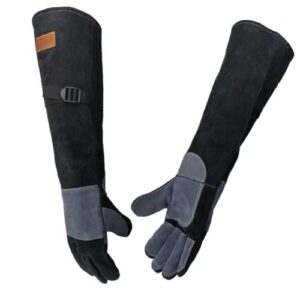
The WZQH’s 23.6-inch cowhide sleeve is one of its strongest selling points — it covers your forearm where most bites actually land during active restraint. The 1.2 mm leather is double-layered across the fingers and palm, and Kevlar stitching keeps the seams from splitting under pressure.
Sizing runs medium through extra-large, and the adjustable cuff locks things down when a large constrictor starts pushing.
It won’t stop a determined strike, but it reduces exposure meaningfully.
| Best For | Anyone who regularly handles animals — from vets and shelter workers to reptile keepers and bird handlers — who needs solid bite and scratch protection without spending a lot. |
|---|---|
| Material | Top-grain cowhide leather |
| Coverage Length | 23.6 inches |
| Bite Resistance | Yes |
| Heat Resistance | Yes |
| Unit Count | 1 pair |
| Price (USD) | $26.99 |
| Additional Features |
|
- The 23.6-inch length covers your forearm, which is exactly where most bites and scratches actually happen during restraint
- Kevlar stitching means the seams hold up under real pressure, not just light use
- At $26.99, you’re getting double-layered leather and multi-hazard protection at a pretty reasonable price
- Leather this thick adds weight, so your hands will fatigue faster during long handling sessions
- Heat resistance isn’t rated to a specific temperature, so you’re guessing a bit if you’re using these for serious welding work
- Only comes in black, and the thick leather cuts down on feel — fine for animal handling, but clunky for anything detail-oriented
8. RAPICCA Bite Proof Animal Gloves
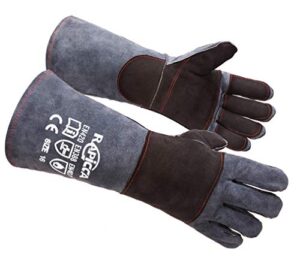
The RAPICCA Bite Proof gloves give you solid forearm coverage with a 16‑inch total length, including a 7.5‑inch sleeve past the wrist. Split cowhide leather with a reinforced double layer across the fingers and palm resists most bite attempts from mid‑sized constrictors without completely stiffening your grip.
The insulated cotton lining adds comfort during longer sessions.
At $24.99, it’s a reasonable entry point. Just know the sizing runs large, so size down if you’re between options.
| Best For | Animal handlers, groomers, and rescue workers who need reliable forearm and hand protection during routine handling of dogs, cats, reptiles, and other unpredictable animals. |
|---|---|
| Material | Split cowhide leather |
| Coverage Length | 16 inches |
| Bite Resistance | Yes |
| Heat Resistance | Yes |
| Unit Count | 1 pair |
| Price (USD) | $24.99 |
| Additional Features |
|
- Double-layered leather on the fingers and palm holds up well against bites, scratches, and general wear
- The 7.5-inch sleeve gives you real forearm coverage, not just token wrist protection
- At $24.99, it pulls double duty for grilling or yard work too, so you’re getting more than a single-use tool
- The bulky build cuts down on finger dexterity, making anything detail-oriented pretty frustrating
- Sizing runs large, so smaller hands will likely feel like they’re swimming in them
- It’s not truly bite-proof — a determined large animal can still get through and leave a mark
9. RAPICCA Leather Animal Handling Gloves
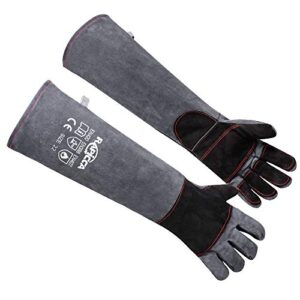
Step up from the previous RAPICCA model and you get noticeably more coverage. These gloves run 22 inches total with a 12.5-inch reinforced sleeve, which puts a solid wall of shoulder-split cowhide between your forearms and a striking constrictor.
Double leather layers on the finger palms and backs add real bite resistance where contact happens most.
At $35.99, the jump in price makes sense for the added protection.
Just remember sizing runs large, so plan accordingly.
| Best For | Animal handlers, vets, and wildlife workers who need serious forearm protection against bites, scratches, and strikes. |
|---|---|
| Material | Top-grain cowhide leather |
| Coverage Length | 22 inches |
| Bite Resistance | Yes |
| Heat Resistance | Yes |
| Unit Count | 1 pair |
| Price (USD) | $35.99 |
| Additional Features |
|
- Double-layer leather on the fingers and backs means the spots that take the most abuse are actually reinforced
- At 22 inches with a 12.5-inch sleeve, your forearms stay covered where most gloves leave you exposed
- $35.99 is a fair price for heavy-duty cowhide that’s built to last
- Sizing runs large, so smaller hands will feel like they’re swimming in them
- All that thick leather cuts down on dexterity, making fine motor work frustrating
- Even with the double layers, a truly determined animal can still get through — these aren’t bite-proof
10. Surfante Bite Proof Animal Gloves Snake Hook
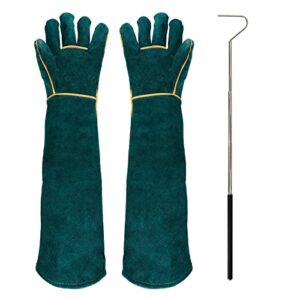
At $25.99, the Surfante gloves pack real value into a simple package. Thickened cowhide runs 23 inches up your forearm, and the included retractable snake hook lets you move a small constrictor without direct contact at all. That’s a smart combination for beginners.
The one-size-fits-most fit works for average hands but may feel loose or tight at the extremes, and the hook isn’t built for heavier animals.
Condition the leather early, and these will hold up well.
| Best For | Beginners and hobbyists who handle small snakes or backyard wildlife and want solid arm protection without spending a lot. |
|---|---|
| Material | Thickened cowhide leather |
| Coverage Length | 23 inches |
| Bite Resistance | Yes |
| Heat Resistance | Yes |
| Unit Count | 1 pair |
| Price (USD) | $25.99 |
| Additional Features |
|
- 23-inch cowhide sleeves cover your forearms and elbows well
- The retractable snake hook lets you move small snakes without touching them
- At $25.99, you get a lot of protection for the price
- One size only — bigger arms may feel cramped, smaller hands get a sloppy fit
- The hook is flimsy and can bend on heavier snakes
- Stiff leather hurts dexterity until you break it in
What Handling Gloves Actually Protect

Gloves do a lot of heavy lifting when you’re working with large constrictors, but they don’t protect everything. Knowing exactly what they cover — and where they fall short — helps you handle with confidence instead of false security.
Here’s a closer look at what you’re actually getting with a good pair.
Protection Against Bites, Scratches, and Abrasions
Good gloves do more than just cover your hands. A quality pair guards against four real threats during every session. Following the hands‑on training requirement ensures gloves are used correctly.
- Biteproof gloves use a Layered Membrane Barrier to resist fang penetration
- Puncture resistance from Temperature Resistant Leather and High Strength Stitching stops teeth cold
- Cut resistance via heavy duty leather grips scraping scales
- Moisture Resistant Coating with Impact Absorbing Padding cushions sudden strikes
Better Grip During Restraint and Repositioning
Protection matters, but grip is what keeps you in control.
Friction Coating Technology on the palm and Grip-Enhancing Finger Caps give you real contact on smooth scales, even when things get slippery.
Moisture-Wicking Liners keep your hands dry for better tactile feedback, while Adjustable Tension Straps and Adaptive Pressure Mapping help maintain high performance dexterity without sacrificing glove flexibility during repositioning.
Where Glove Coverage Stops and Risk Remains
Even the best long cuff gloves for snake handling leave some areas exposed. Here’s where risk quietly lingers:
- Knuckle Exposure and Finger Joint Gaps appear when leather doesn’t flex fully
- Wrist Gap Risks open during rapid repositioning
- Seam Intersection Vulnerability invites strikes at panel junctions
- Cuff Entrapement on hooks or hardware
- Upper forearm protection ends around the elbow
Technique stays your real defense.
Bite Resistance Vs Real-World Safety

Bite-resistant sounds reassuring, but it doesn’t mean the same thing as bite-proof, and that gap matters more than most people realize.
The thickness of the leather, the quality of the stitching, and how you actually handle the snake all play into how much protection you’re really getting.
Here’s a closer look at what those factors mean in practice.
Why Bite-resistant is Not Bite-proof
Bite-resistant" and "bite-proof" aren’t the same thing — and that gap matters when you’re holding a 15-pound boa. Bite-resistant snake handling gloves reduce penetration risk, but micro-tear mechanics, shear force impact, and scale snag risk can compromise even quality gloves over time.
Cumulative bite wear pushes material fatigue limits faster than most handlers expect.
| Threat Type | What Happens | Glove Limitation |
|---|---|---|
| Micro-tear mechanics | Sharp teeth create tiny cuts in leather fibers | Localized skin exposure without visible damage |
| Shear force impact | Twisting bites apply lateral stress | Exceeds simple puncture resistance ratings |
| Cumulative bite wear | Repeated strikes degrade seams progressively | Increases failure risk with each encounter |
No bite-proof gloves truly exist commercially, so treat yours as a layer of protection — not a guarantee.
No truly bite-proof glove exists commercially, so treat every pair as protection — not a promise
How Leather Thickness Affects Puncture Resistance
Leather thickness is your first real line of defense — and the numbers back it up. Doubling thickness from 1.0 mm to 2.0 mm substantially raises puncture resistance, especially in the Corium Layer Depth where fibers interlock most tightly. That’s where Interlock Fiber Density does its best work.
| Feature | What It Does | Why It Matters |
|---|---|---|
| Palm Thickness Gradient | Concentrates bulk in grip zones | Protects where bites land most |
| Corium Layer Depth | Dense fiber structure resists penetration | Core barrier against fang entry |
| Interlock Fiber Density | Tight weave delays ply separation | Slows puncture under strike force |
| Seam Reinforcement Thickness | Extra leather at stress points | Prevents seam failure during bites |
| Diminishing Returns | Protection plateaus past ideal depth | Guides thickness without losing dexterity |
Double leather and heavy-duty leather construction in snake bite proof gloves target those critical palm zones first. Leather glove durability depends on keeping those layers intact — worn-down areas drop puncture resistance fast.
Why Technique Still Matters With Large Constrictors
Gloves won’t save you if your hands are in the wrong place. With large constrictors, technique is what keeps you in control — not gear.
| Technique Element | Why It Matters |
|---|---|
| Hand Positioning | Controls head and distributes weight safely |
| Body Language Reading | Catches stress signals before a strike |
| Weight Distribution | Prevents constriction around single limbs |
| Team Coordination | Balances load across multiple handlers |
| Forearm Protection | Complements hand protection during wraps |
Best Materials for Constrictor Gloves

The material a glove is made from determines how well it holds up when a large constrictor decides to bite, squeeze, or thrash. Not every leather or fiber performs the same way under that kind of pressure, and the differences matter more than most people expect.
Here’s a closer look at the three material types worth knowing before you buy.
Full-grain and Split Leather Performance
Full-grain leather is your best bet here. It keeps the entire grain surface intact, which means better tear strength, stronger flexural endurance, and natural moisture management during long sessions.
Split leather loses some of that density in processing, making it more prone to punctures over time.
Top grain and double leather options also develop a protective patina and maintain reliable water resistance, keeping your protective gloves performing longer.
Kevlar Reinforcement for Seams and High-wear Zones
Kevlar stitching does more than hold seams together — it’s your second line of defense when leather alone isn’t enough. Strategic Kevlar patch placement at palm crotches and knuckles targets high-wear zone design where strikes and friction concentrate.
Stitch reinforcement patterns distribute seam stress distribution evenly, while impact energy absorption prevents sudden blowouts.
Combined with double leather and reinforced padding, you get real cut and puncture protection where it counts.
Hybrid Materials for Flexibility and Grip
Some gloves blend cowhide with synthetic blends to get the best of both worlds — Elastomer‑Leather Laminate construction gives you double layer leather protection without sacrificing movement.
A Nano‑Textured Surface improves grip on smooth scales, while Microchannel Moisture Channeling keeps your hands dry.
Strain‑Tunable Stiffness adapts as you flex, and Thermal‑Management Coating prevents heat buildup — a smart answer to dexterity vs protection tradeoffs in gloves.
Glove Length for Large Constrictors

When you’re working with a large constrictor, how far up your arm the glove reaches can make a real difference. Length affects not just protection, but also how freely you can move during a live handling session.
Here’s what you need to know before choosing between a short-cuff and a full gauntlet style.
Why Forearm Coverage Matters During Handling
A large constrictor doesn’t just bite your hand — it coils, presses, and rakes the full length of your arm. That’s why extended forearm coverage matters.
Long sleeves give you forearm protection against enclosure edge protection hazards, improve visibility and control, and reduce fatigue through better leverage enhancement.
Full hand and forearm guard coverage also enhances thermal comfort, keeping your grip steady throughout the session.
Gauntlet-style Vs Standard-length Gloves
Once you’ve committed to extended forearm coverage, the next question is what style actually delivers it. Gauntlet gloves offer better impact distribution, cuff adjustability, and jacket overlap than standard options.
- Seam Strength — gauntlets reinforce high-flex forearm zones
- Ventilation Design — standard gloves dry faster but trap less wind
- Temperature Regulation — gauntlet liners retain warmth during longer sessions
When Extra Length Reduces Dexterity
Gauntlet coverage protects your forearm well, but extra length comes with real tradeoffs.
Finger drag slows grip adjustments, sensory damping dulls your feel on scales, and wrist fatigue builds faster during long sessions. Tool interference becomes an issue when hooks or tubes clash with the cuff.
For glove length selection, elbow-length gloves balance forearm protection against reduced dexterity and grip delays.
Fit, Grip, and Dexterity

A glove that fits well is one you’ll actually trust when a big constrictor starts moving fast. The way glove sits on your hand affects your grip, your reaction time, and how much you can feel through the leather.
Here’s what to look for when fit, texture, and tactile feedback matter most.
How Proper Sizing Improves Control
When your glove fits right, everything else gets easier. A snug Palm Contour eliminates bunching, and solid Finger Alignment keeps your movements precise. Poor glove fit sizing and dexterity for handlers go hand in hand — a loose glove causes Hand Fatigue fast.
- Wrist Seal prevents slippage during sudden strikes
- Adjustable cuffs lock in arm coverage securely
- Correct sizing preserves hand dexterity throughout handling
Palm Texture and Grip on Smooth Scales
Fit keeps the glove on — but palm texture keeps the snake in your hands.
Microtexture friction on leather or synthetic material creates micro‑interlocks against smooth scales, improving scale slip prevention without crushing them.
Moisture channeling grooves push sweat aside to maintain steady contact.
Even pressure distribution across your palm reduces slippage points, and good grip holds through repositioning without sacrificing hand dexterity.
Balancing Protection With Tactile Feedback
More protection doesn’t always mean better control. Heavy-duty leather and snakebite-proof gloves balance dexterity versus protection tradeoffs in glove design through Pressure Distribution Mapping and Stitch Reinforcement Placement — keeping bulk away from fingertips.
Material Flexibility Tuning and Ergonomic Cuff Design let protective gloves move with your hand.
Sensory Feedback Optimization through glove material performance comparisons shows that thinner, well-reinforced zones preserve the tactile cues you actually need.
Safe Handling With Protective Gloves
Gloves give you protection, but they don’t do the handling for you.
How you move, how you support the snake, and how you use your tools make the real difference between a calm interaction and a defensive strike.
Here’s what good technique looks like when you’re wearing a pair.
Supporting The Snake’s Body Correctly

Think of a large constrictor like a heavy rope — let it sag in the middle and everything goes wrong fast. Slide both hands under the thickest section for midsection weight distribution, and keep your forearm protection engaged throughout.
- Head Clearance Techniques — Keep hands away from the head; let it move freely
- Midsection Weight Distribution — Support the thickest section evenly with both hands
- Tail Support Strategies — Cradle the rear body; never grip the tail alone
- Spine Alignment Control — Keep the body level to avoid harmful torsion
- Breath Management — Move slowly and pause often to reduce the snake’s stress
Your elbow-length glove with long sleeves, adjustable cuff, and full protection gives you the confidence to maintain steady contact without flinching.
Reducing Stress and Defensive Behavior

A stressed snake is a dangerous snake — and your behavior sets the tone before you even make contact.
Calm Breathing (4 counts in, 6 out) signals safety. Soft Vocal Cues keep the environment predictable.
Your glove fit and sizing, adjustable cuffs, long sleeves, and forearm protection all reduce flinching, which directly lowers defensive strikes.
| Signal | Technique | Glove Role |
|---|---|---|
| Environmental Quiet | Dim lighting, minimal movement | Familiar texture reduces novelty |
| Gradual Exposure | Short sessions first | flexibility allows steady grip |
| Positive Reinforcement | Reward calm behavior post-session | Consistent glove feel builds trust |
Using Gloves With Hooks, Tubes, and Enclosures

Gloves work best when your whole setup works together. Hook attachment safety depends on secure cuff tethering, so hooks stay accessible without snagging glove seams.
Tube strain relief prevents sudden jerks that startle the snake mid-transfer. Enclosure port alignment and hook-tube routing keep your workflow ergonomics clean and snag-free.
snake handling gloves with a 40 in collapsible snake hook adds real distance between your hands and the strike zone.
Cleaning and Maintaining Snake Gloves
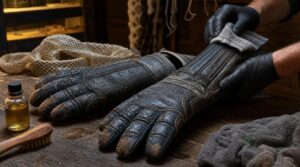
Good gloves don’t last forever, but neglecting them makes them fail much sooner.
How you clean, inspect, and store them directly affects how well they protect you next time.
Here’s what you need to stay on top of.
Cleaning Leather Without Damaging Structure
Leather doesn’t forgive harsh chemicals. Use a pH‑Neutral Cleaner on a soft cloth — never soak the glove.
For oil or musk stains, the Absorbent Powder Stain method works well: dust, wait, brush off. Skip Silicone Sprays entirely on unfinished leather.
The Microfiber Dusting Method between sessions keeps dirt from settling deep. Finish with Conditioner Application after every cleaning to maintain glove durability.
Inspecting Stitching, Seams, and Worn Areas
After every session, run your fingers along every seam. Stitch Consistency Checks catch skipped stitches before they open under pressure.
Seam Type Evaluation at flex points — flatlock seams on Kevlar stitching and double leather panels should lie flat without puckering. Thread Color Degradation signals heat damage early.
Wear Pattern Mapping on reinforced padding and Edge Reinforcement Inspection keep your protective glove maintenance and glove durability on track.
Drying and Storage to Extend Lifespan
After checking those seams, don’t skip the drying step. Air Drying fully before storage is non‑negotiable — trapped moisture breaks down leather fast.
Desiccant Packs nearby for Humidity Control, and aim for Temperature Regulation between 10–20°C.
Rotational Storage keeps older pairs in active use first.
These simple glove cleaning methods and maintenance and care for leather protective gloves habits protect your snake bite proof gloves long‑term.
How to Choose The Right Pair

Picking the right gloves comes down to a few practical factors that are easy to overlook when you’re staring at a wall of options. Your snake’s size, your budget, and how often you handle will all push you toward different choices.
Here’s what to think through before you buy.
Matching Glove Features to Snake Size
Bigger snakes demand more from your gloves.
For species under 6 feet, size MEDIUM with moderate grip texture sizing and forearm-length coverage works well.
Push past that, and you need long sleeve forearm protection, stronger leather thickness grading, and higher Kevlar reinforcement levels.
Elbow-length gloves with adjustable cuffs and sleeve length scaling give you the dexterity balance to stay in control without sacrificing coverage.
Comparing Protection, Comfort, and Value
Once you’ve matched glove features to your snake’s size, the next question is whether the price actually makes sense for what you’re getting.
- Protection Cost Ratio — HexArmor R8E 3180 snake‑bite‑proof gloves run $60–$140 but deliver a stronger performance standard than budget options
- Comfort Index — adjustable cuffs and interior liners reduce fatigue during long sessions
- Bite resistance — heavy‑duty leather with Kevlar stitching outlasts single-layer builds
- Value for Money — reinforced gloves need replacing roughly one cycle less per year
- Lifetime Savings — proper maintenance stretches glove life 20–40%
When to Upgrade to Heavier-duty Gloves
Even a well-priced glove won’t protect you once the material starts breaking down. Watch for visible cracking, material thinning on fingertips, or stitch failure near grip zones — those are your warning signs.
After 6–12 months of heavy use, loss of confidence during restraint is reason enough to move up.
Upgrade to heavy-duty leather, double leather, or Kevlar-reinforced snake bite proof gloves for full protection.
Frequently Asked Questions (FAQs)
What gloves can snakes not bite through?
No glove is truly bite-proof — that’s the hard truth.
Multi-layer Leather, Kevlar Seam Reinforcement, Stainless Steel Mesh, and Hybrid Synthetic Blend materials in snake bite proof gloves like HexArmor R8E 3180 offer the strongest bite-resistant, double-leather thickness standards available.
Should you wear gloves when handling snakes?
Yes, wearing gloves is smart personal protective equipment for any handler.
They offer real snake bite protection, reduce legal liability, and build confidence — though gloves work best alongside solid snake handling equipment and proper technique.
What gloves do they use on Deadliest Catch?
Deadliest Catch crews favor heavy duty leather gloves with anti‑slip palm grip, thermal insulation, waterproof sealing, and gauntlet cuffs built for rope manipulation — worlds apart from HexArmor, Hercules 400R6E, or R8E 3180 cut‑resistance snake handlers need.
Are snake handling gloves suitable for beginners with constrictors?
Snake handling gloves are suitable for beginners, offering tactile feedback and reptile handling safety while building skill progression.
Proper glove sizing and risk awareness help you handle constrictors confidently as your technique develops.
Which safety certifications matter for large constrictor gloves?
For large construction gloves, look for EN 388 rating, ANSI ISEA 105, and CE marking.
EN 374 compliance, SGS certification, and European environmental standards confirm material quality and puncture resistance you can actually trust.
Can I use these gloves during feeding sessions?
You can, but keep hygiene protocols and pre-feeding inspection in mind.
Glove flexibility and sensory feedback drop during feeding, so pair your bite prevention gear with calm, deliberate technique for real snake bite protection strategies.
How well do gloves perform in hot, humid climates?
Like a well-ventilated room on a sweltering afternoon, gloves with moisture wicking liners and humidity breathability panels manage sweat management effectively, keeping your grip steady and your hands drier even when 30 degrees centigrade heat makes every session feel draining.
What other protective gear pairs best with constrictor gloves?
Pair your gloves with Eye Protection, Protective Sleeves, a Neck Guard, and Footwear Armor. Ankle Guards, snakeproof boots, and a collapsible snake hook round out solid PPE for wildlife handlers.
Can gloves protect against constrictor coiling pressure?
Gloves offer coil pressure distribution and arm cushioning, but they don’t stop compression entirely.
Heavy-duty leather with Kevlar stitching and long sleeve forearm protection helps, yet force transfer still reaches tissue beneath.
Do gloves affect snake stress during handling?
Yes — thick protective gloves for snakes cause thermal cue masking and scent transfer reduction, both of which can trigger brief glove odor reactions, but a handler confidence boost often offsets this, keeping the snake calmer overall.
Conclusion
Good snake handling gloves for large constrictors don’t just protect your skin—they protect your confidence. When you’re not bracing for impact, you handle more calmly, and calmer handling means a less defensive snake. Think of the right gloves as buying yourself a second of composure when composure matters most.
Grip well, cover your forearms, inspect the stitching regularly, and replace worn pairs without hesitation.
The best glove is the one you’re actually wearing when it counts.