This site is supported by our readers. We may earn a commission, at no cost to you, if you purchase through links.
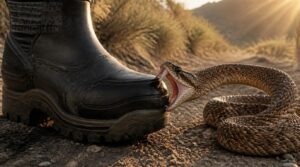
Imagine this: you’re hiking a rocky trail in your favorite rubber boots, and a timber rattlesnake strikes at your ankle. Your boots feel thick enough to stop it, right? Lab tests say otherwise—85% of the time, fangs punch straight through standard rubber like it’s barely there.
Here’s why: a rattlesnake’s fangs can stretch 1.5 inches long, and strike force concentrates on a point smaller than a pinhead. That kind of pressure overwhelms rubber fast, especially once cracks or aging weaken the material.
So can snakes bite through rubber boots? Absolutely—and understanding exactly how it happens is the first step toward picking footwear that actually keeps you safe.
Table Of Contents
- Key Takeaways
- Yes, Snakes Can Bite Through Standard Rubber Boots
- How Snake Fangs Penetrate Rubber Boots
- Rubber Boots Vs. Snake-Proof Boots
- Factors That Affect Snake Bite Protection
- How to Improve Protection Beyond Rubber Boots
- Frequently Asked Questions (FAQs)
- What shoes can snakes not bite through?
- Can a copperhead bite through a boot?
- What material can a snake not bite through?
- Will rubber boots protect you from a snake bite?
- Do rubber boots protect you from snake bites?
- Can a venomous snake bite through a rubber boot?
- Are snake boots venomous?
- Do snakes eat rubber boots?
- Are snake boots impenetrable?
- Are snake boots puncture-proof?
- Conclusion
Key Takeaways
- Standard rubber boots fail to stop snake fangs about 85% of the time, since their thin 2-4mm walls can’t handle the concentrated pressure a fang tip delivers.
- Only boots certified under ASTM F1342 (tested with preserved rattlesnake heads) offer real protection, keeping fang penetration under 5%, while "premium" rubber still fails around 70% of the time.
- Since most snake strikes happen within 8 inches of the ground, boot height above 15 inches, snug closures, and no leg gaps matter just as much as the material itself.
- No boot is completely bite-proof, so real safety comes from layering gear (snake gaiters, tucked pants) with smart habits like scanning the ground and never handling wild snakes.
Yes, Snakes Can Bite Through Standard Rubber Boots
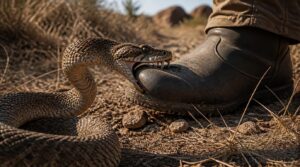
Let’s get straight to it: yes, snakes can bite through standard rubber boots. That thin layer of rubber offers less protection than most people assume. Here’s what you need to know before you head into snake country.
For real protection, pair sturdy footwear with knowledge of common snake strike triggers to avoid before your next hike.
Standard Rubber is Not Bite-Proof
Grab a standard rubber boot and squeeze the shaft — that give is the problem. Standard rubber boots run just 2 to 4 millimeters thick, no match for fangs generating concentrated pressure at two tiny points. Lab tests show 85% fang penetration rates through this material.
Cracks and aging only widen the gap, so wear increases risk fast.
Venomous Snakes Pose Greater Risk
Weak boots matter most against venomous snakes, since a bite carries real medical stakes. Timber rattlesnake fangs hit 1.5 inches, delivering toxins that act in minutes.
Consider what’s at risk:
- Rapid envenoming needing urgent care
- Organ failure if untreated
- Higher bite risk in rural areas
- Limited antivenom access nearby
- Millions affected worldwide yearly
Understanding venomous snake ecology is important for predicting bite likelihood and informing prevention strategies.
Protection Varies by Boot Construction
Not all boots are built the same, and construction matters as much as material. Welted boots hold up better than cemented ones, which flex easily under strike force. Stitchdown designs add durability, while direct attach methods create strong, waterproof seams.
Layered uppers and reinforced toe caps boost resistance too—but none of it beats true snake-proof gear.
No Boot Guarantees Complete Protection
Even certified snake-proof boots aren’t foolproof. Fang penetration can still occur at seams, gaps, or under repeated strikes. No footwear eliminates all risk—think layered defense instead:
- Choose puncture resistant materials
- Pair boots with gaiters
- Assess environmental factors
- Practice smart human behavior
- Know emergency response basics
Real snake bite prevention means combining protective footwear with awareness, not relying on boots alone.
How Snake Fangs Penetrate Rubber Boots

So how exactly does a snake get its fangs through something you’d think would stop it cold? It comes down to physics, not magic. Here’s what’s actually happening at the moment of the strike.
Fang Length and Strike Angle
A timber rattlesnake’s fangs can hit 1.5 inches long, and that length alone decides how deep trouble goes.
For comparison, venomous snake fang length by species shows Western Diamondbacks growing even longer fangs, up to 4.5cm.
| Fang Length | Typical Result |
|---|---|
| Under 1 cm | Shallow scratch |
| 1-2 cm | Moderate puncture |
| Over 1.5 in | Deep tissue risk |
| Steep angle | Faster penetration |
| Shallow angle | Reduced depth |
Strike angle and jaw positioning also decide how far fangs travel before rubber stops them—or doesn’t.
Concentrated Pressure at Fang Tips
Here’s the physics: a fang tip is a needle, not a fist. All that fang strike force lands on a point smaller than a pinhead, so contact area effects turn ordinary bite pressure into something closer to a hydraulic punch.
A fang tip is a needle, not a fist—turning ordinary bite force into a hydraulic punch
That’s why localized stress points push rubber past its material deformation threshold fast—concentrated force beats spread-out force every time.
Rubber Thickness and Material Resistance
Thickness matters, but not the way most folks assume. Standard rubber boots run 2 to 6 millimeters thick—no match for fangs exceeding 10mm.
Five factors decide resistance:
- Sheet thickness
- Shore hardness rating
- Filler content
- Vulcanized rubber quality
- Layer bonding
Certified boots meeting ASTM F1342 pass strict penetration tests. Standard rubber? It fails fang penetration checks 85% of the time.
Cracks, Wear, and Weak Spots
That "brand new" pair of boots you bought three seasons ago? Already weaker. Surface cracks form first at seams and joints, while UV exposure and thermal shock make rubber brittle.
Aging rubber loses elasticity, thinning walls right where fangs strike hardest. Combine boot thickness loss with old wear patterns, and even boots that once passed penetration tests can fail.
Rubber Boots Vs. Snake-Proof Boots
Not all boots are built the same, and that gap matters when a rattlesnake is involved. Your rain boots and a true snake-proof pair might look similar, but they’re playing very different games. Here’s what actually separates the two.
Waterproofing Versus Puncture Resistance

Waterproof and puncture-proof aren’t the same job. Waterproofing stops water under pressure (measured by hydrostatic head); puncture resistance stops fang penetration.
| Feature | Waterproof Boot | Puncture-Resistant Boot |
|---|---|---|
| Focus | Sealed seams | Layered material |
| Rubber | Vulcanized rubber | Reinforced backing |
| Weak spot | Seam integrity | Thin flex zones |
A boot can do both, but rarely equally well.
Reinforced Fabrics and Leather Layers

Layers are where the real defense lives. Snake-proof boots stack reinforced leather layers, high-density nylon, and cross-laminated fabric bonded through resin or hot-melt adhesives.
| Layer | Job |
|---|---|
| Hardened leather | Surface resistance |
| Nylon weave | Fang penetration stop |
| Adhesive bond | Holds it together |
Fabric weave strength matters more than thickness alone.
Tall Shafts and Secure Closures
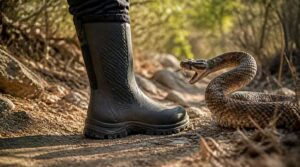
Height matters as much as material. Most snake strikes land within 8 inches of the ground, so boot height above 15 inches shields the calf where bites happen.
| Feature | Function | Benefit |
|---|---|---|
| Gusseted tongue | Blocks debris | Keeps seal tight |
| Secure closure | Locks calf area | No leg gaps |
| Reflective trim | Low-light visibility | Safer trail walks |
Penetration Testing and Safety Claims

A tall shaft only helps if the boot itself holds up under fang pressure, which is where certified testing standards come in. Labs follow ASTM F1342 methodology, using preserved rattlesnake heads to check puncture resistance.
| Boot Type | Fang Penetration Rate | Certified? |
|---|---|---|
| Standard rubber | 85% | No |
| Premium rubber | 70% | No |
| ASTM F1342 | Under 5% | Yes |
Third-party validation matters. Don’t trust a label alone.
Comfort, Traction, and Proper Fit

A certified boot means nothing if it blisters you by mile two. Look for Proper Heel Fit, a Roomy Toe Box, and Breathable Linings.
| Feature | Why It Matters |
|---|---|
| Smooth Interior | Fewer hot spots |
| Cushioning | Less fatigue |
| Traction | Fewer falls |
| Waterproof | Dry, blister-free feet |
| Insulated | Comfort in cold |
Factors That Affect Snake Bite Protection
Not every boot, or every snake encounter, is the same. A handful of details actually decide whether a bite gets through. Here’s what really matters.
Snake Species and Fang Size
Not all fangs are created equal. Rattlesnake fang range runs 12 to 25mm; Copperheads and Cottonmouths sit lower. Fang strike force matters too. A quick fang length comparison:
- Gaboon viper fangs: up to 50mm
- King cobra fang size: 6-10mm
- Coral snake fangs: 3-4mm
- Rattlesnakes: 12-25mm
- Sea snakes: 2-3mm
Bigger fangs mean deeper punctures.
Boot Height and Calf Coverage
Where a snake strikes matters as much as what’s biting. Since 68% of strikes land within 8 inches of the ground, boot height becomes your first line of defense.
Mid boots (8-11.5") cover ankles. Tall shafts (11.5-15") add calf protection height. Over-knee styles guard higher still, though gaps near the top can still let fangs through if coverage stops short.
Fit, Closures, and Leg Gaps
A loose boot is a snake’s welcome mat. Gap prevention starts with fit adjustment: calf clearance around 15-18 cm, ankle 1.5 cm smaller than calf.
Closure alignment matters too. Zips, buckles, or laces should hug your widest calf point. Elastic gussets and shaft sealing keep gaps shut while walking—no room for fangs to sneak in.
Strike Location and Boot Condition
Where a strike lands matters as much as what you’re wearing. Ground ambushes hit the sole edge; eye-level strikes go for the ankle or boot top. Toe cap exposure rises in brush.
Boot condition seals the deal. Cracked seams, worn tread, brittle rubber—all invite fang penetration. Check seams and soles often. Fatigue doesn’t announce itself.
Material Age and Thickness
Old boots lie to you. Rubber doesn’t stay the same over years of sun and flexing—it loses thickness, develops microcracks, and gets brittle from heat exposure. That thin, cracked layer offers way less puncture resistance than the day you bought it.
Vulcanized rubber resists aging better, but nothing’s permanent. Check your boots’ thickness yearly. Fang penetration gets easier as rubber degrades.
How to Improve Protection Beyond Rubber Boots
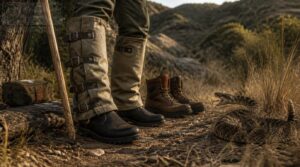
So rubber boots alone won’t cut it. The good news? You’ve got real options to close those gaps and stack the odds in your favor. Here’s what actually works.
Choose Snake-Resistant Footwear
Want real peace of mind? Buy boots built for snakes, not just rain.
Look for snakeproof boots meeting ASTM F1342 standards, with puncture-resistant panels and smart fang deflection design.
- Sole thickness matters as much as shaft height
- Waterproof claims mean nothing against fangs
- A Vibram sole adds traction, not protection
Check gaiter compatibility test results too—layering counts.
Add Snake Gaiters or Guards
Already own decent boots? Snake gaiters can close the gap. Look for 1000D nylon or Cordura with a shin panel, adjustable straps, and hook-and-loop closures.
Tall coverage stops fangs low. Mesh linings keep legs cool.
Clean with mild soap, air dry, and check for worn seams—replace once panels loosen or fabric thins.
Pair Boots With Long Pants
Gaiters help, but long pants still matter. The pant tuck technique is simple: tuck fabric smoothly into the shaft so nothing bunches at the ankle.
- Slim-leg pants tuck cleanest
- Snug boot-pant fit stops leg gaps
- Full ankle coverage blocks low strikes
- Good fabric tucking method limits fang penetration
That’s real puncture resistance, layered onto your protective footwear.
Watch Where You Step
No boot, no gaiter, no fabric beats good ground scanning. Rubber boots and snakeproof leg guards lower your risk, but foot placement and step timing matter just as much.
Slow down in tall grass or rocky terrain. Scan before you step, not after. Safe stepping means eyes down, not just faith in boot thickness or puncture resistance ratings.
Never Handle Wild Snakes
That calm, coiled snake you spot on the trail? Leave it alone. Even experts get bit trying to move or identify one up close.
Never handle wild snakes, venomous or not. Back away slowly, keep several body-lengths of safe retreat distance, and skip sudden movements. Good boots reduce risk, but distance and respect for snake behavior cues are your real defense.
Frequently Asked Questions (FAQs)
What shoes can snakes not bite through?
Look for boots with Kevlar boot protection or ballistic fabric, plus hardened leather and multi-layer puncture barriers. These block far more strikes than plain rubber, meeting ASTM F1342 standards for real fang penetration resistance.
Can a copperhead bite through a boot?
Yes, a copperhead can bite through thin spots. Their fangs concentrate pressure at each tip, exploiting leather boot gaps or worn rubber. Reinforced soles and snug-fitting protective footwear cut puncture risk dramatically, though no boot’s truly bite-proof.
What material can a snake not bite through?
No fangs get through Kevlar fiber weaves, Dyneema layers, or thick full-grain leather. Certified snakeproof boots combine these with Cordura nylon in multi-layer composite builds, meeting ASTM F1342 standards for near-zero fang penetration.
Will rubber boots protect you from a snake bite?
Standard rubber offers partial protection at best. Thin uppers (2-4mm) can’t stop a determined strike at the right angle, while only certified snake-proof boots meeting ASTM F1342 standards truly block fang penetration.
Do rubber boots protect you from snake bites?
Funny thing: those thick rubber boots that feel so tough offer surprisingly limited snake bite protection. Fang penetration hinges on rubber thickness, material degradation, and strike force—standard boots fail most lab tests, while certified snakeproof boots resist punctures far better.
Can a venomous snake bite through a rubber boot?
A venomous snake’s fangs can drive straight through standard rubber, especially at high fang strike velocity. Lab tests show 70-85% penetration rates, while boot seam vulnerability and material degradation make certified snakeproof boots the smarter, safer choice.
Are snake boots venomous?
No, there’s nothing toxic here. Snake boots use puncture-resistant materials like Kevlar and nylon to stop fang penetration during a bite, offering real venomous snake defense without any boot material toxicity risk to you.
Do snakes eat rubber boots?
Curiosity kills the cat, but snakes aren’t curious about boots. They’re strict carnivores, hunting rodents and birds, not rubber. This diet-habit myth confuses fang penetration with feeding—snakes bite defensively, never to chew or swallow synthetic footwear.
Are snake boots impenetrable?
No boot’s completely bite-proof, but certified snakeproof boots score well. Testing shows 95% strike protection, keeping fang penetration under 2mm — as long as fangs don’t reach skin above the boot’s top line.
Are snake boots puncture-proof?
Like Achilles’ heel, even armor has weak points.
Puncture resistance isn’t absolute, but certified snakeproof boots—built from high-density nylon, Kevlar, and vulcanized rubber—block 95% of strikes under ASTM F1342 testing, keeping fang penetration under 2 millimeters when failures occur.
Conclusion
Think of rubber boots like an umbrella in a hailstorm: fine for light stuff, useless against something sharp and fast. That’s the honest answer to whether can snakes bite through rubber boots—yes, easily, unless you upgrade your gear.
Snake-proof boots with reinforced fabric, tall shafts, and snug closures change that story completely. Pair them with gaiters and common sense, and you stop gambling with fangs. Your ankles deserve better than hope. Choose real protection, walk confident, and let the snake stay curious instead of you.
- https://global.danner.com/san-angelo-snake-boot-17-brown.html
- https://support.lacrossefootwear.com/hc/en-us/articles/360017767653-How-does-LaCrosse-test-snake-boots-
- https://timesofindia.indiatimes.com/etimes/trending/snake-vs-scorpion-which-venom-is-more-dangerous-to-humans-and-how-it-affects-survival/articleshow/123743466.cms