This site is supported by our readers. We may earn a commission, at no cost to you, if you purchase through links.

A ball python curled inside a hide slightly too large for it will often stop eating—not because it’s sick, but because it doesn’t feel safe enough to digest. That’s not instinct being dramatic; it’s the same evolutionary logic that drives these snakes to wedge themselves into the tightest, darkest crevices they can find in the wild. Pressure on the body signals safety. Space signals exposure.
Most keepers assume bigger is better, but with hides, that thinking works against you. Whether ball pythons prefer tight or spacious hides comes down to biology, not preference—and once you understand the snug-fit rule, sizing every hide correctly becomes straightforward.
hatchlings under 150 grams to full-grown adult females pushing five feet, the right fit changes with every growth stage, and the behavioral signs your snake gives you are more reliable than any size chart.
Table Of Contents
- Key Takeaways
- Do Ball Pythons Prefer Tight or Spacious Hides
- What Makes a Good Hide for Ball Pythons
- Choosing The Right Hide Size by Growth Stage
- Top 9 Ball Python Hides Worth Buying
- 1. Exo Terra Large Snake Cave
- 2. Exo Terra Extra Large Reptile Cave
- 3. Zilla Bark Bends Terrarium Hide
- 4. Zilla Vertical Rock Cave Grey
- 5. Zilla X Large Terrarium Rock Den
- 6. Zilla Rock Lair Reptile Hide
- 7. Zilla Herp Hotel Terrarium Basking Hide
- 8. Pangea Medium Reptile Hide Box
- 9. Zoo Med Large Reptile Shelter Cave
- How to Place and Maintain Ball Python Hides
- Frequently Asked Questions (FAQs)
- Conclusion
Key Takeaways
- Ball pythons are hardwired to seek tight, enclosed spaces—body contact with surrounding walls signals safety, not comfort, so a snug hide is what actually keeps stress low and feeding consistent.
- The snug-fit rule is simple: if your hand slides in beside a curled snake without force, the hide is too big and needs to go.
- Hide size isn’t a one-time decision—you’ll need to resize every 2–6 months depending on growth stage, with females eventually needing something around 8″ × 6″ and males typically topping out at medium.
- Every enclosure needs at least two hides—one on the warm side, one on the cool side—plus a humid hide packed with damp sphagnum moss to support healthy shedding.
Do Ball Pythons Prefer Tight or Spacious Hides
Ball pythons don’t want a mansion — they want a burrow. Understanding why snug spaces work better than open ones changes how you shop, size, and set up every hide in the enclosure.
A quick look at how to choose the right size snake hide makes it clear why a too-roomy hide leaves your ball python feeling exposed rather than secure.
Here’s what the snug-fit rule actually means and how to tell when you’ve got it wrong.
Why Ball Pythons Seek Snug, Enclosed Spaces
Ball pythons aren’t being dramatic when they squeeze into the tightest corner available — it’s a hardwired predator avoidance strategy carried over from wild burrow life. Snug spaces deliver real sensory security preference, thermal insulation effect, and moisture retention advantage all at once.
That physical contact with surrounding walls isn’t comfort-seeking. It’s survival logic, compressed into a hide.
Wall contact isn’t comfort — it’s survival logic, hardwired into every coil
Providing the recommended minimum adult enclosure size helps maintain their natural behavior.
The Snug-Fit Rule Explained
The snug-fit rule is straightforward: the hide interior should allow your snake to coil with minimal empty space — think coil compression ratio, not room to wander.
Fit measurement techniques are simple: if your hand slides in beside a curled snake without force, size up.
Ventilation gap minimization matters here too — excess space disrupts temperature gradient interaction and undermines the security contact the snake is actually after.
Behavioral Signs Your Hide is The Wrong Size
Your snake’s behavior tells you when the hide size is off. Coiling at the entrance instead of withdrawing fully signals the interior is too tight.
Basking by hide edges rather than retreating points to excess space — the snug-fit rule breaks down fast. Thrashing near hide openings and feeding refusal are hard behavioral indicators that the shelter isn’t matching current growth.
How Hide Size Affects Stress and Feeding
Get the hide size wrong, and feeding problems follow. The stress-feeding correlation is direct — a roomy hide triggers exploratory behavior that competes with feeding motivation, stretching the feeding window unpredictably.
Poor hide size impact compounds over time, dropping body condition scores across a 12-week cycle.
The snug-fit rule isn’t aesthetic preference; it’s hormonal stress response management. Reduced feeding latency follows naturally when the hide fits right.
What Makes a Good Hide for Ball Pythons
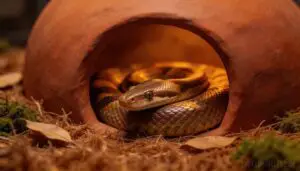
Not every hide earns the job — a good one has to check three specific boxes before it even goes in the enclosure.
Those boxes come down to security, safety, and sturdiness, and skipping any one of them puts your snake at a disadvantage.
Here’s what each actually means in practice.
Security — Single Entrance and Dark Interiors
One entrance, no exceptions. A single entrance design means your ball python feels completely enclosed—there’s no second opening creating anxiety or unexpected light.
Dark interior lighting mimics the tight burrows they’d use in the wild, reducing stress instantly. Think of it as natural access control: one way in, one way out.
That single-entrance secure hide isn’t just preference—it’s biology.
Safety — Smooth Edges and Non-Toxic Materials
Every surface your ball python contacts should earn its place. Rounded Edge Design prevents micro-cuts during entry and exit, while BPA‑Free Coatings and Reptile‑Safe Sealants guarantee nothing leaches into the enclosure environment.
Material safety for reptile hides comes down to three non-negotiables:
- Non-toxic material or nontoxic resin with zero heavy metals
- Moisture‑Resistant Materials that won’t harbor mold
- Non‑Slip Interior Surfaces for stable movement
Sturdiness — Weighted Base and Solid Construction
A hide that tips over mid-exploration is a hide that fails. Weighted Base Stability keeps your ball python from startling — and a wide Base Footprint Design distributes pressure evenly across loose substrate. Non-Slip Pads grip glass or acrylic floors without sliding.
| Feature | Why It Matters |
|---|---|
| Corrosion-Resistant Hardware | Survives repeated humid-environment cleaning |
| Material Compatibility | Nontoxic material won’t leach under moisture |
Strong and solid construction isn’t optional — it’s baseline.
Choosing The Right Hide Size by Growth Stage
Ball pythons don’t stay the same size for long, and neither should their hides. Getting the fit right at each growth stage is one of the easiest ways to keep stress low and feeding consistent.
Here’s how to size it correctly from hatchling to full-grown adult.
As your boa grows, so should its home — check out this guide on vertical vs. horizontal boa enclosure layouts to find the orientation that best suits your snake’s natural preferences.
Hatchlings and Juveniles
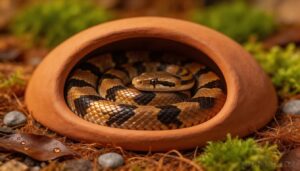
Hatchlings under 150 g need an XS hide — roughly 4″ × 3″. At that size, snug fit hide importance is literal: their stress hormones spike in oversized spaces. Apply the snug-fit rule strictly.
As juveniles hit 150–500 g, step up to a small-to-medium hide. Resize every 4–6 months — growth monitoring isn’t optional when feeding frequency is high and juvenile ball python development moves fast.
Sub-Adults and Growing Snakes
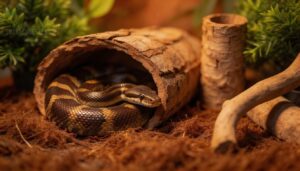
Sub-adults (500–1,500 g) are in the most demanding growth window — feeding frequency drops to every 7–14 days, but prey size scaling matters more than ever here.
- Match hide size to a medium (6″ × 5″) footprint.
- Apply the snug-fit rule every 4–6 months.
- Monitor growth rate via body condition scoring.
- Support hormonal appetite shifts with consistent prey availability.
- Add enclosure enrichment — branches, cork tubes — alongside hide upgrades.
Adult Males Vs. Adult Females
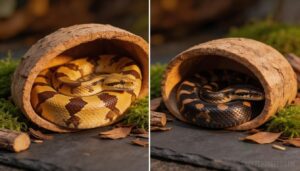
Sex matters more than you’d think when sizing hides. Sexual dimorphism means adult female ball pythons — often 4–5 feet and heavier due to body mass differences — need a large hide (≈8″ × 6″), while adult males usually fit a medium.
Reproductive behaviors and territorial activity can shift hiding preferences seasonally, so apply the snug-fit rule independently for each snake.
How Often to Resize Hides
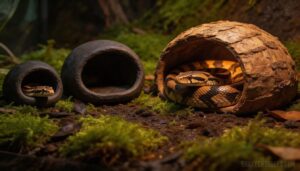
Growth rate triggers the need to resize more than a calendar does. Once your snake hits a 15–20% increase in body length or girth, it’s time to swap the hide.
- Hatchlings: check every 2–4 weeks — they grow fast
- Juveniles: reassess every 2–3 months
- Adults: resize only when girth increases noticeably
Apply the snug-fit rule at every stage.
Top 9 Ball Python Hides Worth Buying
Not all hides are built with ball pythons in mind, so picking the wrong one wastes money and stresses your snake. The nine options below cover a range of sizes, materials, and price points — something for every setup.
Here’s what’s worth your attention.
1. Exo Terra Large Snake Cave
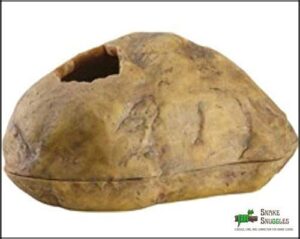
Exo Terra Large Snake Cave (PT2847) earns its spot on this list for a few straightforward reasons. It measures 7.1 × 8.8 × 10.6 inches — roomy enough for a mid-size ball python without being wasteful.
The removable lid makes cleaning and health checks genuinely easy. Its 3-pound weighted base won’t shift on a heat mat.
One honest caveat: the entrance is small, so if your snake exceeds four feet, sizing up is the smarter call.
| Best For | Mid-size reptiles like ball pythons (3–4 ft), corn snakes, and leopard geckos that need a secure, easy-to-clean hide with humidity control. |
|---|---|
| Material | Rigid plastic |
| Entrance Design | Small front opening |
| Removable Lid | Yes |
| Ease of Cleaning | Smooth interior, easy wipe |
| Suitable Species | Ball pythons, corn snakes, leopard geckos |
| Humid Hide Ready | Yes, includes moss pack |
| Additional Features |
|
- The removable lid makes feeding, health checks, and cleanouts quick and hassle-free.
- Heavy weighted base stays put on heat mats — no tipping, no shifting.
- Included moss can be dampened to create a humid hide, which is great for shedding and egg incubation.
- The entrance opening is pretty snug — snakes over four feet will likely find it too tight.
- The solid plastic bottom can get hot on the warm side of a tank, so placement matters.
- Plastic can crack if dropped, and some users notice a faint odor from the moss that takes a wash or two to clear up.
2. Exo Terra Extra Large Reptile Cave
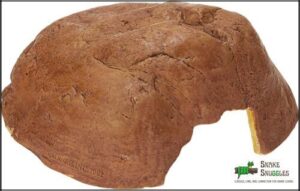
When your snake pushes past that four-foot mark, the Exo Terra Extra Large Reptile Cave (PT2854) becomes the logical next step. At 10.23 × 11.02 × 4.33 inches, it gives a full-grown female room to coil without feeling exposed.
The resin construction manages routine cleaning well — wipe it down, rinse, done.
Worth noting: the entry opening runs narrow, so check your snake’s girth before buying. Thin-walled resin can also develop sharp edges from molding; a quick file before first use prevents skin irritation.
| Best For | Owners of adult ball pythons, corn snakes, bearded dragons, or large geckos who need a roomy, durable hide that fits naturally into their terrarium setup. |
|---|---|
| Material | Resin |
| Entrance Design | Side opening |
| Removable Lid | No |
| Ease of Cleaning | Smooth exterior, moderate |
| Suitable Species | Adult ball pythons, bearded dragons, leopard geckos |
| Humid Hide Ready | Yes, with added moss |
| Additional Features |
|
- Plenty of space for full-grown reptiles to coil up and feel secure without being cramped
- Easy to clean — smooth surfaces mean a quick wipe-down gets the job done
- Holds heat well overnight, which is a real plus for species that need stable temps
- Thin resin walls can leave sharp edges from molding, so you’ll want to file those down before dropping it in the tank
- The interior can get sticky or start to break down with repeated washing or long-term humidity exposure
- It’s a big footprint — won’t work in smaller tanks, so measure your setup before ordering
3. Zilla Bark Bends Terrarium Hide
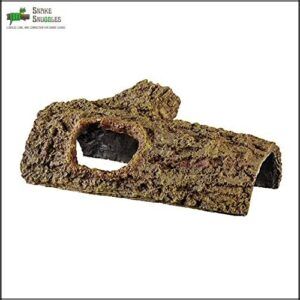
If resin caves feel too polished for your setup, the Zilla Bark Bends Terrarium Hide takes a different direction. Its synthetic bark exterior mimics natural wood without the moisture retention problems that real wood brings — no rot, no mold hiding in the grain. The non-porous plastic wipes clean in seconds.
At 10.75 × 5 × 5.5 inches, the large fits sub‑adults comfortably. One caveat: check the opening size against your snake’s girth before committing.
Some users report sharp edges around the top hole — a quick sand fixes that.
| Best For | Reptile owners who want a natural-looking hide that’s easy to clean and lets them keep an eye on their pet without disturbing it. |
|---|---|
| Material | Rigid plastic |
| Entrance Design | Open-ended bend |
| Removable Lid | No |
| Ease of Cleaning | Non-porous, soap and water |
| Suitable Species | Snakes, bearded dragons, corn snakes |
| Humid Hide Ready | No |
| Additional Features |
|
- Synthetic bark looks like real wood but won’t rot or grow mold
- Open-ended design lets you watch your reptile shed or nest without moving the hide
- Heavy and sturdy — stays put in both dry and semi-aquatic setups
- Some edges around the top hole can be sharp and may need sanding
- The opening might be too tight for larger or fully grown snakes
- Once it’s in place, the weight makes it a hassle to reposition
4. Zilla Vertical Rock Cave Grey
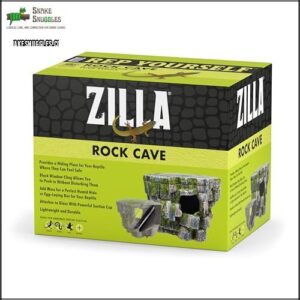
The Zilla Vertical Rock Cave Grey solves a real problem: floor space. It mounts directly to the glass via suction cups, so your snake gets a hide without eating into the enclosure footprint.
At roughly 7.9 × 5.5 × 6.3 inches, it works for small-to-medium snakes that like to rest elevated. The dark interior keeps light out — which is exactly what a stressed ball python needs.
One practical note: clean the glass thoroughly before mounting, or those suction cups won’t hold.
| Best For | Small-to-medium arboreal reptiles and amphibians — like crested geckos and tree frogs — that prefer to hide and rest up off the ground. |
|---|---|
| Material | Hard plastic/foam |
| Entrance Design | Side opening |
| Removable Lid | Yes |
| Ease of Cleaning | Lightweight, easy reposition |
| Suitable Species | Geckos, frogs, small snakes |
| Humid Hide Ready | No |
| Additional Features |
|
- Mounts to the glass with a suction cup, so it keeps your enclosure floor completely open
- The dark interior compartment doubles as a hide and a feeder cup holder — two problems solved at once
- Lightweight and easy to reposition whenever you want to shake up the layout
- Suction cup can slip if the glass isn’t spotless, so installation prep really matters
- It’s a decent size — could feel cramped or overwhelming in a smaller tank
- Some units have come with rough or sharp edges, so worth a quick inspection before putting it in with your animal
5. Zilla X Large Terrarium Rock Den
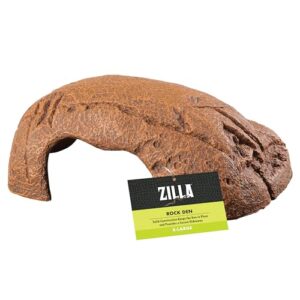
If you’ve got a larger adult snake, this one’s built for the job. The Zilla X Large Rock Den measures 11 × 8 × 6 inches — enough interior space for a full-grown female to coil without feeling exposed.
The non-porous resin holds up to repeated cleanings and doesn’t absorb bacteria or odors.
Heavy construction means it won’t shift when your snake pushes against it during entry.
The top-access opening makes inspection and cleaning straightforward, which matters when you’re maintaining proper hygiene week after week.
| Best For | Reptile owners with small to medium-sized lizards or juvenile snakes who want a sturdy, easy-to-clean hide that mimics a natural rock environment. |
|---|---|
| Material | Rigid plastic |
| Entrance Design | Small top opening |
| Removable Lid | No |
| Ease of Cleaning | Warm soapy water |
| Suitable Species | Leopard geckos, ball pythons, corn snakes |
| Humid Hide Ready | No |
| Additional Features |
|
- Non-porous plastic surface won’t soak up bacteria or odors, so cleanup stays simple — just warm water and soap.
- Heavy, solid build keeps it firmly in place even when your reptile is pushing in and out repeatedly.
- The small, dark opening does a great job mimicking a natural hide, which helps reduce stress for skittish reptiles.
- Interior space is pretty limited, so adult or larger snakes and fast-growing geckos will likely outgrow it quickly.
- Edges and the underside lip can be sharp right out of the box — worth sanding them down before putting it in the tank.
- The complex interior shape can trap shed skin and waste, making a truly thorough clean a bit of a hassle.
6. Zilla Rock Lair Reptile Hide
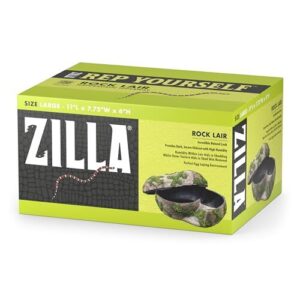
At $49.99, the Zilla Rock Lair punches above its price point.
The 11 × 6 × 8-inch frame fits snugly in tanks up to 40 gallons — practical for sub‑adults and smaller adult males.
The side entrance limits interior light exposure, and the removable top means health checks don’t require evicting your snake first.
Its rough exterior texture doubles as a shedding post — load the interior with damp sphagnum moss and you’ve got a functional humid hide without buying a second product.
| Best For | Small to medium reptiles like geckos and ball pythons that need a secure, humid hide for shedding and comfort. |
|---|---|
| Material | Rigid plastic |
| Entrance Design | Side entrance ramp |
| Removable Lid | Yes |
| Ease of Cleaning | Removable lid aids cleaning |
| Suitable Species | Geckos, snakes, ball pythons |
| Humid Hide Ready | Yes, with damp substrate |
| Additional Features |
|
- Realistic rock look blends well in tanks and décor.
- Removable top makes cleaning and health checks easy.
- Rough surface helps reptiles shed skin naturally.
- Can arrive damaged due to fragile plastic construction.
- Heavier design makes it harder to move in the tank.
- Interior can be too dark, making it tough to spot your pet.
7. Zilla Herp Hotel Terrarium Basking Hide
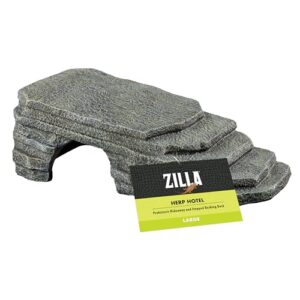
If you want a hide that doubles as a basking spot, this model stands out. The Herp Hotel’s flat top gives your python a proper platform for warmth, while the side and front openings keep the interior dark and secure.
Its non-porous plastic won’t harbor bacteria, and the surface wipes clean in seconds—no fuss.
The 6.9 × 4.7 × 3.3-inch size works for hatchlings and juveniles, but you’ll need something larger as your snake matures. Stability and easy access are built in.
| Best For | Hatchling and juvenile reptiles like leopard geckos or young snakes needing a combined basking and hiding spot. |
|---|---|
| Material | Rigid plastic |
| Entrance Design | Side and front openings |
| Removable Lid | No |
| Ease of Cleaning | Warm soapy water |
| Suitable Species | Leopard geckos, juvenile bearded dragons |
| Humid Hide Ready | No |
| Additional Features |
|
- Flat top offers a sturdy basking platform.
- Easy to clean and resists bacteria.
- Natural look fits both desert and tropical setups.
- Too small for adult or larger reptiles.
- Slick plastic surface can be slippery for heavier animals.
- Limited heat retention compared to stone or wood hides.
8. Pangea Medium Reptile Hide Box
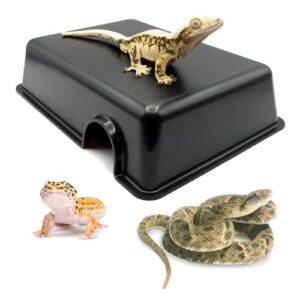
Looking for a hide that nails both security and practicality? The Pangea Medium Reptile Hide Box does exactly that.
Its offset entrance and snug 10 × 7 × 2.25-inch footprint give your ball python a true sense of safety—no wasted space, no visual exposure.
Smooth, non-toxic ABS plastic means easy cleaning and zero risk of skin irritation.
It’s lightweight but sturdy enough for sub-adults, fits standard rack systems, and doubles as a humid hide with moss.
Just check sizing—larger snakes may shift it.
| Best For | Owners of ball pythons, geckos, skinks, and other ground-dwelling reptiles who want a secure, easy-to-clean hide for medium-sized pets. |
|---|---|
| Material | Rigid plastic |
| Entrance Design | Offset entrance |
| Removable Lid | No |
| Ease of Cleaning | Hot water and sanitizer |
| Suitable Species | Snakes, geckos, skinks, bearded dragons |
| Humid Hide Ready | Yes, with added moss |
| Additional Features |
|
- Offset entrance boosts security and reduces stress.
- Smooth, non-porous plastic is simple to clean and sanitize.
- Lightweight yet strong enough for most terrestrial reptiles.
- Larger snakes can shift or lift the hide.
- Entrance may be tight for some species.
- Surface scuffs or scratches can occur on some units.
9. Zoo Med Large Reptile Shelter Cave
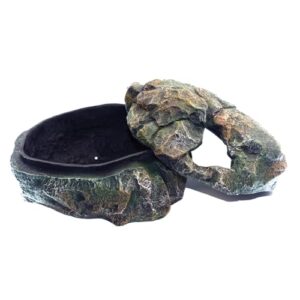
The Zoo Med Large Reptile Shelter Cave earns its place as a serious multi‑purpose hide. Its 3‑in‑1 design works as a standard hide, a humid shedding chamber when packed with damp sphagnum moss, and an egg‑laying site for breeding females.
The removable lid makes cleaning and egg checks straightforward. Ceramic construction adds real weight—it won’t shift when your snake pushes against it.
Best suited for sub‑adults and adult females up to around 1,200 g. Inspect for hairline cracks before use.
| Best For | Small to medium reptiles like leopard geckos, corn snakes, and baby pythons that need a secure hide with humidity control. |
|---|---|
| Material | Ceramic |
| Entrance Design | Side opening |
| Removable Lid | Yes |
| Ease of Cleaning | Removable lid, easy access |
| Suitable Species | Leopard geckos, corn snakes, baby pythons |
| Humid Hide Ready | Yes, retains moisture |
| Additional Features |
|
- 3-in-1 function covers hiding, shedding, and egg-laying — no need to buy separate setups
- Ceramic build is heavy enough to stay put, even with an active snake pushing around inside
- Removable lid makes egg checks and cleanouts quick and painless
- Too cramped for larger or fast-growing reptiles — adults will outgrow it
- Ceramic can crack under prolonged high heat, so keep it off the hot side
- Pricier than basic plastic hides, and some units arrive already damaged
How to Place and Maintain Ball Python Hides
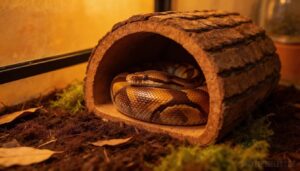
Getting hide in the right spot matters just as much as picking the right one. There are a few simple rules that make a real difference — where it sits, how clean it stays, and whether you’re switching things up often enough.
what you need to know.
Warm-Side Vs. Cool-Side Hide Placement
Thermal Gradient Alignment starts with where you place each hide.
Put the warm side hide directly over the heat source — Entry Angle Optimization matters here, so position it so your snake enters without exposing itself. Heat Source Proximity keeps substrate temps in the mid-to-upper 80s°F.
The cool side hide, using Visibility Reduction Strategies, sits at the far end, around 72–76°F.
Adding a Humid Hide for Shedding Support
Beyond thermal placement, a humid hide for shedding changes everything. Pack a snug-fit hide with damp sphagnum moss and position it toward the warm side — that’s where localized humidity concentrates best.
This moisture gradient protects respiratory health by keeping dampness contained, not spread across the enclosure. Mold control stays manageable, shedding success improves noticeably, and your snake always has reliable shedding assistance on demand.
Cleaning and Replacing Hides Regularly
A clean hide is a functional hide. Organic waste — feces, shed skin, food residue — blocks disinfection methods from working, so remove debris first, then scrub.
Follow this maintenance and cleaning protocol:
- Spot-cleaning schedule: Remove waste daily to control odor management between full washes.
- Weekly wash: Scrub with reptile-safe soap; porous hides need longer contact time.
- Disinfection procedures: Apply chlorhexidine or 3% hydrogen peroxide; bleach requires complete rinsing.
- Drying protocols: Air-dry fully — residual moisture breeds mold fast.
- Replacement timing: Cracks, warping, or persistent odors mean it’s gone.
Rotating Hides to Reduce Stress and Boredom
Once the hides are clean, keep things interesting. A simple hide rotation — moving or swapping hides monthly — introduces scent variation and texture rotation that triggers natural exploration.
| Rotation Strategy | Benefit |
|---|---|
| Seasonal Hide Swap | Matches microclimate diversity to shedding cycles |
| Enrichment Schedule | Sustains behavioral enrichment long-term |
Rotating hides across multiple hide spots reduces stress and prevents habituation.
Frequently Asked Questions (FAQs)
Can ball pythons share a hide safely?
No, they can’t. Ball pythons are solitary — sharing a hide triggers hide competition, dominance behaviors, and stress. Each snake needs its own snug-fitting hide to feel secure.
Separate hides also let each snake choose the right microclimate; see whether ball pythons need a heat mat for safe heating guidance.
How many hides does one enclosure need?
Every enclosure needs a minimum of two hides — one warm, one cool.
A three-hide system adds a moisture hide option, giving your snake real thermal and humidity choices without overcrowding the space.
Do hides need ventilation holes drilled in?
Not necessarily.
If your enclosure already has solid airflow management through lid vents or side panels, extra holes aren’t required — though small ones help with humidity regulation and mold prevention in tighter setups.
Should hides be elevated off the substrate?
Not required, but it helps.
Elevating hides slightly off the substrate improves airflow management, prevents moisture control issues, and reduces scale rot prevention risks — keeping the interior drier without disrupting your thermal gradient.
Can DIY hides replace commercial options effectively?
Yes — a well-built DIY hide can absolutely hold its own against storebought hides. Sand the edges, seal the material, and nail the snug fit.
Custom fit often beats standardized commercial sizing.
Conclusion
Regarding ball python hides, size isn’t everything—it’s about finding that sweet spot. By embracing the snug-fit rule and choosing hides that make your snake feel secure, you’ll be on the right track.
Do ball pythons prefer tight or spacious hides? The answer lies in their biology.
With the right fit and a little know-how, you can create a stress-free environment that lets your pet thrive. Your snake will thank you for it.