This site is supported by our readers. We may earn a commission, at no cost to you, if you purchase through links.
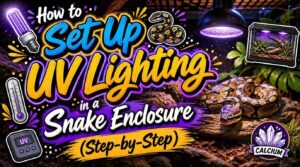
Most snakes kept in captivity never see a single photon of ultraviolet light—and their keepers have no idea that’s slowly working against them. Without UVB, a snake can’t synthesize vitamin D₃, which means calcium metabolism quietly breaks down long before any visible symptoms appear.
It’s the kind of deficiency that looks like "just a picky eater" until it isn’t.
Setting up UV lighting in a snake enclosure isn’t complicated, but it does require matching the right bulb, fixture height, and UVI target to your specific species. Get those three variables right, and you’ve built a setup that upholds genuine long-term health.
Table Of Contents
- Key Takeaways
- Choose Your Snake’s UVB Target
- Pick The Right UVB Bulb
- Match UVB to Snake Species
- Plan The Enclosure Layout
- Set Fixture Height Correctly
- Install UVB Fixtures Safely
- Combine UVB With Heating
- Set a Healthy Light Cycle
- Measure UVB With a Solarmeter
- Maintain Your UVB Setup
- Frequently Asked Questions (FAQs)
- Conclusion
Key Takeaways
- Your snake can’t synthesize vitamin D₃ without UVB, so skipping UV lighting doesn’t just slow growth—it quietly breaks down calcium metabolism before you notice anything’s wrong.
- Match your species’ activity pattern: diurnal snakes need a basking UVI of 1.0–2.5, crepuscular species target 1.0–2.0, and nocturnal snakes only need 0.5–1.0.
- A T5 HO fluorescent tube from a reptile-specific brand like Arcadia or Zoo Med, mounted 12–18 inches above the basking surface and verified monthly with a Solarmeter 6.5, is the most reliable way to hit your target UVI.
- Replace T5 bulbs every 6–9 months regardless of visible brightness, because UVB output fades long before the light does—and a glowing bulb delivering nothing is the easiest mistake to miss.
Choose Your Snake’s UVB Target
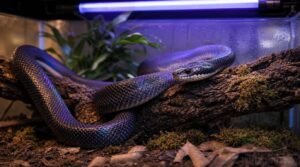
Not every snake needs the same amount of UVB—and getting this wrong can quietly damage their health over time. Your snake’s activity pattern determines the UV Index target you’re aiming for. Here’s how to match the right UVI range to your specific species.
Diurnal species like king snakes often need higher UVI targets than nocturnal colubrids, so brushing up on UVB lighting needs for snakes before you set up your enclosure can save you a lot of guesswork.
Diurnal Snake UVI Range
Diurnal snakes need a basking zone UVI of 1.0 to 2.5 to synthesize vitamin D₃ effectively. That UVI isn’t a guess — it’s measurable and species-specific. Key things to know:
- UVI ambient light shapes overall enclosure exposure, not just the basking spot
- Reflective surfaces can push UVI reflective surfaces readings higher than expected
- UVI daily stability matters more than peak intensity
- Behavioral impact is real — low UVI leads to reduced activity
- Monthly UVI health monitoring catches output decline before it causes harm
UVB‑induced vitamin D₃ production promotes bone growth and muscle function in snakes.
Crepuscular Snake UVI Range
Crepuscular snakes live between two worlds — active at dawn and dusk, resting when the sun peaks. Their UVI target sits between 1.0 and 2.0, gentler than a diurnal setup but still essential for vitamin D₃ synthesis. A low-level UVB gradient across the basking zone mirrors the soft twilight light these species evolved under.
| Crepuscular UVB Factor | Target |
|---|---|
| Basking zone UVI | 1.0–2.0 |
| Ambient UVI | 0.4–1.0 |
| Bulb output | 2–5% UVB |
| Photoperiod | 12h on/off |
| Monitoring frequency | Monthly |
Nocturnal Snake UVI Range
Nocturnal snakes sit at the quieter end of the spectrum — their UVI target is 0.5–1.0, the lowest of any category. Think of it as background glow rather than direct sunlight.
- Ambient indirect lighting promotes calcium balance without overwhelming sensitive eyes
- A gradual dusk shift prevents stress during dawn and dusk periods
- Monthly UVI measurements confirm functional vitamin D₃ production remains stable
Ferguson Zone Basics
Those three UVI ranges — 0.5–1.0, 1.0–2.0, and 2.0–4.0 — map directly onto the Ferguson Zone system, a classification framework that groups reptiles by their natural sun exposure. Zones 1 and 2 cover shade-dwellers and occasional baskers, while Zones 3 and 4 serve full-sun species.
Most snakes fall within Zone 1 or 2.
Avoiding UVB Overexposure
Too much UVB is just as harmful as too little. Photokeratitis and chronic stress can result from overexposure, so staying within your target UVI range matters.
Use distance tuning to fine-tune intensity — even a few inches change the reading noticeably. A mesh guard reduces output further.
Always verify with a Solarmeter, and confirm your snake has shaded retreat access to self-regulate.
Pick The Right UVB Bulb
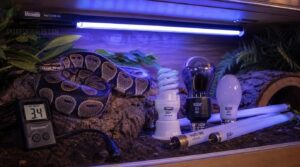
Not every UVB bulb on the shelf will actually do the job, and choosing the wrong one can quietly harm your snake before you notice anything’s wrong. The type, strength, and brand all matter more than most people realize. Here’s what you need to know before you buy.
T5 HO Linear Tubes
T5 HO fluorescent tubes are the industry standard for UVB lighting in a snake enclosure — consistent output, low heat, and reliable coverage. Here’s why they work so well:
- Tube diameter is just 16 mm, fitting slim, purpose-built fixtures
- Bulb length comes in 2, 3, or 4 feet to match your setup
- Ballast compatibility matters — always use a rated T5 HO electronic ballast
- Longevity range runs 10,000–20,000 hours before UVB phosphors fade
That UVB uniformity across the basking zone is what makes them worth it.
Low-output UVB Options
Not every snake needs a high-powered T5 HO fluorescent tube blazing overhead.
Low-output UVB options — commonly emitting 2–6% UVB — suit smaller enclosures and nocturnal species needing only low to moderate UVB exposure. Their compact housing fits clip‑on adapters easily. Mount them closer to hit your target UVI, and use UVB diffusion panels to soften intensity without blocking UVA.
Reptile-specific Bulb Brands
For UVB, brand choice matters more than you’d think. Arcadia ProT5 tubes deliver stable output at 6–12% UVB with high CRI lighting.
Zoo Med ReptiSun and Exo Terra Repti Glo are widely trusted, species-tested options. Reptile Systems rounds out the shortlist.
Stick to reptile-specific manufacturers — their bulbs target the 290–320 nm range your snake actually needs.
Bulbs to Avoid
Not every bulb on the shelf is safe for your snake. Compact fluorescent coil bulbs are the biggest offender — they create uneven UVB hotspots linked to photokeratitis and eye damage.
Aquarium-grade fluorescents skip the critical 290–320 nm range entirely, making them useless for vitamin D₃ synthesis. Skip both, and your snake’s calcium metabolism stays protected.
UVB Percentage Explained
The percentage on a UVB bulb label isn’t the whole story. A 6% T5 HO tube placed too far away can deliver less usable UVB dosage than a 5% bulb mounted closer. What actually matters is the UVI at basking height — the real UVB measurement your snake’s skin is influenced by.
Replacing bulbs on schedule is just as important as placement — corn snake heating and temperature control covers both so your UVI readings stay reliable over time.
- Percentage reflects UVB share of total UV emitted
- Higher percentages often increase UVA output alongside UVB
- Distance dramatically reduces UVB intensity at the basking surface
- Reflector design and enclosure geometry shape final UVB strength
- Always verify UVB dosage with a Solarmeter, not just the label
Match UVB to Snake Species
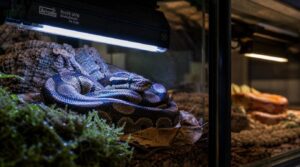
Not every snake needs the same UVB setup, and getting this wrong can quietly cause real harm. Your species determines the target UVI, the bulb strength, and even how you mount the fixture. Here’s how the setup breaks down for the most common snakes people keep.
Ball Python UVB Setup
Ball pythons are crepuscular, so they need a basking UVI of 2.0–3.0 — not the higher ranges you’d set for a diurnal species. A 6% T5 HO fluorescent tube placed over one-third of the enclosure hits that target cleanly.
Keep humidity at 60–80% by mounting the fixture internally in PVC enclosures, which preserves both UVB intensity and airflow without sacrificing moisture.
Corn Snake UVB Setup
Corn snakes are diurnal, so bump your target UVI up to 2.0–3.0 at basking height. A 6% T5 HO tube positioned 12–15 inches above the substrate covers that range reliably. Place the fixture over the warm third of the enclosure, leaving a shaded cool end your snake can retreat to whenever it’s had enough light.
Boa Constrictor UVB Setup
Boas are crepuscular by nature, so your target UVI sits at 2.0–3.0 on the basking spot—enough to support vitamin D₃ synthesis without overwhelming them. A 6% T5 HO tube works well here, but UVB distance calibration matters more with boas because of their size.
- Keep UVB intensity consistent across the basking zone
- Maintain enclosure humidity balance by mounting fixtures internally when possible
- Run a light cycle consistency of 12 hours on, 12 off
Arboreal Snake Considerations
Arboreal snakes rewrite the rulebook entirely.
Species like green tree pythons use concertina climbing and tail prehensility to navigate branches daily, which means their UVB setup must follow them vertically—not horizontally.
Mount your fixture on the enclosure wall rather than the lid, targeting a UVI of 2.0–3.0 at perch height where they actually bask.
Large Enclosure Adjustments
When your enclosure stretches past 6 feet, a single UVB fixture rarely cuts it.
- Floor area optimization — position UVB across at least half the enclosure length
- UV gradient design — taper intensity from target UVI down to zero at the cool end
- UVB lamp placement — use sliding-track mounts to reposition as basking spots shift
- Vertical space utilization — wall-mount fixtures for climbing species above perch height
- Ventilation gap sizing — maintain 1–2 inch gaps to prevent moisture buildup around bulbs
Plan The Enclosure Layout
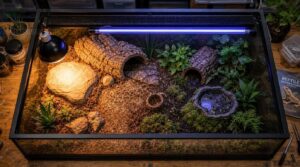
Getting the layout right is what ties everything together. Before you place a single bulb, you need to know exactly where the warm side, cool side, and basking zone sit in relation to each other. Here’s how to arrange each element so your snake gets the right UV exposure without being stuck in it.
Warm-side UVB Placement
Place your UVB fixture directly above the basking spot on the warm side — that’s your snake’s direct exposure zone. Position it so the beam overlaps the basking surface completely, with no thick décor blocking the path.
Maintain a clear line of sight between bulb and snake, and keep the UVB intensity gradient tapering toward the cool end.
Cool-side Shaded Retreat
On the cool side, your snake needs a UV-free retreat area — a genuine escape from both heat and UVB intensity. Dense hides, vertical branches, and shade-blocking décor create a shaded microclimate where UVB drops to zero. Keep your UVB fixture positioned well away from this zone.
A ventilation hide placement with breathable substrate maintains airflow, preventing moisture buildup while keeping temperatures noticeably lower.
Basking Zone Alignment
Alignment is everything — the basking zone must sit directly under your UVB fixture’s strongest output zone. Measure UVI at the snake’s head height, not the bulb.
Adjust fixture angle until the basking area reads within your target UVI range. Keep decor low here; tall objects create shadows that break your UVB exposure guidelines before the snake even settles.
Hide and Branch Positioning
Branches and hides aren’t just décor — they’re part of how your snake self-regulates UVB exposure.
Position branches 12 to 18 inches above the substrate, angling the warm-side branch to terminate directly in your basking zone. Arrange at least three branches in a ladder pattern, giving your snake gradual elevation options.
Keep hide entrances 1.5 to 2 inches wide and orient openings away from direct sightlines.
UV Gradient Design
Think of UVB gradient design as a dimmer switch running the length of your enclosure — bright at one end, dark at the other.
Position your fixture over the basking third, where basking UV intensity peaks at your target UVI.
From there, the UV zone gradient tapers naturally toward the cool retreat, giving your snake full control over its own UV lighting dosage.
Set Fixture Height Correctly
Fixture height isn’t just a minor detail — it determines whether your snake actually gets the UVB dose you’re aiming for. A few inches too high or too low and you’ve either wasted the bulb or stressed the animal. Here’s what to keep in mind before you mount anything.
Standard Mounting Distances
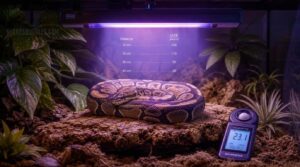
Distance is everything regarding UVB output intensity.
For medium to large enclosures, mount your fixture 12 to 18 inches above the floor. Compact setups work best at 8 to 12 inches.
After any enclosure rearrangement, remeasure immediately — the basking zone shifts, and your UVB gradient design shifts with it. Always verify with a solarmeter before assuming the setup still works.
Screen-top UVB Loss
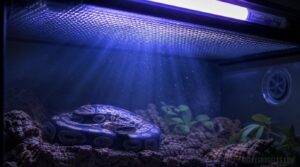
Your screen top is silently stealing UVB before it reaches your snake. Mesh transmission loss commonly cuts UVB by 30–50%, depending on mesh density. That’s a significant UVB attenuation factor — enough to push your snake below its target UVI.
To compensate, move your fixture closer or upgrade to a higher-output T5 HO bulb with a reflector efficiency boost.
Internal PVC Mounting
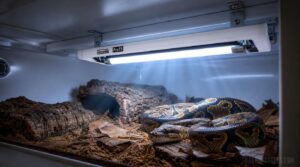
If your enclosure has a screen top, you’ve already adjusted for mesh loss — but internal PVC mounting solves that problem entirely. Mounting an Arcadia ProT5 fixture inside a PVC enclosure on a rigid PVC channel eliminates the mesh barrier, so UVB reaches your snake unfiltered.
Use corrosion-resistant fasteners and check that your mounting bracket capacity matches the fixture weight before securing anything permanently.
Basking-surface Measurements
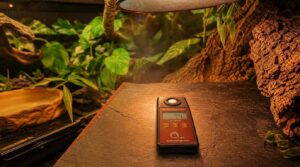
Once the fixture is locked in place, grab your Solarmeter 6.5 and measure the UVI reading directly at the basking surface — not the air above it.
Place the meter flat on the surface material, whether ceramic tile or slate, and confirm it hits your species’ target.
Surface height determines dose; even a few centimeters change everything.
Clearance From Climbing Snakes
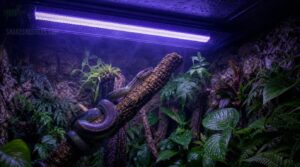
Climbing snakes reshape what "safe distance" means.
If your snake can reach the fixture, it will—so maintain a minimum vertical gap of at least 8 inches between any climbing structure and the bulb. Install protective mesh barriers around the fixture, and design climbing paths so ascending snakes naturally stay below safe UVB exposure zones rather than pressing against the source.
Install UVB Fixtures Safely
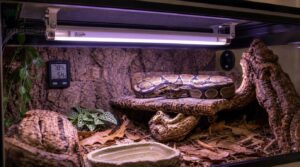
A loose or poorly mounted UVB fixture isn’t just inconvenient — it’s a real hazard for both your snake and your setup. Getting the installation right means thinking through a few key details before you ever flip the switch. Here’s what to check off before your lighting goes live.
Secure Fixture Fasteners
A loose fixture is a liability you can’t afford. Use stainless steel fasteners — grade 304 minimum, grade 316 in high-humidity setups — with an anti-corrosion coating to resist rust. Add vibration dampening grommets where the mount contacts the frame, and follow torque specification guidelines to avoid crushing the housing:
- Tighten firmly, never overtorque
- Add lock washers to prevent loosening
- Inspect weekly for corrosion or movement
- Replace stripped fasteners immediately
Protective Mesh Guards
A mesh guard does double duty: it protects your snake from direct bulb contact and protects your bulb from curious, climbing animals. Use stainless steel mesh — grade 304 at minimum — for corrosion resistance in humid setups.
Maintain 4–6 inches of clearance between guard and bulb so heat dissipates freely.
Note that screen mesh can block 30–45% of UVB output, so factor that into your solarmeter readings.
Heat-safe Mounting Materials
The hardware holding your fixture matters more than most keepers realize. Stainless steel brackets (grade 304 minimum) handle temperatures up to 500°F and won’t corrode in humid PVC enclosures. Aluminum heat sinks dissipate fixture heat efficiently and weigh less — a practical win for top-mounted tube fixtures. For extreme heat zones, ceramic mounts are your non-combustible fallback.
Avoid zinc-coated plates in high-humidity setups unless sealed; corrosion develops faster than you’d expect.
Ventilation Around Bulbs
Think of your bulb as a small engine — it needs room to breathe. Open air pathways around the fixture prevent heat buildup that shortens bulb life and destabilizes UV output.
- Leave ventilation gaps of at least 4–6 inches around the fixture
- Allow vertical airflow to carry heat upward efficiently
- Avoid enclosing bulbs in tight spaces without clearance
- Bulb clearance keeps moisture from collecting near the housing
- Use mesh guards to protect without blocking airflow
Weekly Safety Inspections
A loose fixture won’t announce itself — it’ll fail silently. Run a weekly safety inspection across five areas: Mount Integrity Check, Bulb Position Verify, Guard Mesh Inspection, Cord Strain Relief, and Moisture Spot Check.
| Inspection Area | What to Check |
|---|---|
| Fixture & bulb | No cracks, gaps, or sagging |
| Guard & cords | Secure mesh, no frayed wiring |
Moisture near sockets accelerates UVB output decline — keep it dry.
Combine UVB With Heating
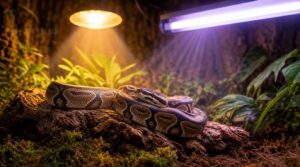
UVB alone won’t keep your snake healthy — heat has to work alongside it. Getting both dialed in together is what turns a good setup into a great one. Here’s how to make sure your heating and UVB are pulling in the same direction.
Basking Heat Alignment
Your basking lamp needs to land heat and UVB strength on the exact same spot. Lamp angle alignment matters more than most people realize — a steep angle creates a tiny, punishing hotspot, while a flat one scatters heat toward the walls.
Aim for a broad, centered basking area and verify it with a surface temperature check before your snake ever steps under it.
Temperature Gradient Support
Once your basking spot is dialed in, the rest of the enclosure needs to follow.
A proper temperature gradient runs from a warm side of 28–30°C down to a cool retreat of 24–26°C.
Place at least three sensors across hot, mid, and cool zones to confirm the drop is steady — not abrupt — so your snake can self-regulate without stress.
Thermostat-controlled Heat Sources
With your gradient mapped, the next step is locking in each heat source with a thermostat-controlled circuit.
- Pair every ceramic emitter, heat pad, and heat lamp with a dedicated thermostat
- Mount your temperature sensor on the basking surface, not in open air
- Set a high-temperature cutout to protect against sensor failure
- Use a programmable thermostat to drop temps slightly during inactive hours
- Avoid extension cords, which introduce voltage drop and overheating risk
Avoiding Excessive Basking Intensity
Once your thermostats are locked in, check that heat and UVB aren’t doubling up intensity in the same tight zone. A UVI above 4.0 at the basking surface risks photokeratitis. Position the basking spot slightly off-center from the bulb’s peak output, and confirm your snake has a shaded cool-side retreat it can actually reach.
Nighttime Heat Considerations
Once the lights go out, your snake’s enclosure still needs careful thermal management. Turn off all UVB lighting at night — snakes need true darkness to rest properly. Use a ceramic heat emitter or radiant heat panel on a thermostat to maintain nighttime temperatures without any visible light disrupting your snake’s natural nocturnal behavior.
- Drop basking-side temps by 5–10°F at night
- Never use visible heat lamps after dark
- Set your thermostat night setpoint separately from daytime
- Ceramic emitters keep warmth without disturbing sleep cycles
- Check humidity after heat sources cycle — substrate dries faster overnight
Set a Healthy Light Cycle
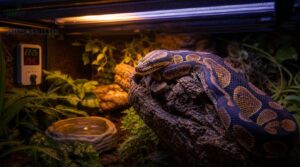
Your snake’s internal clock is more sensitive than most people realize. A consistent light cycle keeps their metabolism, digestion, and stress response running on schedule. Here’s what you need to get it right.
Daily Photoperiod Length
Your snake’s internal clock runs on light.
Daily photoperiod — how many hours of light it receives — shapes its activity window, metabolism, and rest cycles.
Diurnal snakes thrive on a 12-to-14-hour photoperiod; crepuscular species do well with 10 to 12 hours.
Stick to a 12‑hour on 12‑hour off baseline as your reliable starting point.
Digital Timer Setup
Once your photoperiod is set, an automated timer does the hard work of enforcing it. Plug your UVB fixture into a digital timer, then program your chosen on/off window down to the minute.
Use repeat mode to cycle that schedule daily without manual input.
A battery backup keeps your program intact during outages, and a surge protector guards the electronics.
Seasonal Lighting Adjustments
Most keepers set one photoperiod and never touch it again — but your snake’s wild habitat doesn’t work that way. Shift your seasonal timer programming gradually: extend UVB exposure to 13–14 hours in spring, then reduce to 10 hours in winter.
- Spring UVB increase: add 30 minutes monthly from March onward
- Winter light reduction: drop to 10-hour days by December
- Photoperiod shifts: never adjust by more than 30 minutes per week
- UVB gradient adjustment: recheck UVI with your Solarmeter after each schedule change
Circadian Rhythm Support
Your snake’s internal clock runs on contrast — not just light, but the reliable shift between bright days and genuine darkness. Circadian entrainment happens when consistent light-dark signals sync the biological clock to your schedule.
A digital timer delivering the same on/off times daily strengthens that synchronization. Photoperiod consistency matters more than intensity alone; irregular timing fragments your snake’s daily rhythm just as disrupted sleep fragments yours.
Darkness for Nighttime Rest
Once the timer cuts your UVB lighting, complete darkness matters. Even dim ambient light at night suppresses melatonin and fragments your snake’s rest.
Cover any indicator LEDs on thermostats or timers, and lightproof the enclosure by blocking outside streetlight.
A genuinely dark environment lets your snake’s circadian rhythm settle fully, supporting deeper, uninterrupted rest after every consistent photoperiod.
Measure UVB With a Solarmeter
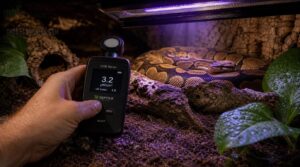
You can’t manage what you don’t measure — and with UVB, guessing is how snakes end up sick. A Solarmeter 6.5 takes the guesswork out entirely, giving you real numbers at the exact spot your snake spends time. Here’s what to check, when to check it, and how to act on what you find.
Checking Basking-zone UVI
Start every basking-zone check by placing your Solarmeter 6.5 directly on the basking surface. Record UVI at the center, then at the edges — this gradient mapping reveals hotspots your snake actually encounters.
- Power the bulb for 15 minutes before measuring
- Hold the sensor flat, facing the bulb
- Log date, height, and UVI reading
- Compare against your species’ target range
- Flag any reading below target immediately
Measuring at Snake Height
Basking-zone readings tell you half the story. The other half lives at snake height — the actual plane where your snake’s body rests.
Place your Solarmeter 6.5 in flat against the dorsal midline, using that reference plane technique to eliminate angular errors. Always measure on a stable surface for repeatable results. That’s your true UVI reading.
Monthly UVB Testing
Once you’ve nailed your snake-height measurement, put it to work by testing every month. Log each UVI reading with the date, same spot, same fixture height.
UVB decay is slow and invisible — your bulb looks fine while output quietly drops. That monthly data log turns a hidden problem into a visible trend you can actually act on.
Adjusting Distance Safely
Once your monthly log flags a dip, adjust the fixture height before the next reading. Move it 2–3 inches closer, remeasure at basking height, and confirm your target UVI.
Account for mesh loss — screen tops cut 30–45% of UVB output, so distance changes alone won’t always be enough. Always verify both UVI and basking temperature after any adjustment.
Tracking Output Decline
Logging every UVI reading turns raw numbers into a story. Note the date, fixture height, and basking-spot location each time so your measurements stay comparable.
UVB output drops gradually — your Solarmeter won’t flash a warning. A steady decline across three monthly checks signals the bulb is past its effective UVB bulb lifespan, even if the light still glows.
Maintain Your UVB Setup
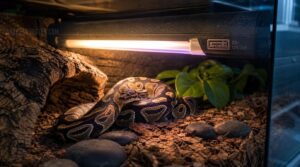
Getting your UVB setup right is only half the job — keeping it working is the other half. Bulbs fade, fixtures get dusty, and a missed replacement can quietly put your snake’s health at risk. Here’s what to stay on top of.
T5 Bulb Replacement Schedule
T5 HO fluorescent tubes don’t announce when they’re done — they just quietly stop working at the UV level your snake actually needs. Replace T5 High Output bulbs every 6–9 months, even if the light still looks bright. Visible light and UVB output decline at different rates, so a glowing bulb can still be delivering almost nothing useful.
A glowing T5 bulb can still be delivering almost nothing useful — replace it every 6–9 months regardless
Here’s a simple replacement routine to follow:
- Mark the installation date on the bulb’s end cap the moment you install it.
- Run a Solarmeter verification monthly to catch output drops before they become a health risk.
- Clean fixtures weekly with a damp microfiber cloth — dust alone can cut UVB output by up to 30%.
Brand lifespan variation is real. Always check the manufacturer’s specs, since some brands rate their tubes closer to 9 months and others fall short of that. Heat is another factor — poor ventilation around the fixture accelerates phosphor degradation and shortens UVB bulb lifespan noticeably. If your snake enclosure runs warm, inspect output more frequently than the standard schedule suggests.
Mercury-vapor Lamp Lifespan
Mercury-vapor lamps outlast T5 tubes by a wide margin — rated at 24,000 to 36,000 hours — but that number hides an important catch.
Lumen depreciation starts early, and UVB output drops well before the lamp visibly fails.
Watch for a pinkish color shift or end-tube blackening; both signal arc tube wear and electrode degradation.
Replace your lamp at 12 months, regardless of appearance.
Weekly Fixture Cleaning
Dust is a silent thief — it can cut UVB output by up to 30% without any visible warning.
- Power off and unplug fixtures; let bulbs cool at least 15 minutes
- Wipe lenses with a lint-free microfiber cloth dampened with 70% isopropyl alcohol
- Use a soft-bristle brush on vents and mounting brackets
- Wear gloves to keep skin oils off bulb surfaces
- Log the cleaning date in your UVB equipment maintenance log
Recording Installation Dates
A sharpie mark on the bulb end cap is your first line of defense against expired UVB.
| Record Field | Example Entry |
|---|---|
| Installation Date | 2026-05-25 |
| Bulb Type & Model | Arcadia T5 HO 6% |
| Next Replacement Due | 2026-11-25 |
| Initial UVI Reading | 1.8 at basking height |
Log every UVB bulb change interval in a digital record — include the installer name, enclosure ID, and baseline UVI reading. Back up that file to cloud storage quarterly. This audit trail keeps your replacement schedule honest.
Troubleshooting Weak UVB
Your Solarmeter isn’t lying — if UVI is low, something specific is wrong. Work through these five causes in order:
- Bulb age — T5 HO tubes lose usable UVB output well before they stop glowing; replace after 6–9 months.
- Dirty bulb surface — dust cuts UVB strength by up to 30%; wipe weekly.
- Screen-top loss — mesh blocks 30–45% of UVB radiation; move the fixture closer.
- Wrong distance — measure UVB exposure at basking height, not at the fixture.
- Wrong bulb type — mismatched UVB output class won’t hit target UVI regardless of brightness.
Frequently Asked Questions (FAQs)
Can snakes get UVB through a glass window?
That sunny window is just a pane of broken promises — standard glass blocks nearly 100% of UVB radiation, so your snake gets zero vitamin D synthesis support from it. You need indoor UVB lighting.
Do hatchling snakes need different UVB levels?
Yes — hatchling UVB dosing differs from adults. Smaller bodies absorb UVB radiation more intensely, so target a UVI of 5–5 and introduce light gradually to avoid stress or skin irritation.
How does UVB interact with vitamin supplements?
UVB and supplements aren’t rivals — they’re teammates. UVB drives vitamin D3 synthesis in skin, while supplements fill the gaps. Together, they support calcium absorption and prevent metabolic bone disease without overshooting safe serum levels.
Can UVB bulbs trigger stress or behavioral changes?
Yes — UVB bulbs can trigger stress. Too much UVB dose causes eye and skin irritation, prompting behavioral avoidance, reduced basking time, and stress response indicators like hiding. Always match UVB intensity to your snake’s Ferguson Zone.
Does enclosure color affect UVB reflection or absorption?
Think of your enclosure walls as a second light source. Light, matte finishes reflect UVB back toward your snake, while dark interiors absorb it, quietly reducing the dose your snake actually receives.
Conclusion
An ounce of prevention is worth a pound of cure—and nowhere is that truer than setting up UV lighting in a snake enclosure correctly from day one.
Match your bulb to your species, measure actual UVI at basking height, and replace bulbs on schedule.
Your snake can’t tell you when the light isn’t working. The Solarmeter can. Build the habit of checking, and you’ll never mistake a preventable deficiency for a picky eater again.
- https://www.zenhabitats.com/blogs/reptile-care-sheets-resources/how-to-set-up-a-naturalistic-reptile-enclosure
- https://www.petco.com/content/content-hub/home/articlePages/home-habitat/reptile-uvb-light-guide.html
- https://vcahospitals.com/know-your-pet/reptiles---proper-lighting
- https://www.aussiepythons.com/threads/question-about-uv-lighting.202445
- https://www.beardeddragon.org/articles/uvb-lighting-setup