This site is supported by our readers. We may earn a commission, at no cost to you, if you purchase through links.

Most keepers who attempt breeding don’t fail because they picked the wrong pair. They fail because they misread the signals—or missed them entirely.
Captive snake breeding behaviors follow a precise biological sequence, and every stage depends on the one before it. Skip the pre-breeding health check, and you risk pairing a pathogen-carrying animal. Misjudge ovulation, and you miss the window. Ignore the pre-lay shed, and egg binding catches you off guard.
The difference between a successful clutch and a failed season often comes down to knowing exactly what to watch for, and when.
Table Of Contents
- Key Takeaways
- Recognize Captive Breeding Readiness
- Create Breeding Season Conditions
- Identify Snake Courtship Behaviors
- Manage Mating and Gravid Females
- Support Eggs and Hatchlings
- Frequently Asked Questions (FAQs)
- How do you breed snakes in captivity?
- Can snakes breed in captivity?
- When do snakes breed?
- What makes a successful snake breeding?
- How can you tell if snakes are mating?
- How do genetics influence captive snake breeding outcomes?
- What quarantine steps protect breeding stock from disease?
- Which morphs carry dangerous or lethal genetic combinations?
- How do breeders maintain genetic diversity across generations?
- When should breeding records and lineage logs be updated?
- Conclusion
Key Takeaways
- Pre-breeding health checks, weight targets, and veterinary pathogen screening aren’t optional steps—they’re the foundation that determines whether any pairing attempt can succeed.
- Environmental triggers like temperature gradients, humidity at 60–80%, and incremental photoperiod shifts are what activate your snake’s reproductive biology, not just background conditions to maintain.
- Reading the female’s body—mid-body ovulation swelling, pre-lay shed, and behavioral restlessness—tells you exactly where you are in the breeding timeline and what’s coming next.
- From egg collection to first feeding, every decision you make in the 60 days post-laying directly affects hatch rates and hatchling survival, leaving no room for guesswork.
Recognize Captive Breeding Readiness

Before you pair snakes, you need to know they’re actually ready — not just old enough, but physically and behaviorally prepared. Rushing this step is one of the most common mistakes captive breeders make. Here’s what to look for before you move forward.
A good starting point is this guide on breeding ball python snakes, which covers the physical and behavioral checkpoints that actually matter before you introduce any animals.
Healthy Adult Body Condition
Before pairing any snake, check its body condition score first. A well-conditioned adult carries visible muscle mass along the spine without prominent vertebral ridges.
For ball pythons, target around 1,500 g minimum; corn snakes need at least 300 g.
Track weight monthly and watch fecal consistency — poor stool signals absorption problems that undermine breeding readiness fast.
Species-Specific Breeding Age
Body condition tells only half the story. Sexual maturity depends on age and size together.
- Smaller species like corn snakes breed at 2–4 years
- Large constrictors need 5–7 years minimum
- Males mature earlier than females in most species
- Underfed snakes delay readiness regardless of age
Growth-driven readiness matters more than calendar age alone.
Longevity associates with better performance reflects earlier laying and larger clutches, highlighting findings from long‑lived species research.
Pre-Breeding Veterinary Checks
Age and size confirm readiness — but a vet visit confirms health.
Schedule pathogen screening protocols before any pairing attempt. Vets check for respiratory infections, mites, and oral rot, then run fecal panels for internal parasites.
Reproductive tract evaluation catches hidden abnormalities early.
If anything flags positive, delay breeding until the animal is fully cleared.
Male and Female Signs
Once your animals clear their health checks, you need to read what their bodies are telling you.
Males show restless roaming behavior and reduced interest in food — a reliable sign of hormonal activation. Females display visible follicular swelling along the lower third of the body when ovaries are developing.
Watch for these cues before you attempt any pairing.
Safe Pairing Timing
Timing makes or breaks a breeding season. Pair only when all five conditions are met:
- Photoperiod stability for two weeks minimum
- Female shows receptivity signs and ovulation indicators within 5–14 days
- Male displays sustained courtship for 2–4 weeks
- Veterinary checks confirm both animals are ready
- Cues align with seasonal mating cycles
Don’t rush it — post-pairing stress begins the moment locking ends.
The weeks ahead involve close monitoring, especially once the prelay shed signals eggs are coming within that three-to-four-week window.
Create Breeding Season Conditions

Getting the environment right is half the battle regarding triggering breeding behavior. Your snake’s enclosure needs to mirror the seasonal shifts it would experience in the wild — temperature, humidity, light, and all. Here’s what to adjust, step by step.
Temperature Gradient Setup
Your enclosure needs a linear temperature ramp running from 88–90 °F at the basking end down to 75–80 °F at the cool refuge. Place sensors every 5–10 cm to map the gradient precisely.
Dual heating elements with feedback-controlled power keep each zone within ±0.5 °C. Seal access ports and line walls with reflective insulation — any draft blurs the gradient fast.
Humidity for Reproductive Cues
Humidity does more than prevent shedding problems — it’s a breeding trigger.
Target 60–80% relative humidity during mating season. At these levels, pheromone dispersion from cloacal secretions intensifies, giving males sharper chemical signals to track. Drop below 40%, and courtship latency increases noticeably.
Use calibrated hygrometers and cypress mulch substrate for reliable humidity retention without guesswork.
Photoperiod Changes
Light is a quiet clock your snakes can’t ignore. As day length extends toward spring, the brain detects the shift and melatonin secretion drops, triggering gonadotropin releasing hormone and activating the reproductive axis.
As spring days lengthen, falling melatonin unlocks the reproductive axis — light is the hidden breeding switch
Set timers to increase photoperiod by 15–30 minutes biweekly, targeting 10 hours of full-spectrum light. That gradual ramp is what separates a productive breeding season from a stalled one.
Brumation or Cooling Cycles
Think of brumation as replaying winter for your snake. Lower daytime temperatures 5 °F every 3–5 days, targeting 55 °F for temperate species like corn snakes. Fast your animal 3–5 weeks before cooling to clear the gut.
Watch for metabolic decline: if weight drops below 10%, restart feeding immediately. Brumation runs 60–90 days, then you begin the slow climb back.
Post-Brumation Feeding
Water comes first. Before any prey hits the enclosure, give your snake 24–48 hours of hydration. Offer a shallow soaking dish and mist gently to encourage drinking.
Then reintroduce food gradually — start small, wait 14 days between meals, and watch for regurgitation. Three to five small meals weekly over the first post-brumation week rebuilds condition and triggers reproductive readiness.
Identify Snake Courtship Behaviors
Once the environment is dialed in, the real show begins. Courtship in snakes is a precise sequence of behaviors, and knowing what to look for puts you in control of the process. Here’s what you’ll observe when your snakes are ready to breed.
Understanding these cues becomes much easier when you’ve studied boa constrictor mating habits and courtship signals in detail before your first breeding attempt.
Pheromone Scent Tracking

When a male detects a female’s presence, olfactory neurons in the nasal cavity fire immediately — triggering a pursuit guided entirely by chemistry. Pheromones are blends of proteins, peptides, and volatile molecules unique to each individual.
He follows micro-gradients in the scent trail, pausing at concentration peaks, tongue-flicking to confirm proximity. Humidity and temperature directly affect how far those signals carry.
Chin Rubbing and Tapping

Once pheromone tracking brings the male close, physical contact begins. He sweeps his chin steadily along the female’s body, stimulating tactile receptors with controlled, exploratory strokes.
This isn’t random — it’s a self-regulatory courtship behavior that signals readiness. Rhythmic tapping follows, usually at 1–2 taps per second, a pacing that indicates active mating selection processing before any cloacal alignment attempt.
Male Combat Displays

When a rival male enters the scene, courtship shifts into competition. Watch for visual threat posturing — arched backs, elevated heads, and dominance body inflation that makes the snake appear larger than it is.
Three signals tell you a fight is escalating:
- Rapid tail flicks and lateral sweeps
- Low hisses — acoustic warning signals reinforcing size displays
- Ground vibrations from lunging, felt through the substrate
Spatial constraints matter. Encounters near shelter sites or females intensify quickly.
Cloacal Alignment

Once dominance resolves, the male shifts focus entirely to the female. He fans his tail, angling his vent toward hers — this is ventral positioning mechanics in action.
Watch for rhythmic body undulations stabilizing the pair. The hemipenes eversion process begins as muscular coordination factors align both cloacae precisely.
Misalignment discourages further courtship, so space and calm matter here.
Successful Locking Behavior

When cloacal alignment holds, successful locking begins. The male’s pelvic spurs anchor position as both snakes flatten into parallel contact, vents joined.
Watch for synchronized respiratory pauses — breathing slows together. That stillness signals stable intromission, not distress. The pair reduces movement to conserve the connection, sometimes holding for several minutes before quietly separating.
Manage Mating and Gravid Females
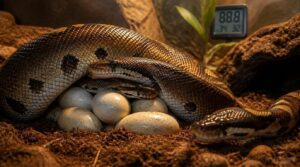
Once mating begins, your job shifts from matchmaker to monitor. Gravid females have specific needs that change fast, and missing the signs can cost you the entire clutch. Here’s what to watch for at each stage.
Pairing Sessions and Supervision
Before introducing snakes, record behavioral baselines for each animal. Two trained staff must supervise every session, taking real-time notes on posture and tactile interactions.
Start with olfactory acclimation in adjacent enclosures before any direct contact.
Watch for stress indicators — excessive gaping or hissing signals trouble. If aggression escalates, your emergency disengagement protocol ends the session immediately.
Reducing Stress During Breeding
Stress kills momentum. Keep the room quiet and restricted — limit handlers to two, and use visual barriers between enclosures to prevent territorial arousal.
Scent cues should feel familiar, not novel. Subtle cork bark retreats give snakes predictable refuge during pairing.
Don’t intervene unless necessary. Minimal human contact lets natural mating behavior unfold on the snakes’ terms.
Ovulation and Swelling Signs
Ovulation in females produces a visible mid-body swelling — a firm, elongated bulge running along the posterior third of the body. This reflects follicle development and fluid shifts tied to rising estrogen.
You’ll notice pelvic fullness when palpating gently.
The swelling is transient, peaking over 24–48 hours.
Track it alongside behavioral shifts — restlessness signals reproductive readiness is peaking.
Pre-Lay Shed Behavior
After ovulation, watch for a pre-lay shed — the female’s skin dulls and eyes cloud within 2–4 weeks before egg deposition.
Signs to track:
- Increased restlessness and substrate investigation
- Reduced feeding response
- Preference for humid hides
- Frequent position shifts across thermal zones
- Prolonged stillness before final site selection
Egg laying usually follows 2–4 weeks post-shed.
Egg Binding Warning Signs
Egg binding is a reproductive emergency. Watch for abdominal distension, visible straining without oviposition, and vent swelling — these signal a retained egg pressing against internal organs.
Lethargy symptoms appear fast: she’ll sit motionless, stop eating, and show elimination changes like absent droppings. Respiratory distress, including open‑mouth breathing, means internal pressure has escalated.
Get veterinary help immediately.
Support Eggs and Hatchlings

Once the eggs are laid, your work shifts from breeding management to careful stewardship. Every decision you make in the next 60 days — from how you collect the eggs to how you house the hatchlings — directly affects survival rates. Here’s exactly what that process looks like, step by step.
Since brooding females and new hatchlings both sleep more than usual, it helps to know the difference between normal snake lethargy and signs of illness before you start second-guessing every still, quiet coil.
Once hatchlings arrive, staying on top of routine reptile health checkup procedures helps you catch subtle issues early, long before they become real setbacks.
Safe Egg Collection
The moment your female finishes oviposition, act quickly but carefully. Wear disposable gloves every time — bacteria transfer from bare hands to porous shells faster than you’d expect.
Collect eggs in their original orientation without rotating them. Place each one gently into a sanitized, padded container. Discard any cracked or discolored eggs immediately — they compromise the clutch.
Incubation Temperature and Humidity
Once collected, incubation temperature is your first variable to lock down. Aim for 80–83°F. Even ±2°F shifts embryo metabolic rates and hatch timing.
- Hold humidity at 80–95%
- Calibrate your incubator weekly
- Balance both — humidity-temperature interaction matters
Higher temps accelerate moisture loss through the shell. Raise humidity to compensate and protect clutch viability.
Monitoring Egg Health
With temperature and humidity locked in, your next job is watching the eggs themselves.
Candle every 3–5 days — embryo vasculature appears by day 5–12, confirming viable growth. A growing air cell signals dehydration.
Shell porosity should stay around 0.5–1.0 mg/cm²/h. Cracks invite infection quickly.
Dark, non-vascular patches under candling mean a dead‑in‑shell embryo — remove it before mold spreads.
Hatching Behavior Signs
Once your eggs pass the candling stage, watch for embryo movement — visible rocking signals repositioning for exit. Pipping begins with pinprick cracks from the egg tooth.
Hatchlings then emit low peeps, confirming air exchange. Expect 24–48 hours from first pip to full emergence. A visible yolk sac diminishes within 3–5 days post-hatch.
First Feeding and Housing
Once hatchlings absorb their yolk sacs (3–5 days), offer prey matched to mouth width. House them separately at 28–32 °C with minimal handling.
- Present pinky mice on tongs, slow and steady
- Log first feeding time and intake amount
- Watch for sunken eyes — dehydration’s earliest sign
Feed every 5–7 days. Never handle right after feeding.
Frequently Asked Questions (FAQs)
How do you breed snakes in captivity?
Breeding snakes in captivity requires replicating seasonal cues — temperature shifts, humidity changes, and photoperiod adjustments — to trigger natural reproductive cycles. Health, nutrition, and proper pairing timing determine success.
Can snakes breed in captivity?
Yes, snakes breed successfully in captivity when you replicate seasonal cues, maintain reproductive health, and control environmental triggers. Mimicking natural temperature gradients and photoperiod changes makes controlled breeding entirely feasible for most species.
When do snakes breed?
When the stars align — warming temperatures, extended daylight, and hormonal maturity — snakes breed. Most temperate species mate in spring after brumation, but resource-rich enclosures can drive year-round mating activity regardless of season.
What makes a successful snake breeding?
Successful snake breeding hinges on health, timing, and environment. Every variable — from parasite-free stock to precise temperature gradients — must align before pairing. Get those fundamentals right, and reproduction follows naturally.
How can you tell if snakes are mating?
Watch for synchronized body alignment and cloacal contact. The male’s hemipenes insertion confirms copulation. Both snakes move in rhythm, hold rigid postures, and the female shows calm, reduced movement afterward.
How do genetics influence captive snake breeding outcomes?
Think of genetics as a blueprint you can’t ignore. MHC gene variety drives immune strength, while inbreeding depression risks shrink clutch viability. Morph inheritance patterns follow allele rules, but epigenetic interactions with your setup shift outcomes quietly.
What quarantine steps protect breeding stock from disease?
Isolate new stock for 60–90 days in a dedicated room. Use separate tools, log all contact, and run fecal and visual health checks. Don’t introduce any snake until it clears the full window.
Which morphs carry dangerous or lethal genetic combinations?
Like a hidden fault line, the Spider morph carries neurological wobble that worsens when paired with Champagne or Hidden Gene Woma — combinations producing lethal alleles, skeletal defects, and up to 25% offspring mortality.
How do breeders maintain genetic diversity across generations?
Track lineage records carefully and pair unrelated animals. Rotate breeding lines annually and use DNA testing to confirm compatibility. Outcrossing introduces new alleles and prevents drift across successive generations.
When should breeding records and lineage logs be updated?
Update records immediately after each event. Log pairings the same day. Enter vet clearances within 24 hours. Confirm pedigree within 48 hours. Record gravidity and litter outcomes within the same day.
Conclusion
Captive snake breeding behaviors don’t forgive guesswork. Every missed signal—a skipped health check, an unnoticed ovulation swell, a pre-lay shed you weren’t watching for—can quietly cost you a clutch.
But when you follow the sequence precisely, the biology works with you. You’ve now mapped the full picture: from readiness cues to hatchling housing.
Trust the process, run it consistently, and your breeding season stops being a gamble. It becomes a system.
- http://www.sauria.org.uk/cap_breed/breeding.htm
- https://journals.biologists.com/jeb/article/212/19/3108/18422/Endocrine-mechanisms-mediating-temperature-induced
- https://www.petplace.com/article/reptiles/general/how-to-breed-your-snake
- https://www.britannica.com/animal/reptile/Courtship-and-fertilization
- https://www.thebreedinglab.com/food-cycle