This site is supported by our readers. We may earn a commission, at no cost to you, if you purchase through links.

A two degree swing in the wrong direction can shut down your corn snake’s digestion for days. Sounds dramatic, but it’s true: these animals rely on external heat to process food, and a basking spot reading 85°F on a cheap dial gauge might actually sit at 79°F. That gap causes real problems, from impacted meals to weakened immune response.
Guesswork has no place in reptile keeping. The right digital terrarium thermometers for corn snakes give you precise, trustworthy numbers instead of hopeful estimates.
Below, you’ll find six models worth your money, plus the calibration tricks and placement rules that make any thermometer actually earn its keep.
Table Of Contents
- Key Takeaways
- 6 Best Digital Terrarium Thermometers for Corn Snakes
- Our Terrarium Thermometer Selection Process
- Key Thermometer Features Worth Comparing
- Digital, Analog, and Infrared Differences
- Best Thermometer Placement for Corn Snakes
- Tracking The Terrarium Temperature Gradient
- Thermometer Accuracy and Calibration Tips
- Humidity Monitoring and Combo Devices
- Choosing The Right Corn Snake Thermometer
- Frequently Asked Questions (FAQs)
- Conclusion
Key Takeaways
- A cheap dial gauge can be off by several degrees, and even a small 2°F swing can shut down your corn snake’s digestion, so accurate digital thermometers aren’t optional gear—they’re essential.
- Cheap analog gauges tend to run 20-25 points low, so you’re better off trusting digital probes with tight accuracy specs like ±0.5°F to ±1°F.
- Your snake needs a real temperature gradient, not just one reading, so you should run at least two sensors (warm side and cool side) and check both air and surface temperatures separately.
- Even good thermometers drift over time, so calibrate yours every 4 weeks for the first 3 months using the ice-water method, then every 6 months after that to keep your readings honest.
6 Best Digital Terrarium Thermometers for Corn Snakes
Corn snakes don’t tolerate guesswork, and a shaky reading can mean a burned belly or a stalled shed. You need a thermometer that holds accuracy, mounts securely, and shows you both temperature and humidity at a glance. Here are six models that pass that test.
Before picking a thermometer, it helps to know what you’re aiming for—this guide to corn snake natural habitat temperature ranges breaks down the exact numbers your enclosure should hit.
1. REPTI ZOO Magnetic Reptile Thermometer Humidity Gauge
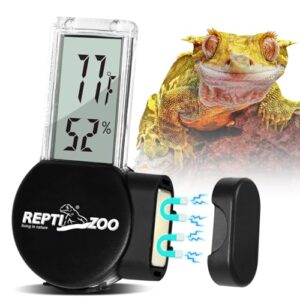
When your snake tank sits on a shelf with limited outlet access, this REPTI ZOO gauge earns its keep. The dual mounting system (rear magnets plus a suction cup) holds firm on glass up to typical enclosure thickness, no drilling or adhesive residue involved.
You get temperature readings from 14-122°F and humidity from 20-90% RH on one compact LCD. Two LR1130 batteries run over a year. Just know accuracy sits within ±4°F and ±5% RH, loose enough that you’ll want a calibration check before trusting it fully.
| Best For | Reptile and amphibian keepers who need reliable, cord-free temperature and humidity monitoring for terrariums, incubators, or brooders without easy access to outlets. |
|---|---|
| Measures | Temp & Humidity |
| Display Type | Digital LCD |
| Mounting Method | Magnet & Suction |
| Material | Plastic |
| Power Source | 2 LR1130 Batteries |
| Brand | REPTI ZOO |
| Additional Features |
|
- Dual mounting system with magnets and a suction cup allows flexible, secure placement on glass, plastic, or metal surfaces
- Long-lasting battery life of over a year means minimal maintenance and uninterrupted monitoring
- Simultaneous temperature and humidity readings on one compact display simplify habitat tracking
- Accuracy range of ±4°F and ±5% RH may not be precise enough for keepers needing tight environmental control
- Compact display size can be hard to read in low light or from a distance, especially in larger tanks
- Some users report inconsistent readings and possible humidity sensor failure over time
2. Magnetic Reptile Thermometer Hygrometer LCD Display
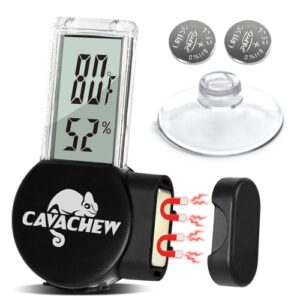
If wall space is tight, this magnetic-mount hygrometer squeezes into corners the REPTI ZOO can’t reach. Its 360-degree rotating angle lets you aim the LCD toward the front glass no matter where the magnet lands.
Readings cover -10°C to 70°C with ±1°C accuracy, tighter than most budget gauges. Humidity runs 10-90% RH at ±5%. A bendable probe reaches basking or cool zones easily, and the 10-second refresh keeps you current without lag.
| Best For | Reptile and amphibian owners who want an easy-to-mount, long-lasting way to keep tabs on temperature and humidity in terrariums, incubators, or brooders. |
|---|---|
| Measures | Temp & Humidity |
| Display Type | Digital LCD |
| Mounting Method | Magnet & Suction |
| Material | Plastic |
| Power Source | 2 LR1130 Batteries |
| Brand | CAVACHEW |
| Additional Features |
|
- Reliable ±4°F/±2°C temperature accuracy and ±5% RH humidity readings for dependable monitoring
- Magnetic back (with optional suction cup) makes it simple to mount on glass, plastic, or metal surfaces
- Batteries can last over a year, cutting down on maintenance
- LCD display can be hard to read in low light or against dark backgrounds
- Magnetic mount may not hold well on thin or non-magnetic surfaces
- Active animals like snakes may knock the unit loose over time
3. Digital Reptile Thermometer Hygrometer
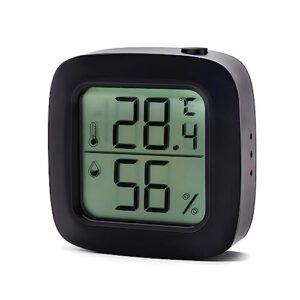
For keepers who want raw sensor coverage over fancy displays, this model earns its spot with 24 sensors feeding a fast, broad temperature profile across the enclosure.
Range runs -10°C to 70°C, though accuracy loosens to ±1°C, wider than the magnetic option above. Readings refresh every 10 seconds, pairing temperature and humidity on one screen so you’re never guessing which zone is drifting.
It won’t win precision contests, but for tracking overall trends, it holds steady.
| Best For | Reptile and amphibian keepers who want precise, easy-to-read temperature and humidity tracking in a compact package that fits neatly into any terrarium, incubator, or brooder. |
|---|---|
| Measures | Temp & Humidity |
| Display Type | LCD w/ Units Toggle |
| Mounting Method | Double-Sided Tape |
| Material | Not Specified |
| Power Source | Battery Operated |
| Brand | Unbranded |
| Additional Features |
|
- Dual monitoring of temperature and humidity on one LCD display, with switchable °C/°F readout
- High accuracy (±0.1°C, ±5% RH) across a wide range (-20°C to 60°C, 10%–95% RH)
- Small, lightweight design (4.3 × 4.3 × 1.3 cm, 21 g) that mounts easily with double-sided tape and stays out of view
- Humidity readings can become less reliable near the upper range (some users saw 99% when actual was closer to 85%)
- Battery life isn’t always consistent, with some units reportedly failing around the 7-month mark
- Packaging is larger than necessary for such a compact device
4. Digital Stick-On Aquarium Thermometer Hygrometer
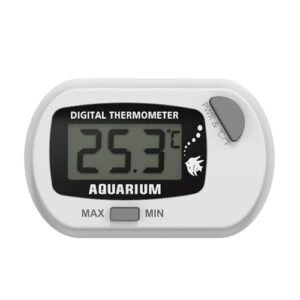
If broad coverage isn’t your priority and simple, no-fuss monitoring is, this stick-on model delivers exactly that. It mounts outside the glass with adhesive backing, sensing temps from 14°F to 140°F at ±0.5°F accuracy, without ever entering the enclosure.
The probe design means no drilling or gaps for your corn snake to exploit. Just know that some users report readings drifting several degrees within short periods, so cross-check it occasionally against a second thermometer.
| Best For | Reptile and aquarium owners who want simple, external temperature monitoring without risking probe damage or giving pets like corn snakes anything to tamper with. |
|---|---|
| Measures | Temperature Only |
| Display Type | Large LCD |
| Mounting Method | Stick-On Probe |
| Material | ABS Plastic |
| Power Source | Button Cell Battery |
| Brand | JLENOVEG |
| Additional Features |
|
- Wide temperature range (14°F to 140°F) with ±0.5°F accuracy for precise monitoring
- Stick-on design keeps the probe outside the enclosure, avoiding drilling, gaps, or submersion
- Large LCD display with MAX/MIN recording makes readings quick and easy to check
- Some users report readings drifting several degrees within short periods
- Fahrenheit mode may malfunction on certain units
- Battery life is inconsistent, with some units failing well before the claimed 6 months
5. Fluker’s Digital Thermometer Hygrometer
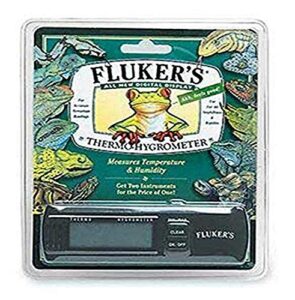
Because stable air conditions matter more than guesswork, Fluker’s gives you two key readings on one compact screen, temperature from 32 to 122°F and humidity from 20 to 99% RH.
The max-min memory is genuinely useful, especially when you’re checking overnight swings without hovering over the enclosure.
Still, treat it as a practical budget tool, not a precision instrument.
Some owners report humidity running 5 to 10% off and temperature drifting by roughly 3 degrees within a month.
| Best For | This thermometer/hygrometer is best for reptile and amphibian owners who want an easy, budget-friendly way to keep an eye on temperature and humidity in enclosures like those for leopard geckos, snakes, tortoises, and hermit crabs. |
|---|---|
| Measures | Temp & Humidity |
| Display Type | Digital Display |
| Mounting Method | Not Specified |
| Material | Plastic |
| Power Source | Battery Included |
| Brand | Fluker’s |
| Additional Features |
|
- Tracks both temperature and humidity on a single easy-to-read digital display
- Compact 4-inch design that’s simple to place in any enclosure setup
- Comes ready to use right out of the box with the battery included
- Humidity readings can be off by 5-10%, so it’s not lab-grade accurate
- Temperature accuracy may drift by about 3 degrees over time
- Some units show reliability issues, with a few stopping working or losing accuracy within a month
6. Zoo Med Dual Thermometer Humidity Gauge
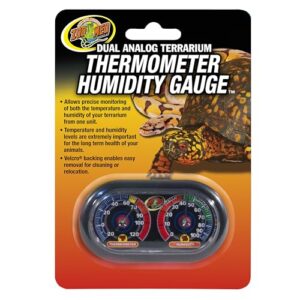
If old-school analog dials still work for you, Zoo Med’s dual gauge keeps things simple: two color-coded readouts, temp and humidity, both visible at a glance from outside the tank.
Just make sure the gauges sit away from vents or heat sources, since airflow patterns can skew readings if you’re not careful about choosing the right terrarium size for proper ventilation.
The fuzzy fastener backing sticks to glass without residue, and repositioning takes seconds.
Just remember what Reptile Forums UK found: analog units like this can run 20 to 25 points low against calibrated instruments. Fine as a quick check, risky as your only gauge.
| Best For | Reptile and amphibian keepers who want a simple, no-fuss way to check both temperature and humidity in enclosures like ball python or bearded dragon tanks. |
|---|---|
| Measures | Temp & Humidity |
| Display Type | Digital Display |
| Mounting Method | Velcro Backing |
| Material | Plastic |
| Power Source | Not Specified |
| Brand | Zoo Med |
| Additional Features |
|
- Combines temperature and humidity monitoring in one compact unit
- Velcro backing makes it easy to attach, remove, and reposition
- Versatile enough for terrariums, flower pots, and egg incubators
- Readings may be inconsistent from unit to unit
- Some users report it doesn’t hold up well in high-humidity conditions
- Humidity levels may read higher than they actually are
Our Terrarium Thermometer Selection Process
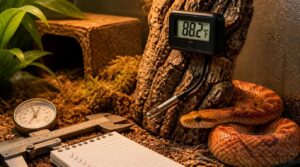
A cheap thermometer that reads wrong by even 5 degrees can quietly cook or chill your corn snake without you ever knowing. That’s why every pick on this list got tested against the same five standards, not just picked for looks or price. Here’s exactly what we checked before any thermometer earned a spot below.
Accuracy and Sensor Consistency
A half-degree off doesn’t sound like much, until your snake’s basking spot runs cold for weeks. We test factory tolerance (±0.5°F at 25°C), sensor drift (up to 3% over six months), and dual-channel consistency (within 0.2°F). Thermal offset and gain drift are well-documented factors influencing sensor accuracy, which is why we weight drift testing so heavily in our rankings.
- Response time under 30 seconds
- Drift under 3% at six months
- Dual-channel match within 0.2°F
- Verified against ice-water calibration
Corn Snake Enclosure Suitability
A thermometer’s only as good as its fit inside your snake’s home. A 40-gallon breeder needs probe cables long enough to bridge basking spots and hides without tangling in climbing branches or blocking water access. Check substrate compatibility, too.
Adhesive mounts can peel off coconut fiber or loosen near ventilation gaps, so secure placement near the temperature gradient matters most.
Display Clarity and Controls
Squinting at a tiny screen across a dim room helps nobody.
Good units let you adjust screen brightness and font size, with high-contrast button labels and icon indicators showing battery and sensor status at a glance. Backlit LCD or touchscreen displays with auto-dimming cut glare at night, while auto shutoff and solid battery life keep readings running without constant fiddling.
Mounting and Probe Security
A loose probe gives you garbage data, plain and simple.
Magnetic mount stability works best on glass under 12mm thick; clean the surface with alcohol first. Adhesive pads need humidity-rated silicone backing.
- Magnetic mounts for glass enclosures
- Adhesive backing for wood or PVC
- Suction cups for quick repositioning
- Velcro mounts for flexible adjustment
- Strain relief at the connector
Probe sheathing protects cable from bites during normal snake activity.
Battery Life and Durability
A secure mount means nothing if the unit dies mid-week. Battery life runs 6 to 12 months for standard AAA or coin cell models under normal conditions.
Look for low-battery alerts so you’re never caught guessing. Sealed, moisture-resistant housing prevents corrosion and sensor drift, while rechargeable USB units cut long-term replacement costs and hassle.
Key Thermometer Features Worth Comparing
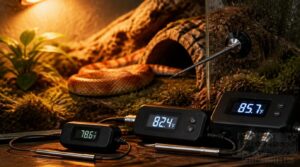
Not every thermometer earns a spot in your snake’s enclosure, and knowing what separates a reliable one from a gimmick makes all the difference.
Five features decide whether you get accurate readings or guesswork: accuracy, probe design, memory functions, display quality, and battery life. Here’s what to check before you buy.
Temperature and Humidity Accuracy
Numbers don’t lie, but cheap sensors do. Look for ±0.5°F to ±1°F accuracy on temperature and ±3-5% RH on humidity, that’s the range corn snakes need for reliable gradient tracking.
Verify claims yourself: run the ice-water calibration method every 6-12 months and compare readings against a second probe. Consistent digital logging beats guesswork every time.
Probe Type and Cable Length
Calibration matters more than the sensor itself. Once your readings check out, the next thing to weigh is what’s touching your snake’s enclosure.
Stainless steel probes resist corrosion and hold up 12 months in humid tanks. NTC thermistors respond fast, within 0.1-0.5°C. Glass probes read accurately but crack easily. Pick longer cables for larger enclosures, giving you flexible placement without cramping the display unit.
Min-max Memory and Alarms
Cable length keeps your setup flexible, but knowing what your snake’s tank did overnight matters more.
That’s where min-max memory earns its keep, like on the Digital Thermometer-Hygrometer Zilla or RSC models, logging highs and lows automatically. Set alarm thresholds, get audible or flashing alerts, and track how long temps stayed out of range. Reset the memory anytime.
Display and Mounting Options
A cluttered enclosure hides a dying snake’s warning signs, so your display needs to work at a glance. Look for a backlit LCD display with color options for low-light reading, plus dual zone probes tracking both sides at once.
For mounting, magnetic mounts, adhesive backing, and suction cup options all secure firmly without blocking your view.
Battery Life Indicators
A dead thermometer at 2 a.m. means a blind snake enclosure, so battery indicators matter more than people think.
- Battery charge percentage on a 0-100 scale
- Low battery alerts below 20%
- Runtime estimation based on power draw
- Battery health status for preemptive swaps
Most units run standard batteries or a CR2032, and a Battery Saver Mode stretches life between changes.
Digital, Analog, and Infrared Differences
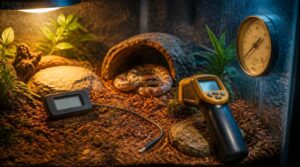
Not every temperature tool does the same job, and mixing them up can cost your snake real health. Digital probes track air temperature around the clock, while infrared guns check surface heat in seconds and analog dials often just mislead you. Here’s how each one actually stacks up.
Continuous Air Temperature Monitoring
Your corn snake’s tank breathes and shifts by the hour, so a digital sensor tracking real-time air temp catches swings analog dials miss. Expect ±0.5 to ±1.0°C accuracy, with drift up to 2°C monthly without calibration. Airflow near vents skews readings, so position probes carefully.
Bonus: dual probe setups, data logging, and remote alerts flag trouble before it harms your snake.
Surface Temperature Spot Checks
Air temp tells you the room’s mood, but that basking rock surface can run hotter, sometimes several degrees. Grab an infrared thermometer, use laser targeted aiming, check emissivity settings for accurate surface temperature reading.
- Multiple point logging
- Gradient mapping technique
- Warm-side hotspots
- Log date, time, location
- Track surface reading accuracy
Analog Gauge Accuracy Limits
That needle on your Zoo Med gauge? It’s lying to you, just not evenly.
An analog gauge’s needle rarely tells the truth, it just lies to you unevenly
| Dial Zone | Accuracy |
|---|---|
| Center third | Tightest |
| Scale ends | Worst, stretched spacing |
| Old/shifted units | 0.5-5% drift |
Parallax error and scale marking drift compound the problem. Exo Terra analog dials read 20-25 points low. Trust digital instead.
Best Tool Combinations
One digital thermometer per zone beats a single unit every time.
Run a dual sensor setup, warm side and cool side, wired to something like the Digital Thermometer-Hygrometer Zilla, then let your thermostat control the heat source based on those readings.
Mount probes with magnetic backs or adhesive pads, check the battery indicator placement before installing, and verify your temperature gradient weekly.
When Infrared Readings Help
Your dual sensor setup controls ongoing monitoring, but grab an infrared thermometer for spot checks. Point it at basking rocks, heat mats, and lamps to compare heat sources fast. It confirms basking spot temperature hits 28-32°C, flags condensation risk after lights-off, and validates night cooling without waiting on slow probe equilibration. Perfect for quick thermal gradient assessments during setup tweaks.
Best Thermometer Placement for Corn Snakes
A great thermometer only works if you put it in the right spot. Placement decides whether you’re reading real temperatures or just guessing at them. Here’s exactly where each probe needs to go.
For accurate basking temperatures, place terrarium thermometer probes correctly by pressing them flat against the heated surface.
Warm-side Probe Positioning
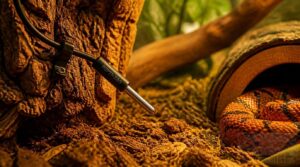
Where you place the warm-side probe can make or break your thermal gradient mapping. Mount it 1 to 2 inches above substrate, right where your corn snake rests during basking.
Avoid heat sources and wiring that skew readings. Secure probe placement stops drift when substrate settles, and tuck cables away to prevent entanglement risks near doors or hides.
Cool-side Sensor Placement
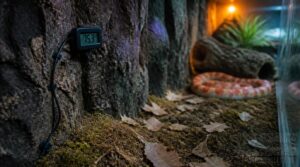
Once the warm side’s dialed in, the cool zone needs its own rules. Keep the sensor off the enclosure lid and mount it on the vertical wall instead, 1 to 2 inches from substrate, away from vents and fans that skew ambient temperature.
Clip cables every 6 to 8 inches, leave slack, and check readings weekly against a reference thermometer.
Measuring at Snake Height
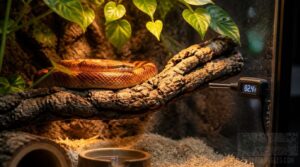
Corn snakes don’t live on the substrate or up on the enclosure wall, they live somewhere in between. Match probe placement height to your snake’s resting level, not the nearest surface.
Vertical temperature tracking matters because air readings shift fast within a few inches.
- Peace of mind knowing your basking spot readings match reality
- Fewer overheating scares
- Confidence in your temperature range data
Securing Probes and Cables
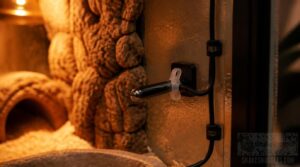
Once you’ve found the right spot, keep it there. A probe dangling loose gives you readings from wherever it happens to land, not where your snake actually basks.
Use heat resistant adhesive clips or a suction cup mount on glass, and a small silicone loop on the warm side to stop dislodgement. Route cables with clips every 6-8 inches, capping exposed ends against moisture.
Avoiding Airflow and Substrate
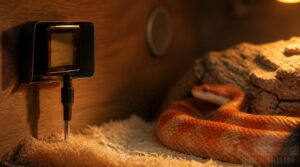
Since even a gentle draft can skew your numbers, keep probes off vents and away from door swings.
- Shield the tip behind a small baffle
- Skip porous substrate contact entirely
- Redirect nearby vents away from the sensor
This airflow optimization stops false lows and keeps ambient vs basking readings honest, preserving your real temperature gradient.
Tracking The Terrarium Temperature Gradient

A single reading tells you almost nothing—what matters is how temperatures shift across the enclosure and through the day. Your corn snake needs a real gradient, not just a warm spot and a hope. Here’s what to watch for on both sides of the tank, day and night.
Warm-side Temperature Trends
Your basking spot should hit 85 to 90°F daily, climbing to setpoint within 15 minutes of heating turning on. Expect a natural gradient: surface readings run 2-4°F hotter than nearby air. Fluctuations should stay within ±2°F over 24 hours.
Digital probe thermometers placed mid-height catch this heating response accurately, without the substrate lag that skews readings low.
Cool-side Temperature Trends
The cool side should feel like a genuine retreat, not just a slightly dimmer version of the basking zone. Aim for 70-85°F, with 2-4°F daily swings if the warm side stays stable.
- Check gradient stability weekly
- Watch nightly drops of 3-7°F
- Note substrate moisture effects
- Confirm cool zone placement
- Compare ambient vs basking readings
Basking Surface Verification
Air temperature only tells half the story, your snake feels the rock, not the room. Press a probe or infrared thermometer directly onto the basking rock, checking daily that it reads 88-92°F and within 2-4°F of ambient. After substrate swaps, retest immediately.
Uneven heat? Swap to a flat ceramic tile for consistent surface contact.
Nighttime Temperature Drops
Clear skies pull heat straight out of your enclosure through radiant heat loss, dropping temps fastest once lights go off. Substrate cools quicker than air, widening the warm-cool gradient overnight. Log readings for a few nights to catch real drop magnitude.
Poor insulation worsens fluctuation, so check walls and lids, without a nighttime heat source, drops below 65°F risk stressing your snake.
Dual-zone Monitoring Setups
Once you’ve logged those overnight dips, a single probe just won’t cut it anymore.
Two independent sensors give you true gradient tracking, one on the basking spot, one on the cool side, each with its own alarm and independent logging. Side-by-side display makes comparing zones instant.
Calibrate both probes separately for real accuracy across your whole enclosure.
Thermometer Accuracy and Calibration Tips
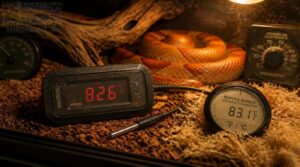
A thermometer is only as good as its accuracy, and even a $30 unit can drift off by a few degrees over time. That gap matters more than you’d think when your corn snake’s health depends on precise numbers, not guesses. Here’s how to check your readings, catch problems early, and keep your setup honest.
Checking Factory Accuracy
Before you trust any reading, check what the factory promises. Most units ship with a factory tolerance spec near ±1-2°F, backed by calibration certificates and traceable reference standards. Sensor preconditioning through burn-in reduces early drift, but shipping jostles still shift alignment.
- A crumpled certificate tucked in the box
- Serial numbers linking back to production lots
- Steady battery voltage keeping readings honest
- A probe seated exactly where your snake basks
- Documentation dated, signed, verified
Ice-water Calibration Method
That certificate only proves accuracy on day one. Test it yourself with an ice water calibration: pack a cup with crushed ice, add distilled water at a 3:1 ratio, and submerge the probe without touching the sides. Wait 30 minutes for stabilization. It should read 0°C (32°F). Off by more than 0.1°C? Log it.
Recommended Calibration Schedule
One ice-water check tells you nothing about long-term drift. Build a schedule instead.
- First 3 months: calibrate every 4 weeks
- After two clean checks: stretch to every 6 months
- Ongoing: keep logging dates, readings, and next due date
Sensor drift creeps in slowly. A rigid log catches it before your corn snake pays the price.
Comparing Multiple Sensor Readings
Two thermometers rarely agree perfectly, and that’s fine, if you know why.
Sync readings within one second and expect up to ±0.5°C drift over 24 hours between probes. Match probe placement, height, and cable length across sensors first. Different sensor types (digital vs. analog) need separate baselines.
Align timestamps on your display so comparisons actually mean something.
Recognizing Inaccurate Readings
How do you know when a number’s lying to you? Watch for sudden jumps with no cause, that’s usually battery drift. Heat source interference and drafts skew readings too. Unsealed sensors cause humidity errors from condensation. Analog gauges run consistently low. If it disagrees with a calibrated backup, don’t trust it, recheck sensor placement first.
Humidity Monitoring and Combo Devices
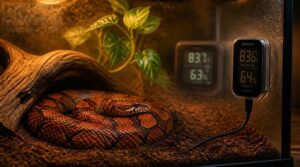
Temperature isn’t the whole story for corn snakes — humidity swings can cause shedding problems just as fast. That’s why combo devices matter, tracking both readings from one probe instead of forcing you to juggle two separate tools. Here’s what to look for before you pick one for your enclosure.
Pairing an accurate combo gauge with sturdy classroom snake hide boxes gives students an easy routine for checking humidity while keeping your corn snake’s favorite hiding spot clean and secure.
If you’re working with limited space, this guide to digital humidity gauges for small apartment enclosures breaks down which combo units stay accurate without cluttering your setup.
Corn Snake Humidity Tracking
Skin only sheds right when humidity sits near 40-60%. Push past 70% and you’re risking scale rot fast.
Keep your humidity sensor placement away from heat, right at snake height. A good hygrometer-thermometer combo, like the Digital Thermometer-Hygrometer Zilla, tracks this automatically and flags humidity spike alerts before dehydration or respiratory trouble sets in.
Combined Sensor Benefits
Two sensors beat one, plain and simple. A Digital Thermometer-Hygrometer running dual probes gives you sensor combination accuracy, correlating air and surface data so you catch drift before it fouls your readings.
- Dual probe correlation flags when one sensor’s off
- Humidity gradient mapping shows condensation risk zones
- Real-time alert teamwork warns you fast, saving battery too
Humidity Accuracy Expectations
Two percentage points. That’s your margin for reliable readings, since corn snakes need 60-75% humidity without guesswork.
Most digital thermohygrometers hold ±3% RH accuracy across 30-90% RH, but sensor drift adds 0.5-1% yearly error. Condensation skews readings up to 5% high. Corner placement underestimates by 3-7%, so sensor placement isn’t optional, it’s how you catch local RH variation before it costs you.
High-low Humidity Alerts
Why wait until humidity crashes to notice? Set humidity threshold settings between 30-70% RH, with delayed alerts firing after several minutes of steady breach, not one blip.
- Push notifications through Bluetooth app history
- Alert history tracking for pattern review
- Multi-sensor connection across warm and cool zones
MinMax memory paired with temperature data logging catches problems fast, before your corn snake’s respiratory health takes the hit.
Avoiding Condensation Damage
Alarms catch humidity spikes, but condensation damage sneaks in quietly.
Check gasket seals weekly, since worn ones let moisture creep past your ventilation.
No electronic unit is waterproof, so mount sensors away from direct drip zones.
Wipe glass daily, watch for dew point monitoring cues, and choose condensation-resistant sensors when possible.
Remote temperature alerts help you catch trouble before your logs show a pattern.
Choosing The Right Corn Snake Thermometer
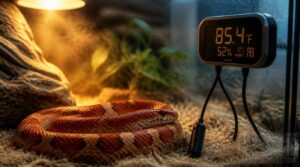
Not every setup needs the same gear, and picking the wrong thermometer wastes money and risks your snake’s health. Your enclosure size, your budget, and how hands-on you want to be all shape the right pick. Here’s what to weigh before you buy.
Single-zone Versus Dual-zone Monitoring
If your snake’s tank has one heat source and one small footprint, single-zone monitoring works fine. But once you’re managing a real temperature gradient, dual-zone monitoring wins:
- Tracks basking spot separately from ambient
- Confirms zone independence during heater cycles
- Catches temperature drift before it’s dangerous
- Verifies gradient accuracy across the enclosure
- Guides smarter probe placement and routing
Air Versus Surface Readings
Dual-zone setups raise a follow-up question: air or surface? Both matter. Air readings track the air temperature gradient fast, within minutes of heater cycles. Surface probes confirm basking spot temperature where your snake actually touches down.
| Reading | Best For | Target Range |
|---|---|---|
| Air | Gradient, airflow | 85-90°F |
| Surface | Contact, basking | 88-92°F |
| Combined | Full verification | Within 2-3°F |
Enclosure Size and Layout
Your enclosure size dictates your thermometer setup, not the other way around. A 55-gallon tank housing a 4-foot corn snake needs multiple sensors to track the full gradient across warm and cool zones.
- Match probe count to enclosure volume and footprint
- Place sensors near hides, not blocking climbing structures
- Account for substrate depth when mounting low probes
- Verify gradient spans both zones, corner to corner
- Adjust for vertical space in tall enclosures
Price, Warranty, and Value
Six to twenty-five dollars covers most corn snake thermometers, and price usually tracks accuracy. Budget units give basic temperature only; midrange adds humidity and bigger displays. Most carry a 1-year warranty, some extend to two for a fee, but misuse voids coverage.
Dual-sensor models cost more upfront yet save money long-term through fewer replacements and reliable readings.
Cleaning and Battery Upkeep
A thermometer only stays accurate if you keep it clean. Wipe the probe weekly with a damp, soapy cloth, then rinse with distilled water to stop mineral buildup on the contacts.
Dry everything fully before reinstalling to prevent corrosion. Check the low-battery indicator often, swap batteries every six months, and recalibrate using the ice-water method twice yearly for reliable readings.
Frequently Asked Questions (FAQs)
Can I use a human thermometer for corn snakes?
Grab your oral thermometer and stick it under your snake’s tongue… good luck with that. Human thermometers lack a reptile probe, miss humidity entirely, and can’t handle enclosure moisture, so accuracy and your snake’s health both suffer.
Do I need both a thermometer and hygrometer?
Yes. Temperature keeps your snake’s metabolism working right, but humidity drives shedding and breathing health. Skip one and you’re flying blind. Dual monitoring catches problems the other sensor misses, so pair a thermometer with a dedicated hygrometer.
How many thermometers does one enclosure need?
Two sensors, minimum. Your dual zone necessity comes from tracking warm and cool sides at once, verifying the temperature gradient stays intact. Larger or multi-level enclosures need three to four for full gradient verification and sensor redundancy benefits.
Can smart thermometers connect to phone apps?
Absolutely, some models pair like a tiny weather station in your pocket. Bluetooth pairing links the sensor to the manufacturer’s app, giving real-time phone display, historical trend viewing, notification alerts, and multiple user access for shared monitoring.
What temperature swing is dangerous for corn snakes?
Swings past 6°C (11°F) between day and night stress your corn snake, causing weight loss and shedding problems. Keep basking and cool side temperature stable, verify daily, and avoid sudden drops that disrupt digestion and thermal gradient balance.
Conclusion
A two-degree reading error can trigger digestive shutdown in cold-blooded animals within 48 hours, that’s how thin the margin runs. Cheap gauges gamble with your snake’s health.
Reliable digital terrarium thermometers for corn snakes remove that gamble, giving you numbers you can trust instead of hopeful guesses. Pair smart placement with regular calibration, and your gradient stays honest.
Get the temperature right, and everything else, digestion, shedding, activity, usually falls into place naturally.