This site is supported by our readers. We may earn a commission, at no cost to you, if you purchase through links.

That sudden exhale from your ball python startles you every time. Ball pythons can hiss, and if you’ve heard it, you know it feels more like a tiny pressure release than anything a cartoon snake would do. It’s sharp, deliberate, and over in less than two seconds.
Here’s what most new keepers get wrong: that sound isn’t aggression. It’s the opposite. Your snake is telling you it feels exposed, and it’s choosing the politest option available before considering anything else.
Understanding what triggers it, what it means, and when it signals something more serious separates confident keepers from anxious ones.
Table Of Contents
- Key Takeaways
- Yes, Ball Pythons Can Hiss
- Why Do Ball Pythons Hiss?
- When is Ball Python Hissing Normal?
- Does Hissing Mean a Ball Python Will Bite?
- Hissing or Wheezing: What’s The Difference?
- Does Shedding Make Hissing More Likely?
- Why Does Handling Trigger Hissing?
- What Should You Do After Hissing?
- How Can You Prevent Excessive Hissing?
- When Should You Contact a Reptile Vet?
- Frequently Asked Questions (FAQs)
- How to tell if a ball python will bite you?
- Are ball pythons bothered by noise?
- How do you tell if your ball python is comfortable with you?
- What are the signs that a ball python is unhappy?
- What are some unusual behaviors that ball pythons have been observed exhibiting?
- What are some other odd snake behaviors that have been reported?
- How old was Sebastian when he was acquired, and how much did he weigh at that time?
- Can hissing damage a ball pythons throat?
- Do all ball python morphs hiss equally?
- Can ball pythons hiss while eating prey?
- Conclusion
Key Takeaways
- A ball python’s hiss is a short, deliberate warning signal — not aggression — triggered by feeling exposed, and it typically stops the moment you remove the stressor.
- Shedding, overhead approaches, tight gripping, and long handling sessions are among the fastest ways to trigger defensive hissing, all of which you can control with simple adjustments to your technique and routine.
- Wheezing, clicking, gurgling, or any breathing sounds that continue when your snake is undisturbed aren’t hissing — they’re signs of respiratory illness that warrant a vet call, not a handling adjustment.
- Consistent short sessions (under 15 minutes, every 2–3 days), paired with proper enclosure conditions — warm side 88–92°F, humidity 60–75%, and two secure hides — will reduce defensive hissing significantly over time.
Yes, Ball Pythons Can Hiss

Yes, ball pythons can hiss, and it’s one of the most misunderstood behaviors new keepers encounter. That sharp, forceful exhale isn’t aggression — it’s a survival reflex, and understanding it changes how you respond. Here’s what’s actually going on when your ball python hisses.
Recognizing these early ball python stress signals and defensive behaviors helps you respond calmly instead of accidentally reinforcing the fear response.
A Normal Defensive Behavior
Hissing is normal defensive behavior in ball pythons, not a sign of aggression. It’s a low-threat warning signal produced before any physical response. Your snake uses the sound to create distance when it feels cornered or exposed. Typical triggers include: If you’re unsure what the sound really means, our guide to why your ball python is hissing at you breaks down the fear-based triggers and how to respond calmly.
- Sudden handling after rest
- Overhead movements mimicking a predator
- Unfamiliar surroundings or routine changes
- Tight gripping during handling sessions
Brief Warnings, Not Conversation
The hiss itself lasts just 1 to 2 seconds, often followed by stillness. That pause in body language is the warning signal doing its job, defusing the perceived threat before any physical response.
Your snake isn’t inviting conversation. Move away, and you’ll usually notice the volume drop as the fear and stress ease. One brief defensive warning, then quiet.
Babies and Adults Both Hiss
Both babies and adults are fully capable of that same brief defensive exhale. Babies hiss more frequently relative to their size, a direct result of their sharper stress sensitivity early in life. Adults usually build some tolerance through repeated handling, so their hissing is less reflexive. The warning itself stays consistent across both ages: short, sharp, and purposeful.
Surprisingly, ball pythons aren’t alone in this behavior, as many animals that hiss defensively — from cobras to bobcats — use the sound as a warning signal to deter perceived threats.
Personality Affects Hissing Frequency
Your snake’s personality plays a bigger role than most keepers expect. Calmer individuals hiss far less during routine handling, while snakes with a high fear tendency react at much lower thresholds. Those with more aggressive personalities hiss longer and more often when restrained.
Consistent, gentle sessions can stabilize those patterns over time, but the baseline always starts with temperament.
Why Do Ball Pythons Hiss?

Ball pythons don’t hiss without a reason — there’s always something driving that sharp exhale, whether it’s obvious or not. Understanding what triggers that response is the first step to making handling feel safer for both of you. Here are the most common causes worth knowing.
Fear and Feeling Threatened
Fear drives most defensive hissing. When your ball python perceives a real threat, its warning signals activate fast: head elevation, coiled posture, and pupil dilation all signal a fear response before the hiss even sounds.
- Head up, scanning for threats
- Body coils, ready to warn
- Pupils dilate, catching movement
- Startle triggers a sharp hiss
- Defensive behavior fades when stress ends
Sudden Movements Near The Enclosure
Sudden movements rank among the fastest hissing triggers you’ll face as a keeper. Ball pythons react within seconds to rapid front approaches, where looming shapes mimic predator behavior and spike warning signals.
| Movement Type | Threat Level | Likely Response |
|---|---|---|
| Slow side approach | Low | Minimal alerting |
| Rapid front approach | High | Sharp defensive hiss |
| Quick lid open/close | High | Heightened warning signals |
| Staring or looming | Very High | Intensified hissing |
| Abrupt hand withdrawal | Moderate | Renewed defensive behavior |
Abrupt hand withdrawal after touching the glass can trigger renewed defensive behavior. Approaching from the side, avoiding quick lid movements, and reading body language cuts stress indicators fast.
Territory and Personal Space
Ball pythons treat their enclosure as personal territory, and any intrusion can feel threatening. When you reach into their space without warning, you’re crossing an invisible boundary they actively defend.
Think of it as their version of a privacy zone, a defined area where they feel genuinely secure. Disturbing that space, especially from directly above, triggers annoyance hissing almost immediately.
Tight Restraint During Handling
Gripping your ball python too tightly is one of the fastest ways to trigger a defensive hiss. When you compress the chest or abdomen, you’re restricting movement and making the snake feel genuinely trapped.
Support the midbody loosely across both forearms, keep the head pressure-free, and let it move. That freedom alone removes a major source of stress.
New Surroundings and Routine Changes
Moving your ball python to a new enclosure is one of the most disruptive events in its routine. Over 64% of newly acquired ball pythons show increased defensive behaviors, including hissing, within the first two weeks of relocation.
- Unfamiliar scents from new substrate trigger alertness and slow exploration
- Feeding schedule changes disrupt established digestion patterns
- Shifted enclosure locations alter temperature gradient access
- New hides or enrichment items change retreat preferences temporarily
- Handling frequency should stay brief and gradual during the first week
When is Ball Python Hissing Normal?

Hissing doesn’t automatically mean something is wrong with your ball python. Context matters far more than the sound itself, and once you know what normal looks like, you’ll stop second-guessing every exhale.
If you want a fuller picture of what calm versus stressed behavior looks like day-to-day, the boa constrictor care sheet at Snake Snuggles walks through how environment—especially temperature gradients—shapes your snake’s mood and body language.
A few clear patterns tell you whether your snake is simply communicating or signaling something worth a closer look.
Occasional Hissing During Stress
A hiss during a stressful moment is your ball python doing exactly what evolution designed it to do. If you’ve just opened the enclosure after a loud disturbance or reached in too quickly, a single forceful exhale is a proportionate, healthy response. It signals discomfort, not aggression, and it’s a sign your snake’s threat-detection instincts are working as they should.
Hissing Stops When Stress Ends
Once you remove the stressor, the hissing stops. Your snake doesn’t hold a grudge.
Within minutes to a few hours, it settles back into calm resting posture, head lowered, coils loosened.
Within 24 hours, normal breathing patterns and relaxed body language usually return, signaling that stress hormones have dropped back to baseline and your snake feels safe again.
Frequent Hissing Needs Investigation
If your ball python hisses repeatedly across multiple handling sessions or throughout the day without a single clear trigger, that pattern deserves a closer look.
Frequent, unprompted hissing often signals a root stressor, whether that’s an inadequate temperature gradient, missing hides, loud ambient noise above 70 dB, or an enclosure that simply isn’t meeting your snake’s needs.
Baseline Behavior Varies by Snake
Every snake is different. One ball python hisses during routine checks while another barely reacts at all.
- Individual tolerance levels shift per snake
- Some prefer tighter, darker hides and less contact
- Juvenile ball pythons tend toward more frequent hissing
- Handling duration affects stress responses differently
- Environmental changes alter baseline defensiveness noticeably
Know your snake’s normal baseline before judging any hiss.
Does Hissing Mean a Ball Python Will Bite?

A hiss doesn’t automatically mean your ball python is gearing up to strike — it’s a warning shot, not a promise. That said, there are specific body language signals that tell you exactly how close to the edge your snake actually is. Knowing what to watch for makes all the difference between a tense moment and an avoidable bite.
A ball python’s hiss is a warning shot, not a promise — learn its body language before assuming the worst
Hissing is a Warning
Think of a hiss as your ball python drawing a firm line. It’s a clear boundary signal, not an immediate declaration of war. Snakes often hiss before striking or retreating, giving you a genuine window to back off and de-escalate.
That single, forceful exhale is your snake’s way of saying, "I need space right now.
Biting is Not Guaranteed
A hiss doesn’t automatically mean teeth. Calm handling reduces bites a lot, because ball pythons prefer warning over confrontation. If you stay composed, move slowly, and avoid sudden gestures, most snakes will never follow through.
Observation before interaction matters too. Spending a few moments watching your snake’s posture before reaching in tells you whether it’s ready.
Watch The S-Shaped Posture
When your snake curves into a smooth S from head to tail, that’s a clear signal to stop. The S-shaped posture means it has shifted into alert defensive mode, head slightly raised, body coiled and ready for quick retreat.
This posture usually lasts only a few seconds, so watch for it before assuming handling can continue safely.
Recoiling and Body Tension
Beyond the S-shape, your ball python’s body will often give you more immediate physical cues. Muscle tension peaks as the midline coils tighten, the neck narrows into a rigid V, and the tail tucks inward. That taut, stiff feel under your hands isn’t aggression yet. It’s a system preparing for retreat, not attack.
Respect Distance and Pause Handling
Your best move is to pause handling immediately and respect distance. Approaching from the side, not above, reduces the predatory height perception that triggers defensive behavior.
- Move slowly and never lunge
- Stay level with the enclosure
- Observe tension before resuming contact
- Keep sessions under 15 minutes
Calm, gradual trust-building is what turns a hissy ball python into a confident one.
Hissing or Wheezing: What’s The Difference?
Not every unusual sound your ball python makes is a hiss, and confusing the two can cost your snake critical time. Wheezing, clicking, or gurgling are your snake’s body sounding an alarm that a defensive exhale simply isn’t. Here’s how to tell the difference across five key signs.
One Forceful Exhale

That sharp, sudden rush of air isn’t random. A single forceful exhale is your ball python launching air through the glottis using tightened throat muscles, producing a loud, startling hiss audible several feet away. It happens fast, often paired with mouth opening and throat flattening, and it’s done in an instant, not a prolonged sequence.
Repeated Noisy Breathing
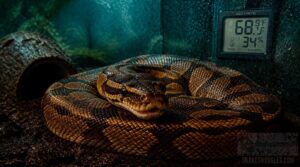
Repeated noisy breathing is a different animal entirely. Where a defensive hiss is a one-off burst, respiratory illness produces sounds that cycle with every breath — faint at first, then louder as the infection takes hold.
Cool temperatures and improper humidity create the exact conditions where bacterial infections establish themselves and spread, often presenting as audible respiration your snake can’t switch off.
Clicking, Gurgling, or Whistling

Clicking is its own category. When a ball python’s jaw moves rapidly during a defensive display, teeth contact creates a short, sharp snap lasting less than a second. It’s not breathing-related; it’s mechanical.
Gurgling and whistling, though, signal mucus in the airway or compromised airflow through inflamed tissue — clear signs of respiratory infection requiring veterinary attention.
Sounds Continuing at Rest
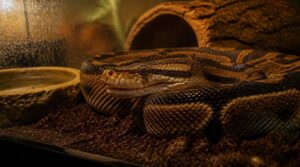
The key difference is timing. A defensive hiss ends when the stressor does, but sounds continuing at rest keep going with no trigger present.
If you hear your ball python breathing audibly while it’s sitting undisturbed in its enclosure, not during handling, not after you’ve walked past, that persistent pattern across multiple breathing cycles points toward illness, not behavior.
Mucus or Open-Mouth Breathing

Two symptoms that rule out defensive hissing almost immediately: mucus discharge and open-mouth breathing. If you see bubbles or discharge around your snake’s nostrils, or catch it breathing with its mouth open at rest, that’s respiratory infection territory, not attitude. Those signs point to a vet call, not a handling adjustment.
Does Shedding Make Hissing More Likely?
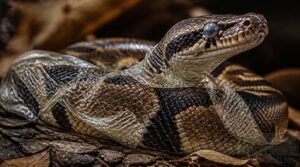
Shedding puts your ball python in a uniquely vulnerable state, and that vulnerability almost always shows up as increased defensiveness. Reduced vision, heightened skin sensitivity, and general discomfort combine to make even routine handling feel threatening to your snake.
Here’s what’s actually happening during a shed — and how each factor affects your python’s behavior.
Cloudy Eyes Reduce Vision
When your ball python’s eyes go milky blue, it’s basically blind. The opaque spectacle blocks light from reaching the retina, cutting visual acuity and leaving your snake much more defensive than usual.
- Eyes turn cloudy blue-gray before shedding
- Vision drops dramatically during this phase
- Your snake can’t see threats clearly
- Defensive hissing spikes mid-shed
- Eye caps shed with old skin
Skin Feels More Sensitive
The loosening outer layer isn’t just a visual cue. It’s physically uncomfortable for your snake.
During active shed cycles, your ball python’s skin becomes hypersensitive to pressure and contact, much like how human skin stings and tightens after sunburn. Pre-shed skin sensitivity lowers the defensive stress threshold a lot, turning even routine environmental contact into a reliable trigger for hissing.
Handling Can Increase Defensiveness
During a shed cycle, handling stress compounds what’s already uncomfortable. Overhead approaches feel predatory to a snake that can barely see, and unsupported lifting disrupts its sense of control fast.
Keep your hands low, slide them under the body confidently, and avoid gripping. A tense snake mid-shed will hiss before it tolerates much.
Provide a Secure Humid Hide
A humid hide does more than trap moisture. Position it on the warm side of the enclosure, where temperatures hold between 84 and 90°F, so your snake gets humidity and heat together. Fill it 1 to 2 inches deep with sphagnum moss or coconut fiber, targeting 70 to 85 percent interior humidity during the shed cycle.
Wait Until Shedding Finishes
Patience is the most effective tool you have during a shed cycle. Once shedding finishes completely, confirmed by clear eye caps and an intact tail shed, you can cautiously resume short, calm sessions.
Until then, keep your hands out of the enclosure. Even gentle contact carries real risk of triggering defensive hissing and skin damage.
Why Does Handling Trigger Hissing?
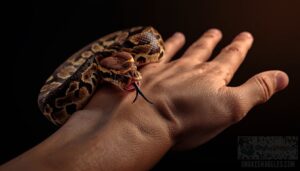
Handling feels like a threat to a ball python — even when your intentions are completely calm and gentle. Every interaction carries signals your snake reads through body language, grip pressure, and duration.
Understanding exactly what triggers hissing during handling gives you the tools to make sessions safer and less stressful.
Overhead Approaches Feel Predatory
Think about what a ball python sees when your hand descends from above: a large, looming shape blocking the light, moving fast. That’s a predator signal.
Overhead approaches trigger a hard-wired defensive reaction, and your snake’s brain doesn’t pause to reconsider. The hiss that follows isn’t attitude, it’s ancient survival instinct firing exactly as it was designed to.
Poor Body Support Causes Stress
When a ball python feels unsupported, its muscles tense immediately as it scrambles for stability. That muscle tension buildup is pure stress, not stubbornness.
Slide one hand under the middle third of the body and use a second contact point near the midsection. Proper body support keeps movement relaxed and trust intact.
Tight Gripping Prevents Movement
Tight gripping works against you. When you clamp down, the snake’s muscles tense immediately, its joints lock, and any natural movement stops, which your ball python reads as a threat response, not a safety signal.
Reduced grip pressure lets the body flow naturally across your hands, signaling control without triggering that defensive, coiled reaction.
Long Sessions Can Overwhelm Snakes
Even with the gentlest technique, time itself becomes a stressor. Ball pythons aren’t built for extended interaction, and sessions that stretch too long push cortisol levels up, leaving the snake fatigued, defensive, and slower to recover. That elevated stress doesn’t reset the moment you put it down, either. It can linger for hours.
Short Gentle Sessions Build Trust
Short, calm sessions solve exactly that problem. Predictable interaction patterns give your snake a rhythm it can follow, reducing defensive behavior over time.
| Session Element | Recommended Practice | Why It Matters |
|---|---|---|
| Duration | Under 15 minutes | Prevents cortisol buildup |
| Frequency | Every 2–3 days | Establishes predictable rhythm |
| Environment | Quiet, low-light space | Minimizes stress triggers |
Gentle handling routines, repeated at consistent times, help your ball python associate your presence with calm rather than threat. The handling pause after any hissing reinforces that pattern, letting stress hormones settle before the next session.
What Should You Do After Hissing?

Your snake just hissed — take a breath, because your next few moves matter more than you think. How you respond in the minutes and days after a hissing episode directly shapes whether your ball python learns to trust you or stays on edge. Work through these five steps to reset the situation and protect your snake’s wellbeing.
Stop and Stay Calm
The moment your snake hisses, freeze immediately. Your reaction in the next few seconds matters more than most keepers realize.
- Stop all movement for 5 seconds
- Take two slow, controlled breaths
- Lower your shoulders and unclench your hands
- Step back slightly to reduce the perceived threat
Calm body language signals safety, giving your snake’s defensive stress a moment to ease.
Return Your Snake Gently
Once the hissing stops and your snake has settled, place it gently onto a stable, flat surface with its head pointing away from you. Support its full body length across both palms, keeping fingers clear of the mouth.
Slow, deliberate movements signal safety far better than speed ever could.
Check for Immediate Stressors
Once your snake is back in its enclosure, scan the room deliberately. Check noise and vibration sources first, since TVs, speakers, or frequent foot traffic keep snakes in a constant alert state.
Verify your temperature and humidity levels: warm side 88-92°F, cool side 75-80°F, and humidity between 50-60%.
Bright lights above 500 lux can trigger defensive behavior just as easily as sound.
Allow 24–48 Hours Alone
After a defensive episode, give your ball python a 24 to 48 hour stress reduction period with no handling or enclosure changes. This behavioral reset window lets stress hormones return to baseline.
- Keep temperature and humidity stable during this handling recovery time
- Avoid sudden movements or overhead approaches near the enclosure
- Resume handling only when your snake shows a relaxed resting posture
Monitor Breathing and Behavior
After that rest window, watch closely how your ball python behaves when you approach the enclosure. Relaxed coiled posture and calm, unlabored breathing signal a stable behavioral baseline.
If you notice wheezing or clicking sounds persisting at rest, that’s not a lingering hissing response. It’s a clear potential sign of respiratory illness, and it warrants contacting a reptile vet promptly.
How Can You Prevent Excessive Hissing?
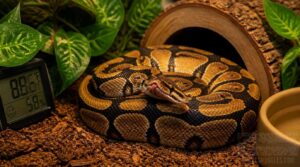
Excessive hissing is almost always a sign that something in your snake’s environment isn’t quite right. The good news is that most of these triggers are well within your control, and small adjustments can make a noticeable difference. Here’s what to focus on to keep your ball python calmer and more comfortable.
Provide Warm and Cool Hides
Two dedicated hides reduce defensive hissing more than almost any other enclosure change. One on the warm side, one on the cool.
- Warm hide: 28–32°C, soft coco fiber substrate inside
- Cool hide: 24–26°C, smooth interior with good airflow
- Entrance: 2–3 inches wide, snug enough to feel secure
- New hides: allow 1–2 weeks before judging comfort
Maintain Proper Temperature Gradients
A stable thermal gradient is one of your most effective tools against defensive hissing. Keep your warm side at 88–92°F and the cool side at 75–80°F, monitored with at least three evenly spaced probes. Place your heat source on one end only, never centered.
For safe, consistent setup, follow this guide on heating a snake terrarium properly and use thermostatic controls.
Log readings daily, and correct any gradient drift exceeding 5–10 degrees before it stresses your snake.
Keep Humidity in Safe Range
Temperature gets most of the attention, but humidity matters just as much.
Keep levels between 60 and 75%. Drop below that range, and incomplete sheds cause real discomfort that drives defensive hissing. Above 75%, mold and respiratory irritation follow.
Check your hygrometer daily, and add a humid hide during shedding to give your snake a moist retreat without soaking the whole enclosure.
Reduce Noise, Light, and Vibrations
Humidity keeps the inside of the enclosure stable, but the environment around it shapes behavior just as directly.
Lights above 500 lux and noise above 70 dB are both documented triggers for defensive stress responses. Keep your setup away from high-traffic areas, and install vibration dampening pads under the stand to absorb footstep impact and mechanical hum from nearby equipment.
Use Consistent Handling Routines
Predictable routines calm your snake faster than almost anything else you can control.
- Start with 60-second introductions, increasing by 30 seconds each session
- Approach from the side, never overhead
- Use the same grip technique every time
- Keep sessions under 15 minutes
- Record reactions to improve individualized handling plans
Snakes recognize patterns quickly, and consistency builds trust where repetition replaces fear.
When Should You Contact a Reptile Vet?

Hissing on its own isn’t a red flag — but certain signs alongside it are worth taking seriously. Knowing when to call a reptile vet can make a real difference in how quickly your snake recovers. Watch for any of the following warning signs:
Persistent Wheezing Between Handling Sessions
Wheezing that continues between handling sessions isn’t something to wait out. If your snake is making repetitive clicking, gurgling, or whistling sounds at rest, that points to a respiratory infection.
Persistent wheezing can stem from incorrect temperatures, humidity below 50%, or secondary viral infections like nidovirus. If it doesn’t improve within 48 hours, get your snake to an exotic vet.
Lethargy or Appetite Changes
When your ball python shows both lethargy and appetite changes, that combination often warrants a vet call.
- Incorrect temperature gradients impair digestion and metabolism
- Humidity below 50% disrupts shedding and appetite
- Internal parasites cause progressive weight loss despite regular feeding
- Respiratory infections limit oxygen intake and cause visible fatigue
- Mouth rot creates oral pain severe enough to completely stop eating
Pain, Injury, or Touch Sensitivity
Scrapes, abrasions, or localized injury sensitivity can make otherwise gentle handling feel threatening to your snake. When nociceptors detect pressure or tissue damage, defensive hissing follows quickly.
Allodynia, where light touch registers as painful, is very real in reptiles recovering from injury or shedding. If your snake hisses and recoils when touched near a specific area, contact your reptile vet.
Repeated Hissing Without Clear Triggers
Sometimes the hissing has no obvious cause. If your snake reaches a baseline hissing rate of 1 to 2 episodes per minute without handling, subtle enclosure changes, vibrations from nearby equipment, or shifting light cycles may be driving the stress response.
When repeated hissing episodes persist across multiple sessions despite a stable environment, that pattern warrants a vet call soon.
Frequently Asked Questions (FAQs)
How to tell if a ball python will bite you?
Watch for body language cues before a bite happens. An S-shaped strike posture, rigid neck coiling, sharp head bobbing, or a sudden forward lunge all signal your ball python is done tolerating the situation.
Are ball pythons bothered by noise?
Think of your snake like someone trying to sleep next to a subwoofer, where every vibration registers in the body. Vibrations and sudden sounds stress ball pythons, often triggering defensive hissing as a direct result.
How do you tell if your ball python is comfortable with you?
A comfortable ball python moves with slow, smooth movement, explores your hands calmly, and maintains a loose body posture. Consistent feeding and a steady tongue flicking rhythm confirm your snake genuinely tolerates your presence.
What are the signs that a ball python is unhappy?
Unhappy ball pythons rarely signal distress obviously, but food refusal, excessive hiding, rigid body tension, and defensive hissing are reliable stress indicators. Breathing changes and persistent defensive behavior tell you the environment needs fixing.
What are some unusual behaviors that ball pythons have been observed exhibiting?
Ball pythons occasionally display tail twitching, head bobbing, and mouth gaping, each signaling stress, defensiveness, or discomfort. Body coiling and scale rattling during shedding cycles or enclosure changes are also well-documented unusual behaviors worth tracking.
What are some other odd snake behaviors that have been reported?
Some snakes rotate their bodies to face a threat directly, then resume normal posture. Others tap their tails against surfaces, producing a staccato warning sound before any hissing begins.
How old was Sebastian when he was acquired, and how much did he weigh at that time?
Sebastian’s age and weight at acquisition aren’t documented, and his full history remains unverified. Without that baseline data, any conclusions about his early size, development, or acclimation period simply can’t be confirmed with confidence.
Can hissing damage a ball pythons throat?
No, hissing won’t damage your ball python’s throat. Air forces through the glottis in a brief, controlled exhale, and throat tissues stay intact. Normal hissing is a warning signal, not a physical strain.
Do all ball python morphs hiss equally?
No, morph temperament varies widely. Some morphs trend bolder and more reactive, while quieter individuals may rarely hiss at all. Your snake’s individual handling history and enclosure enrichment matter just as much as genetics do.
Can ball pythons hiss while eating prey?
A ball python locked onto prey seems too focused to react to anything else, yet a brief hiss mid-strike is common, a prey threat response directed at nearby disturbances, not at the food itself.
Conclusion
Can ball pythons hiss at you without it signaling that you’ve done something terribly wrong? Almost always, yes. That single sharp exhale is your snake drawing a clear boundary, not declaring war. Respect it, give it space, and adjust your approach before you try handling again.
Consistent, patient handling paired with a correctly set enclosure will reduce hissing over time. When it persists without a clear trigger, a reptile vet is your smartest next move.