This site is supported by our readers. We may earn a commission, at no cost to you, if you purchase through links.

You walk up to the enclosure and find your snake with its own tail halfway down its throat. It’s alarming, and it’s also more common than most keepers realize.
So why do snakes eat themselves? Usually it isn’t madness. A tail can smell like dinner, feel warm like prey, or twitch at exactly the wrong moment for a stressed, overheated, or hungry snake. Sometimes a hidden health problem sits underneath. The stakes are real, though, because a swallowed tail can block the airway or lead to deadly infection.
Here’s what’s likely going on inside your snake’s head, and what you can do right now.
Table Of Contents
- Key Takeaways
- Why Do Snakes Eat Themselves?
- What Should You Do if Your Snake Starts Eating Its Tail?
- Can Snakes Die From Eating Themselves?
- How Do Reptile Vets Treat Tail Biting and Self-Ingestion?
- How Can You Prevent Your Pet Snake From Eating Itself?
- Frequently Asked Questions (FAQs)
- What happens if a snake eats itself?
- Why does a snake try to eat itself?
- What is a snake’s worst enemy?
- Do snakes like to be petted?
- Why does a snake eat itself?
- What does the snake eating itself mean?
- Can snakes self cannibalize?
- Why do snakes hate hand sanitizer?
- Do snakes feel pain when eating themselves?
- Can snake poop be used to regurgitate?
- Conclusion
Key Takeaways
- Your snake usually isn’t going mad, because stress, overheating, hunger, or a tail that smells and feels like prey can trick it into biting down on its own body.
- Hidden health problems like inclusion body disease, thiamine deficiency, or parasites may also scramble your snake’s signals, so it’s worth a vet visit even after the tail is free.
- If it happens, stay calm, gently ease the tail out without forcing it, cool your snake down, and get to a reptile vet fast, since a stuck tail can block breathing or cause deadly infection within hours.
- You can prevent most cases by fixing husbandry, which means a roomy enclosure, a proper temperature gradient, snug hiding spots, and a steady feeding schedule.
Why Do Snakes Eat Themselves?

Watching your snake swallow its own tail is alarming, and it’s natural to wonder what on earth is going on. The cause usually isn’t a single thing, but a handful of likely culprits you can learn to spot. Here are the main reasons this happens, starting with the ones you can often fix at home.
Stress, incorrect temperatures, and mistaking its own tail for prey are common triggers, and this guide to why snakes eat themselves and how to prevent it explains how to spot the warning signs early.
Stress, Overheating, and Disorientation
A snake that bites its own tail is rarely being strange for fun.
Stress is often the first culprit, and a cramped or bare captive environment can quietly build it up. Overheating is another. Snakes can’t cool themselves, so poor thermal regulation may leave yours confused and hungry. Disorientation follows, and that’s when the tail starts looking edible.
Mistaking Their Tail for Prey
So why would your snake bite its own tail? Blame Prey Misidentification. Heat pits and chemoreception can send mixed signals, and a wriggling tail may feel warm and alive. Three things likely feed the sensory confusion:
- Heat-pit signals from the moving tail
- Olfactory misidentification, where leftover prey scent clings
- Hunger or stress switching on feeding mode
It’s honestly just confused.
Possible Underlying Health Problems
Sometimes it’s not just confusion. Root Health Issues may be scrambling your snake’s signals, and neurological conditions top the list. Inclusion body disease, thiamine deficiency, toxin exposure, and gout can all muddy how a snake senses its own body. In boas and pythons, inclusion body disease attacks the neurological, gastrointestinal, and respiratory systems, and often shows up as stargazing or an inability to right itself.
Parasitic infections matter too. Internal parasites and external parasites like mites can leave a snake stressed, itchy, and off.
Regular habitat cleaning and quarantining new arrivals go a long way, and this guide on preventing snake infections covers the habits that keep parasites away.
What Should You Do if Your Snake Starts Eating Its Tail?
Once you’ve spotted the likely cause, it’s time to act, and calmly is the way to go. Panicking won’t help your snake, and yanking could hurt it.
If the problem looks more serious than a simple fix, this guide to snake health emergencies can help you decide when to call a reptile vet right away.
- Stay calm and wear gloves, since a stressed snake may bite.
- Gently ease the tail out of its mouth. If it won’t budge, don’t force it.
- Move your snake to a cooler spot and switch off the heat lamp.
- Place it in a ventilated, padded container and call a reptile veterinarian.
If the tail stays stuck or you see bleeding, head to an emergency vet right away. Some cases need veterinary intervention for reptiles. Afterward, revisit your enclosure size and environmental enrichment for snakes, because boredom and cramped quarters may play a part.
Can Snakes Die From Eating Themselves?
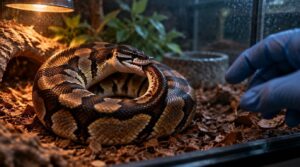
Two things usually decide the outcome: how much body gets swallowed and how quickly you act. Self-cannibalism in animals is rare, but in snake behavior in captivity, it can turn deadly fast.
| Complication | What may happen |
|---|---|
| Suffocation | Swallowed tail blocks the airway |
| Organ damage | Stretched gut, blockages, tissue death |
| Sepsis | Bite wounds let infection spread |
Picture your snake slowly choking on its own body. That’s the real risk, and it may happen within hours, not days. Without rescue, most snakes die, but your quick response changes those odds a lot.
While you act fast, watch for subtle warning signs, since changes in your snake’s behavior that point to illness often show up before a crisis hits.
If you spot a tail disappearing, call an emergency vet. Is it overkill? Not at all. Veterinary intervention for reptiles can prevent death, even in severe cases of stress-induced stereotypy.
How Do Reptile Vets Treat Tail Biting and Self-Ingestion?

How does a reptile vet actually handle a snake that’s biting or swallowing its own tail? It starts with a hands-on exam, and the vet may check wound depth, hydration, reflexes, and pain level. X-rays can show whether any tail section was swallowed, while bloodwork may reveal infection or organ trouble.
Treatment often looks like this:
- Debridement of dead tissue, plus suturing or amputation if the tail can’t be saved
- Antibiotics, pain relief, and fluids to fight infection and keep your snake stable
- Assisted feeding and a warm, padded recovery container
Veterinary treatment works if you follow medication and wound care schedules, and your vet may review stress triggers, enclosure issues, and reptile husbandry. Catching self-harm early likely helps recovery.
How Can You Prevent Your Pet Snake From Eating Itself?

You might think a snake eating itself is just a freak accident you can’t control. It isn’t, and most of the risk comes down to husbandry you can fix this weekend.
A snake swallowing its own tail may feel like a freak accident, but most of the risk comes from husbandry you can fix
Here’s where to start:
- Size the enclosure so your adult snake can stretch fully without bunching up.
- Keep a gradient, roughly 75 to 80°F on the cool side and 88 to 92°F at the basking spot for many common species.
- Offer at least two snug hiding spots, one warm and one cool.
- Choose a substrate that suits the species, such as aspen for dry-climate snakes or cypress mulch for humidity lovers.
- Feed prey sized to the snake’s widest point, about every 7 to 14 days for most adults, using tongs.
A hungry, stressed snake may mistake its own tail for dinner, so consistency matters. Check temperatures with a thermostat, not guesswork.
Frequently Asked Questions (FAQs)
What happens if a snake eats itself?
Dinner for one, and the main course is you. A snake that swallows its tail usually gets stuck, because backward-curving teeth lock in. It may suffocate or injure itself, so call a reptile vet immediately.
Why does a snake try to eat itself?
Picture a snake mistaking its own tail for dinner. That’s self-eating behavior, a feeding response malfunction.
Heat, stress, and cramped enclosures act as environmental triggers, and self-cannibalism in animals like this may signal root illness.
What is a snake’s worst enemy?
Honestly, your snake’s worst enemy is us. Habitat loss, poaching, and road traffic take far more snakes than any hawk or mongoose ever will. Even the pet trade adds pressure, so good husbandry matters.
Do snakes like to be petted?
Mostly, they tolerate it. Snakes don’t feel affection, but a calm one may accept gentle contact. Watch for stress like hissing or refusing food, and keep handling short, because overhandling and stress can harm your snake.
Why does a snake eat itself?
Picture a snake curled in a too-warm tank, tongue flicking, then biting down on its own tail. Usually it’s sensory confusion: stress, heat, or a lingering prey scent leaves it disoriented, and it may mistake itself for dinner.
What does the snake eating itself mean?
Seen a snake swallowing its own tail? It usually isn’t symbolic. It’s a warning sign of abnormal reptile behavior, often tied to stress-induced stereotypy, thermoregulation problems, or environmental disorientation, and it needs your attention quickly.
Can snakes self cannibalize?
Yes, they can, and it’s more common than you’d think. A stressed, overheated, or hungry snake may mistake its own tail for prey, and self-cannibalism can quickly turn dangerous, so call a reptile vet.
Why do snakes hate hand sanitizer?
Alcohol’s sharp smell and taste likely feel threatening to a snake, so it may release its grip.
Still, a stressed captive snake in an enclosure is showing behavioral pathology, and feeding response triggers need fixing.
Do snakes feel pain when eating themselves?
Do snakes feel pain? Almost certainly, yes. They have nociceptors and opioid receptors, so a bite likely hurts. But "unquestionably excruciating" overstates it. Self-cannibalism in animals signals stress-induced behavior or neurological impairment, so call a vet consultation.
Can snake poop be used to regurgitate?
Poop is a locked door, not a key. It won’t trigger regurgitation, and it can spread parasites. If your snake has swallowed its own tail, gently ease it free, or ask your vet about cool baths.
Conclusion
Picture a coiled snake, warm under the lamp, its tail flicking like a worm on a hook. When you wonder why do snakes eat themselves, remember the answer is usually confusion, not madness.
Fix the heat, the humidity, and the feeding schedule, and most snakes will leave their tails alone. If it happens anyway, stay calm, cool things down, and call your vet fast. A little attention now spares you a very bad afternoon later.