This site is supported by our readers. We may earn a commission, at no cost to you, if you purchase through links.
Red touches yellow, kill a fellow." You’ve likely heard the rhyme, but it only works for snakes found in the United States, and even then it demands correct identification under stress. Coral snake venom carries a neurotoxic punch that can delay symptoms for 12 to 24 hours, quietly shutting down respiratory muscles while a bite looks trivial.
With over 80 recognized species spanning Arizona scrubland to Philippine rainforest canopies, these secretive elapids vary widely in pattern, habitat, and risk. This profile breaks down the taxonomy, physical traits, and bite protocols you need to tell a coral snake from its mimics and respond correctly if one strikes.
Table Of Contents
- Key Takeaways
- Coral Snake Taxonomy and Species Overview
- Coral Snake Pictures and Physical Features
- Where Coral Snakes Live
- Coral Snake Behavior, Diet, and Lifespan
- Identifying Coral Snakes and Look-Alikes
- Coral Snake Venom and Bite Symptoms
- Coral Snake Bite Response and Safety
- Frequently Asked Questions (FAQs)
- Can a coral snake bite a human?
- Is a coral snake worse than a rattlesnake?
- Have coral snakes killed anyone?
- What to do if I see a coral snake in my yard?
- What two states are snake free?
- Do coral snakes bite?
- How to tell which coral snake is poisonous?
- What should you do if you spot a coral snake around your home or in your neighborhood?
- Can coral snakes survive in captivity long-term?
- How do coral snakes reproduce and mate?
- Conclusion
Key Takeaways
- The "red touches yellow" rhyme only applies to snakes in the United States, and even then it’s not foolproof since juveniles match adult coloring and mimics can blur the lines, so band continuity, snout color, and head shape matter more than color alone.
- Coral snake bites are sneaky because they often don’t hurt right away, symptoms like tingling, slurred speech, and drooping eyelids can take 12 to 24 hours to show up, which is exactly why doctors keep patients under watch even when they feel fine.
- If you or someone else gets bitten, call emergency services immediately, keep the person calm and still, and skip the tourniquets, ice, and cutting the wound since those old-school tricks actually make things worse.
- These snakes would rather hide than fight, spending most of their time underground and only biting when handled or cornered, so keeping your distance (at least 10 feet) and leaving removal to the professionals is the safest bet.
Coral Snake Taxonomy and Species Overview
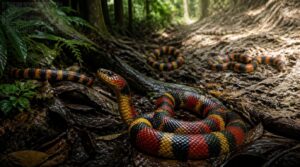
Coral snakes span a surprisingly wide family tree, with distinct genera on opposite sides of the globe and right here in North America. Knowing which species you’re looking at matters, since it shapes everything from range to risk. Here’s a breakdown of the key groups you’ll want to recognize.
All coral snakes fall under Elapidae, and this complete guide to venomous snake types breaks down how they compare to vipers and other families.
New World Coral Snake Genera
Two genera define New World coral snakes: Micrurus and Micruroides, both within family Elapidae. Micrurus dominates, with over 80 species showing striking band pattern variation and strong geographic endemism across Mexico, Central America, and northern South America. Micruroides, by contrast, holds just one U.S. species, the Arizona coral snake, restricted to arid Southwestern habitats. Both deliver potent neurotoxic venom through fixed fangs.
These snakes primarily hunt other snakes and lizards, using their venom to subdue prey before consumption.
Old World Coral Snake Genera
While Micrurus rules the New World, Asia claims its own coral snake diversity.
Calliophis spans India to Indonesia, slender-bodied with potent neurotoxic venom. Sinomicrurus ranges from the Russian Far East to Indonesia, often nocturnal. Hemibungarus occupies Southeast Asian forests and farmland. Some taxonomies fold in African Homoroselaps, though its placement stays debated among herpetologists.
Eastern and Arizona Coral Snakes
North America hosts two genera worth knowing by name. The Eastern Coral Snake (Micrurus fulvius) inhabits southeastern coastal plains, while the Arizona Coral Snake (Micruroides euryxanthus) occupies arid Southwest scrubland, with minimal habitat overlap.
Both carry potent neurotoxic venom, though Arizona’s species delivers smaller doses. Remember: "red on yellow kill a fellow" helps identification, but juveniles match adult coloring exactly, so size never confirms species safely.
Rare and Endangered Species
Beyond the familiar Eastern and Arizona species, several Micrurus face genuine extinction risk. The Roatan coral snake and M. medemi rank critically endangered; the Catamayo and Merida coral snakes follow as endangered.
Key pressures:
- Habitat loss from deforestation
- Populations often below 10,000
- Shrinking genetic diversity
- Weak protected area management
- Climate change disrupting breeding
Coral Snake Pictures and Physical Features
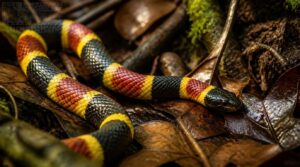
Knowing a coral snake’s taxonomy only gets you so far when you’re standing in leaf litter trying to figure out what’s in front of you. Visual identification matters just as much, and it comes down to a handful of physical traits you can actually check. Here’s what to look for, starting with body size and shape.
Body Size and Shape
A slender build defines you’re looking at when identifying coral snakes. Length runs 18 to 36 inches, with a high length to girth ratio and uniform body diameter throughout.
The neck tapers gradually into a small head, smooth scales, minimal head width comparison to neck, and a short, tapering tail suited to a fossorial lifestyle.
Color Bands and Ring Patterns
Since childhood, "red touches yellow, kill a fellow" has stuck with you, and for good reason: band order matters more than color alone. Color sequence consistency distinguishes venomous corals from mimics.
Ring pattern symmetry, band width variation, and neck band interaction all factor in, though band adjacency alone shouldn’t guide identification, especially with color pattern mimicry blurring the lines between species.
Head Shape and Snout Color
A snake’s head tells you almost as much as its bands do. Head shape stays slender across most New World species, with a head-to-neck ratio barely wider than the body itself, unlike the broad, triangular heads of vipers.
Snout color varies by species and even by shed cycle. A black snout followed by a yellow band signals venomous status, so facial band alignment deserves your full attention before assuming any pattern is safe.
Eastern Coral Snake Appearance
Micrurus fulvius wears its warning plainly. Adults reach 20 to 30 inches, occasionally 40, with a slender, smooth-scaled body of uniform girth.
Its bold red, yellow, and black bands aren’t just striking—they’re a genuine signal, since how dangerous coral snake venom really is explains why that pattern demands respect.
The red black yellow bands form a consistent ringed pattern circling the entire body. Juvenile coloration matches adults exactly; hatchlings, just 6 to 8 inches at birth, display identical head markings and color pattern from day one.
Arizona Coral Snake Appearance
A pocket-sized cousin of its eastern relative, Micruroides euryxanthus rarely tops 16 to 24 inches, with a slim, cylindrical build. Its red black yellow bands form a tight ringed pattern, though band widths shift slightly by population.
The head shows sharp head color contrast, solid black to behind the eyes. Glossy scales and juvenile-adult color match aid venomous snake identification.
Where Coral Snakes Live
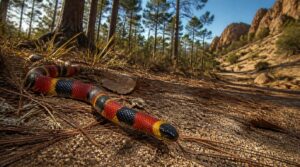
Coral snakes turn up in a surprisingly wide range of places, from sandy pine woods in the American Southeast to arid canyons out West, and even across parts of Asia.
Where you might encounter one depends heavily on which species you’re dealing with and what kind of terrain it calls home.
Here’s a closer look at the specific regions and habitats where these snakes actually live.
North American Geographic Range
Two very different worlds share the same continent here. North American reptiles in this group split into coastal and desert lineages: the Eastern Coral Snake favors humid coastal plain distribution across the Southeast, while the Arizona Coral Snake occupies Southwest desert scrub habitats. Both share a sandy soil preference and turn up along riparian corridors, though populations stay patchy, scattered wherever the right microhabitat persists.
Eastern Coral Snake Habitats
Within the southeastern United States, this species favors pine flatwoods and sandy soils blanketed in leaf litter. You’ll also find it working forest floor microhabitats, wetland and marsh zones, and even suburban woodland edges.
Fire-maintained habitats keep the understory open, and the region’s subtropical climate zones sustain year-round activity in these humid, shaded refuges.
Arizona Coral Snake Habitats
Cross into the Sonoran and Chihuahuan deserts, and the habitat shifts entirely. Micruroides euryxanthus favors arid desert scrubland, rocky canyons, and bajadas with loose, burrow-friendly soils between 300 and 1,500 meters elevation.
You’ll find it sheltering under timber during peak heat, most active in spring and monsoon season, foraging on lizards along leaf litter. "Red on black, friend of Jack" helps here, since this venomous snake wears reversed banding from its mimics.
Central and South American Ranges
South of the desert, genus Micrurus takes over across the Central Highlands, Caribbean Lowlands, and Northern South America. Cordillera de Talamanca and Andean foothills push ranges above 3,000 meters, while species distribution maps show fragmentation into isolated populations.
The critically endangered Roatan coral snake and M. medemi reflect habitat loss pressures shaping conservation status throughout the Amazon Basin Range’s transitional forests.
Asian and Philippine Habitats
Move from the Amazon to southern Asia, and you’ll find a different branch of Elapidae entirely. Genera Calliophis and Sinomicrurus inhabit monsoon forest ecosystems and mangrove coastal zones across Southeast Asian biodiversity hotspots.
Philippine rainforest layers, up to 2,500 meters, plus island habitat diversity, drive endemism. Their banding pattern signals the same neurotoxic venom risk found in New World species.
Coral Snake Behavior, Diet, and Lifespan
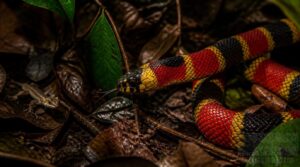
Coral snakes spend most of their lives out of sight, and that hidden lifestyle shapes everything from how they hunt to how long they live. Knowing what drives their daily habits gives you a clearer picture of the animal behind the warning colors. Here’s what to expect from these secretive reptiles, covering their behavior, diet, and lifespan.
Secretive and Burrowing Behavior
You’ll rarely spot a coral snake in the open; it prefers subterranean habits over exposure. Using muscular body movements, it carves shallow tunnels beneath logs and rocks, then conceals entrances with loose soil and leaf litter. Multiple burrow entrances offer redundancy against collapse and quick retreat.
By day, it retreats underground, ambushing wormlike prey, small lizards, and amphibians from cover.
Daily and Seasonal Activity
Timing matters more than luck on the trail. Coral snakes favor mornings between 75 and 85°F, retreating once afternoon heat tops 90°F. Activity peaks in late spring through early summer, tied to mating and shedding cycles. Rainfall briefly draws them to the surface. Below 64°F, movement nearly stops. Plan hikes accordingly, since cooler, cloudy days mean lower encounter risk.
Prey and Hunting Methods
Patience defines the hunt. Coral snakes rely on ambush predation, coiling motionless and using heat and chemical cues for prey detection.
Their menu includes:
- Small lizards
- Frogs
- Nestling birds
- Other snakes
Strikes stay short and swift, delivering neurotoxic venom before the snake repositions to consume prey head first, minimizing injury from tough tissue or spines.
Egg Laying and Hatchlings
Coral snakes are oviparous, laying 1 to 13 eggs per clutch in humid leaf litter, rotting logs, or abandoned burrows. Incubation runs 40 runs 40 to 60 days, shaped by temperature and moisture. Hatchlings emerge at 6 to 12 cm, fully colored and venomous, then disperse immediately. There’s no parental care; juvenile independence begins at hatching, and secretive sheltering behavior starts right away.
Wild and Captive Lifespan
Predators and sporadic prey keep wild coral snakes to 4 to 6 years, while captivity often doubles that. Steady feeding, climate control, and veterinary care let captives reach 6 to 10 years, with some Micrurus individuals documented at 18 years.
Maturity arrives at 2 to 3 years wild, sometimes earlier in captivity. As oviparous, egg-laying snakes, reproductive demands further shorten wild lifespans.
Identifying Coral Snakes and Look-Alikes
Telling a coral snake apart from its mimics comes down to a handful of visual cues, and knowing them can genuinely keep you safe.
Several harmless species wear strikingly similar red, black, and yellow bands, which is exactly why confusion happens so often in the field.
Here’s what actually separates them, along with why relying on color alone won’t always give you the full picture.
Milk Snake Differences
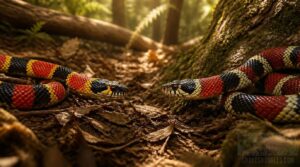
Milk snakes fool plenty of hikers, and even some seasoned handlers pause before ruling them venomous.
- Complete ring patterns wrap fully around the body
- Yellow or cream background, not white
- No venom, they constrict prey instead
- Less triangular head shape
- Geographic color morphs vary by region
Band adjacency, not just color, separates them from true coral snakes.
Scarlet Snake Differences
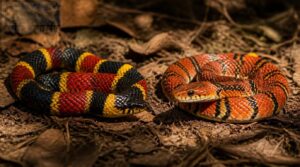
Ring confusion doesn’t stop with milk snakes. Cemophora coccinea, the Scarlet Snake, shows orange-red bands edged in black on a white to light-yellow belly, distinct from true coral banding.
Head shape comparison favors identification too: rounded, not fanged. Scale texture differs, smoother dorsally.
Juvenile band spacing runs slightly wider than in adults, an easy Coral Snake vs Scarlet Snake distinction once you know where to look.
Other Common Coral Mimics
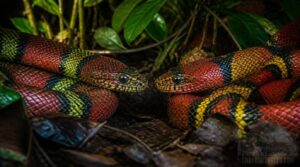
Beyond the scarlet king snake, several other false coral snakes exploit the same trick. Their red-yellow-black bands overlap coral snake microhabitats, leaf litter, low brush, so encounter rates with predators climb.
Band width shifts with molt cycles, and some morphs show greenish casts in odd light, complicating visual identification for anyone relying on color alone.
Banding Mnemonic Limitations
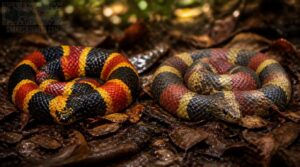
Red on Yellow Kill a Fellow, Red on Black Friend of Jack" relies on strict band order and adjacency, yet color sequence confusion, fading, and pattern variation erode its reliability.
Juveniles show different band contrast than adults, and weathered specimens blur distinctions further. You can’t trust this rhyme as your sole method; it’s a starting cue, not a diagnostic tool.
Safe Visual Identification Methods
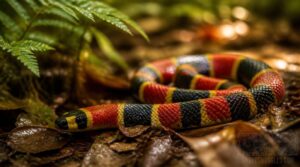
Since rhymes fail, rely on layered checks instead. Confirm band continuity, uninterrupted rings circling the body, then verify color sequence and intensity against known Micrurus patterns. Examine snout coloration and head shape; a rounded head with color continuing past the snout suggests coral snake identification. Never handle for confirmation. Photograph from a safe distance and consult a herpetologist or regional field guide for visual confirmation.
Coral Snake Venom and Bite Symptoms
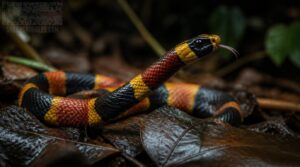
A coral snake’s bite doesn’t announce itself the way you might expect, and that’s exactly what makes it worth understanding. The venom works differently than what most people picture when they think "snakebite," and the timeline for symptoms can catch you off guard. Here’s what you need to know about how this venom behaves and what to watch for.
Neurotoxic Venom Effects
What makes coral snake venom so dangerous isn’t volume, it’s precision. Presynaptic blockade halts acetylcholine release, while postsynaptic receptor inhibition and ion channel disruption compound the damage. Venom synergism accelerates onset, driving flaccid paralysis toward respiratory paralysis.
Coral snake venom’s danger lies not in volume but in precision, blocking nerve signals until paralysis spreads from muscle to breath
You’ll need prompt antivenom administration and snake envenomation treatment before neurotoxin binding sites cause irreversible nerve damage.
Delayed Bite Symptoms
Because coral snake bites rarely hurt, you may assume you’re fine, yet delayed bite symptoms often wait 12 to 24 hours. Watch for:
- Tingling or numbness
- Slurred speech
- Drooping eyelids
- Muscle weakness
Neurotoxin effects then drive symptom progression toward paralysis. This delayed bite symptoms window explains why hospitals require extended monitoring, even when you feel asymptomatic.
Signs of Respiratory Failure
Watch your breathing closely once neurotoxin effects set in. Respiratory paralysis develops through recognizable stages: rapid or shallow breaths, then visible neck and chest muscle strain, then bluish lips or nail beds (cyanosis).
| Sign | What You’ll Notice | Urgency |
|---|---|---|
| Tachypnea | Breathing rate climbs | High |
| Accessory muscle use | Visible neck/chest effort | Critical |
| Cyanosis | Blue lips, nail beds | Emergency |
Confusion or drowsiness means seek antivenom treatment immediately.
Coral Snake Versus Rattlesnake Bites
Two venoms, two entirely different threats. Coral snake venom is neurotoxic, targeting your nervous system, while rattlesnake bites deliver hemotoxic venom causing swelling and tissue damage.
Onset differs too: coral bites can delay symptoms for hours, whereas rattlesnake pain hits fast. Coral snake bites are also rarer.
Each requires species-specific antivenom, so accurate identification matters for proper treatment.
Bite Severity and Fatality Risk
Not all bites carry equal weight. Severity hinges on venom yield, bite duration, and how fast you reach care, not on body size.
Untreated cases risk respiratory paralysis within hours; delayed symptom onset often misleads victims.
- Ptosis and slurred speech signal trouble
- Breathing difficulty demands urgent response
- Antivenom timing determines survival odds
Fatalities are rare with prompt treatment, common without it.
Coral Snake Bite Response and Safety

Knowing what a coral snake’s venom does is only half the picture; knowing what to do in the minutes after a bite is what actually protects you. A calm, correct response can mean the difference between a manageable medical event and a life-threatening one, while the wrong move can waste precious time.
Here’s what you need to know, from first aid to hospital care to keeping snakes out of your yard in the first place.
Immediate First Aid Steps
Every minute counts, but panic costs more than it saves.
Call emergency services first, then keep the victim calm and still. Immobilize the bitten limb at heart level and remove constrictive items like rings or watches before swelling starts. Wash the wound gently with soap and water.
This sequence buys time until antivenom administration begins.
Dangerous First Aid Mistakes
Good intentions cause real harm here. A tourniquet cuts blood flow without stopping venom, which moves through lymphatics, and risks tissue death. Cutting the wound or attempting suction introduces bacteria and damages nerves. Ice slows antivenom absorption later. Electric shock devices risk cardiac arrhythmias, doing nothing for venom itself.
- Applying a tourniquet or tight band
- Cutting the bite site
- Using ice or suction devices
- Attempting electric shock treatment
Antivenom and Hospital Treatment
Skipping those mistakes buys time until you reach a hospital, where NACSA remains first-line therapy. If unavailable, Coralmyn or Costa Rica’s Anticoral serve as alternatives. Antivenom is given only after neurologic symptoms appear, since dry bites need no treatment.
| Protocol Step | Purpose |
|---|---|
| IV access, monitoring | Detect early deterioration |
| Ventilator readiness | Prevent respiratory failure |
| Poison control consult | Confirm antivenom choice |
Safe Outdoor Encounter Practices
Hospital treatment matters only if you avoid the bite altogether, which comes down to trail discipline.
Wear tall boots, tuck pants in, and keep hands out of leaf litter. Spot a coral snake? Freeze, back away slowly, and hold at least 10 feet distance. Never corner or handle it.
Stay on marked trails; that alone prevents most encounters.
Yard Sightings and Professional Removal
Trail discipline won’t help once a coral snake turns up in your yard. Call a licensed wildlife control professional rather than attempting removal yourself; they inspect first, then relocate using tongs and protective gear.
Whether it’s an eastern coral snake or Arizona coral snake, non-lethal capture is standard. You’ll get a written report plus habitat modification tips afterward.
Frequently Asked Questions (FAQs)
Can a coral snake bite a human?
Yes. Small fixed fangs deliver neurotoxic venom during bites, usually when the snake is handled or disturbed. Symptoms can lag hours behind the bite, so any suspected envenomation warrants immediate emergency medical care and antivenom, given the respiratory paralysis risk.
Is a coral snake worse than a rattlesnake?
Neither is strictly "worse." Coral snake venom brings slower-onset respiratory paralysis risk requiring urgent antivenom, while rattlesnakes cause faster, severe tissue damage.
Venom potency, symptom onset, and antivenom availability differ, making fatality rate analysis and treatment urgency dependent on species and response time.
Have coral snakes killed anyone?
Like a quiet fire that rarely flares, coral snake venom can kill, but seldom does. Confirmed U.S. deaths remain historically rare, with prompt antivenom and respiratory support turning most bites into survivable, if serious, medical emergencies.
What to do if I see a coral snake in my yard?
Stay calm, back away slowly, and keep children indoors. Avoid handling snakes, don’t rely on the identification rhyme alone, and call wildlife professionals for safe removal. Watch for snake bite symptoms if contact occurs, and follow basic snake safety protocols.
What two states are snake free?
Alaska and Hawaii are the two snake free states, with no native populations, venomous or nonvenomous. Alaska’s climate and Hawaii’s island isolation explain the terrestrial snake absence, though sea snakes occasionally appear in Hawaiian waters.
Do coral snakes bite?
Discretion is the better part of valor, and coral snakes prove it: yes, they bite, but rarely. Most bites happen when handled, injecting less venom than pit vipers, yet still demanding immediate emergency care.
How to tell which coral snake is poisonous?
Check band order: when red touches yellow, assume venomous. Verify snout color and head shape as secondary confirmation. Mnemonic rhymes help, but band continuity and species range matter more than color alone for accurate identification.
What should you do if you spot a coral snake around your home or in your neighborhood?
Freeze like you’ve spotted a landmine. Keep at least 10 feet distance, herd kids and pets inside, and call animal control or a licensed remover, never attempt handling or relocation yourself.
Can coral snakes survive in captivity long-term?
Long-term survival is possible but demanding: success hinges on precise enclosure design, stable temperature gradients, careful feeding practices, and vigilant health monitoring.
Given venomous handling risks, most keepers find sustained captivity realistic only in experienced, specialized herpetology settings.
How do coral snakes reproduce and mate?
Courtship unfolds through chemical trails during breeding season, with males using hemipenes for copulation. Females may store sperm for months. This oviparous reproduction yields clutches of 2 to 12 eggs; hatchlings emerge fully independent, no parental care needed.
Conclusion
The next flash of red and yellow in the leaf litter won’t announce itself with a rhyme.
This coral snakes species profile with pictures and bite information exists so you can trust pattern, habitat, and behavior over guesswork. Rhymes fail. Regions vary. Mimics fool even careful eyes.
What doesn’t fail is preparation: knowing the bands, respecting the venom, and calling for help immediately after a bite. That knowledge, not luck, is what keeps you safe in coral snake country.