This site is supported by our readers. We may earn a commission, at no cost to you, if you purchase through links.

Pick up a hognose snake for the first time and you’ll notice something immediately—it acts nothing like a snake "should". That upturned snout, theatrical death performance, and absurd cobra impression defy expectations.
Despite sharing a genus and a flair for drama, eastern and western hognose snakes are shaped by wildly different landscapes. One haunts the humid pine barrens of the Atlantic coast, while the other crosses arid Great Plains prairie where rainfall is a rumor. These contrasting environments forge genuinely distinct animals.
The differences between eastern vs western hognose snakes extend beyond geography. Snout angle, size, venom delivery, captive temperament, and lifespan all diverge in ways that matter, reflecting their evolutionary adaptations to disparate worlds.
Table Of Contents
- Key Takeaways
- Eastern Vs Western Hognose Overview
- Range and Natural Habitat
- Size, Color, and Appearance
- Behavior, Defense, and Venom
- Diet and Pet Suitability
- Eastern Diet: Toads and Amphibian Specialization
- Western Diet: Frogs, Lizards, Rodents, and Toads
- Why Eastern Hognoses Can Be Difficult Pets
- Why Western Hognoses Are Popular Pets
- Feeding Frozen-Thawed Mice in Captivity
- Basic Enclosure, Temperature, and Humidity Needs
- Which Hognose Snake is Better for Beginners?
- Frequently Asked Questions (FAQs)
- How venomous is an eastern hognose snake?
- What is the difference between eastern hognose and Plains hognose snakes?
- How to identify eastern hognose?
- Is the Eastern Hognose snake rare?
- What is the difference between eastern and western hognose snakes?
- Are eastern hognose snakes aggressive?
- Do western hognose snakes like to be held?
- How do their breeding habits differ?
- What are their preferred prey species?
- Are there any subspecies or morphs?
- Conclusion
Key Takeaways
- Western hognose snakes dominate the pet trade because they eat frozen mice readily, stay small, and come in over 60 color morphs — eastern hognoses demand live toads and serious patience.
- Same genus, genuinely different animals: eastern hognoses run a full cobra bluff and commit hard to playing dead, while westerns keep their defensive drama surprisingly low-key.
- Snout shape isn’t cosmetic — the eastern’s broad, rounded nose and the western’s sharply upturned snout are evolutionary answers to different soils and prey-hunting demands.
- Despite being rear-fanged venomous, neither species poses any real threat to humans — their venom targets amphibians, and a bite rarely causes more than mild local swelling.
Eastern Vs Western Hognose Overview
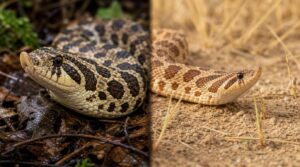
If you’ve ever stood in a pet store staring at a hognose snake and wondered whether it’s the eastern or western species, you’re not alone. These two share a genus — Heterodon — but differ more than you’d expect once you start looking closely.
Knowing which species you’re looking at matters more than you’d think — this hognose snake care sheet and species guide breaks down the key differences that even experienced keepers sometimes miss.
Here’s what sets them apart.
Scientific Names: Heterodon Platirhinos Vs Heterodon Nasicus
Both share a genus—Heterodon—but that’s where the common ancestor ends. The eastern hognose snake carries the species epithet platirhinos; the western, nasicus. These names aren’t arbitrary. Each reflects a phylogenetic split confirmed through taxonomic revisions and maintained across major databases like ITIS and GBIF, each with distinct database IDs. Binomial authority matters here—knowing which species you’re working with changes everything.
| Feature | Heterodon platirhinos | Heterodon nasicus |
|---|---|---|
| Common Name | Eastern Hognose Snake | Western Hognose Snake |
| Species Epithet | platirhinos | nasicus |
| Taxonomic Authority | ITIS / GBIF confirmed | ITIS / GBIF confirmed |
| Geographic Origin | Eastern United States | Central U.S. to Mexico |
| Phylogenetic Status | Distinct lineage | Distinct lineage |
Eastern hognose prefers warm‑soil wetlands, a habitat highlighted in the wetland habitat description.
Key Similarities Between Both Hognose Snakes
Strip away the geographic split and what’s left surprises most people—these two are remarkably alike. Both sport that signature upturned snout built for burrowing behavior in loose soil.
Their shared traits run deeper than expected. A Common Amphibian Diet unites them, with both favoring toads, frogs, and occasionally lizards. Shared Burrowing Traits extend beyond anatomy, while Similar Defense Displays—like bluff strikes and hissing—highlight parallel survival strategies. Even their Oviparous Reproduction methods align closely, despite the continental divide.
| Trait | Eastern Hognose | Western Hognose |
|---|---|---|
| Snout Type | Upturned snout | Upturned snout |
| Primary Diet | Toads, amphibians | Toads, frogs, lizards |
| Reproduction | Oviparous | Oviparous |
| Defense Style | Bluff strikes, hissing | Bluff strikes, hissing |
| Venom Type | Rear-fanged, mild | Rear-fanged, mild |
Biggest Differences at a Glance
Similarities are easy to spot — but the differences are where things get interesting. Regarding a true comparison of eastern and western hognose snakes, the contrasts run from differences in size and growth potential to physical characteristics and coloration patterns, defensive behaviors and bluffing tactics, habitat and moisture requirement differences, seasonal activity windows, egg clutch size, soil compaction tolerance, predator perception strategies, and captive breeding success rates.
| Trait | Eastern Hognose | Western Hognose |
|---|---|---|
| Adult Size | Up to 46 in (117 cm) | Up to 35 in (89 cm) females |
| Coloration | Highly variable — melanistic to yellow | Sandy-brown, black-spotted belly |
| Defense Style | Full cobra display, thanatosis | Mild bluff, rarely plays dead |
| Habitat Moisture | Higher humidity, wetland margins | Dry prairie, low moisture tolerance |
| Captive Feeding | Specialist — often refuses rodents | Generalist — accepts frozen-thawed mice |
Which Species is More Common in Captivity?
The western hognose snake dominates the pet trade — and the numbers back that up. With over 60 recognized color morphs, easy acceptance of rodents, and a manageable size, Heterodon nasicus has become a staple of captive breeding programs and pet store stock worldwide.
| Factor | Western | Eastern |
|---|---|---|
| Pet trade demand | High | Moderate |
| Captive breeding records | Extensive | Limited |
| Beginner suitability | Yes | Rarely |
Eastern hognose snakes (H. platirhinos) have a longer collection history in some regions, though regulatory restrictions and feeding challenges keep regional market demand comparatively low.
Their ecological role makes them worth understanding beyond the pet trade—Eastern hognose snake behaviors and biology highlight why protecting declining northeastern populations matters for local ecosystems.
Range and Natural Habitat
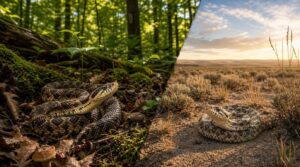
Where a snake lives tells you a lot about what it needs. Eastern and western hognoses have carved out very different territories across North America — and their habitat preferences run deeper than just geography.
Here’s how their ranges and natural environments break down.
Eastern Hognose Snake Geographic Range
The eastern hognose snake (Heterodon platirhinos) has one of the broadest species distributions of any North American colubrid. Its range spans 30 states, stretching from southern New Hampshire at the northern edge to peninsular Florida in the south.
Geographically, the distribution extends westward through the Midwestern extension, encompassing Kansas, Nebraska, and eastern Texas. This wide-ranging habitat reflects the species’ adaptability to diverse environments.
Elevation limits remain modest, with populations thinning out above 300 meters. This constraint highlights the snake’s preference for lower-lying regions, shaping its ecological niche across North America.
Western Hognose Snake Geographic Range
Unlike its eastern cousin, the western hognose snake (Heterodon nasicus) runs a longer north-south corridor — stretching from Saskatchewan and Manitoba down through the Great Plains into northern Mexico. That’s a prairie corridor cutting through the heart of the continent.
Sandy soils and arid grasslands define most of this range. The elevation ceiling sits around 2,500 meters, though fragmented populations thin out considerably above that.
Eastern Habitat: Forests, Dunes, Fields, and Wetlands
The eastern hognose snake is genuinely habitat-flexible — but it has preferences. Dense forest understory, where oak and hickory canopies drop seasonal leaf litter, gives it cover and toad-hunting ground.
Coastal dunes, wetland edges, and open field microhabitats round out its range. Dune vegetation stabilizes sandy soils it depends on for burrowing.
Soil composition and moisture requirements both matter: loose, well-drained ground is non-negotiable.
Western Habitat: Prairies, Drylands, and Sandy Soils
The western hognose snake is built for open, punishing landscapes. Across the Great Plains, it thrives where drought-driven vegetation stays sparse and fire-maintained grasslands keep the canopy nonexistent. Sandy substrate isn’t a preference — it’s a requirement.
What defines western hognose territory:
- Arid grasslands with minimal moisture retention
- Desert scrub edges where soil texture stays loose and friable
- Burrowing microhabitats hidden beneath short-grass cover
- Sandy soils on dune ridges warmed fast by prairie sun
Why Loose Soil Matters for Burrowing
Loose, sandy soils aren’t just convenient — they’re engineered for survival. Sandy soils drain fast, so burrow walls stay stable without mud collapse. Digging energy drops dramatically when there’s no dense clay to fight through. Improved aeration supports microhabitat creation beneath the surface.
Thermal buffering kicks in at depth, shielding snakes from temperature extremes. Both species’ burrowing behavior and sand adaptation depend entirely on finding the right substrate.
Size, Color, and Appearance
Size is one of the fastest ways to tell these two species apart—and the differences go deeper than you might expect. Beyond length, their coloration and snout shapes tell their own stories.
Here’s what to look for when comparing eastern and western hognoses side by side.
Eastern Hognose Snake Average Size
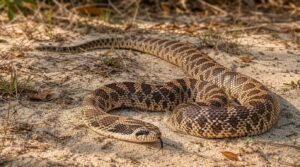
Most adult eastern hognose snakes land somewhere between 20 and 33 inches — stocky, muscular animals built for digging. Females tend toward the longer end of this range, while males are typically shorter.
Growth rates slow in cooler climates, and habitat plays a significant role: snakes in sandy, resource-rich areas often develop stouter, larger physiques. Captive size differences may reflect variations in diet quality.
Lifespan commonly spans 6–12 years, with a clear correlation between longevity and size.
Western Hognose Snake Average Size
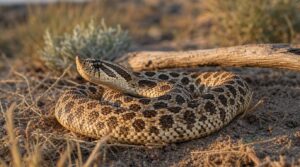
Western hognose snakes are noticeably smaller. Most adults settle between 20 and 33 inches — females trending toward the upper end, males remaining compact. Weight benchmarks typically fall between 100 and 350 grams.
Growth is influenced by seasonality: cooler environments significantly slow development. This environmental factor plays a critical role in their maturation timelines.
Captive versus wild individuals diverge in growth patterns. Captive-raised snakes, with consistent feeding, often reach maturity faster and attain the higher end of size ranges compared to their wild counterparts.
Male Vs Female Size Differences
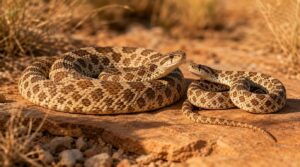
Sexual dimorphism in hognose snakes involves more than just average length differences, centering on a length-width tradeoff between sexes.
Females typically grow longer and stockier while males stay shorter but often thicker-bodied relative to their length, a pattern this hognose snake size guide by sex breaks down in detail.
- Eastern females outsize males considerably — sometimes by several inches
- Western females reach up to 35 inches, while males stay under 20 inches
- Tail length disparity favors males
- Bigger females produce more eggs, correlating with clutch size
Regional size variation further shapes these differences across populations.
Eastern Color Variations and Patterns
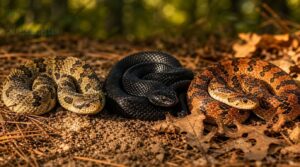
Color is where the eastern hognose gets genuinely interesting. Unlike its western cousin’s predictable sandy palette, Heterodon platirhinos exhibits a full spectrum of hues—tan, olive, orange, and even deep melanistic morphs that appear nearly black. Regional pattern types shift with soil conditions: dune populations remain pale, while forest-edge snakes develop darker, high-contrast markings.
| Pattern Type | Typical Habitat | Key Feature |
|---|---|---|
| Spotted/pale | Sandy dunes | Light ground color |
| Irregular blotch | Forest edge | High-contrast markings |
| Melanistic | Variable | Near-solid dark pigment |
Juveniles display sharper contrast than adults, with patterns that fade gradually with age—a classic juvenile coloration shift. Rare aberrant markings, such as lateral stripes or asymmetric blotches, occur occasionally in the wild. Captive breeding programs have driven the development of albino morph, leucistic, and lavender morph variants, though these lack natural analogs. Despite such variations, habitat-driven hue changes remain the defining feature of wild eastern hognose snake populations.
Western Coloration and Black Belly Markings
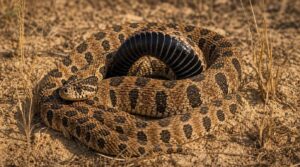
Switch from the eastern wild palette to the western, and the color story gets more disciplined. Heterodon nasicus sticks to tans, reddish-browns, and olive-brown dorsals with dark saddle blotches—reliable enough that regional color differences are subtle rather than dramatic.
Seasonal shedding effects can shift contrast slightly.
The real signature? That high-contrast black belly. Scale texture influence and belly pattern variation together create surprisingly effective camouflage mechanisms on sandy prairie soils.
Snout Shape: Rounded Vs Sharply Upturned
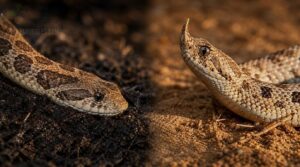
The snout tells the whole story. Eastern hognoses carry a broad, rounded nose — built for pushing straight into loose sand without snagging. Western hognose snakes developed a sharply upturned snout, angled above 15 degrees, ideal for debris clearance and prey detection in surface litter.
Comparative morphology of Eastern and Western hognose snakes reveals real evolutionary divergence — morphological trade-offs shaped by substrate preference and burrowing mechanics.
Behavior, Defense, and Venom

Hognose snakes are theatrical — and that’s putting it mildly. Between the two species, you’ll find a surprising range of behaviors, from full cobra impressions to barely-there bluffs.
Here’s how they differ in defense, temperament, and venom.
Eastern Hognose Cobra-Like Defensive Display
When threatened, eastern hognose snakes pull off one of nature’s most convincing bluffs. Through rapid throat muscle inflating and neck flattening, the neck expansion mechanics mimic cobras with a striking visual contrast effect — wide hood, raised head, loud hiss.
When threatened, eastern hognose snakes inflate their throats and flatten their necks into a flawless cobra impersonation
This display triggers a predator learning response, causing most to retreat. The energy cost of this performance is justified when thanatosis becomes the only backup plan.
Western Hognose Bluffing and Mild Defensiveness
Western hognose snakes run a tamer operation. Their bluffing involves neck flattening, a coiled posture with head raised, and a closed mouth strike — all show, no contact. If a burrow escape route exists, they’ll take it.
Compared to the Eastern’s full cobra drama, the Western’s defensive displays are dialed back considerably.
With gentle handling, most individuals calm down quickly.
Playing Dead: More Common in Eastern Hognoses
Eastern hognose snakes take death feigning to another level entirely. When predator cues — a fox circling, a hawk overhead — trigger the response, hormonal triggers kick in fast. The snake flips, goes limp, tongue out, musk flowing. Full muscular relaxation. It’s energy conservation through performance.
- Feigning duration can stretch from minutes to hours
- Eastern hognose snakes commit harder than Western hognose snakes
- Defensive displays escalate — before thanatosis begins
- Death feigning works — most predators walk away
Hissing, Musk, and Bluff Strikes Compared
Eastern hognose snakes employ high auditory warning intensity — a shrill, glottis-driven hiss — paired with cobra-like neck flaring and musk composition variation that genuinely clears a room.
Western hognose snakes opt for a closed-mouth bluff strike, minimal musk, and low energy cost displays.
Same toolkit, very different commitment levels.
Rear Fangs and Mild Venom Explained
Both hognose species are rear-fanged venomous — but don’t picture hollow needles. The venom delivery system relies on grooved tooth mechanics: enlarged back teeth channel venom along grooves through a chewing envenomation process, not a single strike.
Venom gland composition is seromucous and prey-specific toxins target amphibians, not you.
For humans, a bite means mild local swelling at most.
Are Eastern or Western Hognoses Dangerous?
Short answer? Neither. Despite being rear-fanged venomous, both the eastern hognose snake and western hognose snake pose minimal medical relevance to humans — their venom targets amphibians, not you.
Bite likelihood is low, and human reactions rarely exceed mild swelling. That’s the myth-debunking part most people skip.
- Bites are uncommon and not medically significant.
- Neither species meets legal restrictions as dangerous reptiles in most U.S. states.
- Human interaction and safety concerns drop sharply with calm, confident handling.
Diet and Pet Suitability
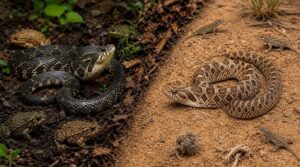
What a snake eats tells you a lot about how easy it is to keep. Eastern and western hognoses have genuinely different diets—and that gap matters when you’re deciding which one belongs in your home.
Here’s what sets them apart, from wild prey preferences to captive feeding realities.
Eastern Diet: Toads and Amphibian Specialization
If there’s one snake built around a single prey type, it’s the eastern hognose. Its upturned snout isn’t decorative — it digs out buried toads with surgical efficiency.
Specialized digestive enzymes handle amphibian tissue, while toad toxin tolerance lets it eat prey most snakes avoid. Amphibian hunting tactics peak during spring migrations.
That’s genuine dietary specialization on toads and amphibians — an ecological role that keeps toad populations in check.
Western Diet: Frogs, Lizards, Rodents, and Toads
The western hognose snake plays it smarter — it doesn’t commit to one prey type. Frogs, lizards, rodents, toads — its feeding and dietary preferences shift with what’s available.
Seasonal prey shifts follow rainfall and temperature, with amphibian prey dominating wet springs and rodent prey filling gaps in dry stretches.
That dietary flexibility also means better nutrient balance, prey moisture variety, and built-in toxin management across a mixed menu.
Why Eastern Hognoses Can Be Difficult Pets
That dietary flexibility is exactly what makes H. nasicus the more forgiving pet.
Eastern hognose snakes lean the opposite direction — feeding reluctance is real, and it’s the first wall most keepers hit. Their toad preference creates constant pressure on your substrate depth, humidity balance, and patience. Add defensive displays and handling stress, and disease susceptibility climbs fast. They’re rewarding, but not beginner-friendly.
Why Western Hognoses Are Popular Pets
Breeder availability is high, affordable cost keeps entry barriers low, and a stable temperament ensures quiet handling sessions—even for nervous beginners. No UVB required simplifies pet care guidelines considerably.
Over 60 color morphs exist, fueling trends in hognose snake popularity and breeding while reducing impact of the pet trade on wild populations.
Feeding Frozen-Thawed Mice in Captivity
Getting frozen-thawed feeding right is where western hognose care separates good keepers from great ones. Follow these four steps every time:
- Thaw sealed prey in warm water — never hot
- Warm to 37–38°C to trigger a strike response
- Match prey width to the snake’s girth
- Sanitize tongs and surfaces after each session
Consistent feeding frequency — every 7–14 days for adults — keeps condition stable.
Basic Enclosure, Temperature, and Humidity Needs
Both species share the same reptile enclosure setup fundamentals: a temperature gradient (22–32°C), humidity control (30–60%), and a burrowing substrate like sandy loam or coconut fiber.
Eastern hognose snakes require slightly higher humidity gradients and a moist hide, while Western hognose snakes tolerate drier conditions.
Smart hide placement, proper ventilation design, and a reliable thermostat are critical for success.
Which Hognose Snake is Better for Beginners?
Western hognose snakes win — and it’s not close. Their calm temperament, acceptance of frozen-thawed mice, and widespread availability at pet stores make them ideal for beginners. The learning curve is gentler, initial setup costs are reasonable, and they boast a 15–20 year lifespan.
Eastern hognose snakes, by contrast, demand live prey and higher humidity — not ideal for first-time keepers adhering to basic pet care guidelines.
Frequently Asked Questions (FAQs)
How venomous is an eastern hognose snake?
The eastern hognose snake is rear-fanged venomous — but barely dangerous to you. Its venom composition targets amphibians, not humans. Human bite reactions stay local: minor swelling, mild irritation, nothing systemic.
What is the difference between eastern hognose and Plains hognose snakes?
Both are hognose species sharing an upturned snout.
The Plains hognose snake is smaller, more docile, and eats a broader diet — making it the easier captive compared to Eastern hognose snakes.
How to identify eastern hognose?
Look for the shovel-like rostral scale — that upturned, pig-nosed snout is the giveaway. Eastern hognose snakes also show keeled scales, divided anal vent hue, and wild color variation across populations.
Is the Eastern Hognose snake rare?
Eastern hognose snakes hold Least Concern conservation status, with stable population trends across their broad geographic distribution. Habitat fragmentation poses real risks, but captive breeding has helped ease the pressure on wild populations.
What is the difference between eastern and western hognose snakes?
Same genus, different personalities. Eastern hognose snakes are larger, toad-dependent drama queens. Western hognose snakes stay small, eat mice readily, and make calmer pets — making them the clear beginner favorite.
Are eastern hognose snakes aggressive?
No — eastern hognose snakes aren’t aggressive. Their defensive temperament leans theatrical, not territorial. Stress-induced strikes are rare, and with regular handling, most individuals settle into docile, predictable behavior.
Do western hognose snakes like to be held?
Western hognose snakes are generally docile and tolerate handling well with patience.
Build tolerance training gradually — through short handling sessions, calm movements, and reading stress signals like neck-flattening — to keep the experience positive for both of you.
How do their breeding habits differ?
Season timing differs slightly — eastern hognoses breed April to May, westerns shift later based on rainfall. Both skip parental care after laying clutches of 5–20 eggs, with a 40–70 day incubation period.
What are their preferred prey species?
Toad specialization defines the eastern’s diet — its a toad hunter, plain and simple.
The western prefers a frog lizard mix, with seasonal prey variation and a juvenile diet shift toward toads as they grow.
Are there any subspecies or morphs?
Neither species has formally named subspecies — taxonomic ambiguity reigns here.
Geographic polymorphism produces natural color variation, while captive-bred variants like albino and patternless morphs drive strong morph market demand, especially for westerns.
Conclusion
Ironically, the snake famous for faking death is the one that keeps surprising you the longer you study it. The eastern vs western hognose snake debate isn’t really about which is better—it’s about recognizing how differently evolution solves the same problems.
Sandy soil, toad-heavy diets, theatrical bluffs—each species is a precise answer to a specific landscape. Choose the one whose world makes sense to you, and you’ll understand it deeply.