This site is supported by our readers. We may earn a commission, at no cost to you, if you purchase through links.
An experienced keeper often spots trouble before a snake misses a meal. A kingsnake lingering at the warm end after months of enthusiastic feeding, or a pit viper carrying an outdated label, tells a trained observer that details matter.
That skill doesn’t come from memorizing care sheets. Keepers cross-check field guides, Reptile Database records, and their own dated notes on sheds, temperatures, and feeding.
How experienced keepers learn about snake species follows a disciplined loop: verify, observe, compare, revise. Field scale rows and enclosure records then sharpen identification, safety, and care over years, across species, habitats, and changing taxonomies alike.
Table Of Contents
- Key Takeaways
- Experienced Keepers Combine Research and Practice
- They Study Snake Families and Taxonomy
- They Master Field Identification Techniques
- They Gain Supervised Hands-on Experience
- Frequently Asked Questions (FAQs)
- What state has the worst snake problem?
- What did Jesus say about snakes?
- What snake is worth $100,000?
- What smell does a snake hate?
- How do keepers learn snake dietary and feeding needs?
- What legal permits are required for keeping venomous snakes?
- How do keepers recognize signs of illness in snakes?
- How does climate change affect snake population distributions?
- What role does captive breeding play in conservation efforts?
- Conclusion
Key Takeaways
- Real snake expertise isn’t built from a single care sheet — it comes from cross-referencing field guides, the Reptile Database, and your own dated observation logs until three independent sources agree.
- Taxonomy changes, and your records become dangerously outdated the moment a species gets reclassified, so checking ITIS or herpetological journals for current binomials isn’t optional.
- Field identification only gets reliable when you read multiple physical markers together — scale texture, head shape, pupil type, and heat-sensing pits — because no single trait safely separates venomous from nonvenomous.
- Supervised hands-on experience, whether through mentor training, zoo observation, or citizen science field trips, is what converts book knowledge into the kind of calm, species-specific judgment that keeps both you and the animal safe.
Experienced Keepers Combine Research and Practice

Knowing a snake’s name is just the starting point. The keepers who build real expertise pair solid research with time in the field — and they follow a clear process to do it. Here’s how that process breaks down.
That process often starts with the basics — like understanding carpet python enclosure size requirements — before expanding into the hands-on experience that turns beginners into confident keepers.
Compare Multiple Reliable Sources
Regarding species identification, no single source is ever enough.
Cross-reference your Peterson Field Guide against the Reptile Database, then check iNaturalist for georeferenced specimen photos. A herpetological society publication adds peer-reviewed weight to your research.
When three independent sources agree on a detail, trust it. When they don’t, dig deeper. That gap is where real understanding begins.
Trust three sources in agreement, but seek truth in the gaps where they diverge
Record Observations Over Time
Cross-referencing sources gives you a baseline. Your observation log turns that baseline into living data.
Log feeding responses and shed cycles with timestamps. Note enclosure temperatures at the time. Even small behavioral shifts, like a snake refusing food at 78°F instead of its usual 82°F, become clear patterns across months of entries. That’s when you stop guessing and start knowing. This mirrors research showing that data-centered observation habits lead to lasting improvements in how we interpret patterns over time.
Recheck Changing Taxonomy
Your log stays accurate only if the names in it still hold. Reptile taxonomy shifts: species get reclassified, families get split, synonyms accumulate. Stay current by checking these sources:
- ITIS or Reptile Database for current binomials
- Registered synonyms with reclassification dates
- Herpetological journals for family-level revisions
- Husbandry protocols tied to updated names
- Venomous snake taxonomy alerts for staff
Study Captive and Wild Snakes
Once your taxonomy is current, test it against the animal itself. Captive and wild observation together reveal what no field guide captures alone. A snake’s temperament shifts between settings, and that gap matters.
| Setting | What You Observe | Focus Area |
|---|---|---|
| Captive enclosure | Species temperament, feeding | Behavioral observation |
| Field encounter | Activity range, timing | Herpetology fieldwork |
| Comparative study | Morphology patterns | Snake identification |
Prioritize Safety and Welfare
Knowing a species means nothing if you handle it recklessly. PPE, enclosure security, and veterinary partnerships aren’t optional extras. They’re the foundation.
Understanding your snake’s biology—like how snakes perceive light and movement in low-visibility environments—sharpens your instincts as a keeper and reduces handling risks.
Species temperament dictates your approach. A defensive Agkistrodon needs more distance than a calm Lampropeltis. Respect that difference every time.
Track welfare indicators like shedding and feeding response. Safety and knowledge build together.
They Study Snake Families and Taxonomy

Taxonomy isn’t just academic—it’s the framework that makes everything else click. Experienced keepers know that understanding snake families gives you a reliable mental map before you ever pick up a hook. Here’s what that foundation actually covers.
Major Snake Family Traits
Every snake family has a signature. Jaw flexibility and skull kinesis let colubrids and pythons swallow prey whole, while venomous families like Viperidae deploy paired hollow fangs to inject toxins fast.
Head shape, scale arrangement, and constriction behavior all signal family membership before you even flip a field guide. Read those traits correctly, and identification gets a lot cleaner.
Scientific Names and Synonyms
Scientific names aren’t just Latin labels. Binomial nomenclature locks each snake species to a unique two-word identity, like Pantherophis obsoletus for the black rat snake. The genus is capitalized; the species epithet isn’t.
Synonyms complicate things. Taxonomy shifts, names get revised, and older literature may use a name your current database has already replaced. Cross-referencing synonyms keeps your research accurate.
Evolutionary Relationships
Phylogenetic trees tell you where a snake fits in the broader picture of reptile evolution. Colubrids and elapids share a common ancestor, which explains why certain traits overlap across both families.
Shared derived characters like scale arrangement and venom delivery systems are what anchor these groupings in herpetology. Taxonomy isn’t just naming. It’s mapping biological history you can actually use.
Regional Distribution and Habitat
Where a snake lives shapes everything about it. Regional distribution tells you which habitats a species has adapted to, and why its morphology looks the way it does. Riparian zones, montane forests, and desert fringes each produce distinct traits.
Experienced keepers cross-reference snake distribution maps with climate and elevation data. In herpetology, snake habitat isn’t background. It’s a diagnostic tool.
Venomous Snake Classification
Classification of venomous snakes isn’t just academic. Three families carry the most weight: Viperidae, Elapidae, and certain colubrids.
Vipers have long hinged fangs that fold back when not in use. Elapids use fixed front fangs. Some rear-fanged colubrids are venomous too, just less obviously.
Knowing which family you’re dealing with tells you exactly what venom delivery system you’re actually facing.
They Master Field Identification Techniques
Taxonomy gets you in the door, but field identification is where real competence shows. Knowing a snake on sight — scale texture, head shape, pupil, tail — takes deliberate practice with specific markers. Here’s what experienced keepers focus on when reading a snake in the field.
Scale Texture and Arrangement
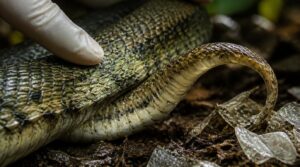
Rough or smooth tells you more than you’d expect.
- Keeled dorsal scales indicate rough-terrain species
- Ventral scales stay smooth for ground movement
- Paired subcaudal columns signal tail flexibility
- Regular shedding refreshes scale health
- Row count per segment is always species-consistent
Texture and scale arrangement patterns are taxonomic data hiding in plain sight. Run your fingers along the dorsal surface first.
Head and Pupil Clues

Moving up from scales, the head tells a faster story. Triangular head shape signals pit vipers almost instantly. A wider head width relative to neck also narrows your options quickly.
Pupil shape closes the gap. Elliptical pupils point toward ambush predators, while round pupils are typical in most colubrids. Study both features together, and misidentification gets considerably harder to make.
Heat-Sensing Pits
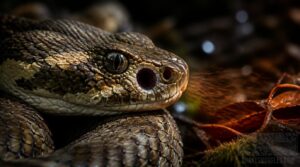
Pupil shape narrows your choices, but heat-sensing pits confirm the family. No field guide beats direct observation here. Crotalines carry paired pits between eye and nostril, and herpetology professionals know exactly where to look.
Experienced keepers check five things:
- Location: eye-to-nostril gap
- Depth: visible cavity
- Pairing: bilateral
- Membrane: thin inner lining
- Snake behavior: heat tracking
Tail and Color Patterns
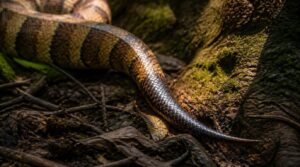
After you confirm pits, read the rear half of the animal.
Tail morphology often separates similar species: note length, taper, lateral flattening, and whether caudal scales are smooth or keeled. Compare bands, stripes, spots, and color breaks against a field guide. Watch tail vibration and body coiling from distance; these behaviors can alter how patterns appear in grass or leaf litter.
Preventing Dangerous Misidentification

Because snake head shape, snake pupils, and snake coloration overlap widely, never use one trait to decide venomous vs nonvenomous status. Treat every uncertain animal as potentially dangerous.
- Keep beyond strike range
- Use a field guide
- Photograph, don’t handle
Separate venomous and nonvenomous snakes behind a secure barrier during observation. Use two hands only after identification, wear reinforced gloves, and record uncertainty in your handling notes.
Regional Snake Field Guides
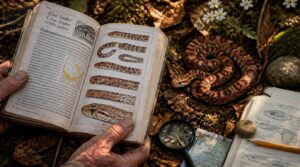
A regional field guide narrows the problem to snakes you can actually encounter. Carry a Peterson Field Guide or a current state guide with range maps, scale notes, and dorsal photographs.
Use habitat and county records to test an identification. A herpetological society may sell revised local checklists at reptile expos or citizen science field trips. Taxonomy shifts, so date your guide and replace outdated editions.
Community Identification Platforms
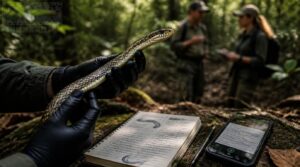
When range maps and scale counts leave doubt, post clear dorsal, ventral, and habitat photographs to iNaturalist. Include location only at county level for sensitive species. Compare responses against a Peterson Field Guide, not crowd consensus alone.
A herpetological society may flag errors at reptile expos or citizen science field trips. Treat every identification as a testable hypothesis.
Herpetological Society Publications

Herpetological society publications turn uncertain sightings into testable records. Read distribution notes, taxonomic updates, and natural-history reports, then compare their specimen details with your photographs and locality data.
For reptile enthusiasts, these sources connect field marks to reptile husbandry. Experienced keepers use them to track snake taxonomy, verify unusual records, and learn which habitat details actually separate similar species.
Snake Identification Apps

Apps give you a fast first-pass identification, not a verdict. Upload clear snake photography to iNaturalist, compare the confidence score with range data, then ask the snake community or rsnakes for independent review.
Check common and Latin names, habitat notes, and hazard warnings. Save snake sightings with date and locality. If venom is possible, keep your distance. Pixels can mislead; morphology and caution win.
They Gain Supervised Hands-on Experience

Book knowledge gives you a framework; supervised experience tests it against a living animal. Under qualified guidance, you learn to read posture, stress signals, and safe limits without taking unnecessary risks. The following settings build that judgment step by step.
Mentor-Guided Keeper Training
Mentor-guided keeper training turns theory into controlled practice. Experienced keepers demonstrate calm approach, body support, and precise restraint before you handle any snake.
Your mentor uses welfare checklists, then reviews your observation log each week. Feedback stays concrete: support the midbody sooner, reduce handling time, verify enclosure requirements. That discipline builds reliable species-specific care and safe handling techniques.
Zoo Behavior Observation
After mentor feedback sharpens your handling, Zoo Behavior Observation teaches you what hands-on sessions can miss. Watch several snake species across feeding, cleaning, and public hours. Record posture, tongue-flick rate, refuge use, and responses to keeper activity.
Experienced keepers compare these notes with enclosure temperature and morphology. This field to mastery habit strengthens herpetology judgment without stressing the animal unnecessarily.
Citizen Science Field Trips
Field notes become more useful when you collect them outdoors, under supervision. Citizen science field trips place you beside experienced keepers, biologists, and local volunteers who model distance, habitat respect, and records. Log sightings, weather, GPS points, and photographs in iNaturalist. A waterproof field notebook keeps your sightings, GPS coordinates, and sketch notes legible even through rain or stream crossings.
Compare wild behavior with captive routines, then improve species-specific care. Save reptile expos for later, not field identification practice.
Herpetology Workshops and Expos
After supervised field trips, attend reptile expos and herpetology workshops to watch experienced keepers work. Choose sessions with live demonstrations, published presenter bios, and contact hours. Observe restraint tools, enclosure hardware, and safe handling techniques without treating a vendor booth as a training floor.
Use social hours to compare notes, exchange contacts, and join regional groups. Meet again after the expo. Questions sharpen judgment.
Species-Specific Husbandry Practice
Put expo lessons to work under experienced keepers. Start with one nonvenomous species and master its environmental parameters: gradient, humidity, hides, substrate, and photoperiod. Log digital readings daily. A digital thermometer hygrometer monitor takes the guesswork out of tracking temperature gradients and humidity in real time.
Match feeding regimens to morphology and age. A juvenile Pantherophis needs different prey intervals than an adult Python regius. Weigh snakes, record sheds, and adjust slowly.
Good husbandry skills come from repetition, not guesswork.
Frequently Asked Questions (FAQs)
What state has the worst snake problem?
Ironically, there’s no clean answer. Texas reports the most venomous encounters overall, driven by sheer size and diverse habitat. But if you’re counting bites per person, North Carolina leads per capita by a clear margin.
What did Jesus say about snakes?
In Matthew 10:16, Jesus urged his disciples to be "shrewd as snakes" — wise enough to navigate danger without losing moral integrity. It’s a striking endorsement of snake-level cunning.
What snake is worth $100,000?
A living emerald with a price tag to match. Blue-green tree pythons carrying rare morphs, documented provenance, and confirmed lineage can easily clear six figures. Some specimens have reportedly sold for $445,800 in rare transactions.
What smell does a snake hate?
Snakes hate citrus, cinnamon, and clove scents most. Eugenol and limonene overwhelm their Jacobson’s organ. Ammonia and vinegar work similarly. These odors don’t discriminate by species, so results vary.
How do keepers learn snake dietary and feeding needs?
The best feeders know when not to feed. You match prey size to girth, roughly 0 to 5 times the head diameter, track digestion, adjust frequency by age, and rotate prey to close nutrient gaps.
What legal permits are required for keeping venomous snakes?
State and local permits vary widely. Some jurisdictions require a specific venomous reptile license, while others restrict possession entirely. Breeding and selling often require separate approvals. Always check your state’s wildlife regulations before acquiring any species.
How do keepers recognize signs of illness in snakes?
Health monitoring starts with daily observation. Watch for reduced appetite, lethargy, or labored breathing. Eye cap retention and scale rot flag problems early. Regular parasite screening and attention to respiratory health round it out.
How does climate change affect snake population distributions?
Climate change shifts snake ranges by pushing warm-adapted species into higher latitudes and elevations. Altered precipitation reduces suitable microhabitats, while extreme heat events compress activity windows and ultimately reshape population distributions across broad regional scales.
What role does captive breeding play in conservation efforts?
Around 20% of reptile species face extinction risk. Captive breeding gives threatened snake populations a controlled lifeline while wild habitats stabilize and recover. Studbooks track lineage, preventing inbreeding and preserving genetic diversity across conservation efforts.
Conclusion
Scales, synonyms, and systematic records form the foundation of mastery.
How experienced keepers learn about snake species isn’t a single course or a finished checklist. It’s a loop you never fully close. Each shed counted, each taxonomy update noted, each handling session adds a layer. You don’t guess with a kingsnake at the warm end. You check records, cross-reference the field guide, and adjust. That discipline separates a keeper from someone who just owns snakes.