This site is supported by our readers. We may earn a commission, at no cost to you, if you purchase through links.
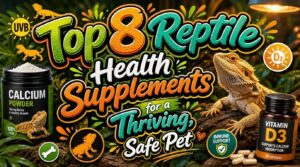
Most captive reptiles don’t die from infections or injuries—they die slowly from nutritional gaps that build silently over months. Knowing which products actually deliver bioavailable nutrients—and which ones just look good on a shelf—separates keepers who watch their animals thrive from those who find themselves at an emergency vet visit wondering where they went wrong.
A bearded dragon receiving daily feedings without proper supplementation can develop metabolic bone disease before any keeper notices the tremors. Reptile health supplements exist precisely to close the distance between what captivity offers and what these animals require in the wild.
Table Of Contents
- Key Takeaways
- Top 8 Reptile Health Supplements
- 1. reptile vitamins and mineral supplements
- 2. Reptile and Amphibian Multivitamin Supplement
- 3. Reptile vitamin supplement food spray
- 4. Reptile and Amphibian Vitamin Supplement
- 5. Reptile vitamin supplement with beta
- 6. Reptile liquid vitamin supplement concentrate
- 7. Reptile calcium supplement with vitamin
- 8. Reptile probiotic digestive health supplement
- Essential Nutrients for Reptile Wellness
- Choosing Safe Reptile Supplements
- Supplement Needs by Reptile Type
- Safe Dosing and Health Monitoring
- Frequently Asked Questions (FAQs)
- What supplements do reptiles need?
- How often should reptiles receive vitamin supplements?
- Can reptiles overdose on vitamin supplements?
- Do baby reptiles need different supplements?
- Should supplements be given year-round or seasonally?
- What signs indicate supplement deficiency in reptiles?
- Can supplements interact with reptile medications?
- How should supplements be stored long-term?
- Do rescued reptiles need different supplement protocols?
- Are homemade reptile diets ever nutritionally complete?
- Conclusion
Key Takeaways
- Most captive reptile deaths trace back to slow-building nutritional gaps, not acute injuries, making consistent calcium and multivitamin supplementation your most powerful preventive tool.
- The calcium-to-phosphorus ratio must stay at 2:1 or higher—drop below 1:1 and parathyroid hormone starts pulling calcium straight from your reptile’s bones, triggering metabolic bone disease before you notice a single tremor.
- Fat-soluble vitamins A, D3, E, and K accumulate in tissue over time, so stacking multiple supplements or overdosing doesn’t just fail to help—it causes toxicity that can lead to kidney damage and seizures.
- Supplement choice isn’t one-size-fits-all: snakes eating whole prey rarely need extras, carnivorous lizards can’t efficiently convert beta-carotene to vitamin A, and indoor reptiles without UVB exposure require dietary D3 that outdoor animals synthesize on their own.
Top 8 Reptile Health Supplements
Not all reptile supplements are created equal, and picking the wrong one can do more harm than good. Your species, setup, and feeding routine all determine which products actually belong in your cabinet.
Before buying anything, brush up on proper reptile feeding techniques so you know exactly what your animal needs first.
Here are eight supplements worth knowing about.
1. reptile vitamins and mineral supplements
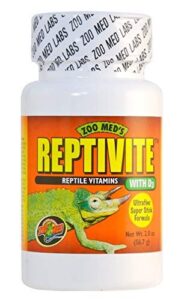
Zoo Med ReptiVite with D3 (Model A362) is a solid starting point for most captive reptile keepers. At $3.09 for 45 g, it delivers a 2:1 calcium-to-phosphorus ratio, essential amino acids, and Vitamin D3 in an ultra-fine powder that coats crickets and leafy greens without artificial fillers, soy, or sucrose.
It’s trusted in professional zoological settings, including the San Diego Zoo. Just watch your dosage—if your reptile already eats a calcium-rich diet, over-supplementation is a real risk.
| Best For | Reptile owners keeping turtles, lizards, geckos, or chameleons who want a trusted, no-fuss supplement to dust on feeders or veggies. |
|---|---|
| Form | Powder |
| Vitamin D3 | Yes |
| Vitamin A Source | Preformed |
| Calcium Included | Yes |
| Species Suitability | Reptiles |
| Price | $3.09 |
| Additional Features |
|
- Clean formula — no artificial additives, soy, yeast, or sucrose, so you know exactly what your reptile is getting
- The 2:1 calcium-to-phosphorus ratio plus D3 is the gold standard for bone health in captive reptiles
- Used at the San Diego Zoo, which is about as solid a stamp of approval as you can get
- The powder isn’t super fine, so some of it shakes off prey before your reptile even eats it
- At 45g for $3.09, you’ll go through it fast if you have multiple animals
- Easy to over-supplement if your reptile’s diet is already calcium-heavy — you’ll want to track your dosing
2. Reptile and Amphibian Multivitamin Supplement
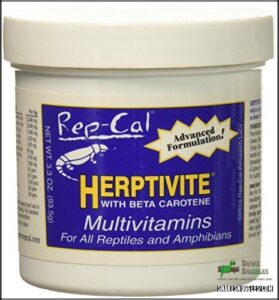
Rep-Cal’s Herptivite takes multivitamin support a step further. Where ReptiVite covers the basics, Herptivite layers in amino acids like glutamic acid and leucine alongside fat-soluble vitamins A, D₃, and E—all sourced from natural bases like dried kelp and sun-cured alfalfa.
At $12.91 for 3.3 oz, it’s priced higher than some competitors, but the formulation breadth justifies it for keepers managing species with complex nutritional demands.
Dust it onto crickets or mix it into greens right before feeding—don’t let it sit.
| Best For | Reptile and amphibian keepers who want a well-rounded multivitamin with amino acid support for species like bearded dragons, geckos, and dart frogs. |
|---|---|
| Form | Powder |
| Vitamin D3 | Yes |
| Vitamin A Source | Preformed |
| Calcium Included | No |
| Species Suitability | Reptiles & Amphibians |
| Price | $12.91 |
| Additional Features |
|
- Broad formulation that goes beyond basic vitamins, adding amino acids and natural ingredients like kelp and alfalfa
- Easy to use—just dust onto feeder insects or mix into veggies before mealtime
- Works across a wide range of reptile and amphibian species, making it versatile for multi-pet households
- Pricier than competitors like Zoo Med, which might sting if you’re supplementing on a budget
- No independent lab testing to back up the manufacturer’s claims
- Still needs a separate calcium supplement, so it’s not a one-and-done solution
3. Reptile vitamin supplement food spray
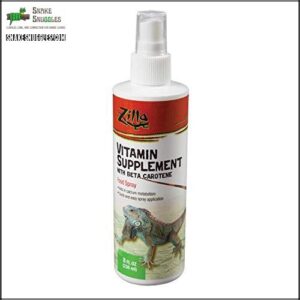
Zilla’s Vitamin Food Spray offers a cleaner alternative to dusting. Shake the bottle, mist it directly onto insects or greens, wait 15 seconds, and feed—that’s the entire protocol.
At $8.79 for 9.6 oz, the value is solid. The formula delivers vitamins C, B-complex, D3, and beta-carotene-sourced vitamin A, with no retinol—critical for species sensitive to preformed A toxicity.
Pair it with a separate calcium spray, as this product alone won’t meet calcium requirements.
| Best For | Reptile and amphibian owners who want a low-stress, no-mess way to supplement vitamins for their pets across all life stages. |
|---|---|
| Form | Spray |
| Vitamin D3 | Yes |
| Vitamin A Source | Beta-carotene |
| Calcium Included | No |
| Species Suitability | Reptiles & Amphibians |
| Price | $8.79 |
| Additional Features |
|
- Super easy to use — just spray on food or insects, wait 15 seconds, and you’re done
- Covers a solid range of vitamins (C, B-complex, D3, beta-carotene) with no allergens or added flavors
- Works for a wide variety of species, from bearded dragons to frogs and everything in between
- No protective cap, and the spray nozzle has been known to break after just a few uses
- Doesn’t include calcium, so you’ll need to buy a separate calcium spray for complete nutrition
- Can get a little messy if you’re not careful with the nozzle
4. Reptile and Amphibian Vitamin Supplement
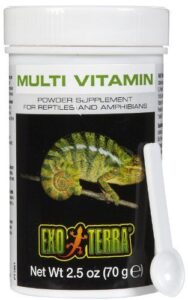
When a spray doesn’t quite fit your routine, a powder multivitamin gives you more control. Exo Terra’s Reptile and Amphibian Multivitamin (PT1861, $7.51) offers this flexibility, covering the full spectrum of essential nutrients.
This supplement includes vitamin A via beta-carotene, a complete B-complex, vitamins E and K, amino acids, and trace minerals like zinc, copper, and manganese.
Dust it onto crickets or mix into produce two to three times weekly for optimal absorption.
It won’t replace your calcium supplement but, paired with a D3 calcium powder, it builds a genuinely complete nutritional foundation.
| Best For | Reptile and amphibian owners who want an easy, affordable way to fill nutritional gaps in their pet’s diet without overhauling their whole supplement routine. |
|---|---|
| Form | Powder |
| Vitamin D3 | Yes |
| Vitamin A Source | Beta-carotene |
| Calcium Included | No |
| Species Suitability | Reptiles & Amphibians |
| Price | $7.51 |
| Additional Features |
|
- Covers a wide range of vitamins, amino acids, and trace minerals in one simple powder
- Easy to use — just dust onto feeder insects or mix into fresh produce
- At $7.51, it’s a budget-friendly addition to any reptile care setup
- Not a calcium replacement — you’ll still need a separate calcium D3 supplement
- Some animals may turn their nose up at food coated in the powder due to the gritty texture
- Contains menadione (synthetic vitamin K), which might be a dealbreaker for owners who prefer natural ingredients
5. Reptile vitamin supplement with beta
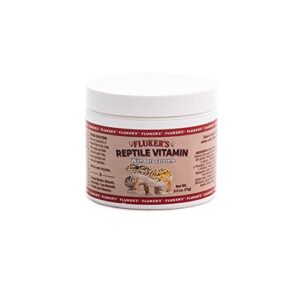
Fluker’s Repta-Vitamin with Beta Carotene (Model 73003) takes a smart approach to vitamin A delivery. Instead of loading the formula with preformed vitamin A—which can quickly reach toxic levels—it uses beta-carotene, letting your reptile’s metabolism convert only what it needs. That built-in safety buffer matters.
For feeding tips that support healthy calcium balance, see our guide to reptile vitamins for picky eaters.
For reptile owners navigating the vitamin A question, choosing the right vitamins for carnivorous reptiles starts with understanding exactly why that preformed-versus-beta-carotene distinction is so critical.
The 3.84 oz powder dusts easily onto crickets or produce and includes D3, E, C, B-complex, zinc, and iron.
Note that carnivorous species convert beta-carotene poorly, so confirm this format suits your animal before committing.
| Best For | Reptile owners with omnivores or herbivores—like tortoises, bearded dragons, or leopard geckos—who want a safe, easy way to fill nutritional gaps without risking vitamin A toxicity. |
|---|---|
| Form | Powder |
| Vitamin D3 | Yes |
| Vitamin A Source | Beta-carotene |
| Calcium Included | No |
| Species Suitability | Reptiles |
| Price | Not listed |
| Additional Features |
|
- Beta-carotene lets your reptile’s body self-regulate vitamin A conversion, so you’re not risking an accidental overdose
- Dusts easily onto crickets, produce, or other feeders—quick to use, no prep needed
- Covers a solid range of nutrients (D3, E, C, B-complex, zinc, iron) in one product
- The smell is noticeable, which some owners find annoying even if it’s not overwhelming
- No scoop included, so you’re eyeballing doses or improvising your own measuring tool
- Zero dosage guidance on the packaging—you’re on your own figuring out how much to use
6. Reptile liquid vitamin supplement concentrate
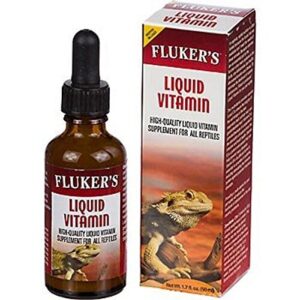
Liquid concentrates offer something powders can’t always match: precise, drop-by-drop dosing. Fluker’s liquid vitamin concentrate (Model 73060) delivers vitamins A, D3, E, C, and a full B-complex in a glycerin-water base—allergen-free and easy to administer via the included glass dropper.
Dosing involves 2 drops per 50 g of body weight twice weekly. Increase to four times weekly for juveniles or breeding animals.
A critical caution: fat-soluble vitamins A and D3 accumulate, so do not alter the dose without veterinary guidance.
| Best For | Reptile owners — especially those with bearded dragons, tortoises, or turtles — who need a reliable way to correct vitamin deficiencies or support juveniles and breeding animals. |
|---|---|
| Form | Liquid |
| Vitamin D3 | Yes |
| Vitamin A Source | Preformed |
| Calcium Included | No |
| Species Suitability | Reptiles |
| Price | Not listed |
| Additional Features |
|
- Drop-by-drop dosing makes it easy to dial in the right amount for your reptile’s exact body weight.
- Mixes into food or water, so you’ve got options if your reptile won’t take it directly.
- Covers all the key bases — A, C, D3, E, and a full B-complex — in one allergen-free formula.
- Strong smell and bitter taste put some reptiles off, which can make dosing a bit of a battle.
- The glass dropper is fragile, and the thick liquid stains if you spill it — so handle with care.
- Fat-soluble vitamins A and D3 build up over time, so overdosing is a real risk without vet guidance.
7. Reptile calcium supplement with vitamin
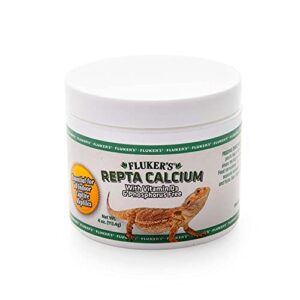
Fluker’s phosphorus-free calcium powder delivers a minimum of 30% calcium alongside Vitamin D3, specifically formulated for indoor reptiles that lack adequate UVB exposure. Without sufficient D3, dietary calcium cannot mineralize bone effectively, regardless of dose. This supplement addresses the critical interplay between calcium and vitamin D3 for reptiles in controlled environments.
Apply the powder by dusting feeder insects immediately before feeding, 2–3 times weekly. If your setup already provides strong UVB, coordinate use carefully—excess D3 accumulates and can trigger hypercalcemia. This caution ensures safe supplementation without overloading your reptile’s system.
The fine powder formulation ensures an even coating on feeder insects, optimizing calcium absorption. This design maximizes nutritional benefits while minimizing waste, supporting your reptile’s bone health and overall vitality.
| Best For | Indoor reptile owners—especially those with bearded dragons, leopard geckos, or turtles—who need a reliable calcium boost for animals with limited UVB exposure. |
|---|---|
| Form | Powder |
| Vitamin D3 | Yes |
| Vitamin A Source | Not included |
| Calcium Included | Yes |
| Species Suitability | Reptiles |
| Price | Not listed |
| Additional Features |
|
- Easy to use—just dust it on crickets or mealworms before feeding and you’re done
- Vitamin D3 is built right in, so indoor reptiles can actually absorb the calcium
- All-natural, abalone-free formula from a trusted brand
- Not a complete supplement on its own—you may still need additional vitamins for a full diet
- If your reptile already gets strong UVB light, the added D3 could become too much over time
- The powder can get a little messy and needs to be mixed well to coat feeders evenly
8. Reptile probiotic digestive health supplement
Gut health is the foundation of everything else you’re building with supplements.
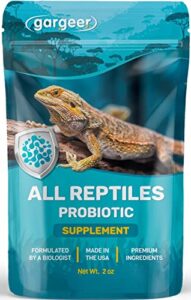
Garger’s probiotic powder delivers four live strains — Lactobacillus acidophilus, L. casei, Enterococcus faecium, and Aspergillus oryzae — to reinforce your reptile’s intestinal microflora.
It’s especially useful after antibiotic treatment or deworming, when beneficial bacteria need replenishment.
Dust it onto crickets or hornworms once weekly at 1 teaspoon per pound of food.
Refrigerate after opening to preserve bacterial viability.
| Best For | Reptile and amphibian owners who want to support their pet’s digestion and gut recovery — especially after antibiotics, deworming, or times of stress. |
|---|---|
| Form | Powder |
| Vitamin D3 | No |
| Vitamin A Source | Not included |
| Calcium Included | No |
| Species Suitability | Reptiles & Amphibians |
| Price | $15.95 |
| Additional Features |
|
- Four live probiotic strains work together to boost digestion, nutrient absorption, and immune health
- Easy to use — just dust it on feeder insects or mix into salads once a week
- Made in the USA and works across all life stages and a wide range of species
- Maltodextrin is the main carrier, which adds carbs some owners would rather avoid
- Needs to be refrigerated after opening, which can be easy to forget
- The 1 tsp per pound dosing doesn’t translate well for small reptiles or picky eaters who don’t eat much at once
Essential Nutrients for Reptile Wellness
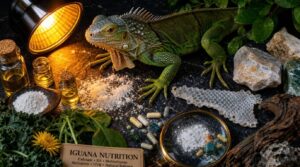
Getting your reptile’s nutrition right isn’t guesswork — it’s science.
The nutrients your pet needs fall into a few distinct categories, each playing a specific role in keeping them healthy, active, and properly developed. Here’s what you need to know about the core building blocks of reptile wellness.
Vitamins A, D3, E, K
Fat-soluble vitamins — A, D3, E, and K — form the backbone of reptile metabolic health, and their fat solubility means both deficiency and overdose are real risks.
Vitamin A promotes Vision Support and epithelial integrity; vitamin D3 deficiency directly compromises Bone Mineralization and calcium uptake.
Vitamin E provides Antioxidant Defense against cellular damage, while vitamin K governs Blood Clotting.
Supplement dosage and vitamin bioavailability matter enormously here.
B-complex and Vitamin C
Water-soluble vitamins don’t get the spotlight fat-soluble ones do, but they’re just as critical. Vitamin C drives collagen synthesis and wound healing, while also boosting iron absorption from food.
B-complex vitamins—thiamine through B12—power energy metabolism at the cellular level. Together, they deliver essential immune support and immune system reinforcement.
Consistent vitamin supplementation and dietary supplementation ensure these systems function optimally.
Calcium and Phosphorus Balance
Beyond water-soluble vitamins, bone health depends on maintaining an ideal calcium-to-phosphorus ratio of 2:1 or higher. Dropping below a 1:1 ratio triggers a surge in parathyroid hormone, which pulls calcium from bones, ultimately causing metabolic bone disease.
FGF23 regulation and renal phosphate excretion normally balance dietary phosphorus levels. However, excess phosphorus overwhelms these protective systems, disrupting equilibrium.
Calcium supplementation alone cannot offset poor nutrient ratios. As a result, bone mineralization suffers, regardless of calcium intake.
Hydration and Digestive Support
Bone health and digestion are more connected than most keepers realize.
Hydrated reptiles maintain gut mucus hydration that protects intestinal tissue and keeps stool softening on track. Without adequate moisture, constipation sets in fast.
Support digestive health with these five strategies:
- Use Fluid‑Mixable Additives to deliver electrolyte balance alongside daily water access
- Apply Moisture‑Rich Sprays to prey items for a hydration boost for reptiles that refuse standing water
- Add Electrolyte Enrichment products during heat stress to stabilize gut fluid distribution
- Introduce probiotics to reinforce gut health and microbial balance during rehydration recovery
- Monitor stool consistency weekly — dry, chalky feces signal dehydration before other symptoms appear
Deficiency Warning Signs
Stool consistency tells part of the story — but your reptile’s skeleton, skin, and nervous system reveal the rest. Calcium deficiency and vitamin deficiency manifest as soft bone symptoms, stunted growth, skeletal deformities, and neuromuscular tremors. Retained shed signals failing skin turnover, while secondary hyperparathyroidism develops silently before fractures occur.
Soft bones, stunted growth, and silent fractures reveal what stool consistency alone never will
Early detection of these nutritional deficiencies forms the foundation of disease prevention.
Choosing Safe Reptile Supplements
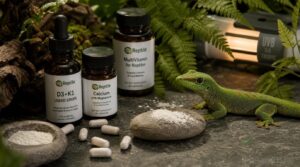
Not every supplement on the market deserves a place in your reptile’s routine.
The right choice comes down to a few key factors that separate genuinely effective products from ones that look good on the label. Here’s what you need to evaluate before picking anything off the shelf.
Species-specific Formulas
Not all reptile supplements are created equal — and using the wrong formula is one of the most common mistakes in reptile husbandry. Species-specific nutrition matters because a bearded dragon’s needs differ sharply from those of a tortoise.
Look for products that address:
- Species‑Specific Ratios for calcium and vitamins
- Specialized Vitamin Sprays matched to feeding behavior
- Pre‑Formed A Options versus beta-carotene for carnivores
- Growth‑Stage Formulas for juveniles versus adults
Bioavailable Calcium Sources
Not all calcium supplements absorb equally well. Calcium carbonate bioavailability depends heavily on stomach acidity — carbonate solubility drops in low-acid environments, limiting calcium absorption. Citrate bioavailability is more consistent because it doesn’t rely on strong acid conditions. Chelated calcium offers even greater delivery reliability.
Watch for phytate interference from plant-based feeds; oxalate-rich greens also bind calcium.
Vitamin D synergy remains essential — without adequate D3, even a correct calcium-to-phosphorus ratio won’t protect your reptile’s calcium metabolism.
Beta Carotene Versus Vitamin A
Not all vitamin A sources carry the same risk. Preformed retinol offers high retinol bioavailability but raises hypervitaminosis A risk when over-supplemented — storage differences matter because the liver accumulates retinoids rapidly.
Beta carotene antioxidant forms convert only as needed, reducing toxicity potential. Carotenemia indicator? Yellowed skin signals excess carotene, not true Vitamin A deficiency.
Your supplement choice should match your species’ conversion efficiency.
UVB and D3 Needs
UVB lighting importance cannot be overstated — wavelength precision matters more than simply having a lamp running. Effective vitamin D3 synthesis requires UVB output between 290–320 nm, with peak activity near 297 nm.
Suberythemal dosing means your reptile’s skin doesn’t need to burn to produce D3. Exposure duration directly shapes circulating vitamin D3 levels for months.
Do not rely on dietary D3 substitution alone; lamp output testing ensures your setup actually delivers the necessary UVB.
Fillers and Ingredient Quality
Not all labels tell the full story. Lower-cost formulas often rely on starchy bulking agents that dilute nutrient bioavailability, turning your careful dosing routine into guesswork.
Prioritize products manufactured under Good Manufacturing Practices or ISO 9001 standards, with clear lot traceability and stability testing on file.
Inactive filler detection, carrier purity standards, and allergen risk disclosures separate reliable natural supplements and organic feeding additives from products that merely look complete.
Supplement Needs by Reptile Type
Not every reptile needs the same supplement routine — and getting this wrong can do more harm than good. A bearded dragon’s needs look nothing like a ball python’s, and a tortoise living indoors is a completely different case from one grazing outside.
Here’s how supplementation breaks down across the most common reptile types.
Snakes and Whole Prey
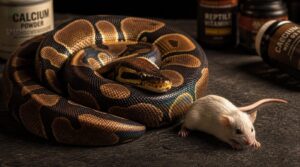
Snakes are the exception in reptile nutrition. Thanks to jaw gape mechanics and tooth grip adaptations, they swallow whole prey intact — bones, organs, fur, and all. That natural completeness means dietary supplements aren’t usually necessary.
The digestive enzyme process manages nutrient absorption efficiently, and the metabolic meal cost of processing whole prey delivers species-specific nutrition without additional intervention.
Lizards and Insect Dusting
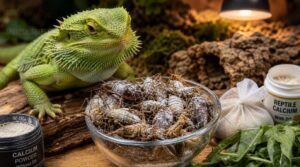
Lizards depend on insect dusting and powder supplements in ways snakes simply don’t. For species like the bearded dragon, the calcium to phosphorus ratio directly dictates skeletal integrity.
Employ the Light Coating Technique—shake insects gently until visibly dusted, never caked—and practice Gut-Loading Pairing beforehand. Establish a consistent Dusting Schedule Timing, select Insect Sizes matching your lizard’s jaw width, and discard Excess Powder Waste promptly.
Turtles and Tortoises

Indoor tortoises lacking UVB access require consistent vitamin D3 supplementation to prevent calcium deficiency and shell integrity loss. Maintain a strict calcium to phosphorus ratio of 2:1, and ensure your basking spot reaches adequate temperatures for absorption.
Aquatic turtles thrive on nutritionally complete pellets, which significantly reduce reliance on supplements.
Amphibian Supplement Considerations

Amphibians require a distinct approach compared to reptiles, with calcium deficiency prevention beginning at the larval stage. Nutritional needs shift significantly as animals mature, making early intervention critical.
Vitamin A precursors like beta-carotene are essential for skin pigmentation and overall health, while insect gut-loading reduces reliance on direct powder supplementation. For aquatic species, stress-related supplementation becomes paramount during environmental transitions.
Key strategies include:
- Calcium powder dusted on crickets prevents silent metabolic bone disease
- Vitamin D3 absorption fails without proper temperature gradients in the enclosure
- Beta-carotene deficiency dulls your frog’s natural coloration noticeably
- Gut-loaded feeders deliver nutrients your animal actually absorbs
- Ignoring larval stage needs creates permanent developmental deficits
Herbivores Versus Carnivores
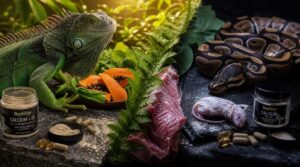
Diet type reshapes every supplementation decision, unlike in amphibians. Herbivores’ fiber digestion demands slow nutrient extraction, and carotenoid conversion efficiency varies widely—meaning beta-carotene doesn’t reliably become vitamin A.
Carnivores face distinct challenges, including protein metabolism needs and mineral ratio imbalances from phosphorus-heavy prey.
Gut microbiota variation between diet types further complicates calcium absorption. Thus, species-specific nutrition and targeted vitamin supplementation are critical to prevent calcium deficiency in both groups.
Safe Dosing and Health Monitoring
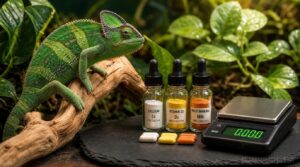
Getting the dose right is just as important as choosing the right supplement. Too little and your reptile remains deficient; too much and you are dealing with toxicity — both outcomes are avoidable.
Here’s what you need to know about dosing safely and keeping a close eye on your animal’s health.
Calcium Dosing Frequency
Most reptiles do best when calcium is given two to three times weekly using Split Dose Timing—one dose in the morning, another in the evening. This Morning-Evening Split improves absorption and avoids gut overload.
Always calculate Elemental Calcium Calculations based on your product’s actual strength and practice Meal-Linked Dosing with calcium carbonate.
As bulb age advances, Bulb Age Adjustments to your supplement dosing frequency become essential to maintain a healthy calcium-to-phosphorus ratio and prevent calcium deficiency.
Multivitamin Schedule Basics
Most multivitamin supplements work best on a one-to-two-times-weekly schedule tied to Consistent Meal Timing—your reptile’s digestive system absorbs fat-soluble vitamins more efficiently alongside food.
Always follow your product’s Label Serving Size; splitting into a Split Dose Option is acceptable only when the label permits it.
Maintain a Supplement Log, and if you miss a dose, apply your Missed Dose Protocol: resume at the next scheduled feeding without doubling up.
Avoiding Vitamin Overdose
Fat-soluble vitamins—A, D, E, and K—accumulate in tissue, so Label Dose Checks are not optional. Product Stacking Awareness matters most here: combining a multivitamin with a calcium-D₃ supplement on the same day quietly doubles your D₃ intake.
Watch for these Overlap Prevention Strategies:
- Confirm only one product contains D₃ per feeding day
- Review every ingredient label for hidden vitamin A
- Keep dose record-keeping records to spot accidental doubles
- Schedule vitamin blood tests annually with your vet
Tracking Weight and Behavior
Consistent weigh schedule data tells you more than a single number ever could. Weigh weekly, same time, same container—tare the scale, record to the nearest gram, and log it alongside your feeding weight log. Pair that with activity pattern monitoring to catch what weight alone misses.
| Metric | Normal Sign | Concern Flag |
|---|---|---|
| Weekly weight | Stable or gradual gain | >10% loss over 2 weeks |
| Appetite | Consistent feeding response | Sudden refusal despite balanced diet |
| Activity | Regular basking or movement | Prolonged hiding, lethargy |
Stress-free handling keeps your data clean—calm, consistent technique prevents defensive responses that skew behavior readings and suppress appetite.
Weight behavior correlation only works when your supplementation protocol stays documented alongside it.
When to Call a Vet
Some symptoms simply can’t wait for your next scheduled health monitoring check. Respiratory distress, neurological emergencies, and severe dehydration demand same-day veterinary contact—not watchful waiting. Call your vet immediately if you notice:
- Open-mouth breathing, wheezing, or nasal discharge
- Seizures, collapse, or sudden inability to right itself
- Sunken eyes, tacky mucous membranes, or extreme lethargy
Suspected fractures, eye infections, vitamin toxicity from over-supplementation, and signs of dietary deficiencies confirmed through vitamin blood tests all warrant urgent professional evaluation to protect your reptile’s health.
Frequently Asked Questions (FAQs)
What supplements do reptiles need?
Your reptile needs calcium, vitamin D3, essential vitamins like A and E, and gut microbiome boosters — with calcium-to-phosphorus ratio and UVB lighting guiding how you address dietary deficiencies effectively.
How often should reptiles receive vitamin supplements?
Most reptiles do well with multivitamins once or twice weekly and calcium two to three times weekly.
Ensure at least one supplement-free feeding per week to maintain a balanced and safe rotation frequency.
Can reptiles overdose on vitamin supplements?
Yes, they can — think of fat-soluble vitamins as a slow-filling tank.
Vitamin A toxicity and Vitamin D3 toxicity both develop through gradual accumulation, causing kidney stress, skin sloughing, and seizures long before you notice anything obvious.
Do baby reptiles need different supplements?
Yes — hatchlings demand more frequent calcium dusting and tighter calcium-to-phosphorus ratio control than adults.
Hatchlings’ UVB sensitivity, rapid growth rates, and early metabolic risks make vitamin D3 deficiency and metabolic bone disease real and urgent concerns.
Should supplements be given year-round or seasonally?
Year-round supplementation isn’t always necessary. Seasonal appetite shifts, temperature metabolism shifts, and reproductive cycle dosing all affect needs. Adjust your vitamin supplementation schedule accordingly rather than toggling blindly.
What signs indicate supplement deficiency in reptiles?
Silent signals speak volumes: dull coloration, shell softening, frequent infections, and mucus discoloration all point to nutrient deficiencies. These symptoms collectively indicate a lack of essential nutrients affecting the animal’s health.
Metabolic bone disease, reduced reproduction, and compromised skin health confirm serious nutritional problems, demanding immediate immune support.
Can supplements interact with reptile medications?
Drug-supplement interactions are real. Vitamin A overdose, calcium toxicity risk, and probiotic medication conflict can all complicate treatment.
Always review your supplement stack with a veterinary herpetology specialist before starting any medication.
How should supplements be stored long-term?
Store supplements like vault contents—cool, dry storage away from heat and light. Airtight sealing prevents moisture control failure.
Liquid supplements require refrigeration; gel-based supplements and shelf-stable powders tolerate stable room temperatures if humidity levels remain low.
Do rescued reptiles need different supplement protocols?
Rescued reptiles almost always need tailored dosing. Intake variability, parasite impact, and stress-related appetite changes mean you can’t apply a standard protocol.
Rehab stage adjustments guided by blood work analysis are essential.
Are homemade reptile diets ever nutritionally complete?
Homemade reptile diets can work, but nutrient variability in ingredient sourcing makes true recipe standardization nearly impossible without rigorous nutrient tracking —
so vitamin supplementation almost always fills the gaps in balanced diet formulation.
Conclusion
Think of your reptile’s supplement routine as the invisible scaffolding behind every healthy shed, steady gait, and strong bone—quietly holding everything together. The right reptile health supplements don’t just fill nutritional gaps; they replicate what captivity strips away.
Dosing calcium correctly, rotating multivitamins on schedule, and matching formulas to your specific species aren’t optional refinements—they’re the foundation. Get the foundation right, and your animal’s body does the rest.
- https://reptifiles.com/reptile-vitamins-reptile-calcium
- https://www.merckvetmanual.com/management-and-nutrition/nutrition-exotic-and-zoo-animals/nutrition-in-reptiles
- https://www.thebiodude.com/blogs/reptile-and-amphibian-husbandry-basics/how-to-properly-utilize-supplements-for-your-reptiles-amphibians-and-arachnids