This site is supported by our readers. We may earn a commission, at no cost to you, if you purchase through links.

A reticulated python can hatch in a 6-quart tub and outgrow an 8x4x2 enclosure in just a few years. That’s the catch with the world’s longest snake: every mistake scales up with it.
Undersized cages, a missing thermostat, or a prey item wider than 1.5 times your snake’s girth can turn a manageable pet into a medical emergency. As an exotic animal veterinarian, I see these errors in clinic far more often than I’d like.
Meeting reticulated python care requirements takes precision, not guesswork. Here’s how to build the right setup, feed on schedule, and handle a growing giant safely.
Table Of Contents
- Key Takeaways
- Reticulated Python Enclosure Setup: Size, Security, Heating, and Humidity
- Feeding Your Reticulated Python: Prey Size, Meal Frequency, and Hydration
- Reticulated Python Handling and Health Care: Safety, Shedding, and Cleaning
- Top 5 Products for Reticulated Python Care
- Frequently Asked Questions (FAQs)
- How big is a 4 year old reticulated python?
- What is the hardest reptile to care for?
- Do reticulated python bites hurt?
- What do you feed a full grown reticulated python?
- What is the reptifiles reticulated python care sheet?
- How often do reticulated pythons need to be cleaned?
- How do you care for a reticulated python?
- How often should you feed a reticulated python?
- How to feed a reticulated python?
- Are reticulated pythons difficult to house?
- Conclusion
Key Takeaways
- Build your python’s enclosure for its adult length (8x4x2 feet or larger), with secure locking doors, since retics grow fast and are strong escape artists.
- Run a thermostat-controlled gradient with a 88-92°F hot side, a 75-80°F cool side, and 65-90% humidity, and check the numbers yourself instead of assuming they’re right.
- Size every meal to your snake’s widest girth (never beyond 1.5 times), and feed on a schedule that stretches from weekly for hatchlings to every 4-6 weeks for adults.
- Wait 24-48 hours after feeding before handling, bring a second person once your snake passes 8-10 feet, and call a vet right away if you see wheezing or open-mouth breathing.
Reticulated Python Enclosure Setup: Size, Security, Heating, and Humidity
A reticulated python outgrows cheap housing fast, so plan your enclosure size around adult length. Make the floor length match your snake’s length, the width half that, and the height as tall as you can manage. Hatchlings start in a 6qt tub, subadults need 4x2x2, and adults need 8x4x2 or larger.
Since big enclosures add up fast, it helps to budget early by checking the real costs of setting up a large snake habitat.
A reticulated python outgrows cheap housing fast, so build its enclosure for adult length: floor matching its body, width half that, and height as generous as possible
Escape prevention isn’t optional here. Use lockable sliding doors or secure lids, and check latches and glass thickness regularly.
Build a temperature gradient with a hot side of 88-92°F and a cool side of 75-80°F. Heat one third of the floor, creating basking zones, and run everything through thermostats. Keep in mind that heat panel limitations can reduce effective warmth in taller enclosures for large snakes, so choose your enclosure height based on your heating element.
For humidity control, hold 65-90% with a large water bowl, coconut chip, and a hygrometer. Keep airflow gentle and draft-free.
Feeding Your Reticulated Python: Prey Size, Meal Frequency, and Hydration

Your enclosure’s water bowl already helps humidity, and it also helps with water provision. Keep fresh water available at all times in a heavy, tip-resistant container, and change it daily. Offer soaks before sheds to aid hydration.
Good feeding protocols start with prey size. Match prey to your snake’s widest girth, never beyond 1.5 times its body width.
- Hatchlings: feed every 7 days with fuzzy mice or rat pups.
- Juveniles: set your feeding frequency to every 1-2 weeks.
- Adults: feed every 4-6 weeks, using rabbits or jumbo rats past 8 feet.
- Meals: aim for 10-30% of body weight.
Expect a visible food lump, which should disappear within 2-3 days. Rotate quail, guinea pigs, or ducks for better dietary variety and balance.
Reticulated Python Handling and Health Care: Safety, Shedding, and Cleaning

Once your python’s fed, keep the enclosure secured and leave it alone. Wait 24-48 hours before handling to prevent regurgitation, and wash your hands so you don’t smell like prey.
If your snake seems extra jumpy or skips its next meal, this reticulated python beginner care guide explains how feeding schedules and stress signs usually play out.
Safe handling means supporting the body with both hands, one behind the head and one underneath. Never let a reticulated python wrap your neck or torso. Past 10 feet, bring two handlers.
During shedding cycles, raise humidity to 80-90% and skip handling. For stuck shed, soak your snake in lukewarm water for 20-30 minutes, then rub with a damp cloth.
Spot clean daily, scrub water bowls weekly, and deep clean every 4 weeks using F10SC at 1:250. Book annual vet exams and call fast if you see wheezing or open-mouth breathing.
Top 5 Products for Reticulated Python Care
You’ve covered setup, feeding, handling, and cleaning, so now it’s time to gear up. The five products below cover bedding, temperature checks, transport, water, and disinfection. Each one solves a specific problem you’ll face as your python grows.
1. ReptiChip Coconut Chip Reptile Bedding
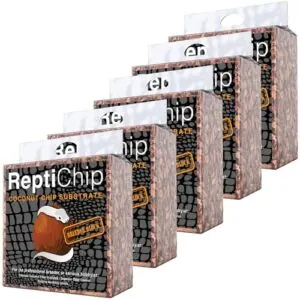
Think of this brick as a dry sponge waiting for water. Add it, and the 72-quart block expands into deep, loose bedding that covers a large enclosure.
The 100% organic coconut chips hold humidity well, which helps maintain the 60-80% range your reticulated python needs, and they absorb waste odors. You’ll also get dust-free processing, so setup stays easy on your snake’s airways.
Don’t skip the drying step. After expansion, spread the bedding out and let it dry, or mold growth becomes a real risk. Add water gradually to avoid oversaturation. Some users find the brick hard to break apart, and mite resistance gets mixed feedback, so inspect your enclosure regularly.
| Best For | Reptile keepers with ball pythons, leopard geckos, or bearded dragons who want a humidity-holding, odor-absorbing bedding for a large or bioactive enclosure and don’t mind a little prep work. |
|---|---|
| Primary Use | Substrate bedding |
| Key Material | Coconut chips |
| Capacity/Range | 72 quarts |
| Dimensions | N/A |
| Setup Required | Expand and dry |
| Main Drawback | Mold risk if undried |
| Additional Features |
|
- Expands from a compact brick into 72 quarts of deep, loose bedding
- Made of 100% organic, dust-free coconut chips that retain humidity well
- Absorbs waste odors and encapsulates waste
- Needs to be dried after expansion, or mold can grow
- Some users find the brick hard to break apart
- Mite resistance gets mixed feedback, with some infestation reports
2. Etekcity Laser Infrared Temperature Measurement Gun

Two readings tell you whether your heating works: the basking spot and the cool side. The Etekcity Laser Infrared Temperature Measurement Gun gives you both without touching your python or opening the enclosure for long. It measures -58°F to 842°F with a 12:1 distance-to-spot ratio, so at 12 inches you’re reading a 1-inch circle.
Get close. Scan the basking surface, then sweep across the floor to find hot and cold spots in your gradient.
Readings arrive in 0.5 seconds on a backlit LCD, and two AAA batteries come included. Battery life reviews are mixed, so keep spares handy. Shiny or reflective surfaces skew results, so scan matte materials. Don’t use it for body temperature, and don’t expect it to read through glass.
| Best For | Reptile owners, like python keepers, who want a quick, touch-free way to check basking spots and cool-side temperatures in their enclosures. |
|---|---|
| Primary Use | Temperature measuring |
| Key Material | N/A |
| Capacity/Range | -58°F to 842°F |
| Dimensions | N/A |
| Setup Required | Insert batteries |
| Main Drawback | Reflective surfaces skew readings |
| Additional Features |
|
- Wide range of -58°F to 842°F covers everything from cool-side checks to hot basking surfaces
- 12:1 distance-to-spot ratio lets you measure from a distance without disturbing your pet
- Fast 0.5-second readings on a backlit LCD, with batteries included
- Shiny or reflective surfaces can skew readings
- Mixed reviews on long-term reliability and battery life
- Not designed for body temperature and can’t read through glass
3. Bon Tool Heavy Duty Utility Tub
The Bon Tool Heavy Duty Utility Tub gives you a practical container for routine enclosure maintenance. It measures 36 inches long, 24 wide, and 8 high, with a capacity of 3.5 cubic feet, roughly 26 gallons. That’s plenty of room to soak enclosure décor or mix substrate.
The brown polypropylene resists mortar and lime, so its non-stick surface wipes clean after disinfectant use. The leak-proof design also tolerates hot water, which helps when you’re scrubbing equipment.
Know the limits, though. Some owners find the walls thin for the size, so support the tub from underneath when it’s full. Value feedback is mixed, so compare prices first.
| Best For | DIYers, masons, and pet owners who need a roomy, easy-to-clean tub for mixing small batches of mortar, washing grill or smoker parts, or handling pet chores. |
|---|---|
| Primary Use | Maintenance tub |
| Key Material | Polypropylene |
| Capacity/Range | 3.5 cubic feet |
| Dimensions | 36 x 24 x 8 inches |
| Setup Required | None |
| Main Drawback | Thin walls |
| Additional Features |
|
- Non-stick polypropylene surface resists mortar and lime, so it wipes clean easily
- Large 3.5 cubic foot capacity (36 x 24 x 8 inches) gives plenty of room for mixing or soaking
- Leak-proof, temperature-resistant build holds up to hot water and soap
- Some users find the walls feel thin for the tub’s size
- Value for money gets mixed feedback relative to the price
- May need modifications, such as cutting the sides, for certain pet access needs
4. Python No Spill Aquarium Cleaner System
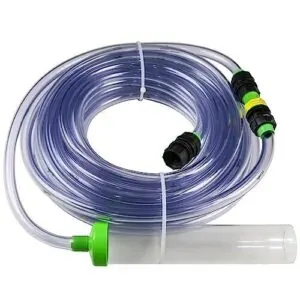
Picture hauling a bucket across your house a dozen times just to refresh one big water tub. That’s the chore the Python No Spill system (Model 25NS) eliminates.
It uses your faucet’s household water pressure to drain and refill, so you skip buckets and siphoning by mouth. The 10-inch gravel tube vacuums substrate while you drain, and extended tubes up to 72 inches reach deep enclosures.
Expect trade-offs. It uses a lot of water, and low water pressure weakens suction. Some sinks need an extra faucet adapter, so check your fittings before water-change day.
Open the switch slowly and watch the discharge. Fast flow can stir up decor, so ease off near any fragile pieces.
| Best For | Aquarium owners with medium to large tanks who want to cut water changes from hours to minutes and have a faucet with good water pressure nearby. |
|---|---|
| Primary Use | Water changing |
| Key Material | N/A |
| Capacity/Range | Tubes up to 72 inches |
| Dimensions | N/A |
| Setup Required | Faucet adapter may be needed |
| Main Drawback | High water usage |
| Additional Features |
|
- Drains and refills the tank using faucet pressure, so there are no buckets to carry and no siphoning by mouth.
- Vacuums gravel while draining without disturbing fish or plants, and works with freshwater and saltwater tanks of any size.
- Comes with a 10" gravel tube, hose, switch, connectors, faucet pump, and brass adapter, with longer tubes available separately for deeper tanks.
- Uses a significant amount of water during operation.
- Suction can be weak when your home’s water pressure is low.
- May need extra faucet adapters to fit some sink types.
5. F10 Veterinary Disinfectant Concentrated Solution
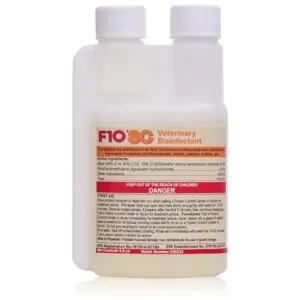
Say your 12-foot reticulated python just finished a nasty respiratory infection. Once she’s out of the enclosure, you’ll want a disinfectant that actually works on every surface she touched.
F10 Veterinary Disinfectant Concentrated Solution fits that job. It’s an EPA-registered concentrate that hits bacteria, viruses, fungi, and spores. Mix 1:250, which is 4 mL per liter of water, for routine cleaning. Step up to 1:100, or 10 mL per liter, for resistant viruses and bacterial spores.
Always remove your snake first, and never spray near pets. Concentrate can harm animals, so dilute it every time. Then use it on cages, water bowls, floors, and perches.
| Best For | Pet owners, breeders, and animal care staff at clinics, kennels, and shelters who need a diluted-at-home disinfectant for cages, bowls, floors, and reptile habitats after an illness like a snake’s respiratory infection. |
|---|---|
| Primary Use | Disinfecting |
| Key Material | N/A |
| Capacity/Range | Dilutes 1:250 or 1:100 |
| Dimensions | 3.94 x 3.35 x 1.57 inches |
| Setup Required | Dilute before use |
| Main Drawback | Not effective against all pathogens |
| Additional Features |
|
- EPA-registered concentrate that works against bacteria, viruses, fungi, and spores.
- Non-corrosive and odorless, and safe around animals once properly diluted.
- Easy dilution at 1:250 (4 mL per liter) for routine cleaning, or 1:100 (10 mL per liter) for resistant viruses and bacterial spores.
- Must be diluted before every use, since the concentrate can harm animals.
- Not proven against every pathogen, and there is some uncertainty about its effect on Giardia.
- Animals must be removed from the area during application, and it should never be sprayed near pets.
Frequently Asked Questions (FAQs)
How big is a 4 year old reticulated python?
Most 4-year-old retics measure 12 to 17 feet, depending on feeding frequency and growth rates. Check parental size inheritance, ask your breeder for size projections, and plan your minimum floor space, since males stay smaller.
What is the hardest reptile to care for?
Reticulated pythons can top 6 m, so no universal ranking exists, but they’re a strong contender. Your experience, budget, and vet access decide difficulty. Their Reticulated Python Care Requirements demand purposebuilt enclosures, strict feeding protocols, and decades of commitment.
Do reticulated python bites hurt?
Yes, sharp, tearing pain hits fast, especially from big snakes. Defensive behavior and feeding mistakes cause most bites, so you’ll want safe handling, proven handling techniques, and strong enclosure security.
What do you feed a full grown reticulated python?
Why gamble with live bites? Offer frozen-thawed prey like rabbits, with prey size matching your snake’s widest girth.
Follow your feeding schedule, every four weeks, using gutloading prey items and a strict python feeding protocol.
What is the reptifiles reticulated python care sheet?
Think a care sheet is generic advice? It isn’t. The ReptiFiles guide covers Reticulated Python Care Requirements for Malayopython reticulatus: enclosure size, heating, humidity, prey size, shedding cycle, and enrichment, so you’ll master reptile husbandry.
How often do reticulated pythons need to be cleaned?
Wondering how often your retic really needs a cleanup? Spot clean waste and soiled substrate daily. Replace all substrate and disinfect the enclosure every 1–3 months. Scrub your water bowl daily and disinfect it weekly.
How do you care for a reticulated python?
You’ll care for a reticulated python by getting enclosure size right, holding a temperature gradient of 78-92°F, keeping humidity control at 65-85%, and following a strict feeding protocol for 20 years.
How often should you feed a reticulated python?
Stick to a python feeding schedule that follows age: hatchlings eat weekly, juveniles every 7 to 14 days, adults every 2 to 6 weeks. Watch body condition, not appetite, and always respect prey size safety.
How to feed a reticulated python?
Use frozen-thawed prey warmed to 100°F, offered with long tongs.
Follow your feeding protocol, respect prey size safety and the python feeding schedule, and support reptile vitamin D3 synthesis with proper heat. Bring a helper.
Are reticulated pythons difficult to house?
Reticulated pythons are among the hardest snakes to house. Adults need enclosure size of roughly 8’L x 4’W x 4’H, steady thermal gradients of 78–88°F, and enclosure security strong enough to stop a powerful escape artist.
Conclusion
Ready to raise a snake that could one day top 15 feet? Meeting reticulated python care requirements comes down to three habits: an enclosure that grows with your animal, prey sized to girth, and temperatures you verify instead of assume.
Stay consistent with feeding, cleaning, and handling, and bring a second person once your snake passes 8 feet. Do that, and your python won’t just survive. It’ll thrive for decades. Precision today prevents emergencies tomorrow.