This site is supported by our readers. We may earn a commission, at no cost to you, if you purchase through links.
shake its tail can shake its tail up to 90 times per second—faster than a hummingbird beats its wings—and sustain that pace without muscular fatigue. That’s not luck. It’s the result of a highly specialized physiology that took millions of years to hone.
Most people hear the rattle and freeze, which is precisely the point: the sound triggers a hardwired avoidance reflex across mammals, birds, and even animals that have never encountered a snake.
Understanding rattlesnake tail shaking behavior reveals something far more intricate than a simple alarm—it’s a finely tuned communication system built from interlocking keratin, dedicated muscle fibers, and acoustic engineering.
Table Of Contents
Key Takeaways
- The rattlesnake’s rattle is a precision-engineered warning system built from interlocking keratin segments and fatigue-resistant muscles that can sustain up to 90 vibrations per second, making it one of evolution’s most efficient deterrents.
- Rattling is a last resort, not a first move—snakes freeze, assess, and shake their tail only when escape is impossible, conserving venom for prey rather than wasting it on threats.
- As a predator gets closer, the rattle shifts from ~40 Hz to 60–100 Hz, creating an acoustic illusion that makes the snake seem nearer than it actually is, triggering retreat before any strike occurs.
- Several nonvenomous snakes like bullsnakes and corn snakes mimic rattling behavior through tail vibration and body posturing, borrowing the rattlesnake’s feared reputation at zero biological cost—no venom required.
Why Rattlesnakes Shake Their Tails
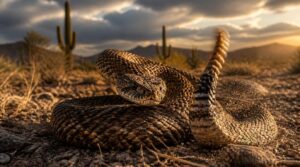
That distinctive buzzing sound a rattlesnake makes isn’t random — it’s one of nature’s most purposeful warning systems. Understanding exactly why rattlesnakes shake their tails reveals a surprisingly strategic behavior shaped by millions of years of survival pressure. Here’s what’s actually driving that rattling display.
Rattlesnakes share this habitat with species like the gopher snake, and studying how rattlesnakes and gopher snakes differ in behavior and appearance helps explain why that warning rattle evolved as such a critical survival tool.
The rattle itself is a marvel of biological engineering — explore how rattlesnake rattles form and develop to see just how precisely this warning system is built.
Defensive Warning Signal
When a rattlesnake shakes its tail, it isn’t acting out of aggression — it’s delivering a precise acoustic warning signal refined over millions of years of predator-prey interaction.
- The rattle triggers reflexive avoidance in mammals, birds, and even naive captive-born animals
- Defensive posture synergy — a raised head, coiled body, and vibrating tail — amplifies the visual and acoustic threat simultaneously
- The display functions as a threat de-escalation tactic, reducing the need for a venomous strike
- Predator learning cues embedded in the signal help local species develop stronger long-term avoidance behaviors
- Both tail vibration and rattlesnake mimicry across unrelated snake species confirm the signal’s proven survival value
The acoustic warning signal integrates directly with body posture, creating a multimodal display that targets predator perception on two fronts at once — sound and sight. That combination is what makes it so effective as an avoidance behavior trigger, conditioning predators to retreat before any physical confrontation becomes necessary. Research indicates that sympatric species display higher aversion to the combined snake and rattle display.
Avoiding Predator Attacks
The acoustic warning signal doesn’t just announce presence — it actively stops a predator’s approach before any physical contact occurs. Mammalian predators like coyotes and foxes retreat strongly when confronted with rattling, making the display a reliable predator deterrence tool.
Rattlesnakes don’t rattle as a first move. They freeze, assess, and rattle only when escape isn’t viable — buying critical seconds to locate safe escape routes through rocky outcrops or dense cover.
Conserving Venom
You’re witnessing a finely tuned defensive signal—tail shaking lets snakes conserve their venom. Venom isn’t cheap; it’s produced through complex physiological processes, and its preservation demands strict temperature control, lyophilization, and protein integrity checks.
By rattling, snakes warn off threats without risking venom loss, reserving it for prey capture, not pointless confrontations, and adhering to ethical collection practices.
Stress and Threat Response
Venom conservation is only part of the story. Behind every tail vibration lies a full-body stress cascade that begins the moment a threat registers.
The rattlesnake’s amygdala-equivalent neural circuitry detects danger instantly, triggering adrenaline release that redirects blood to muscles, sharpens sensory focus, and conditions the body for action. Cortisol then mobilizes glucose, sustaining that heightened state.
- HPA axis activation elevates cortisol and adrenaline simultaneously
- Pupils dilate, sharpening threat detection at close range
- Heart rate spikes within seconds of perceived danger
- Tail vibration begins as sympathetic activation peaks
Freeze, Flee, Then Rattle
Before the rattlesnake ever shakes its tail, it freezes. Stillness reduces motion detection, buying critical seconds to assess whether a threat is real.
Once a predator closes past a critical distance, the flee response triggers. Only when escape isn’t viable does rattlesnake tail shaking begin — a last‑resort acoustic warning that turns the rattle into a predator avoidance tool without sacrificing a single drop of venom.
How The Rattlesnake Rattle Works
The rattle itself is one of nature’s more elegant pieces of engineering, and understanding how it actually works changes the way you hear it. Several distinct anatomical and physiological features work together to produce that unmistakable sound. Here’s what’s happening from the inside out.
Each rattle segment is a hollow keratin ring, and the rattlesnake tail vibration mechanics driving that sound involve muscle contractions firing up to 90 times per second.
Keratin Rattle Segments
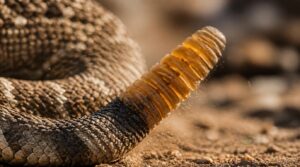
The rattlesnake rattle is one of nature’s most precisely engineered noise-makers — not a hollow chamber of loose beads, but a keratinized structure built from interlocking segments of keratin that click against one another at extraordinary speed.
Each segment in the rattlesnake rattle features a layered keratin matrix reinforced by disulfide bonds, giving the structure superior durability against the constant abrasion of high-frequency tail shaking. The outer surface carries micro roughness sound-influencing textures that shape the acoustic quality of each vibration.
Key structural features you’ll notice include:
- Sequential shedding patterns deposit newer segments toward the tip, with older segments sitting closer to the base
- The segment interlocking mechanism relies on tiny grooves along each ring’s edge, locking adjacent segments loosely enough to click but firmly enough to stay connected
- Disulfide bond durability within the keratin matrix resists wear across thousands of rapid vibration cycles
Through sequential shedding, each new rattle segment forms inside the previous one and remains hooked after the shed skin falls away. Because segments break off regularly during normal activity, segment count reflects recent retention — not the snake’s true age.
Specialized Shaker Muscles
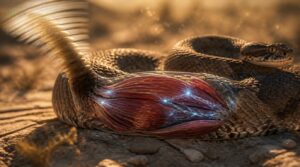
What makes the rattlesnake’s tail physically capable of sustaining that relentless, high-frequency buzz comes down to one notable structure: the shaker muscle.
Unlike typical fast-twitch fibers that fatigue rapidly, the caudal shaker muscle pairs dense mitochondria, abundant glycogen stores, and rapid calcium cycling to sustain contractions near 50 cycles per second for several hours. A dense neuromuscular junction — featuring multiple nerve terminal expansions and deep junctional folds — ensures millisecond-precision activation across every fiber simultaneously. That extraordinarily low ATP cost per twitch, just 0.015 µmol per gram of muscle, keeps energy expenditure minimal despite the relentless contraction rate.
Vertical Tail Position
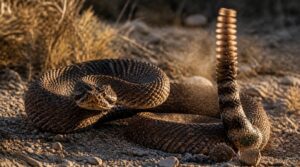
When a rattlesnake rattles, it holds its tail vertically, elevating the rattle clear of the ground. This precise posture isn’t incidental — it functions like a well-positioned lever, maximizing defensive tail vibration efficiency through ideal tail moment arms:
- Elevation increases acoustic projection
- Vertical alignment reduces substrate drag
- Upright posture signals threat orientation clearly
That vertical rattle position is a reliable field identifier no mimic replicates.
Sound Without Ground Contact
Here’s the section on Sound Without Ground Contact:
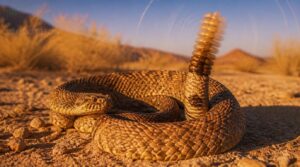
The rattle doesn’t need to touch anything to be heard — it functions as a self-contained acoustic broadcaster, radiating sound directly into the surrounding air through rapid segment collision.
| Mechanism | Effect |
|---|---|
| Airborne sound coupling | Keratin segments radiate vibration into open air without substrate contact |
| Structural resonance | Interlocked hollow segments boost specific frequencies internally |
| Noncontact vibration pathway | Elevated tail position prevents ground dampening of the signal |
Each tail shake produces broadband pulses that merge into a continuous signal as vibration frequency increases. The hollow keratin segments act as an acoustic bridge — their loosely interlocked architecture allows each collision to transfer vibrational energy outward, producing the characteristic dry buzz that carries across open terrain without any ground-borne pathway. This noncontact vibration transfer is why the sound doesn’t muffle when the snake moves across soft soil or sand. The rattle’s internal cavity also sustains structural resonance amplification, reinforcing certain frequencies and shaping the timbre of the display into something unmistakably sharp and penetrating — a form of auditory deception that requires no substrate at all to work.
Why Segments Break Off
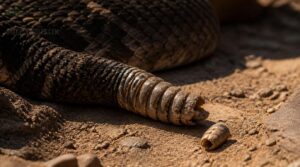
Think of each rattle segment as a link in a chain — functional until wear, trauma, or age quietly severs the connection.
Keratin brittleness drives most detachment events; dry conditions accelerate micro-cracking, loosening distal segments until substrate contact during movement finally pulls them free. Physical trauma — collisions with rocks, predation attempts, or forceful tail contractions — can crack segments outright. Older snakes face compounding disadvantages: segment formation slows with age, while cumulative wear makes existing segments increasingly fragile, widening gaps in the rattle and gradually altering sound production mechanics as mass at the tail tip decreases.
What Rattlesnake Tail Shaking Sounds Like
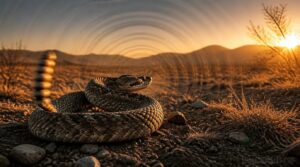
Once you’ve seen how the rattle is built, the next step is understanding what it actually sounds like in the wild. The sound carries more information than most people realize — frequency, distance, urgency, all wrapped into one sharp signal. Here’s what each acoustic quality tells you.
Dry Buzzing Rattle
That unmistakable dry buzzing rattle isn’t random noise — it’s a precision acoustic instrument built from interlocking hollow keratin segment resonance. When shaker muscles fire in rapid strike patterns, each segment collides against the next, projecting a crisp, continuous buzz without any substrate contact required.
Five defining features drive this sound production mechanism:
- Hollow segment cavities enhance each micro-collision, boosting volume across open terrain
- Rounded contact points between segments reduce wear, preserving buzzing consistency over time
- Rapid strike patterns at 50–90 cycles per second sustain the dry, unbroken tone
- Segment count progressively enriches acoustic output — more segments, fuller buzz
- Environmental debris like sand dampens initial strikes, temporarily softening loudness
Notably, pitch temperature fluctuations subtly shape the sound’s character — cooler conditions produce a crisper, more metallic quality, while warmer environments yield a slightly softer buzz. In cluttered habitats with dry leaves, the sound takes on a diffuse, airy texture that complicates acoustic mimicry identification. Segment wear patterns develop naturally at contact points but rarely compromise the rattle’s integrity unless dehydration or injury slows keratin production entirely.
Changing Vibration Frequency
Beyond the raw buzzing quality, what makes rattlesnake vibrational communication genuinely notable is how deliberately the frequency shifts.
Shaker muscles drive vibration frequencies from roughly 40 Hz at baseline, but muscle contraction speed accelerates sharply when a threat closes in — jumping to between 60 and 90Hz — creating a perceptual illusion that tricks listeners into misjudging the snake’s actual distance. That abrupt frequency modulation, driven by tighter muscle contraction timing and keratin segment friction between interlocking segments, functions as an adaptive proximity signal rather than a static alarm.
Temperature Effects
Temperature shapes the rattle’s acoustic output more directly than most people realize. Warm ambient conditions accelerate muscle contraction rates, pushing vibration frequencies toward the upper end of the 20–100 Hz range, while cooler temperatures slow nerve conduction and enzymatic activity, softening both the tempo and intensity of the rattle.
Humidity compounds this further — drier heat keeps keratin segments flexible and resonant, whereas cold air increases brittleness, risking micro-fractures that subtly degrade sound clarity.
Seasonally, you’ll notice rattlesnakes rattle most vigorously during warmer months, when thermal metabolic rates support sustained shaker-muscle output.
Close-threat Sound Illusion
What the rattle actually communicates goes beyond simple noise — it manufactures perceptual distance deception. As a threat closes in, rattlesnakes shift vibration frequency from roughly 40 Hz upward to 60–100 Hz, creating an acoustic proximity illusion that makes the snake seem nearer than it actually is.
That frequency shift alone triggers retreat in mammalian predators, achieving sensory predator confusion without a single strike.
Loudness and Warning Distance
Beyond the frequency illusion, loudness and detection distance work together as the rattle’s final line of acoustic defense. High-frequency components above 60 Hz fade faster with distance, while ambient noise interference from wind or rustling vegetation raises the audibility threshold, shrinking effective warning range.
In quiet outdoor settings, the rattle carries reliably across several tens of meters — but that detection distance contracts sharply when environmental noise climbs.
Tail Shaking in Nonvenomous Snakes
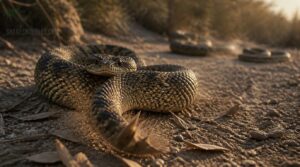
Tail shaking isn’t exclusive to rattlesnakes — several nonvenomous species have independently developed the same behavior, and for good reason. Understanding how and why they do it reveals one of nature’s more clever survival strategies. Here’s a closer look at the key ways this mimicry plays out across different species.
Bullsnake Rattlesnake Mimicry
The bullsnake (Pituophis catenifer sayi) is a master of defensive mimicry, deploying a coordinated multi-signal display — tail vibration, head flattening, and loud hissing — that convincingly impersonates a rattlesnake without possessing a single rattle segment.
- Habitat-based mimicry intensifies in open grasslands and prairies where rattlesnake ranges overlap
- Visual bluffing techniques include flattening the head into a triangular pit-viper shape
- A modified glottis produces an unusually loud, harsh hiss reinforcing the rattlesnake impression
- Predator learning effects make coyotes and foxes wary of similar displays in other snakes
- Batesian mimicry benefits the bullsnake by reducing fatal encounters with both predators and humans
This rattlesnake mimicry within the Pituophis genus represents textbook Batesian mimicry — a harmless species borrowing a dangerous species’ warning signals. When cornered, the bullsnake coils, inflates its neck, and vibrates its slender tail against dry substrate, generating a buzzing sound acoustically similar to a true rattle.
Corn Snake Tail Vibration
While the bullsnake draws most of the attention, the corn snake’s tail vibration is equally calculated. When cornered, it vibrates the tail tip rapidly against dry leaves or cage walls, producing a buzzing sound that triggers predator hesitation.
Warmer temperatures push vibration speed higher, sharpening that acoustic bluff. The body often coils simultaneously, making the snake appear larger — a layered, efficient defense requiring no venom at all.
Leaf Litter Amplification
The forest floor is a natural amplifier hiding in plain sight.
Leaf litter depth and composition directly shape how convincing a nonvenomous snake’s tail-shake sounds — dry leaves trap air pockets that sharpen reverberation, while mixed moist and dry layers create multiple acoustic pathways, intensifying perceived volume.
Fall’s dense litter beds consistently outperform spring’s thinner coverage, giving mimics a seasonal acoustic advantage worth understanding.
Horizontal Tail Movement
What separates a convincing mimic from an obvious fake often comes down to a single mechanical detail: the plane of vibration.
Nonvenomous snakes shake their tails laterally, sweeping side to side across the substrate, while rattlesnakes hold their tails vertically. That horizontal movement limits sound production to substrate contact, but when arousal intensifies, oscillation rhythm accelerates, and the distal tail tip stabilizes just enough to sustain a persuasive, continuous buzz.
Batesian Mimicry Benefits
Getting away with a bluff depends entirely on who’s watching — and what they remember.
Batesian mimicry hands nonvenomous snakes a survival advantage they didn’t have to earn through toxin production. Predators that once encountered a rattlesnake generalize that learned fear to any snake producing a similar buzzing display, including harmless mimics. That borrowed protection is remarkably energy-efficient: no venom, no cost.
Nonvenomous snakes borrow a rattlesnake’s feared reputation and pay nothing for it
Identifying Rattlesnakes and Mimics
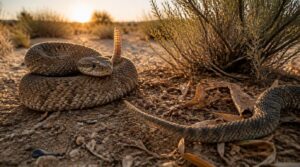
Telling a rattlesnake apart from a harmless mimic in the field comes down to reading a handful of reliable physical and behavioral clues. Once you know what to look for, the differences become surprisingly clear. Here are the key features that will help you make that distinction safely.
Tail Shape Differences
When you’re trying to tell a rattlesnake apart from a harmless mimic, tail shape is your clearest visual cue. A rattlesnake’s tail terminates in a blunt, widened cluster of interlocking keratin segments, while a nonvenomous snake’s tail tapers to a slender, pointed tip.
Pair that with the triangular head and elliptical pupils common to rattlesnakes, and the visual warning display becomes harder to misread — though neither feature alone is a reliable identifier.
Rattle Versus Slender Tail
Beyond tail shape, the functional difference between a rattle and a slender tail tells you everything:
- A rattle produces sound without touching the ground
- Slender tails require dry leaf contact to generate any buzz
- Rattle segments create a silhouette visibly wider than the body
That widened, blunt terminus isn’t decorative — it’s a purpose-built warning system nonvenomous mimics simply can’t replicate structurally.
Sound Source Clues
The structural difference between a rattle and a slender tail is only half the story — sound source clues give you the other half.
A true rattle produces its dry buzz without substrate contact , so if the sound originates clearly above ground, that’s a strong directional arrival cue pointing to a rattlesnake. A nonvenomous mimic’s buzz, by contrast, rises from the leaf litter itself — the sound onset is tied directly to ground-level contact.
Watch for frequency shifts over time, too. As you approach, a rattlesnake abruptly jumps from ~40 Hz to 60–100 Hz, a temporal pattern no mimic can replicate.
Body Posture Cues
Sound source clues narrow the field considerably — but body posture closes it.
A rattlesnake entering defensive mode shifts into a tight defensive coil, pulling its body into a compact, elevated S-shape that signals controlled readiness. It simultaneously raises its head to dominate the threat’s line of sight, flattens its neck slightly, and inflates its body to appear larger — a coordinated set of visual warning cues no bullsnake fully replicates.
Watch for these three posture markers that distinguish a rattlesnake’s defensive display:
- Imposing body stance — body elevated and coiled, not sprawled flat against the substrate
- Alert head positioning — head held level or raised, eyes locked on the threat
- Defensive weight shifting — forward weight distribution with stabilizing ground contact through the lower body
Mimics like gophersnakes flatten their heads into a triangular shape and semi-coil convincingly, but their visual threat signaling lacks the rattlesnake’s vertical tail elevation and synchronized body inflation. That combination — defensive coil, raised head, inflated body — is the rattlesnake’s full multimodal warning, and recognizing it from a safe distance gives you the clearest confirmation of what you’re actually looking at.
Safe Viewing Distance
Once you’ve read the body posture cues and confirmed a rattlesnake’s defensive display, safe observation distance becomes your immediate priority.
Keep at least six feet of clearance — roughly two body lengths — since most rattlesnakes strike no farther than two-thirds of their length. That margin lets you observe tail orientation, rattle presence, and coil posture clearly without entering the snake’s defensive strike zone .
Even a startled coil-and-lunge can look like a jump, so understanding how far a snake can actually jump helps you judge safe distance more accurately.
Frequently Asked Questions (FAQs)
How did the rattlesnake rattle evolve over time?
What began as a simple ancestral tail vibration — a stress reflex shared across many snake lineages — gradually became one of nature’s most refined acoustic warning signals, as natural selection favored snakes whose keratin segment development produced louder, more reliable deterrents over 5 to 10 million years.
Do rattlesnakes ever shake their tails while moving?
Yes, but rarely. Rattlesnakes prioritize stealth during movement, pausing or suppressing tail vibration to avoid detection. Shaking resumes immediately when a threat is sensed, shifting the snake from locomotion into active defensive signaling.
Can rattlesnake rattling last for hours continuously?
Like a drumroll that refuses to stop, rattling can last up to two hours continuously. Warm temperatures, sustained threat presence, and the rattle’s remarkably low ATP consumption make prolonged defensive signaling physiologically possible.
How does rattlesnake population decline affect mimic snakes?
When rattlesnake populations decline, mimic snakes lose the selective pressure that sharpens their displays, reducing their tail vibration frequency by up to 20%, leaving them more vulnerable to predators that have learned to ignore the signal.
Conclusion
The rattle is nature’s clearest sentence—no translation needed. Rattlesnake tail shaking behavior is the product of interlocking keratin segments, fatigue‑resistant muscle fibers, and millions of years of acoustic refinement.
When you hear that dry buzz, whether from a rattlesnake or a harmless mimic vibrating through leaf litter, you’re receiving one of evolution’s oldest messages. Understanding the mechanism behind it doesn’t make the sound less urgent—it makes your response far more informed and precise.