This site is supported by our readers. We may earn a commission, at no cost to you, if you purchase through links.

The right hook, used the right way, does something impressive: it turns an unpredictable animal into a predictable one.
Table Of Contents
Key Takeaways
- Match your hook length to your snake’s size — smaller species need 12–14 inches of reach, while large constrictors require 47–72 inches to keep your hands safely out of striking range.
- Use your hook exclusively for handling and tongs exclusively for feeding, and keep that separation consistent every single session, because mixing those cues is how defensive strikes become a habit.
- Mid-body contact with the hook — not near the head or tail — is the one signal your snake can reliably learn to associate with safe handling rather than a feeding response.
- Clean tools aren’t optional: prey scent left on hooks or hands doesn’t just create a bacterial hazard, it actively dismantles the behavioral cues your snake has learned to trust.
Choose The Right Snake Hook
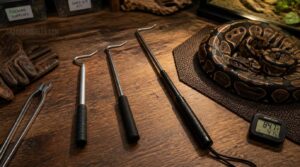
The hook you choose shapes every interaction you have with your snake, from routine checks to feeding prep. Getting the right fit isn’t complicated, but the wrong size can cost you control when it matters most. Here’s what to look for before you buy or reach into that enclosure.
Once you’ve got the right hook in hand, pairing it with a solid post-feeding handling schedule keeps digestion on track and your snake stress-free.
Hook size often depends on enclosure layout too, so browsing DIY snake cage ideas and designs can help you think through access points before committing to a tool.
Match Hook to Snake Length
Hook length and snake size go hand in hand — get it wrong and you’re either working too close to the head or losing the precise control that makes snake handling tools effective.
As a rule, scale hook length proportionally: a 2-foot corn snake needs 18 inches of reach, while a 6-foot boa demands at least 36 inches.
Telescoping hooks eliminate guesswork by adjusting mid-session, reducing handler fatigue without sacrificing vertical standoff distance.
For small species, the guide suggests 12‑inch hook size as the ideal size.
Small Snake Hook Sizes
For small snakes — hatchlings, juvenile corn snakes, and similar species — a 12 to 14-inch hook strikes the right balance between control and clearance.
Pair that with a 1/4-inch shaft diameter, and you get a tool light enough to guide delicate animals without pressing hard into their scales, which matters most inside tight rack systems where maneuverability is everything.
Large Constrictor Hook Sizes
When you’re working with large constrictors, hook length becomes a safety margin, not just a preference.
For snakes over 6 feet, a 47 to 60-inch hook keeps your hands well clear of striking range, while exceptionally large pythons approaching 15 feet may require 60 to 72 inches.
Heavy-duty steel construction supports their weight without bending.
Soft Tips for Delicate Scales
Once you’ve matched hook length to your snake’s size, the next question is what that hook is actually touching — and that matters more than most keepers realize.
A scale-friendly hook tip isn’t a luxury; it’s how you prevent injury during routine contact.
- Soft gelatinous coating cushions impact and prevents scale snag
- Oblique contact angles distribute midline pressure evenly across scale rows
- Rounded tips minimize scale flex, reducing micro-tears
- Extra care during shed protects loosening shedding skin from friction damage
Distance Control Basics
Distance from the snake isn’t passive — it’s your first line of bite prevention. Keep your hook at a range where the snake moves slowly and stays low-headed.
A relaxed coil signals safe spacing; a retracting head means to increase distance temporarily.
Move deliberately, pause between advances, and let the snake set the tempo.
Separate Handling From Feeding Cues

Your snake needs to know the difference between "it’s time to be handled" and "food is coming," because mixing those signals is how accidents happen. The hook is your clearest tool for drawing that line, but only if you use it consistently and correctly. Here’s what that separation looks like in practice:
The hook draws the line between handling and feeding — but only if you use it consistently every time
Hook Means Handling
The snake hook carries one meaning: handling is about to begin.
Every time you apply it as a consistent cue — touching the mid-body, then lifting briefly — your snake learns that contact from your hands follows.
This mid-body contact signals safety, not prey, which is exactly what makes it so effective at reducing defensive strikes before handling sessions.
Tongs Mean Feeding
Feeding tongs carry the second half of this two-tool system. Where the snake hook signals handling, tongs signal one thing only: food is coming.
Present prey at eye level, keeping it steady just outside the strike zone, oriented naturally so your snake can lock on cleanly, with minimal lateral motion to keep the feeding response focused and deliberate.
Avoid Prey Scent Transfer
Your hook carries more than metal — it carries scent memory, and snakes read that information precisely.
Scent transfer risks collapse the two-tool system fast. Follow these five controls:
- Wash hands thoroughly before touching your hook after prey handling
- Sterilize feeding tongs separately from handling tools after every session
- Change gloves between prey contact and hook use
- Sanitize hook tips with approved cleaner to remove residual odor
- Store tools separately to prevent cross-contamination between sessions
Never Hook During Meals
One rule stands above all others during a feeding session: never introduce the hook.
The moment a snake detects prey, its feeding response activates, and anything entering the enclosure risks triggering a strike — including your hook. Keeping hooks entirely absent during meals eliminates this feeding cue confusion before it starts, protecting both you and the animal.
Build Clear Associations
Every behavior your snake reliably shows starts with a clear, repeated pattern you’ve built over time. When the hook appears, that signals handling; when tongs appear, that signals feeding — and your snake learns this distinction through consistent repetition, not instinct. Keep these associations clean by controlling three things:
- Visual cues: use distinct tools for each purpose
- Temporal consistency: schedule sessions at the same times
- Environmental control: minimize competing scents or signals
Start Hook Training Step-by-Step
Hook training only works if you follow a consistent sequence from the very first session. The steps themselves aren’t complicated, but the order and the repetition are what build the association your snake actually learns from. Here’s exactly how to build that habit from day one.
Touch The Mid-body

Position yourself at the enclosure’s side, not directly in front, so your approach doesn’t read as a threat.
From there, use the hook to make brief, feather-light contact on the snake’s mid-body — never near the head or tail, where reflexes run strongest.
A relaxed posture and slow movement from you signal safety, and the snake’s loosened coils will confirm it’s working.
Lift Briefly and Gently
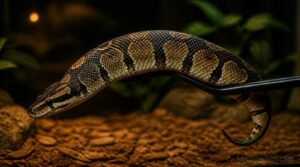
Once mid-body contact is made, lift briefly and gently — one to two seconds — keeping the hook steady so rib pressure stays minimal and the snake’s organs aren’t stressed by sudden force.
- Keep lift height just above the enclosure rim
- Maintain mid-body stability throughout
- Avoid abrupt motion in any direction
- Watch stress indicators like gaping or tail flicking
Wait Before Hand Contact
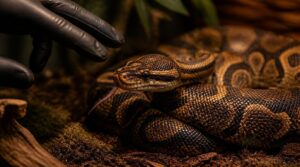
After the brief lift, pause two to five seconds before your hand enters the enclosure. This gap lets the snake register your presence without triggering a defensive response.
Watch for a relaxed mouth and slow tongue flicks — those are your green light. If the snake tenses or gapes, wait longer before proceeding.
Repeat Every Handling Session

Once you’ve confirmed the snake stays relaxed during that pause, consistency is your next commitment. The hook cue only works if you repeat the same sequence — mid-body touch, brief lift, pause — at the start of every handling session, without exception.
- Follow the same order of steps each time
- Use identical posture and grip during initiation
- Log any deviations from your standard routine
Keep Sessions Calm

Calm sessions are built on deliberate slowness, not luck. Keep every movement unhurried — from the moment you open the enclosure to the moment the hook makes contact.
Watch for coiling, gaping, or rapid tongue flicking, because these signal rising tension. If you notice any of those cues, pause immediately and give the snake time to settle before continuing.
Use Hooks During Feeding Prep
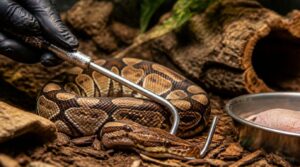
Feeding prep is where the hook earns its place in your daily routine. It’s not just about presenting prey — it’s about managing the space, reading your snake’s mood, and keeping every interaction predictable. Here’s how to handle each part of that process safely.
Open Enclosures Safely
Before you reach into any enclosure on feeding day, treat the door like a controlled access point, not just a lid to flip open. Apply lockout tagout principles: disconnect heat mats and UVB lighting before entry, so no live components create interference or distraction. Three steps set you up correctly:
- Verify all heating elements are powered off
- Check enclosure seal integrity — worn gaskets let prey scent escape and confuse your snake’s response patterns
- Put on gloves and safety glasses before the door opens
An interlock-style latch, if your setup includes one, prevents accidental access mid-session. If yours doesn’t, a visual inspection window lets you assess positioning without disturbing the enclosure at all, which is always the safer first move.
Check Snake Body Language
Before you open the enclosure door, scan your snake’s posture through the viewing window. Tight defensive coiling with the head tucked inward signals clear stress — don’t proceed.
Watch tongue-flick frequency: rapid, repetitive flicking without movement indicates agitation, while slow, relaxed flicks mean your snake is calm and ready to be approached safely.
Move Snakes When Needed
When your snake needs to be relocated before feeding, the approach matters as much as the tool.
Position the hook at the snake’s mid-body contact point, then use lateral nudge techniques — gentle sideways pressure rather than pushing forward — to guide movement naturally.
Move in short, deliberate bursts, pausing between each shift to read the snake’s response, keeping your hand well outside any defensive strike zones throughout.
Use Tongs for Prey
Once your snake is positioned, tongs take over. Long-handled tongs — ideally 20–30 cm — keep your hands well outside the strike zone while giving you precise control.
Grip prey at the midsection, applying firm but light pressure, and present it with a slow, steady motion along the substrate near your snake’s preferred ambush point. Release immediately on strike.
Avoid Feeding-day Handling
Feeding day is the wrong time to test your snake’s patience. Scheduling handling sessions on non-feeding days keeps feeding motivation and handling completely separate, which is exactly how snakes build a predictable routine they can trust.
- Avoid handling 24–48 hours after feeding
- Watch for coiled, alert postures signaling feeding anticipation
- Brief, calm sessions minimize agitation risks on active feeding days
Adjust by Snake Species

Not every snake reads from the same playbook, and your hook routine should reflect that. The way you approach a ball python differs from how you’d handle a nine-foot boa, and getting those details right is what separates confident keepers from anxious ones.
Here’s how to adjust your hook technique for each type of snake you’re likely to work with.
Ball Python Routines
Ball pythons are often the easiest snakes to hook‑train, but individual temperament variations mean you can’t treat every animal the same.
Before lifting, watch for a relaxed, loosely coiled posture — that’s your green light. Apply midbody contact with your hook first, lift briefly, then wait.
Keep sessions short, and maintain stable temperatures, since environmental stress directly disrupts a calm feeding schedule response.
Boa Constrictor Safety
Boas are a different beast from ball pythons — larger, stronger, and capable of constriction force that can restrict blood flow within seconds of a defensive response.
That’s why midbody support and a properly sized hook (47–60 inches for adults) aren’t optional; they’re your first line of control before your hands ever enter the enclosure.
Corn Snake Confidence
Corn snakes sit at the calmer end of the spectrum, but that doesn’t mean hook training is optional. Consistent hook cueing before each session still builds the signal they need to distinguish handling from feeding.
Touch the mid-body, lift briefly, then proceed — reducing defensive strikes over time through repetition, not force. Their naturally trusting behavior makes the process straightforward.
Large Python Precautions
Large pythons — reticulated pythons, Burmese pythons, and large boas — demand a different level of discipline.
Use a purpose-built heavy-duty hook to lift mid-body, keeping the snake’s full length supported to prevent spinal stress.
Always wear cut-resistant gloves and long sleeves, have a second handler nearby, and watch for wheezing or sudden tightening — both signal stress-induced aggression before a feeding response escalates.
Aggressive Snake Limitations
Some snakes simply aren’t good candidates for standard hook training. Highly defensive individuals — particularly those that flatten their necks, inflate their heads, or coil tightly the moment you approach — are signaling stress that no hook routine can override.
A strike can come from as close as 3 cm or as far as 60 cm, depending on the snake’s size and agitation level, so don’t assume distance protects you.
Clean Tools and Prevent Mistakes
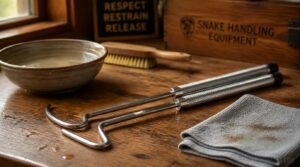
Even the best hook training falls apart if your tools carry prey scent or your cues become inconsistent over time. Keeping your equipment clean and your habits sharp is what separates a snake that stays calm from one that’s slowly losing trust in the process.
Here’s what you need to stay on top of.
Sanitize Hooks and Tongs
Every tool that touched prey carries residue, and that residue becomes a biofilm problem fast. After each session, scrub hooks and tongs with hot water and mild detergent, paying close attention to joints, seams, and tips where organic matter collects. Follow with a chlorhexidine-based disinfectant immersion or brief boil, then air dry completely before storage.
Keep your workflow tight:
- Dedicate separate tools to each enclosure group to prevent pathogen transfer between animals
- Store cleaned tools in a sealed, clean container away from prey scent and environmental contaminants
- Schedule monthly sanitation audits to confirm your cleaning protocol stays consistent
- Choose stainless steel or corrosion-resistant finishes — smooth surfaces resist biofilm buildup and tolerate repeated disinfection cycles
Avoid abrasive scrubbers that scratch metal surfaces, since those microcuts harbor bacteria even after sanitizing. Wash hands thoroughly for at least 20 seconds after handling prey before you touch any equipment, because prey scent on your hooks can blur the cue your snake has learned to recognize.
Inspect Worn Hook Tips
Checking your hook tip isn’t optional — it’s the difference between a clean lift and a panicked strike. Look for visible rounding or flattening at the contact point, which signals metal fatigue from repeated enclosure contact. If the tip diameter has decreased even slightly from its original spec, grip precision drops on slippery scales, making control unreliable.
Hairline cracks near the tip edge are the most dangerous sign, because they indicate potential failure under load — exactly when you need the hook most. Corrosion accelerates in humid enclosures, and once rust pockets form along the contact face, replacement isn’t optional. Any misalignment between tip and shaft also shifts your contact point, increasing the risk of snagging or gouging scales during handling.
Wash Hands After Prey
Your hands carry more risk than the hook does. Rodent fur, thaw liquid, and blood leave Salmonella-laden residue on your skin long before the snake is ever offered food — and it transfers fast.
Follow this sequence every feeding session:
- Wash immediately after touching prey, before reaching into the enclosure
- Scrub palms, fingertips, nail edges, and between fingers for at least 20 seconds
- Rinse under clean running water to flush loosened bacteria away
- Dry with a clean towel — dirty cloths recontaminate instantly
- Wash again after removing uneaten prey or soiled substrate
Prey scent lingers on skin even when hands look clean, and a feeding-motivated snake reads that odor as a cue. Washing eliminates both the bacterial hazard and the scent signal simultaneously, protecting your household surfaces and your next handling session.
Prevent Inconsistent Cueing
Inconsistency is the fastest way to undo weeks of behavioral conditioning.
If you apply the hook cue during one session but skip it the next, associative learning breaks down — your snake can’t build a predictable pattern from mixed signals.
Every non-feeding handling session requires the same mid-body touch, every time, without exception.
Stop if Strikes Increase
A snake that strikes once and settles is reacting; one that strikes again and again is escalating, and that’s your signal to stop.
Watch for tight S-coils, tail vibration, or repeated head jerks during hook contact.
End the session, log the pattern, and screen for illness or husbandry stress before resuming. Pushing through worsening defensive strikes only deepens the habit.
Frequently Asked Questions (FAQs)
Can you handle your snake on feeding day?
Avoid handling your snake on feeding day. Digestion stress can trigger regurgitation, and even brief contact may cause a defensive bite. Post-meal safety means waiting 48–72 hours before any interaction.
How often should snake hooks be fully replaced?
Replace your hook at least every 5 years, retiring aluminum models sooner if heavily used. Watch for micro fractures near pivot points and swap immediately when coatings delaminate or bare metal shows through.
Can hook training work for venomous snake species?
Yes, hook training can work for venomous species, but requires greater caution. Shorter sessions, deliberate movements, and extended hook reach help build predictable response patterns while keeping a safe buffer between you and the snake’s head.
What hook materials reduce wrist fatigue during handling?
Wrist fatigue comes down to tool weight and balance. Lightweight aluminum shafts cut workload around 8%, rubberized grips reduce extension by 12%, and hollow shaft designs lower perceived fatigue by 10% over a 30-minute session.
Do experts recommend hook training for all snakes?
Not every snake needs hook training. Individual temperament matters most — calm, well-socialized species like corn snakes often handle fine without it. Experts recommend tailoring your approach, using hooks primarily for food-reactive or defensive animals.
How much do quality snake handling hooks cost?
Quality snake hooks span a surprisingly wide range. Basic aluminum hooks run $10–$20, mid-range telescoping models hit $25–$49, and heavy-duty titanium or ergonomic professional-grade tools reach $40–$60+.
Conclusion
You’ve got this handled—pun intended.
Snake handling hooks for daily feeding routines aren’t just tools; they’re the foundation of a system your snake can genuinely learn to trust over time.
Consistent cues, clean equipment, and species-aware technique transform unpredictable feeding days into controlled, repeatable routines.
The hook signals safety, not threat, and your snake reads that distinction clearly.
Build the habit right, and every enclosure door you open becomes far less of a gamble.